At the family barbecue, for the 8th time this year, my golden-child sister leaned into my fiancé in front of 32 relatives: “you could do better than her — call me when you figure that out”; my parents laughed; i said nothing and kept slicing the cake; then my fiancé set down his drink, walked straight to my parents’ table, reached into his jacket, and—
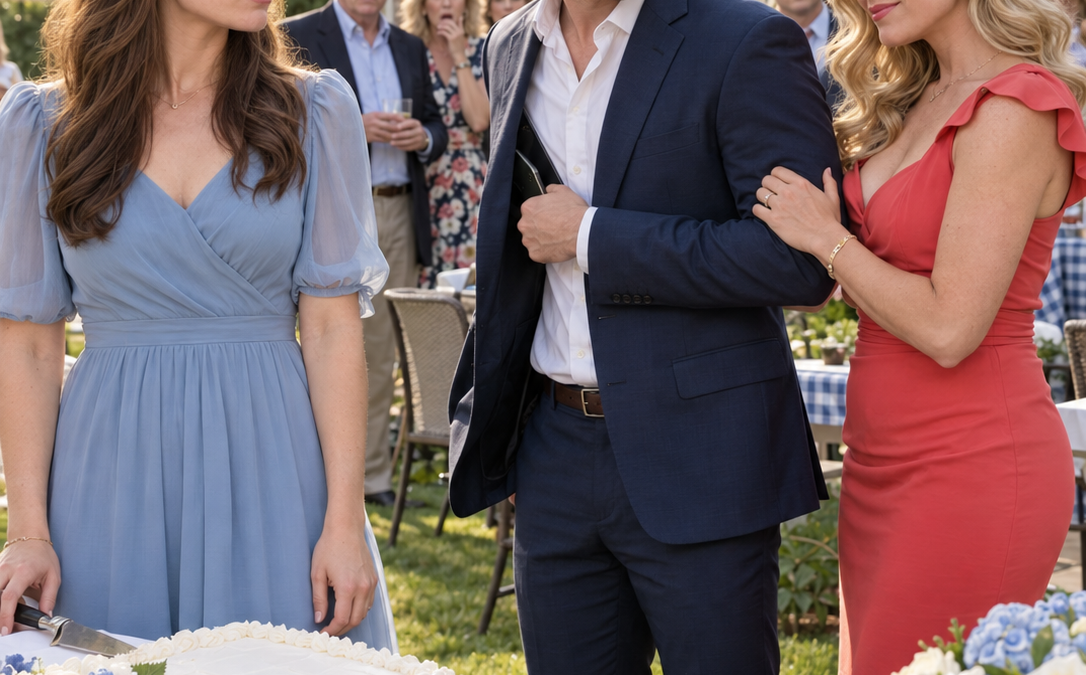
My name is Charlotte. I’m 29 years old. And at my family’s barbecue this spring, for the eighth time this year, my sister leaned into my fiancé in front of 32 relatives. She put her hand on his arm. She smiled the way she always smiles, slow, certain, like the room belonged to her. And she said it loud enough for the whole backyard to hear.
“You could do better than her. Call me when you figure that out.”
My parents laughed. My mother actually laughed. I was standing at the dessert table with a knife over a sheet cake. I did not look up. I kept slicing. Even squares, steady hand, the way I’d been taught to keep the peace since before I could spell my own name.
Then Adrien set down his drink. He didn’t raise his voice. He walked straight to my parents’ table, reached into his jacket, and before I go any further, if your chest is already tight, take one second to like and subscribe. It helps this story reach the people who need to hear it tonight, and tell me in the comments where you’re listening from and what time it is there. I read every single one.
I’m Charlotte. This is the story of the lie my family told for 10 years and the night it finally ran out of room. Let’s go back to the beginning. I grew up in a brick house on a quiet street outside Columbus, Ohio. [snorts] Two daughters, one set of parents, and a rule nobody ever said out loud.
The rule was simple. Brooke was fragile. I was strong. Brooke is my older sister, three years older. From the day I could understand language, I understood that she needed things and I provided them. Quiet, space, patience, the last slice of everything. The smaller bedroom, the blame. When blame had to land somewhere.
My mother Coral had a gift for making this sound like a compliment.
“You can handle it, Charlotte.”
She said it about everything. A canceled birthday, a recital nobody came to, a sister who walked into my room and walked out with whatever she wanted.
“You can handle it.”
By the time I was 10, I believed her. By the time I was 20, I had built an entire personality out of handling it.
My father, Russell, had one job in this family, and he did it well. He kept the peace. Not real peace. The kind where nothing is solved and nobody is allowed.
“Don’t make a scene,” he would say.
He said it the way other fathers say I love you. So I became a person who did not make scenes. I became a nurse. A pediatric nurse, which is a job built almost entirely out of staying calm while something is going wrong. I was good at it. I am still good at it.
For a long time, I thought that was the best thing about me. The not flinching.
Then I met Adrien. It was 2021. A friend’s cookout, a folding chair, a paper plate going soft in my hand. He taught high school history. And he talked about it the way some people talk about the ocean.
He told me history is just whatever the winners write down, unless somebody keeps the originals. And he kept everything. Ticket stubs, birthday cards, the receipt from our first cup of coffee. I used to tease him about it. The man could not throw away a piece of paper.
But here is what I remember most about those early days. Adrien was the first person who ever asked me what I wanted. Not what I could handle, what I wanted. The first few times I had no answer. I had to learn the question.
We dated almost 4 years. He proposed last April. An ordinary Tuesday, our own kitchen, no audience at all. He said he didn’t want to share that moment with a crowd. I cried. He didn’t tell me to stop.
And I understood slowly the way a sunrise happens. That I had spent my whole life waiting for permission to feel things. And this man was never going to make me ask.
I was happy. I want you to hear that clearly. I was happy.
We started planning a wedding, a real one. And here is something I didn’t expect. Planning a wedding in my family meant planning it for 32 relatives because that is how many people my mother considers non-negotiable.
Aunts, uncles, cousins, the cousins of cousins. My family is large and loud and very proud of being a family. We gather constantly. Birthdays, holidays, half-invented occasions. I used to think we were that family, the close one, the kind a lonely person would want.
[snorts] I had to look very carefully to see that all that closeness was just proximity. 32 people standing near each other, agreeing not to notice the same things.
Adrien noticed it before I did. After his third or fourth Mercer gathering, he said something I laughed off at the time.
“My family didn’t have conversations exactly. They had a script, and everyone knew their lines, and the whole point of the evening was that nobody went off book.”
I told him he was being dramatic. He wasn’t. He was being a historian. He was reading the primary source.
And then last summer, Brooke’s marriage ended. I won’t pretend I know everything about her divorce. I know it was not gentle. I know she moved into a townhouse 15 minutes from our parents. And I know my mother started every phone call the same way that whole year.
“Your sister is having such a hard time.”
I felt sorry for her. Whatever comes next in this story, I need you to understand that when my sister came home broken, the first thing I felt was pity. The second thing I felt, I didn’t have a name for yet.
It happened at my mother’s birthday dinner last July. Brooke arrived late. She sat down beside Adrien instead of beside me, and she put her hand flat on his forearm while she laughed at something he had not said. The whole table laughed with her.
My father smiled down into his plate. My mother watched the entire thing and said nothing at all, and the nameless thing moved through me, cold, familiar, like a draft slipping under a door I thought we had closed and locked years ago.
I told myself I was just tired. I told myself it was nothing. I had told myself that exact sentence before, a long time ago, about a different man.
To explain why that draft felt so familiar, I have to take you back further than Adrien, I have to take you back to the science fair.
I was 10 years old. I had spent six weeks building a model of a working lung out of a plastic bottle and two balloons. I practiced the explanation in the bathroom mirror until I could say it without stumbling. I won second place in my grade.
I had never won anything before. I came home holding that ribbon like it was made of glass.
That same week, Brooke had been cast in a community play, a small part, three lines. And when I walked through the door with my ribbon, my mother was already on the phone with my aunt, describing Brooke’s three lines like they were Broadway.
I waited. I held the ribbon up when she finally looked over.
She smiled at me and said, “That’s nice. A sweetheart, put it somewhere safe.”
Then she turned back to the phone.
“Anyway, you should hear Brooke deliver this monologue.”
It wasn’t a monologue. It was three lines.
But that is the moment I want you to hold on to. Not because it was cruel. It wasn’t really. It was just the shape of things. There was a daughter whose three lines were a triumph and a daughter whose blue ribbon went somewhere safe and was never mentioned again.
I found that ribbon years later in a drawer. My mother had been right. It was somewhere safe.
Safe meant forgotten.
That was the mold. Everything after that just got poured into it.
When I was 16, I gave up my summer to care for my grandmother after her surgery. Brooke was supposed to split the weeks with me. She went to the lake instead.
When my grandmother thanked the family at Thanksgiving, she thanked Brooke for being there. Brooke smiled and accepted it. My mother caught my eye across the table and gave me a small nod.
The nod meant, “You can handle it. Don’t make a scene.”
I didn’t.
But the real story, the one that explains the draft under the door, that one starts when I was 19.
His name was Spencer.
I met Spencer in my second year of college. He was the first boyfriend I ever brought home because he was the first one I trusted enough to let near my family. He was easy to be around. He laughed at my jokes a half second before everyone else, like he’d been waiting for them.
For about 8 months, I was a version of myself I had never met. Lighter, louder. A girl who took up space.
My mother noticed. I remember that clearly. She watched me come alive that spring and her face did something I didn’t have a word for then. I have a word for it now.
It wasn’t happiness for me. It was a kind of accounting. As if a resource she’d assumed was permanently low had unexpectedly risen, and she wasn’t sure she liked the new number.
I brought him to the lakehouse that summer for a long family weekend. By the second day, I noticed Brooke had changed. She wore different clothes. She found reasons to be wherever Spencer was. She laughed at his jokes the way she would later laugh at Adrien’s. A beat too loud, a hand a beat too long on his arm.
I told myself I was imagining it.
On the third night, I came back from a walk and found them on the dock. Brooke was very close to him. Close enough that I stopped on the path and didn’t breathe.
I didn’t make a scene. Of course, I didn’t.
I walked back up to the house in the dark. I lay down in the small bedroom. The small bedroom was always mine, and I stared at the ceiling and built careful, reasonable explanations until the sun came up.
They were only talking. The dock was a friendly place. I had always had a good imagination and a bad habit of aiming it at myself.
But Spencer pulled away from her a few days later when we were home. He told me Brooke had kissed him at the lake. He told me he’d stopped it. He was shaking when he said it. He couldn’t look at me.
I went to my parents.
I want you to picture this. A 19-year-old girl going to her mother and father saying, “My sister kissed my boyfriend. Here is what happened. Brooke didn’t cry. Brooke didn’t deny it.”
Brooke smiled. The way she smiles and she said the sentence that would echo through the next 10 years of my life.
“It was a test, Charlotte. We were just testing him for you to see if he was loyal. Honestly, you should be thanking me.”
And my parents nodded. They nodded.
My father said something about how it was better to know now. My mother said Brooke had been looking out for me. Nobody asked Spencer how he felt about being tested. Nobody asked me anything at all.
I remember standing in my parents’ living room afterward holding the verdict in my hands like something hot. I remember thinking, “But it happened. He told me.”
She didn’t even deny it.
And I remember watching all three of them, my mother, my father, my sister, settle so comfortably into the word test. They settled into it the way you settle into a chair that has held you a thousand times. It fit them. It had clearly fit them before.
I should have heard that.
At 19, I didn’t.
At 19, when three adults tell you the floor is the ceiling, you start walking on your hands.
Spencer left a few weeks later quietly, the way he did everything. He told me he couldn’t be in a family that worked like mine, and that he was sorry, and that he hoped I’d get out one day, too.
I didn’t fight for him. I want to be honest about that. By then I had been so thoroughly taught that the problem was me that I let him go almost gratefully, as if his leaving proved the family right and saved everyone the trouble of arguing.
I helped him carry his bag to the car. I told him I understood. I waved.
Then I went inside and I cut a cake for somebody’s birthday in even squares and I did not make a scene.
And after he was gone, my parents reached their verdict. Out loud, more than once, where relatives could hear it.
“Charlotte just can’t seem to hold on to a man.”
That became the family fact.
Not Brooke kissed her sister’s boyfriend. Never that.
The fact was that I couldn’t hold on to a man. The fact was that I was the daughter who failed at love.
I carried that fact for 10 years. I let it shape who I dated, how fast I ran when things got good, how grateful I was when Adrien stayed.
10 years.
And then at a birthday dinner last July, I watched my sister put her hand on another man’s arm. And somewhere underneath the noise of the table, I heard it again.
The word test.
I didn’t know it yet, but it was about to happen all over again.
After that birthday dinner, Brooke didn’t stop. She accelerated.
I started counting. I’m a nurse. I count things. Doses, heartbeats, hours. So, I counted this, too.
There was Labor Day at my parents’ house when she sat in Adrien’s lap as a joke because there weren’t enough chairs. There were nine empty chairs. I counted those, too.
There was my cousin’s wedding in September where she pulled Adrien onto the dance floor and told him loud that I had always been the practical sister, not the fun one.
People laughed. The band kept playing.
There was Thanksgiving. Brooke spent that meal telling a long story about a man she’d met and then pivoting every single time to how Adrien reminded her of him only better until Adrien quietly excused himself to help with the dishes just to get out of the chair.
I followed him into the kitchen. He was standing at the sink with his hands in the water, completely still.
“I’m okay,” he said before I could ask.
He wasn’t. Neither of us was.
We were just very practiced.
There was Christmas when she gave Adrien a gift, a nice watch, and gave me a candle. She’d kept the receipts in the same bag. I saw them. Hers cost more than a week of my pay.
There was a birthday in January, a baby shower in February. Each time the same choreography, the hand on the arm, the lean, the little comment about how lucky he was and how I didn’t quite deserve it, delivered with a smile so the words could not be caught and held.
Seven times between July and March, I counted seven.
And every single time, my parents did the same thing. They laughed or they looked away or my father said the line, “Don’t make a scene, Charlotte. It’s your sister.”
Once, just once, I tried to talk to my mother directly. We were doing dishes.
I said carefully in my smallest voice, “Mom, the way Brooke is with Adrien, it makes me uncomfortable.”
My mother didn’t even turn off the water.
“Oh, Charlotte, you’ve always been so sensitive. Your sister is going through the worst year of her life. She’s just enjoying herself a little. Don’t take that away from her, too.”
Too, as if I had already taken something.
I tried once with Brooke, too. I called her. I kept my voice as level as a hospital chart.
I said, “When you touch Adrien like that, it hurts me. I’m asking you as my sister to stop.”
There was a pause on the line.
And then Brooke laughed. Not cruelly.
That was the thing. She laughed warmly like I’d said something endearing.
“Charlotte,” she said. “You’ve always been so serious. I’m being friendly. If you feel threatened by friendly, that’s something you should probably look at for the wedding’s sake.”
She said she loved me. She hung up.
And I sat there holding the phone, feeling somehow like I owed her an apology.
And here is the part I am least proud of.
I believed her a little.
I went home and I lay awake and I asked myself if I was the problem. If I was jealous. If I was somehow the kind of woman who could not let her grieving sister have a single light moment.
That is what years of training does to you. They tell you the floor is the ceiling for so long that when you finally hit your head, you apologize to the room.
Adrien saw it. He never made me feel small for it, but he saw it.
After [snorts] the February shower, in the car, he was very quiet. Then he said, “Charlotte, you know none of that is about you, right?”
I said, “I know.”
I didn’t know. I said it the way you say a line you’ve been handed.
He looked at the road for a long moment. Then he said something I didn’t understand until much later.
“I think I need to stop being polite about this.”
I thought he meant he’d say something to Brooke. Set a boundary. Be a little colder at the next event. That’s what I would have done. The smallest possible thing.
I had no idea.
I had no idea that Adrien had already quietly started keeping the originals because there was something I didn’t know. Something that had happened back in January at 2:00 in the morning while I was asleep.
I’m going to tell you this next part the way Adrien told it to me because I wasn’t there. I was asleep in the next room and I had no idea my whole life was about to turn over in the dark.
It was a Tuesday night in January.
Adrien’s phone buzzed on the nightstand at 2 a.m. He almost didn’t look. A teacher’s phone at 2 in the morning is usually nothing. A robo text, a weather alert.
But he looked.
It was a voicemail from Brooke.
He stepped out into the hallway so the sound wouldn’t wake me. He stood at the top of the stairs in the dark and he played it.
He has told me what was on it more than once now, slowly so I could absorb it in pieces.
Brooke was drunk, not stumbling, the careful, deliberate drunk of a person who has decided something. Her voice was low, almost gentle.
That was the worst part, he said.
How gentle it was.
She said his name first, just his name, like she was tasting it. She said she’d been thinking about him since the day I introduced them. She said she didn’t know why everyone pretended not to see it.
She said I was a sweet girl, but a small one, that I’d never know what to do with a man like him.
And then she said the thing that made Adrien sit down on the top step in the dark.
“There’s no test, by the way. You know that, right?”
Whatever they tell you. There’s no test. There never was. I just want you to stop wasting yourself on her.
There’s no test.
Adrien didn’t know yet what those words meant. He didn’t know about Spencer. He didn’t know the word test had a 10-year history in my family.
To him, in that moment, it was just a strange, ugly thing a drunk woman had said.
But Adrien is a history teacher, and history teachers have a particular instinct. When something doesn’t fit, they don’t throw it away, they file it.
He did not delete the voicemail.
He sat on that step for a long time. He told me later that his first instinct, his very first one, was to come into the bedroom, wake me up, and play it for me.
And then he stopped himself.
He looked through the bedroom doorway at me sleeping. And he thought about the version of me he had been living with for months. The woman doing dishes and apologizing. The woman who said, “I know.” Like a line she’d been handed. The woman who flinched at family dinners and then lay awake asking if she was the problem.
He thought about something else, too. He told me this part last and quietly.
He thought about how many times over those months he had watched my family do their small daily work on me, and how many times he had stayed polite, passed the potatoes, changed the subject, been a good guest.
He had told himself that keeping the peace was a kindness to me.
Standing on that dark step with my sister’s voice still in his ear, he understood that it had not been a kindness at all. It had been the same silence everyone else in my life had handed me, just in a nicer voice.
And he decided he was done handing it to me.
He realized that if he woke me up with a 30-second voicemail and nothing else, I would not believe it freed me. I would find a way to make it my fault.
I would say Brooke was drunk. That drunk people say things. That maybe I’d done something to invite it.
He knew me. He knew exactly what I would do with half a truth.
“I didn’t want to hand you half of it,” he told me later. “You’d been handed halves your whole life. I wanted to hand you the whole thing once so nobody could ever take it back.”
So he made a decision in that dark hallway.
He would not say a word to me, not yet. He would find out what the word test meant. He would find out if this had happened before.
He would gather every original he could put his hands on, and only when it was solid. Only when it was something my family could not laugh away would bring it to me.
He came back to bed. He told me later he didn’t sleep at all.
The next morning, I made coffee and complained about a double shift. And he kissed my forehead and said, “Have a good day.”
And I noticed nothing.
Nothing at all.
That same night, after I’d gone to bed early, Adrien sat at the kitchen table and opened a brand new notebook, plain black cover. And on the first line of the first page, he wrote a single date.
January, the night the voicemail came in.
He had started keeping the originals.
I need to tell you what Adrien did over the next two months. Not in a summary, in detail.
Because the detail is the whole point.
It’s the difference between a man who got lucky and a man who decided.
First, the voicemail itself. He didn’t just leave it sitting in his phone where one cracked screen could erase it. He saved the audio file in three places.
He wrote down the date and the exact time it arrived, 2:00 in the morning. He wrote down that he had not asked for it, had not called her, had never once called my sister in his life.
In Ohio, where we live, you’re allowed to keep a message someone chooses to leave for you.
Brooke had picked up her own phone. Brooke had called him. Brooke had spoken.
Adrien, the history teacher, simply refused to be the kind of man who throws away a primary source.
Then he went through his phone message by message, going back months, and he found things I hadn’t known existed.
Brooke had been texting him.
Not constantly. She was smarter than that.
Just often enough, a message after every family event.
“You looked tired today. You deserve better than tired.”
A message on a Sunday night.
“Does she even know how lucky she is?”
A message at midnight with no words at all, just a photo of herself.
Adrien had never answered a single one. I checked later. I read every line of that thread, and his side of it was almost empty. A thanks, a good night, Brooke, twice, just nothing.
He hadn’t encouraged her, but he also, I realized, hadn’t told me to protect me.
He carried that decision like a stone, and I have made my peace with it. But I want to be honest that it was a stone.
He printed those texts, all of them, in order, with the dates showing.
I have looked at that stack since it is not thick.
That is the thing about a slow campaign. On any given week, it is one text, easy to wave away, easy to call friendly.
It is only when you lay 11 months of it on a kitchen table in order with the dates showing that it stops being a series of moments and becomes a single patient thing with a direction.
And then he noticed the pattern that changed everything.
The word test was in them more than once.
Months before the drunk voicemail, Brooke had written things like, “They’ll probably tell you it was just a test. Play along.”
And it’s easier if you let them call it a test.
It was a script.
She wasn’t improvising. She had a ready-made explanation sitting in her pocket waiting.
And that meant the explanation had been used before.
So Adrien went looking for the before.
He called my cousin Tessa.
You should know about Tessa. She’s 27 and she has filmed every family gathering for years. Not for any reason, just the way some people garden, birthdays, holidays, the lake, hours of it.
Nobody ever thought about those videos. They were just Tessa being Tessa with her phone up.
Adrien asked if he could see the old ones.
Tessa, it turned out, had been waiting most of her life for someone in this family to ask her a real question.
She handed over everything.
Adrien drove out to see her on a Saturday. He told me about it after. He said Tessa met him at her door with a hard drive already in her hand like she’d packed it for a trip.
She talked for 2 hours. She told him things I had never known. That she’d been the kid in the corner of every gathering, the one nobody performed for, which meant she was the one who actually watched.
She’d seen the choreography for years. The lean, the hand, the comment.
She just hadn’t known it was hers to do anything about.
“I thought it was just how your family was,” she told him. “I didn’t know it was a thing that could be wrong.”
Adrien watched hours of footage, sat at our kitchen table with headphones in after I’d gone to sleep, scrubbing through years of birthday songs and backyard noise.
And on a clip from a lake weekend, almost 10 years old, he found it.
Background audio.
Brooke, younger, talking to a relative just off camera, not knowing she was being recorded. And in that easy certain voice of hers, she said, “Relax. If anyone gets weird about it, we just say it was a test for Charlotte. People love that. It makes them the good guys.”
Adrien sat in our dark kitchen and listened to my sister, 10 years younger, explain the trick.
A test for Charlotte.
It makes them the good guys.
That was the night he learned the name Spencer.
Tessa told him.
She’d been a teenager then, but she remembered. She remembered me bringing home a boy who laughed early at jokes, and she remembered him leaving, and she remembered the grown-ups deciding it was because Charlotte couldn’t hold on to a man.
Adrien wrote the name in the black notebook.
Spencer.
It took him three weeks to find him.
Spencer Walsh. He lives two states away now. He’s married. He has a kid.
Adrien wrote him a careful, honest letter. He explained who he was. He explained what was happening to me. He didn’t ask for anything dramatic.
He just asked, “Do you remember how it ended? And would you be willing to say so in writing?”
For 11 days, nothing.
11 days is a long time to wait for the past to answer you.
Adrien checked that account every morning before school and every night after. [snorts] He didn’t tell me he was doing it. He just carried it.
He told me later that he half hoped Spencer would never reply. That some part of him didn’t want to be the man who dug up a stranger’s worst weekend.
But he left the letter sent because the alternative was handing me a story with a hole in it. And he had promised himself the whole thing or nothing.
Then an email came back.
It was long.
Adrien read it once and then came and found me doing laundry and just held me before I knew anything. Before I’d read a word of it.
I didn’t understand why.
I do now.
Adrien closed the black notebook that night.
He had the voicemail. He had the texts. He had 10-year-old audio. He had Tessa. And now he had Spencer Walsh who remembered everything.
He told me later, “That was the night I knew I could finally hand you the whole thing.”
He chose a Saturday. I remember it was raining. He made tea, which Adrien never does.
And I knew before he said a word that something was coming.
He sat across from me at the kitchen table and he put two things on it. His phone and a black notebook I had never seen before.
“I need you to listen to something,” he said. “And I need you to know before you hear it that nothing on this table is your fault. Nothing. I just need you to remember that.”
Then he played the voicemail.
I knew her voice in the first half second. You always know your sister’s voice.
I sat very still while it played the way I sit still for everything.
And I listened to Brooke, gentle and drunk, say that she’d wanted my fiancé since the day I introduced them.
And then I heard her say, “There’s no test. There never was.”
Something happened in my body that I had never felt before.
It was not a breakdown.
It was the opposite of a breakdown.
It was as if a sound that had been playing my whole life. A high, thin, anxious sound, so constant I had stopped hearing it.
Suddenly stopped.
For 10 years, I had carried a fact.
Charlotte can’t hold on to a man.
I had let it pick my clothes and lower my voice and shrink my life.
And here was my sister in her own words telling the truth into a phone at 2 in the morning.
There was no test.
There was never a test.
There was just a woman who took things and a family that called it something nicer.
I didn’t cry right away. Adrien told me later that frightened him a little. How quiet I got.
I sat at that kitchen table and I did the math of my own life.
I counted backward 10 years of careful shrinking choices. Every time I had ended something good early before it could end me. Every time I had introduced a new person to my family with my shoulders already up around my ears.
Every time I had heard, “Charlotte just can’t hold on to a man,” and felt the small sick click of agreement.
Because the people who loved me had said it, and surely the people who loved you would not lie.
The voicemail did not break my heart.
It rebuilt something.
It told me the architect of my whole adult fear had been a woman who wanted what I had, and a mother and father who found it cheaper to rename the theft than to stop it.
Then he opened the notebook and showed me the texts. The “she doesn’t deserve you,” the midnight photo, the little instruction.
“Play along. They’ll call it a test.”
I read his replies, too. The good night, Brooke, the nothing.
I want you to know I looked for the betrayal in him because I’m trained to expect it.
It wasn’t there.
And then he gave me Spencer’s email.
I read it twice.
Spencer wrote that Brooke had kissed him on the dock at the lake, that he’d pushed her away, that when he tried to tell the truth, my family had sat him down and called it a loyalty test until he stopped arguing.
He wrote that he had spent years feeling guilty for leaving me alone in that house.
He wrote one line I will keep forever.
“You were never hard to love, Charlotte. You were just surrounded by people who found it useful to pretend you were.”
That was when I cried.
Not for Adrien, not even really for Brooke.
I cried for the 19-year-old at the kitchen sink who had been told she was the failure and who believed it and who had no Adrien and no notebook and no one who kept the originals.
When I was done, Adrien asked me what I wanted to do.
Not what I could handle, what I wanted.
And I found this time that I had an answer.
I didn’t want a screaming match. I didn’t want to trap anyone or trick anyone. I’d watched my family weaponize drama my whole life, and I would not hand them mine.
I wanted the truth said out loud once in a room they could not control. With every relative who had ever laughed at that dessert table sitting right there to hear it.
“Then that’s what we’ll do,” Adrien said.
He closed the notebook.
“We don’t lie. We don’t ambush. We just stop protecting them from the truth.”
I asked him if he was sure.
He had married into none of this yet. He could still choose a quieter life.
He looked at me for a long moment. Then he said, “I didn’t fall in love with a woman who keeps the peace. I fell in love with a woman who keeps strangers’ children alive on the worst day of their lives and stays calm doing it. I’ve just been waiting for you to point that calm at the right people. I think that was the moment I actually believed I would survive this, not the voicemail. That we had two events left before the wedding, a family barbecue and the rehearsal dinner.”
They had no idea the voicemail existed. They had no idea about the notebook or Tessa’s footage or Spencer’s letter.
They thought I was still the girl who slices the cake in even squares and says nothing.
They didn’t know that we knew.
4 days later, my mother called.
Her voice was, “Honey, Charlotte, sweetheart, we want to do a barbecue before the wedding. A chance for everyone to come together and just heal as a family.”
Heal.
My mother used the word heal.
I knew exactly what the barbecue was.
It was a stage.
It was Brooke’s stage built by my mother with 32 relatives for an audience.
They wanted one more chance before the wedding locked things in to remind everyone who the fragile daughter was and who the practical one was. To get the story straight.
I almost said no.
The old reflex came up hard and fast.
Avoid it. Skip it. Don’t make a scene.
I told Adrien I didn’t think I could walk into that backyard.
He didn’t argue.
He just said, “If we don’t go, they get to tell the story without us in the room again. They’ve been doing that for 10 years.”
Then softer.
“But if you can’t, we don’t go. This is yours to decide, not mine, and definitely not theirs.”
I sat with it for a long time, and I thought about that sheet cake, about every family party where I had stood at the dessert table with a knife, slicing even squares, keeping my hands busy so I would have a reason not to look up.
Slicing cake had been my hiding place my whole life.
I said, “We’ll go, but I’m not cutting the cake alone this time.”
Adrien smiled.
It wasn’t a happy smile.
It was the smile of a man confirming a plan.
That week before the barbecue was the strangest of my life.
I went to work. I checked small patients’ temperatures and read them stories and told their parents true calm things.
And underneath all of it ran a second current.
The knowledge that I was about to do the one thing I had been trained since birth never to do.
We didn’t rehearse speeches. We made one agreement and we made it twice out loud so it would hold.
We would not lie. We would not trap anyone. We would not perform.
We would simply stop being the people who kept the family’s secrets comfortable.
If they wanted the secrets kept after that, they would have to do it themselves in front of everyone with their own hands.
The morning of the barbecue, I watched him get dressed.
He took his phone. The voicemail on it saved three ways and he slid it into the inside pocket of his jacket.
He patted it once like checking for keys.
We drove out to my parents’ house, the same brick house, the same quiet street.
I could hear the party before I could see it.
Laughter, a screen door, my mother’s voice carrying.
Adrien put his hand over mine on the console.
“Whatever happens in there,” he said, “you are not handling it alone anymore.”
We walked around the side of the house.
He pushed open the backyard gate and 32 faces turned to look at us.
Before I take you back into that backyard, what do you think Adrien reached for?
Inside his jacket.
Tell me your guess now in the comments before you see it.
The barbecue looked exactly like every barbecue of my childhood. Folding tables in the grass, a cooler, my father at the grill in an apron somebody had given him as a joke a decade ago.
Citronella candles even though it was daylight and the dessert table near the back fence with a sheet cake on it.
White frosting waiting for me.
Of course, it was waiting for me.
For the first hour, nothing happened.
And that was its own kind of pressure.
Relatives hugged me. An aunt told me I looked thin, which in my family is both an insult and a compliment. My mother floated between tables being radiant.
My father flipped burgers and accepted praise for flipping burgers.
Brooke arrived late.
She always arrives late.
She came through the gate in a bright dress, and the backyard turned toward her the way a field of flowers turns toward the sun.
And I watched my mother’s whole face open up.
Brooke hugged me first.
She smelled like wine already.
“Charlotte,” she said into my ear, warm as anything. “Big week, you must be a wreck.”
Then she pulled back and looked at me with enormous sympathy.
“You look tired,” I said.
“I’m fine, Brooke.”
And I went to the dessert table and I picked up the knife and I started to cut the cake.
I want you to understand that I wasn’t hiding this time.
I was listening.
Adrien was 20 ft away near my parents’ table, a glass of lemonade in his hand, not drinking it.
We had not made a plan with steps.
We had made a plan with one rule.
We would not start anything.
We would simply finally not protect them from themselves.
It took Brooke about 40 minutes.
She had a small audience by then. The dessert end of the yard. Easily 30 people with an earshot. My parents at their table just behind Adrien.
She crossed the grass with a fresh glass of wine.
She walked up to Adrien and she did the move.
The lean, the hand sliding onto his forearm, the tilt of the head, and then loud.
Loud enough for the fence, loud enough for the cake, loud enough for every relative who had ever laughed.
She said it.
“You could do better than her. You know, you really could call me when you figure that out.”
And my parents laughed.
That is the moment from the very start of this story.
That is the eighth time.
Now you know everything standing behind it.
10 years, a blue ribbon in a drawer, a boy named Spencer on a dock, a voicemail at 2 in the morning.
I was holding the knife.
I felt the old machine in me start up.
Keep slicing, even squares.
Don’t look up.
Don’t make a scene.
And for the first time in 29 years, I set the knife down.
I set it down on the table.
The small sound of it made a few people glance over.
Adrien set down his glass.
He didn’t look angry.
That’s what I keep coming back to.
He looked the way he looks when he’s about to teach something difficult and true.
He stepped back just enough that Brooke’s hand fell off his arm into the air and he walked past Brooke, past the cake, straight to my parents’ table.
He reached into his jacket and he took out his phone.
That’s all it was, a phone.
I heard a relative behind me let out a breath, and I understood that the whole yard had been holding one.
For one suspended second, I think every adult in that backyard had braced for something else.
I don’t know what, something loud, something with a temper.
My family has always believed that the danger in a room is the person who finally raises their voice.
Never the eight quiet years that made them raise it.
So when Adrien simply set a phone on the table, the yard didn’t relax.
It got confused.
A calm man is genuinely frightening to people who have only ever defended themselves against loud ones.
He didn’t play anything.
Not there.
He set the phone face down on my parents’ table next to my father’s plate, and he kept his hand flat on top of it.
Then he spoke, and his teacher’s voice carried without rising at all.
“Brooke, I want to ask you something and I want everyone here to hear your answer. When you say things like that to me in front of Charlotte, in front of all these people, what is it exactly that you’re doing?”
The yard went quiet.
Brooke laughed, but the laugh had a wobble in it.
“Oh, lighten up,” she said. “It’s a joke. It’s always a joke.”
“It’s the eighth joke this year,” Adrien said. “I counted. Charlotte counts, too. So, I’m asking, what is it?”
And I watched my sister reach for the tool.
The same tool, the one that had worked her whole life.
She straightened up. She let her eyes go a little wet. She turned to the audience, not to Adrien, to the audience, and she said in a voice gone suddenly small and brave, “Fine. You want the truth in front of everyone? It’s a test. It’s a loyalty test. Mom and dad and I, we do this. We always have. We test the men who marry into this family to make sure they’re solid, to make sure they won’t hurt our girls. I’ve been testing Adrien for Charlotte because I love my sister.”
And the yard exhaled.
I watched it happen.
I watched 32 people decide to be relieved.
My mother stood up.
“That’s exactly right,” she said warmly, resting a hand on Brooke’s shoulder. “It’s a family tradition. We should have explained it. Adrien, sweetheart, you passed.”
My father nodded into his burger.
“Better to know a man’s solid,” he said. “No harm done.”
And just like that, the machine ran.
Relatives chuckled. An uncle said something about how every family should do that.
The pressure broke and the warmth flowed back in.
And within 30 seconds, I had been quietly, expertly turned back into the problem.
The sensitive one, the one who’d let her fiancé make it weird, the one who couldn’t even take a compliment about her own loyalty test.
I heard it start around me.
An aunt murmured that Adrien was a little intense, wasn’t he?
A cousin laughed and said, “Weddings made everyone crazy.”
Someone asked brightly whether the cake was ready to cut.
The story was reassembling itself in real time and I was being slotted back into my place inside it.
And the terrible thing, the thing I need you to understand is how good it felt for half a second.
How warm to be folded back into the family even as the problem is still to be folded back in.
That is the trap.
That is how they keep you.
They make belonging and silence the same coat and they hold it open and it is cold outside.
I felt it pulling at me.
The current 10 years strong.
Smile. Pick the knife back up. Let it go.
Don’t make a scene.
But Adrien didn’t argue.
He didn’t raise his voice.
He didn’t take his hand off the phone.
He just waited for the laughter to die down.
And then he asked one more question gently, almost kindly.
“Mrs. Mercer, that’s a beautiful tradition. How long has the family been doing it?”
My mother’s smile flickered.
Just once.
“Oh, years,” she said. “Years and years.”
“So, you’d have tested Charlotte’s other boyfriends, too,” Adrien said. “Spencer, for instance.”
The backyard didn’t know what that name meant, but my mother did and Brooke did.
I saw the wine glass go still in my sister’s hand.
“I think,” Adrien said, picking the phone back up and sliding it into his jacket, “that this is a conversation for the rehearsal dinner with everyone there, including the people who can confirm how the tradition really works.”
He looked at my father.
“We’ll see you all Friday.”
He held out his hand to me.
I took it.
We walked out through the gate and behind us, the backyard erupted into the comfortable noise of a family agreeing with itself.
Brooke watched us go.
The last thing I saw before the gate swung shut was her face.
She was smiling.
She thought she had won.
She thought it was over.
It was not over.
The rehearsal dinner was at a restaurant with a private room, long tables in a U-shape, about 36 people, family from both sides.
The night before the wedding, my mother had planned it back when she still thought she was planning a coronation.
Place cards, a toast order.
She had built the room, and we let her we let her have the room exactly the way she wanted it.
Because a room my mother controls is a room where my mother feels safe.
And I had learned finally that the most dangerous moment for a liar is the moment they feel safe.
Dinner was served.
Glasses were filled.
My father stood and gave a short gruff toast about family sticking together, and everyone clapped, and he looked pleased.
Then Brooke stood up.
She had a glass in her hand, and that brave, wet-eyed look already loaded.
She was going to get ahead of it.
She was going to tell the loyalty test story first on her terms.
Turn it into something charming before anyone could turn it into something else.
“I just want to say,” she began, “that being a big sister means protecting your little sister, even when she doesn’t understand it. Our family has a tradition—”
“Brooke.”
I stood up.
My voice was not loud.
But I’d spent my life in quiet rooms, and a quiet voice carries in a quiet room.
“Sit down. I’d like to talk about the tradition, too.”
She blinked.
The room rustled.
My mother’s hand found her own throat.
I didn’t shout.
I want you to know that everything I’m about to describe, I said in the voice I used to tell a frightened child that the needle will only sting for a second.
“For 10 years,” I said, “this family has had a story about me, that I’m the sensitive one, the practical one, the one who can’t hold on to a man.”
“Tonight, I’d like to play you where that story actually comes from.”
I looked at Adrien.
He took out his phone.
He set it on the table and he played the voicemail.
Brooke’s voice filled the private room.
Gentle, drunk, certain.
I’ve wanted you since the day she introduced us. She’s a sweet girl, but a small one. There’s no test, by the way. You know that, right? There never was. I just want you to stop wasting yourself on her. There’s no test. There never was.
The room did not breathe.
I watched it travel across 36 faces.
I watched an aunt’s hand rise slowly to her mouth.
I watched two cousins look at each other, then look very deliberately down at the table.
I watched an older relative, a man who had laughed at that dessert table for 30 years, go completely gray.
The voicemail was 40 seconds long.
It undid a decade in 40 seconds because the decade had only ever been held together with laughter.
And you cannot laugh at your own daughter’s voice saying there’s no test.
There never was.
Brooke moved fast.
“I was drunk,” she said with a laugh that came out cracked. “Okay, I was drunk. I don’t even remember. You can’t hold a drunk voicemail against a person. That’s insane.”
“Turn it off,” my father said.
Not to me, to the room.
“Turn it off. This is private.”
“It stopped already, Dad,” I said.
“That was the whole thing.”
“She’s twisting this,” Brooke said to the room, fast, bright, reaching for the old machine. “Charlotte has always done this. She gets an idea in her head and she builds a whole case around it. She always has. Ask mom. Ask anyone here.”
“I’d like to ask mom,” I said. “In a minute. Keep going.”
But Brooke didn’t have a keep going.
She had a beginning and she had a smile and she had always relied on the room to supply the rest.
The room was not supplying anything tonight.
And then Tessa stood up.
“My cousin Tessa, who has filmed this family for years and never once been asked a question.”
She had her phone in her hand.
“I have something from the lake,” she said, and her voice shook, but she did not sit down.
From a long time ago. Nobody knew I was recording. I think people should hear it.
She played it.
10-year-old audio crackling, unmistakable.
Brooke, young, easy, certain.
If anyone gets weird about it, we just say it was a test for Charlotte. People love that. It makes them the good guys.
36 people sat in a private room and listened to my sister, a decade younger, explain the trick.
“That’s—that’s out of context,” Brooke said.
Her voice had lost its music.
“Tessa, you little— That’s out of context.”
“Then let me give you the context,” I said.
And I read them Spencer’s letter.
I read the part about the dock.
I read the part where my family sat a frightened 19-year-old boy down and called what my sister did a loyalty test until he stopped arguing and left.
I read the last line.
You were never hard to love, Charlotte. You were just surrounded by people who found it useful to pretend you were.
When I finished, I set the letter down and I looked at my mother.
“Um, Mom,” I said, “Adrien asked you a question at the barbecue and you didn’t answer it, so I’ll ask it here where everyone can hear. How long has this family been running loyalty tests?”
“Give us a year. Give us one other husband it was ever done to one.”
The room turned to my mother, and my mother, who has had an answer for everything for 59 years, opened her mouth, and nothing came out.
She looked at my father.
My father looked at his plate.
The silence stretched until it was the loudest thing in the room.
There was no tradition.
There had never been a tradition.
There was a word test.
That my family pulled out of a drawer whenever Brooke took something.
The way you pull out a coaster so the table doesn’t stain.
If you’ve ever been the one told you were too sensitive for noticing the truth, I hope tonight you finally believe yourself.
Tell me in the comments about the moment you stopped doubting what you saw.
And then Brooke did the thing I will never forget.
The thing that ended it.
Nobody was attacking her.
We had stopped talking.
We were just letting the silence sit there.
And Brooke could not stand the silence.
She had needed to be the sun in every room her whole life.
And the room had finally gone dark, and she could not bear it.
She stood up so fast her chair fell over.
“Fine,” she shouted. “Fine, you want the truth? Yes, there’s no stupid test. There never was. But look at her. Look at her. And look at me. I had everything and I lost it.
“My marriage, my house, everything. And she gets the nice, quiet man and the wedding and the whole little life. Me. I’m supposed to just watch that. I deserve better than what I got. I deserve him. I have always deserved more than her.”
The sound of it.
My sister in a room of 36 relatives screaming that she deserved my fiancé because her own life had disappointed her.
No one made her say it.
We had been silent.
She hung herself with her own voice in front of every person whose laughter had ever held her up.
Nobody laughed this time.
My uncle stood up from his chair and walked the length of the table and stood behind me and Adrien.
He didn’t say anything grand.
He just put a hand on my shoulder and stood there on my side where everyone could see.
Then my aunt moved her chair.
Then two of my cousins, then Tessa.
One by one, quietly, people in that room stood up or turned their chairs and chose.
It was not dramatic.
Nobody made a speech.
That is what I want you to picture.
If you picture any of this, not shouting, not a movie, just chairs, just the small wooden sound of people in an ordinary restaurant deciding after a very long time which way they were going to face.
Some of them did not move at all.
I noticed that too, without anger.
A person who has been comfortable for 30 years does not always have it in them to be uncomfortable for you.
I had finally learned to stop waiting on the ones who didn’t move.
My mother was crying—performing it, I think, even then—but no one was watching her do it.
My father said my name once, low.
“Charlotte.”
Just my name, like a door he was hoping was still open.
I looked at him for a moment.
Then I picked up Spencer’s letter and Adrien picked up his phone and we left while the room was still rearranging itself around the truth.
For the first time in my whole life, a room had gone silent for me and not so it could go back to ignoring me.
Silent because it was finally listening.
Adrien and I got married the next afternoon.
It was small.
We moved it to a friend’s garden that morning with 11 phone calls and a borrowed arch.
My parents were not there.
Brooke was not there.
Tessa was my maid of honor.
My uncle walked me down a short grass aisle.
Spencer Walsh sent flowers with a card that said only, “Got out. So glad you did, too.”
We did not invite my parents and we will not.
3 weeks later, my mother sent a single text.
It did not say sorry.
It said, “I hope you’re happy after the scene you caused at your own rehearsal dinner. This family doesn’t air things like that.”
I read it once, then I put my phone down and I did not answer it.
And I felt nothing collapse, no guilt, no pull, just a quiet, clean closing, like a door that finally fits its frame.
I have not spoken to my parents or my sister since.
Some people will tell you that’s sad.
It isn’t.
Sad is 29 years of believing you are the daughter who can’t be loved.
This is just quiet.
There is a difference and I had to lose the whole family to learn it.
People ask me if I miss them.
I tell them the truth which is complicated.
I do not miss the barbecues or the dessert table or the careful arithmetic of being the strong one.
I do not miss being handled, but sometimes I miss the family I thought I had, the close, loud, proud one, before I understood that it had never quite existed.
That it was 32 people agreeing not to look at the same thing.
You can grieve something that was never real.
I did.
And then I stopped.
Here is what I know now.
My whole childhood, my mother told me one sentence.
You can handle it, Charlotte.
She meant it as a leash.
For 29 years, I let it be one.
But it turns out the sentence was true.
I just didn’t get to find out what it meant until I stopped using it to swallow things and started using it to set them down.
I can handle it.
I handled it.
There’s a cake knife somewhere in my mother’s kitchen drawer.
For my whole life, that knife was where I went to hide.
Head down, even squares, keeping the piece.
I don’t slice the cake in silence anymore.
Not for her, not for Brooke, not for anyone.
I’m Charlotte.
I’m 29.
And I finally put the knife








