At the christmas party, mom demanded, “transfer $1,000, now, your sister needs it,” i refused, mom lowered her voice, “you don’t say no to us,” then she hurled my phone—i crashed into a glass cabinet, that’s when my uncle stood up, “i have 17 recordings,” mom froze, dad shouted, “turn it off!” police sirens screamed outside.
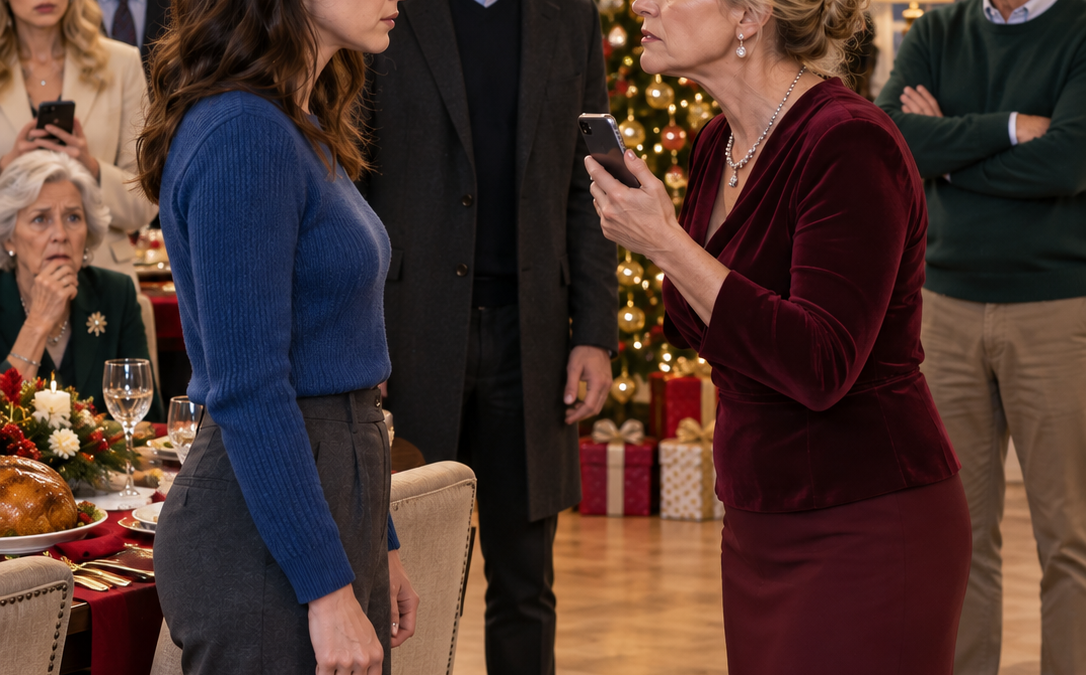
“Transfer $1,000 now. Your sister needs it.”
That was my mother’s order in front of twenty relatives on Christmas night. Eight hundred dollars for my sister’s rent and $200 for utilities.
I said no.
My mother lowered her voice. “You don’t get to say no to us.”
Then she grabbed my wrist and squeezed so hard her nails dug through my sleeve.
And that was only the beginning.
Before the night was over, she would hurl my phone across the room. I would step back, catch my heel on broken porcelain, and crash into a glass cabinet.
My name is Cecilia Walker. I’m 28 years old. For years, I was the daughter expected to sacrifice while my younger sister, Ruby, was protected, excused, and somehow, her bills always became my responsibility.
That was already the fourth time that year I’d been pressured to pay for her.
My family had taught me one brutal lesson: love came with a price tag, and I was always the one expected to pay it.
But that Christmas night, for the first time, I refused.
My parents thought they could pressure me one more time and I’d give in like always.
They were wrong.
Because before the night was over, police sirens would be outside their house. Handcuffs would come out, and nearly thirty years of family secrets would finally be dragged into the light.
The people who had spent years breaking me down would finally face consequences they could no longer talk their way out of.
Before we begin, feel free to like the video, subscribe to the channel, and tell me where you’re watching from and what time it is there. I’m always curious how far these stories travel.
Now, let me take you back to where this story began.
The snow had started falling just as I pulled into my parents’ driveway in Adena, Minnesota.
The house glowed from the inside, every window lit like a picture-perfect Christmas card. Garland framed the door. A wreath hung perfectly centered, its red bow fluffed and symmetrical.
My mother, Valerie Walker, cared deeply about appearances, order, control, tradition—at least the version she wanted others to see.
I balanced two carefully wrapped gifts in my arms as I walked up the familiar stone path. I’d worked late all week at Northstar Digital to make sure I could take this night off.
Christmas mattered to my family, or at least obedience dressed up as togetherness did.
The moment I stepped inside, warmth rushed over me: heat from the fireplace, the smell of roast turkey and cinnamon, the hum of conversation spilling from the dining room.
For a split second, I let myself believe this year might be different.
Then my mother’s voice cut through the house like glass.
“Cecilia, before you go any further, we need to talk. Right now.”
The room went quiet.
I froze near the front door, still holding my coat, still not fully inside.
My father, Nicholas Walker, stood a few feet behind her, arms crossed, his broad frame angled just enough to block my path.
Twenty relatives sat around the dining table—aunts, uncles, cousins—their forks paused midair, eyes shifting toward me with open curiosity.
This wasn’t an accident.
Valerie never did anything without an audience.
“We need to settle Ruby’s rent for January,” she said sharply. “Tonight.”
I felt my stomach drop.
“Mom,” I said carefully, lowering my voice. “I already told you. I’ve covered it three times this year. Nathan and I are saving for our wedding. I can’t keep—”
“Saving?” she snapped loudly enough for everyone to hear. “Your sister is struggling, and you’re planning flowers and venues like you’re some kind of celebrity.”
Heat rushed to my face as heads turned fully now.
My younger sister Ruby sat at the far end of the table, eyes on her phone, her perfectly manicured nails tapping the screen. Designer boots. A new coat draped over the chair beside her.
She didn’t look up.
“That’s not fair,” I said. “And you know it.”
Valerie turned toward the table, her voice rising.
“Everyone should know Cecilia makes $78,000 a year, and she can’t spare $800 a month to keep her own sister from being homeless.”
The word echoed through the room.
Homeless.
A few people gasped. Someone shifted uncomfortably.
My maternal grandmother, Eleanor, slowly pushed her chair back, concern lining her face.
I swallowed hard. “This isn’t appropriate. Can we not do this in front of everyone?”
Nicholas finally spoke, his tone heavy with disappointment.
“You want privacy while your sister might end up on the street?”
I glanced at Ruby again.
She still hadn’t looked up.
I set my gifts down with shaking hands.
“I’ve already given her $2,400 this year. That’s on top of my student loans, my car payment, everything else. I’m not a bank.”
Valerie pulled out her phone.
“Transfer it now. Eight hundred for rent, two hundred for utilities. One thousand dollars. That’s nothing to someone with your salary.”
The front door opened behind me, letting in a burst of cold air.
Nathan Brooks stepped inside, cheeks pink from the cold, holding a bottle of wine and a small bouquet for my mother.
His smile faded instantly as he took in the scene: me cornered by the door, my parents blocking the way, and an audience watching like this was entertainment.
“What’s going on?” he asked quietly.
“Cecilia is refusing to help her sister,” Valerie announced, as if presenting evidence in court. “Maybe you can explain family responsibility to her.”
Nathan moved to my side.
“I think Cecilia has been more than generous.”
Nicholas’s finger shot up.
“This is family business. Stay out of it.”
That was the moment I realized something was wrong in a deeper way than usual.
Not just the money. Not just the pressure.
There was a tension in the room I’d never felt before, tight and electric, like a wire pulled too far.
From the corner of my eye, I noticed my cousin Brandon, sixteen years old, holding his phone a little too steadily, the screen angled toward the table.
I didn’t know yet that everything my parents had hidden for decades was about to surface.
But standing there with my back against the door and my family watching me like prey, I felt it in my bones.
This Christmas wasn’t going to end quietly.
No one spoke for a moment after Nicholas snapped at Nathan.
The silence stretched thick and uncomfortable, broken only by the faint crackle of the fireplace and the soft clink of silverware someone nervously set down.
I became painfully aware of how I was standing—back against the door, coat still on, keys heavy in my pocket like an anchor.
It was a position I’d learned early in life.
Stay near the exit. Just in case.
“Let’s all calm down,” my grandmother Eleanor said at last, her voice thin but steady. “It’s Christmas.”
Valerie didn’t even look at her.
Her eyes stayed locked on me, sharp and expectant.
“Christmas is about family,” she said. “And family helps each other. Or have you forgotten where you came from, Cecilia?”
The familiar guilt stirred in my chest, automatic and well trained.
Years of hearing the same lines. The same refrains.
We raised you.
We sacrificed for you.
You owe us.
It was a script I could recite in my sleep.
“I haven’t forgotten anything,” I said. “I just won’t keep paying for things that don’t add up.”
That finally got Ruby’s attention.
She looked up from her phone, slow and deliberate, pale blonde hair falling perfectly into place as if she’d practiced the motion.
Her expression wasn’t embarrassed or apologetic.
It was irritated, like I’d interrupted her mid-thought.
“I told you I’m trying,” she said flatly. “You don’t have to make it a whole thing.”
I stared at her.
“I’m not making it anything. I just want the truth.”
Valerie laughed, sharp and humorless.
“The truth? Don’t be dramatic. Ruby doesn’t need to justify herself to you.”
Nicholas nodded.
“You’re the older one. You’re supposed to set an example.”
Nathan’s jaw tightened beside me.
I felt his hand brush mine, grounding me.
“An example of what?” he asked. “Being financially drained until there’s nothing left?”
Nicholas took a step forward.
Not close enough to touch, but close enough to loom.
“You’re awfully comfortable speaking out of turn in our house.”
“It’s her house, too,” Nathan said evenly. “At least it used to be.”
That did it.
Valerie’s face flushed a deep, angry red.
“Don’t you dare rewrite history,” she snapped. “Cecilia walked out the moment she thought she was too good for us. College, career, city life. And now she wants to lecture us about money.”
A few relatives shifted in their chairs.
I could feel the judgment settling in—the quiet recalculations.
Seventy-eight thousand a year.
Fancy job.
Big city.
Ungrateful daughter.
I opened my mouth to respond, but Valerie barreled on.
“You know what your problem is?” she said, turning toward the table like a preacher addressing her congregation. “You’ve always been selfish. From the moment you realized you were smart, you thought the world owed you something.”
“That’s not true,” I said, my voice shaking despite my effort to keep it steady.
She waved me off.
“I’m not finished. You think because you have a title and a paycheck that you’re above responsibility. Meanwhile, your sister is barely keeping her head above water.”
Ruby sighed loudly, like she was bored with the conversation.
“Mom, it’s fine. If she doesn’t want to help, I’ll figure something out.”
The words should have sounded noble.
Instead, they landed hollow.
I looked at her again.
Really looked.
The coat. The boots. The phone that looked newer than mine. The way she didn’t seem scared or desperate or even particularly concerned.
“What exactly are you figuring out?” I asked quietly.
Ruby’s eyes flicked toward our parents before returning to me.
“I don’t need to explain my finances to you.”
“Then stop asking for my money.”
Valerie slammed her hand on the table.
“Enough. I’m done with this back-and-forth. Transfer the money now.”
“I’m not doing that.”
The words felt foreign in my mouth.
Dangerous.
Powerful.
Nicholas’s expression hardened.
“Excuse me?”
“No,” I repeated, louder this time. “I’m done being pressured in front of people. I’m done being shamed, and I’m done paying for things I’m not responsible for.”
A ripple of reaction moved through the room—whispers, sharp inhales, someone muttering my name like a warning.
Valerie stepped closer, lowering her voice in a way that felt far more threatening than yelling.
“You don’t say no to us.”
Nathan shifted, placing himself slightly in front of me without making it obvious.
“She just did.”
Nicholas’s eyes narrowed.
“You need to leave.”
“Gladly,” Nathan said. “Cecilia, grab your coat.”
Before I could move, Valerie reached out and grabbed my wrist.
Her grip was tighter than it looked.
Her nails dug into my skin through the sleeve of my sweater.
“You are not walking away from this,” she hissed. “Not until you fix what you’ve done.”
“Mom,” I said sharply. “Let go of me.”
She tightened her grip.
A few people stood abruptly. Chairs scraped against the floor.
I heard my grandmother gasp my name.
“Let her go,” Uncle James said from across the table.
His voice was calm, but there was something underneath it. Something steely.
Valerie ignored him.
“You think humiliating us like this comes without consequences?”
“I didn’t humiliate anyone,” I said. “You did.”
That was when James stood up fully.
“Actually,” he said, reaching into his pocket, “there’s something everyone here needs to hear.”
Valerie finally released my wrist and turned toward him, her expression flickering with annoyance.
“James, don’t start.”
“I should have started a long time ago,” he replied.
He pulled out his phone, his hand steady despite the sudden stillness in the room.
“I’ve been recording conversations at family gatherings for the past year because something about this—about the way Cecilia is always singled out—didn’t sit right with me.”
Valerie’s face went pale.
“What are you talking about?” she demanded.
James tapped his screen.
Then my mother’s voice filled the room, clear and unmistakable.
“Ruby doesn’t need a better job. Cecilia will always pay. She’s too soft to say no if we pressure her enough.”
A collective gasp swept through the dining room.
James didn’t stop there.
He scrolled, then hit play again.
My father’s voice followed, casual and cold.
“We trained Cecilia well. She’s been paying Ruby’s way since high school. Why stop now?”
The world seemed to tilt.
I felt Nathan’s hand tighten around mine as forks clattered onto plates and people erupted into overlapping voices.
Valerie screamed something about privacy.
Nicholas cursed.
My grandmother sank back into her chair, one hand pressed to her chest.
And at the far end of the table, Ruby stared at her phone, her expression unreadable.
Whatever game my parents had been playing was no longer under their control.
This Christmas dinner was officially past the point of repair.
For a moment, no one spoke.
The recording ended, but my mother’s voice lingered in the air like smoke that refused to clear.
I stood frozen, my mind scrambling to catch up with what my ears had just heard.
There it was.
Everything I’d spent years doubting about myself, laid bare in two careless sentences.
I wasn’t imagining it.
I wasn’t too sensitive.
I wasn’t selfish or ungrateful.
I had been managed.
Valerie recovered first.
She always did.
Her shock hardened into outrage, sharp and theatrical.
“How dare you record private family conversations?” she snapped at James. “That’s illegal.”
James didn’t flinch.
“Minnesota is a one-party consent state. I was part of those conversations.”
Nicholas rounded on him.
“You sanctimonious piece of garbage. You sit at our table, eat our food, and then pull something like this?”
“Someone had to protect Cecilia,” James said calmly. “You turned her into a cash machine.”
The room erupted.
People spoke over one another—questions, accusations, disbelief.
Aunt Patricia pressed a hand to her mouth. A cousin whispered something frantic to the person beside her.
My grandmother, Eleanor, stared at my parents like she was seeing them for the first time.
I felt like I was underwater.
Nathan leaned close, his voice low and steady.
“Are you okay?”
I nodded automatically even though I wasn’t.
My chest felt tight, my heartbeat too loud in my ears.
Across the table, Ruby still hadn’t said a word. She sat perfectly still, phone resting in her hand, eyes flicking up only long enough to assess the damage.
“Is this true?” Eleanor asked suddenly, her voice cutting through the noise. “Ruby, have you been manipulating your sister?”
Every sound seemed to fall away as Ruby slowly lifted her head.
“It’s not manipulation,” she said with a shrug. “Mom and Dad said Cecilia wanted to help. That it made her feel needed.”
My stomach dropped.
“I never said that,” I whispered.
Ruby’s gaze slid back to her phone.
“You never checked either.”
The casual cruelty of it hit harder than the recordings.
Years of stress. Of skipped vacations. Of guilt-laced phone calls.
Dismissed like a misunderstanding over the weather.
Nathan straightened.
“We’re leaving.”
“She’s not going anywhere,” Nicholas said, stepping forward and blocking the path to the door again. “Not until this is resolved.”
“It is resolved,” Nathan shot back. “She’s done.”
Valerie moved fast.
One moment she was across the room. The next, her hand clamped around my arm again, nails biting into skin.
“You selfish little witch,” she hissed. “After everything we’ve done for you.”
“Let go of me,” I said, my voice rising. “You’re hurting me.”
“Good,” she said. “Maybe pain will teach you something.”
That was when I heard James again.
“There’s more,” he said quietly.
Valerie froze.
James scrolled through his phone, his face dark.
“Seventeen recordings. Seventeen times you discussed how to guilt Cecilia into paying, how to pressure her in public, how to make sure she never felt comfortable saying no.”
Nicholas lunged toward him.
“Turn that off.”
Before anyone could react, a new voice cut in, nervous, adolescent, unmistakably out of place.
“Uh, Aunt Valerie?”
Everyone turned.
Brandon stood near the corner of the room, phone held upright now, his face pale.
“This is live.”
“What?” Valerie snapped.
“It’s Facebook Live,” he said. “Like three hundred people are watching.”
The color drained from my mother’s face.
“Turn that off right now.”
“I can’t,” Brandon said helplessly. “People are sharing it.”
My phone buzzed in my pocket.
I pulled it out with shaking hands.
A text from my boss lit up the cracked screen.
Cecilia, someone just sent me a video. Are you safe?
The room descended into chaos.
Valerie screamed at Brandon. Nicholas threatened lawsuits. Relatives shouted, argued, took sides.
Ruby kept typing, her thumbs moving faster now, jaw tight.
Nathan grabbed my hand.
“We’re leaving. Now.”
This time, no one stopped us.
Everyone was too busy scrambling to control a narrative that had already escaped them.
Cold air hit my face as we stepped outside, snow swirling beneath the porch light.
My breath came in short, shaky bursts.
From inside the house, my grandmother’s voice rose above the din.
“Enough. This family has become poison.”
Nathan guided me toward his car, but before we reached it, my phone rang again.
Eleanor’s name flashed on the screen.
“Cecilia, dear,” she said, her voice trembling. “Please come back. Your mother is having a breakdown. She’s throwing things. We need to handle this as a family.”
I closed my eyes.
Despite everything, the conditioning ran deep.
“Five minutes,” I told Nathan quietly. “Just to make sure she’s okay.”
He didn’t argue.
He just nodded, jaw tight.
Walking back into that house felt like stepping into a disaster zone.
Plates lay shattered across the floor. The white tablecloth was strewn with gravy and wine. The gifts I’d brought sat crushed near the doorway.
Valerie spotted me instantly.
“Do you see what you’ve done?” she screamed. “You’ve ruined Christmas.”
“I didn’t ruin anything,” I said, surprised by how steady my voice sounded. “You did.”
Someone asked if Brandon was still recording.
He nodded, holding his phone low.
“Mom said to document everything for insurance.”
Nicholas emerged from the kitchen, his face purple with rage.
“Your little stunt has gone viral. People from my golf club are texting. Valerie’s book club.”
“Good.”
The word hung in the air.
Maybe public shame would finally do what private conversations never had.
I straightened.
“I’m done. I’m not paying Ruby’s rent. I’m not apologizing. And I’m not staying.”
Valerie laughed, sharp and hollow.
“You’re done when we say you’re done.”
Ruby stood up then, finally, phone still in her hand.
For one reckless second, hope sparked in my chest.
“This has gone too far,” she said.
My breath caught.
“I think we should cut Cecilia off completely,” Ruby continued calmly. “She’s too selfish to be part of this family. I’ll manage my rent without her.”
The betrayal landed like a physical blow.
Before I could respond, Valerie ripped my phone from my hand and hurled it across the room.
It shattered against the wall.
“That’s assault,” Nathan said from the doorway.
Nicholas moved toward him, fists clenched.
As I stepped back instinctively, trying to create space, my heel caught on broken porcelain.
I stumbled hard, straight into the china cabinet.
Glass exploded around me.
Pain sliced through my palm as something sharp cut deep.
Blood dripped onto the carpet.
“Look what you’ve done!” Valerie shrieked.
The room spun.
Somewhere through the ringing in my ears, I heard Brandon’s voice again, faint but urgent.
“There are twelve thousand people watching now,” he said. “And someone just commented, ‘They’re calling 911.’”
I sank to the floor, clutching my hand, surrounded by shattered glass and my family shouting over one another.
And in that moment, bleeding on my parents’ living room floor while the world watched, I understood something with terrifying clarity.
This wasn’t just manipulation anymore.
It was abuse.
And there was no going back to pretending otherwise.
The pain came in waves, sharp and blinding, then distant, like it belonged to someone else.
I sat on the floor amid shattered porcelain and splintered glass, my back against the broken cabinet. My injured hand pressed tight against my sweater as blood seeped through my fingers.
The carpet beneath me bloomed dark red.
Somewhere above me, voices clashed and overlapped, too loud to make sense of.
“Oh my God,” someone whispered.
“Don’t touch anything.”
“Call an ambulance.”
“I told you to turn that off.”
Brandon’s voice cut through the chaos, trembling now.
“I didn’t do anything. People are already calling. I swear someone said 911 is on the way.”
Aunt Patricia pushed through the crowd, her nurse’s instincts snapping into place.
“Move,” she ordered, kneeling in front of me. “Cecilia, look at me. Stay with me.”
“I’m here,” I said weakly, though my vision swam.
She gently took my wrist, examining the cut with practiced efficiency.
“You’re going to need stitches.”
As she lifted my sleeve, her hands stilled.
Her expression changed.
“What?” I asked, fear creeping in.
Patricia slowly pushed the fabric higher, exposing my forearm.
The room went quiet again.
Not the tense silence from before, but something heavier.
Older bruises bloomed beneath the skin, yellowed and purple, half hidden but unmistakable.
“These aren’t from tonight,” Patricia said, loud enough for everyone to hear.
My heart sank.
Valerie let out a sharp laugh.
“She’s clumsy. Always has been.”
Patricia looked up at her, eyes blazing.
“These are healing at different stages. Cecilia, how long has this been happening?”
“It’s not—” I started, the reflex to protect them rising automatically. “They don’t usually—”
“Don’t you dare,” Nicholas snapped. “Don’t imply we abuse our daughter.”
Patricia stood, her voice steady but fierce.
“I’m a nurse. What I’m seeing tells me these injuries didn’t all happen tonight. Cecilia, you need to tell the police what’s been happening.”
The words landed like a bomb.
Valerie’s confidence cracked.
“You’re overreacting.”
“No,” Patricia said. “I’m reacting appropriately.”
Sirens wailed faintly in the distance.
Nathan knelt beside me, his face pale with fury.
“You’re safe,” he said softly. “I’ve got you.”
I looked past him to Ruby.
She stood a few feet away, phone still in her hand, eyes unreadable.
Not shocked.
Not panicked.
Watching.
When the paramedics arrived, the house seemed to shrink around us.
Questions. Lights. The smell of antiseptic cutting through pine and cinnamon.
Patricia wrapped my hand in clean cloths as they loaded me onto the stretcher.
As they wheeled me out, I caught sight of my grandmother standing in the doorway, tears streaking her face.
“I’m so sorry,” she mouthed.
The hospital was a blur of white walls and fluorescent light.
The sharp sting of numbing injections. The tug of sutures pulling skin together.
I stared at the ceiling while a nurse worked, counting breaths to keep from shaking apart.
My phone was gone, shattered and silent.
Nathan sat nearby, speaking quietly with a police officer.
I heard fragments.
Assault.
Witnesses.
Live stream.
A soft knock came at the bathroom door where I waited after being stitched.
“Cecilia,” my grandmother’s voice said. “May I come in?”
She looked smaller under the harsh lights, older somehow.
She took my uninjured hand gently.
“I should have spoken up years ago,” she whispered. “Your mother learned this behavior from somewhere. I didn’t stop it.”
I swallowed hard, exhausted beyond words.
Before I could respond, Brandon appeared in the doorway, eyes wide.
“It’s everywhere,” he said. “The live stream. Two hundred thousand views and climbing.”
My stomach twisted.
Then Nathan returned, his face grim.
“The police want to take a statement. But there’s something else.”
He hesitated.
“Ruby quietly sent me some screenshots from her bank records while you were being treated,” he said. “Something in them doesn’t look right. I think we need an attorney to look at your credit and tax history.”
I stared at him.
“What?”
The hits kept coming.
And then, finally, Ruby asked to see me.
I didn’t want to.
Every part of me wanted distance, silence, an end to this night.
But curiosity—or maybe the need for answers—won.
She stepped into the room slowly, her composure finally cracked, designer coat wrinkled, eyes red.
“I know you hate me,” she said. “You should.”
I said nothing.
“There’s something you need to know,” she continued. “I haven’t needed rent money for over a year.”
The words didn’t register at first.
“I got promoted,” she said. “Senior developer. My salary is actually higher than yours.”
The room tilted.
“Over the years, I saved almost everything you gave me,” Ruby went on, her voice eerily calm. “It adds up to $60,000. I was planning to buy a house.”
My chest constricted.
“Why?” I whispered.
“Because Mom and Dad told me to,” she said. “They said the point was to keep you used to paying whenever they asked. And they knew about every dollar I saved.”
Silence swallowed us whole.
Ruby looked at me, really looked at me, and for the first time I saw fear beneath the calculation.
“I was scared they’d turn on me next.”
Police radios crackled in the hallway.
Nathan stepped closer to me, protective and solid.
“We’re leaving,” he said firmly. “And this time, anyone who tries to stop us will answer to the law.”
As officers moved down the corridor toward my parents, I realized something with quiet certainty.
The night had already destroyed their image.
What came next would dismantle everything else.
And there would be no undoing it.
The police station lobby felt nothing like safety.
It was bright and sterile. Every sound amplified—the scrape of chairs, the murmur of radios, the distant ring of phones.
I sat wrapped in a thin hospital blanket, my stitched hand throbbing in time with my heartbeat.
Nathan stayed close, one arm resting lightly across my shoulders like an anchor, reminding me I was still here, still upright, still breathing.
Across the room, Ruby sat alone.
Not beside our parents.
Not near anyone.
Just a single plastic chair pushed against the wall, her coat folded neatly in her lap, eyes fixed on the floor.
The separation felt deliberate, symbolic, as if some invisible line had finally been crossed.
A female detective introduced herself quietly and asked if I felt well enough to give a statement.
I nodded.
At that point, it felt like the only thing left I could control was telling the truth.
She led us into a small interview room.
The door closed with a soft click that sounded final in a way I wasn’t prepared for.
As I spoke about the money, the pressure, the public shaming, the grip on my arm that turned bruises into routine, I watched the detective’s expression shift from professional neutrality to something tighter, more intent.
Halfway through, she stopped taking notes and looked directly at me.
“Has this happened before?”
“Yes,” I said.
The word came out easily now.
Too easily.
“Not like tonight. But enough.”
When the interview ended, Nathan squeezed my hand gently, careful of the stitches.
“You did good,” he murmured.
Outside the room, voices rose again.
My parents had arrived.
Valerie Walker stood near the front desk, phone held high, narrating into the camera like she was giving a tour.
“We’re being detained without cause,” she announced to her followers. “Our ungrateful daughter staged a scene, and now the police are harassing us.”
Nicholas paced beside her, his face dark with fury, whispering urgently to a man in a cheap suit who could only be their lawyer.
Ruby stood up when she saw me.
“Cecilia,” she said softly.
I stopped a few feet away.
“What?”
She swallowed.
“I have evidence. Videos, bank statements, recordings. Everything.”
I stared at her.
“You had it this whole time.”
“Yes.”
“And you let it continue.”
Her shoulders sagged.
“I was scared.”
“So was I.”
The words weren’t loud, but they landed hard.
Ruby flinched.
“I’ll testify,” she said quickly. “Against them. I’ve already started returning the money. All $60,000, plus interest. You’ll get every cent back.”
I felt nothing.
No relief.
No vindication.
Just a hollow ache where trust used to live.
“The money doesn’t change what happened,” I said.
Her eyes filled.
“I know.”
Before she could say more, an officer approached.
“Ruby Walker, we need to speak with you.”
As she followed him away, the detective turned back to me.
“There’s more,” she said carefully. “We’ve received multiple reports tonight—from viewers, from family members, from medical professionals.”
Patricia’s warning echoed in my head.
The detective continued.
“A judge in Oregon contacted the department after a relative sent her the live stream. She recognized what was happening and offered to provide a sworn statement.”
My breath caught.
“A judge?”
“Yes. Catherine Williams.”
The name hit me like a shockwave.
My mother’s older sister.
The aunt I’d never met.
The one Valerie had erased from family history as if she’d never existed.
“She reports a pattern of financial coercion and abuse consistent with what you described,” the detective said. “Going back nearly thirty years.”
Nearly thirty years.
The pieces clicked into place with sickening clarity.
This wasn’t chaos.
It was design.
Rehearsed.
Refined.
Nathan exhaled slowly beside me.
“They’ve been doing this a long time.”
“Yes,” I said. “And they didn’t start with us.”
What happened next moved quickly, but only because the officers already had the live stream, multiple witnesses, and my statement about what had happened that night.
They arrested my parents in connection with the events at the house, while the financial allegations were referred for further investigation.
Valerie screamed as officers read her rights, her live-stream audience watching every second.
Nicholas tried to argue, to threaten, to posture his way out of handcuffs like he always had.
It didn’t work.
As they were led past me, Valerie locked eyes with me, her face twisted with fury and disbelief.
“This is all your fault,” she hissed.
I met her gaze steadily for the first time in my life.
“I’m done carrying the blame for what you chose to do,” I said quietly.
The doors closed behind them with a sound that felt like a chapter ending.
Hours later, after statements and signatures and too much coffee, Nathan guided me outside.
Snow still fell, soft and steady, covering the ugliness of the night in clean white silence.
Nathan’s phone vibrated.
A message from an unknown number.
Hi, this is Melissa Chang. I’m a trial attorney and a friend of Nathan’s sister. I saw the live stream. I’m on my way.
I leaned back against the car, exhaustion finally crashing over me.
My hand ached.
My head throbbed.
My heart felt like it had been split open and examined under fluorescent light.
But beneath all of it—under the shock, the grief, the betrayal—something else stirred.
Clarity.
For the first time, I wasn’t wondering how to fix my family.
I was wondering how to live without them.
And that question, terrifying as it was, felt like the beginning of freedom.
Melissa Chang arrived before dawn the next morning, still in her work suit, hair pulled back tight, eyes sharp and focused.
She didn’t waste time on comfort she knew I wasn’t ready to accept.
“They left a paper trail,” she said, opening her laptop. “A bad one.”
With my permission, she had already begun reviewing the records Ruby had preserved and the credit information we were able to access.
“They also claimed you as a dependent on their tax returns for five years after you moved out,” she said. “That’s one of several things investigators are going to want explained.”
Nathan stood behind me, one hand resting lightly on my shoulder as Melissa pulled up document after document.
Credit cards opened in my name that I had never seen.
Utility accounts tied to my Social Security number but linked to my parents’ address.
Loan applications flagged for irregularities.
An attempted home-equity loan against my condo, stopped only because the bank had questioned a forged deed.
“They tried to steal my home,” I whispered.
“Yes,” Melissa said gently. “And they would have if someone at the bank hadn’t done their job.”
The word steal felt too small.
This wasn’t theft born of desperation.
It was systematic.
Deliberate.
Comfortable.
The days that followed blurred together, measured in interviews, paperwork, and the low hum of exhaustion that never quite lifted.
The days after Christmas passed quietly that year, not with carols or candles, but with legal forms spread across a kitchen table and my stitched hand wrapped in fresh bandages.
The IRS contacted me soon after.
A forensic accountant was assigned to the case while Adult Protective Services began reviewing my grandmother’s finances.
Each conversation followed the same pattern.
Calm voices.
Precise questions.
And an undercurrent of disbelief as the scope widened.
“What you’re describing,” one investigator said carefully, “is long-term financial exploitation.”
Over the following days and weeks, the investigation widened and the potential charges began to stack up.
Fraud.
Identity theft.
Tax-related fraud.
Assault.
Elder abuse.
My grandmother, Eleanor, was interviewed next.
When they reviewed her accounts, they found forged signatures on checks, unauthorized withdrawals, even a reverse mortgage taken out without her knowledge.
“I thought I was helping the girls,” she said later, tears filling her eyes. “I didn’t know I was being robbed, too.”
James called me that night, his voice heavy with guilt.
“I should have played the recordings sooner.”
“You played them when it mattered,” I told him.
And I meant it.
Ruby gave a formal statement two days later.
She sat across from me in a small conference room at the station, a therapist, Dr. Sarah Winters, beside her.
Ruby looked smaller than I’d ever seen her, her shoulders rounded, hands folded tight in her lap.
“They controlled me differently,” she said quietly. “When you left for college, they told me you abandoned us. That you only helped because they forced you. They monitored my calls, my texts. If I tried to tell you the truth, they threatened to call my employer, to tell my boyfriend about my eating disorder. They had my medical records from when I was a minor.”
She rolled up her sleeve, revealing old scars I’d never known existed.
“I documented everything,” she continued. “Not because I was brave. Because I was scared.”
I didn’t forgive her in that moment.
But I understood her.
And that understanding shifted something fundamental between us.
When Catherine Williams flew in from Oregon, the story finally completed itself.
She was composed, calm, unmistakably authoritative—the kind of woman who had built a life far away from the chaos she’d escaped.
Sitting across from her in Melissa’s office, I felt like I was looking at a future version of myself.
“Valerie did the same thing to me for years,” Catherine said. “Money for emergencies that never seemed to end. Loans that were never repaid. Public guilt whenever I tried to say no. And when I finally stopped giving her what she wanted, she cut me off and told the family I was the selfish one.”
“How did you survive?” I asked.
“I left,” she said simply. “And I never looked back.”
Before Catherine left that afternoon, she opened the worn leather folder she had carried into Melissa’s office.
Inside were dozens of old letters and printed emails, some yellowed with age.
Catherine had kept them because, over time, she had stopped trusting the version of family history Valerie told everyone else.
I picked up one letter and recognized my mother’s handwriting immediately.
It accused a cousin I barely remembered of being selfish and choosing money over family.
Another described an aunt as unstable and vindictive.
A third claimed an old family friend had tried to destroy my parents’ reputation.
I remembered those names.
People who had once appeared at birthdays and holidays, then suddenly disappeared.
Whenever I asked why, my parents always said the same things.
They changed.
They betrayed us.
They were never really family.
For the first time, I wondered if those people hadn’t disappeared because they were cruel.
Maybe they had simply stopped cooperating.
Ruby read another letter, then looked at me.
“How many people did they make us hate?” she whispered.
I didn’t know.
That was what frightened me most.
My parents hadn’t just controlled money.
They controlled who we trusted, who we feared, and who was erased from our lives.
They controlled the story long enough that it became our memory.
Catherine closed the folder gently.
“You may never know every truth they buried,” she said. “But you don’t have to keep repeating their version.”
I looked at the letters scattered across the table.
This was bigger than fraud.
Valerie and Nicholas had built our family around one rule.
They were always right.
Everyone else was replaceable.
The legal process moved faster than I expected once everything was on the table.
With the live-stream footage, recordings, bank statements, and multiple witnesses, the prosecutor didn’t hesitate.
Bail was denied.
Assets were frozen.
My parents were held pending trial.
The night before the preliminary hearing, I lay awake listening to the soft rhythm of Nathan’s breathing beside me, my mind racing despite the exhaustion.
“What if they still find a way out?” I asked quietly.
He turned toward me, eyes steady.
“Then we keep going. But this time, you’re not alone.”
The hearing itself was brief and devastating.
Twenty-three counts of fraud.
Eighteen counts of identity theft.
Tax-related fraud.
Assault.
Elder abuse.
Not-guilty pleas.
No remorse.
No acknowledgment.
As my parents were led away in handcuffs, I searched my chest for the familiar guilt, the reflexive ache.
It wasn’t there.
What replaced it wasn’t satisfaction or triumph.
It was resolve.
Outside the courthouse, reporters gathered, microphones poised.
Melissa handed me a prepared statement, but Ruby stepped forward first.
“They stole more than money,” she said, her voice trembling but clear. “They stole our trust, our relationship as sisters, and years of our lives. But they didn’t steal our future.”
When it was my turn, I spoke without notes.
“Abuse like this survives because families are taught to stay silent,” I said. “In shame. In the idea that family harm should be hidden. Today, that silence ends.”
The headlines followed us for weeks.
Interviews.
Messages from strangers who recognized their own lives in mine.
Emails from relatives who admitted they’d suspected something but hadn’t known how to speak up.
The system my parents relied on—secrecy, guilt, isolation—had collapsed under its own weight.
And as the trial date approached, I realized something quietly transformative.
This story was no longer about what they had done to me.
It was about what I was no longer willing to carry.
For the first time in my life, the future didn’t feel like something I had to earn through sacrifice.
It felt like something I was finally allowed to choose.
The courthouse was quieter than I expected.
No shouting.
No drama spilling into the hallways.
Just the muted shuffle of shoes against polished floors and the low murmur of voices kept deliberately calm.
By the time we took our seats, the weight of what was about to happen had settled into my chest like something solid and immovable.
Ruby sat beside me, not close enough to touch, but close enough that I could feel her presence.
Nathan was on my other side, steady as ever.
Behind us sat a small row of familiar faces: James, Patricia, my grandmother Eleanor, and Catherine, who sat with the quiet confidence of someone who knew exactly how the system worked.
When my parents were brought in, the room shifted.
Six months in county jail had changed them.
Valerie’s carefully maintained image had cracked completely. Gray roots showed beneath hair pulled into a careless ponytail, her posture stiff with indignation rather than authority.
Nicholas looked smaller somehow, his usual bulk diminished by an oversized suit and the absence of control.
They didn’t look at me at first.
The judge entered.
Everyone stood.
The formalities passed in a blur, and then the charges were read aloud, one after another, stacking higher than I could have imagined when I walked into that Christmas dinner believing this was just another argument about money.
Fraud.
Identity theft.
Tax-related fraud.
Assault.
Elder abuse.
Each count felt like a quiet confirmation that what I’d lived through had names.
Definitions.
Consequences.
When the prosecutor called my name, my legs felt unsteady as I stood.
I forced myself to meet my parents’ eyes as I took the stand.
Their expressions didn’t soften.
If anything, they hardened—offended, wounded, certain they were the wronged party here.
The prosecutor guided me carefully, starting with the financial abuse.
Bank statements appeared on a screen behind us.
Every transfer I’d made to Ruby, believing I was helping my struggling sister.
Then the credit cards I never opened.
The attempted loan against my condo.
The tax filings that claimed me as a dependent long after I’d moved out.
“Did you consent to any of this?” she asked.
“No,” I said. “I didn’t even know it was happening.”
“And when you tried to set boundaries?”
I inhaled slowly.
“I was punished. Publicly shamed. Threatened. Sometimes physically hurt.”
The courtroom was silent.
When the defense attorney stood, her tone was polite.
Distant.
“Miss Walker, isn’t it true you voluntarily gave money to your sister?”
“Yes,” I said.
“No one forced you to write those checks.”
I met her gaze.
“Coercion doesn’t always look like force. Sometimes it looks like guilt you’re raised with from childhood. Like believing love is conditional. Like being told your family will suffer if you say no.”
She pressed on.
“You’re a successful professional. Surely you could have walked away sooner.”
I didn’t look at my parents when I answered.
“It took twenty-eight years and being assaulted in front of witnesses for me to understand that saying no was allowed.”
When Ruby testified, the room changed again.
Her voice shook at first, but it grew steadier as she described a different kind of control—monitoring, isolation, threats tied to her mental health.
Medical records were entered into evidence.
Recordings followed.
The forensic accountant’s findings.
Catherine’s affidavit outlining the same abuse nearly thirty years earlier.
This wasn’t a family dispute.
It was a pattern.
When my grandmother took the stand, her hands trembled.
She spoke about forged checks, missing savings, the guilt of not realizing sooner that she, too, had been a victim.
“I thought I was protecting my family,” she said softly. “Instead, I helped them hurt each other.”
By the final day, there was no drama left in the courtroom.
Only inevitability.
The jury didn’t take long to reach its verdict.
When we were called back into the courtroom, the foreperson stood.
“Guilty on all counts.”
The words felt like air returning to my lungs.
Before dismissing the jury, the judge looked toward my parents.
“This case has been described as a family matter blown out of proportion,” she said. “Let me be clear. Financial abuse is not a misunderstanding. Physical assault is not discipline. Exploitation disguised as parenting is still exploitation.”
She turned directly toward them.
“You were entrusted with the care of your children. Instead, you treated them as resources.”
Valerie collapsed into sobs.
Nicholas’s face flushed dark with rage, his mouth opening as if to argue even now.
Several weeks later, we returned to court for sentencing.
Seven years in state prison.
Full restitution.
Assets liquidated.
A twenty-year no-contact order.
As officers moved to escort them out, Valerie twisted toward me, her voice sharp and broken.
“You destroyed this family.”
I stood with my hands steady at my sides.
“No,” I said. “You did. I just stopped protecting the lie.”
The gavel fell.
And in that sound—final, undeniable—I felt something I’d never known before.
Not victory.
Freedom.
The days after sentencing felt strangely quiet.
Not peaceful quiet.
The kind of quiet a storm leaves behind, heavy and unfamiliar.
The kind that makes you realize how much noise you’ve been living with without noticing.
For the first time in my life, no one was demanding anything from me.
No urgent calls.
No guilt-laced messages.
No calculations running in the back of my mind about how much love would cost this month.
I didn’t know what to do with that kind of silence.
Ruby and I started therapy together a week later.
The first session was awkward.
Our chairs angled slightly away from each other, both of us unsure where to begin now that the enemy we’d been trained to orbit was gone.
Dr. Winters didn’t rush us.
She let the quiet sit until it softened.
“They taught you to survive in opposite ways,” she said gently. “Cecilia learned to give until there was nothing left. Ruby learned to hide until she was safe.”
Ruby stared at the floor.
I watched her hands twist together, the same nervous habit she’d had as a kid.
“I thought if I stayed useful,” she said quietly, “they wouldn’t hurt me.”
Something in my chest loosened.
Not forgiveness.
Not yet.
But understanding.
Real understanding.
The kind that doesn’t erase damage but finally explains it.
We didn’t fix everything in those sessions.
Some days, we barely spoke.
Other days, we cried until our faces hurt.
Healing, I learned, wasn’t linear.
It was uncomfortable and slow and full of moments where you wondered if you were doing it wrong.
Nathan was steady through all of it.
He never pushed me to move faster.
Never told me to look on the bright side.
He just showed up.
Coffee in the mornings.
His jacket draped over my shoulders when I forgot how cold Minnesota winters could be.
His hand finding mine in quiet moments when my thoughts spiraled.
One night, curled up on the couch, I finally said the thing I’d been afraid to voice.
“What if I don’t know who I am without them?”
He didn’t answer right away.
He just brushed his thumb gently over my knuckles.
“Then we figure it out together.”
The wedding, which we’d postponed without hesitation, became something different in my mind.
Not an obligation.
Not a milestone I had to earn.
But a choice.
One made freely, without fear of backlash or manipulation.
Catherine had returned for the trial and stayed a little longer afterward.
We spent hours talking about boundaries, about the first year after leaving, about the grief that comes even when escape is the right decision.
“They don’t disappear from your head just because they disappear from your life,” she told me over coffee one afternoon. “But one day, you realize their voice isn’t the loudest anymore.”
My grandmother, Eleanor, moved forward with a quiet determination I’d never seen before.
She updated her will, changed her accounts, apologized not once but often.
“I can’t undo what I didn’t see,” she said, holding my hand. “But I can choose differently now.”
So could I.
Some nights, the memories still came uninvited.
The sound of Valerie’s voice.
The way Nicholas blocked doorways.
The moment glass shattered and everything changed.
Trauma doesn’t vanish just because justice arrives.
But something else arrived with it.
Space.
Space to say no without flinching.
Space to rest without guilt.
Space to imagine a future that didn’t revolve around fixing broken people who never wanted to change.
Ruby and I weren’t suddenly close.
We didn’t pretend the past hadn’t happened.
But we started over carefully, honestly, with boundaries instead of obligation.
One afternoon, as we left therapy together, she stopped in the parking lot.
“I don’t expect you to trust me,” she said. “But I want to earn it.”
I nodded.
“That’s the first honest thing we’ve ever had.”
Nathan and I eventually rescheduled the wedding.
Not because everything was resolved, but because joy doesn’t need permission from pain.
We stood surrounded by chosen family.
No obligation.
No guilt.
No leverage.
Just love freely given and freely returned.
Ruby gave the maid-of-honor speech.
Her voice shook, but she didn’t hide from it.
“They tried to teach us that love was something you earn by suffering,” she said. “But we’re building something different. Something honest.”
It wasn’t a happy ending.
It was something better.
It was a beginning.
Quiet.
Imperfect.
And finally our own.
Five years later, I stood in my backyard watching my daughter run through the grass, her laughter cutting clean and bright through the afternoon air.
Her name was Eleanor—Ellie for short—named after the grandmother who finally found the courage to speak before it was too late.
She was three years old, fearless, convinced the world existed to be explored rather than survived.
Nathan manned the grill nearby, pretending not to smile every time she shrieked with delight as he lifted her high into the air.
Ruby sat on the porch steps with her son, a toddler just learning how to balance bravery with caution.
We weren’t perfect.
We weren’t magically healed.
But we were present.
Honest.
Learning how to build something without fear baked into the foundation.
“Do you ever think about them?” Ruby asked quietly, nodding toward the house as if our parents might still exist somewhere in the corners of our lives.
“Sometimes,” I admitted. “Mostly as a reminder of what not to repeat.”
Prison and therapy had not rewritten the past.
Consequences didn’t erase harm.
And forgiveness—real forgiveness—didn’t require access to my life or my children.
I’d learned that the hardest boundary wasn’t cutting contact.
It was letting go of the fantasy that accountability would turn them into different people.
Ellie ran toward me, arms outstretched.
“Mama, watch me!”
“I’m watching,” I said, crouching down as she launched herself into my arms.
And I meant it.
As our children grew older, we told them the truth carefully and honestly when they were old enough to ask.
Not with bitterness.
Not with lies softened into something easier to swallow.
Just the truth that some people don’t know how to love safely, and that walking away can be the bravest thing you ever do.
What began as the two of us quietly sharing our story with others eventually grew into something we never planned.
A foundation.
Workshops.
Resources for people trapped in family systems that used guilt and money as weapons.
Messages poured in from strangers who recognized themselves in our story.
From people who thought they were alone because abuse didn’t leave visible bruises.
Financial abuse thrives in silence.
We learned that early.
We learned it the hard way.
But silence breaks the moment someone says:
“This isn’t normal. This isn’t love.”
One afternoon, years after the trial, a letter arrived from the prison system.
Valerie’s handwriting wavered across the envelope.
I didn’t open it right away.
When I finally did, the pages were filled with justifications, accusations, and, at the very end, four uncertain words.
Maybe we were wrong.
I folded the letter and put it away.
Sometimes closure means choosing not to respond.
Life moved forward anyway.
Looking at the life we had built and the people who stayed without keeping score, I understood something I wish I’d known earlier.
Family isn’t defined by blood.
It’s defined by behavior.
And the greatest revenge isn’t survival.
It’s freedom.
If this story resonated with you, if you’ve ever felt trapped between family obligation and self-preservation, have you ever had to set boundaries with someone who should have protected you?
Share your thoughts in the comments.
Your story might be exactly what someone else needs to hear.
And if you found value here, like the video, subscribe, and share it with anyone who needs the reminder that love should never come with a price tag.
See you in the next video.
Thank you.








