At my sister’s engagement dinner, mom introduced me to the groom’s family: “this is our other daughter – cleans houses for a living”; my dad added: “we’ve given up on her”; the groom’s mother froze, looked me dead in the eye, and whispered: “wait… you’re…” she went quiet, the whole table locked up, my mom lost all color.
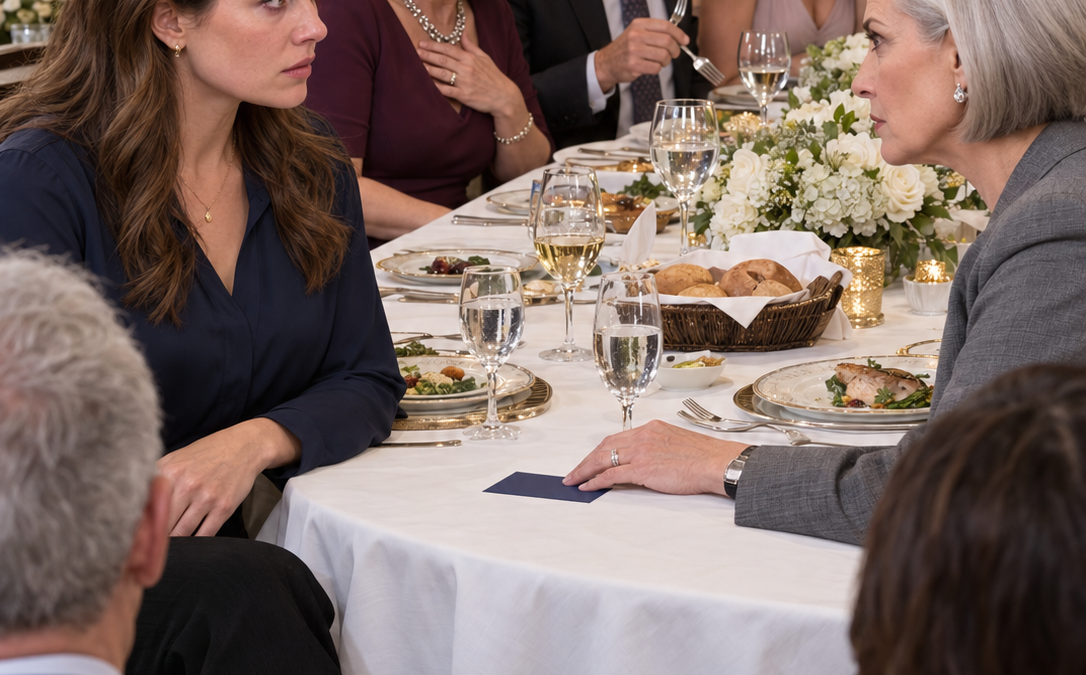
I don’t think she ever forgave us for that. Not me. Not my sister. Not really.
My sister Paige is four years younger, 28 now. She works as a marketing coordinator in Indianapolis. She’s been promoted twice in three years, and every time she is, my mother calls me—not to share Paige’s news, but to make sure I’ve heard it.
Our living room wall tells the whole story.
Paige’s diplomas. Paige’s Employee of the Quarter plaque. Paige’s sorority composite.
My frames stop at my college graduation photo.
Four years of a business degree, and that’s the last thing I did that made sense to them.
There’s a rhythm to how my mother introduces us at church, at grocery stores, at family reunions.
“Paige just got promoted again.”
Pause.
Then the pivot.
“Julia’s still doing her thing.”
My dad never corrects her. He never adds detail. He just stands there with his hands in his pockets, looking at the floor like a man waiting for his number to be called at the deli counter.
Silence is a kind of agreement.
I learned that early.
The summer I turned 22, I had a degree in business administration and a suitcase full of plans. My mother had other ones.
She’d enrolled me in an MBA program at the state university, paid the deposit, told my dad’s coworkers, printed the course catalog, and left it on my nightstand like a hymnal.
I sat her down at the kitchen table one Thursday evening and told her I wasn’t going.
“I’m starting a commercial cleaning company,” I said.
I had a binder. Market research. Cost projections. A twelve-month cash-flow estimate.
She didn’t look at the binder.
Fourteen seconds.
That’s how long she sat in silence. I counted the ticks on the wall clock behind her head.
Then she said, “You want to clean toilets? That’s your big plan?”
My dad walked in from the garage. He’d heard enough.
“I already told Jim at work about your MBA.”
Paige was at a friend’s house. She texted me later that night.
Mom says you’re being dramatic.
Only one person asked to see the binder.
My grandmother, Ruth. She’s 78 now, but back then she was 68 and sharp as a tax audit.
She sat on her porch, read every page, and said, “Show me where you’ll be in year three.”
She gave me $800 from her savings and a handkerchief—white cotton, hand-embroidered, monogrammed with her initials, RH.
She pressed it into my palm and said, “For the hard days.”
That night, my mother told me that if I wanted to scrub floors, I could do it without her money.
She cut me off.
I folded my binder, put it in my backpack, and drove four hours to Indianapolis.
I didn’t argue.
I just drove.
My first apartment cost $475 a month. Studio. One window. A radiator that clanked at 3:00 a.m. like someone was trapped inside the wall.
I bought a used van for $2,200. White. No logo. The air conditioning worked on Tuesdays and Fridays for no discernible reason.
My first client was a dental office on Meridian Street. Three rooms, a waiting area, a bathroom with mint-green tile.
Two hundred dollars a week.
I cleaned it myself every morning at 5:00 a.m. before spending the afternoon knocking on doors and the evening doing my own books at the kitchen counter.
Six months in, I had four contracts. I was working seven days a week, and my shoulders ached in a way that didn’t stop when I slept.
By the end of year one, I’d brought in $62,000 in revenue.
Profit: $11,000.
I hired my first employee, Maria, a single mom from Guatemala who showed up fifteen minutes early every shift and never once complained about the work.
She’s still with me.
Every Sunday, I called Grandma Ruth.
She’d ask specifics.
“How many clients?”
“What was your close rate?”
“Have you looked into liability insurance yet?”
She listened the way people listen when they believe what you’re building is real.
Every other week, I called home.
My mom picked up, and the conversation was always the same.
“You ready to come home yet?”
“Not yet, Mom.”
“Well, Paige is doing very well at her new job.”
“Tell her I said congrats.”
My dad never got on the line.
By year three, something happened that almost made me pick up the phone and call my mother.
Almost.
But I’d learned by then that almost doesn’t count in my family.
Year three changed everything.
I signed a contract with a twelve-story office building on the north side of Indianapolis.
Annual value: $340,000.
I opened a second location and hired my 38th employee. Revenue crossed $1.4 million.
I was 25 years old and running a company that cleaned more square footage in a week than most people walk in a year.
I called my mother.
“Mom, I just signed a contract worth $340,000 a year.”
Pause.
Then:
“So how many people are you sending to mop floors now?”
“Thirty-eight.”
“Thirty-eight people mopping floors. That’s something.”
My dad’s voice came through the speakerphone.
“Your sister just got accepted into a leadership program at her company.”
I sat in my office—a real office by then, with a desk and a filing cabinet and a framed photo of Grandma Ruth on the shelf—and stared at the business card I’d just had printed.
Navy blue. Clean font.
Holloway Commercial Services.
Tagline along the bottom: Excellence in every detail.
I designed it myself.
Spent two days choosing the shade of blue.
That was the last time I volunteered information about my business to my parents.
I didn’t make a decision about it. There was no dramatic moment, no declaration.
I just ran out of doors to knock on.
When you tell someone you signed a contract worth $340,000 and they ask how many people you’re sending to mop floors, the message is clear.
They’ve decided what you are.
New information won’t change the file.
For the next seven years, they believed exactly what they wanted to believe.
And I let them.
Fast-forward.
Holloway Commercial Services: fourteen states, 283 employees, annual revenue of $18 million.
We service hospitals, universities, corporate headquarters, government buildings.
My employee retention rate—87 percent—is the highest in the industry. I built a training program for ESL workers that three competitors have tried to copy.
I live in Indianapolis. I drive a 2019 Honda Accord. I own a condo downtown that I bought in cash.
And I keep a bottle of homemade lemon-vinegar cleaner on my desk because I still like the smell.
It reminds me of the beginning.
None of this is secret.
I have a website. A LinkedIn page. A short Wikipedia article I didn’t write.
My parents have never looked at any of it.
Then Paige called.
It was the first time in four months.
I was reviewing a facilities proposal when her name popped up. I almost let it ring.
“I’m engaged,” she said.
“Garrett Ellsworth. His family is hosting an engagement dinner next Saturday. Mom wants you there.”
“Mom wants me there, or you want me there?”
“Does it matter? Grandma Ruth’s coming. She asked for you specifically.”
That settled it.
When Ruth asks, I show up.
After we hung up, I typed the name into my laptop.
Ellsworth Property Group.
Two hundred commercial properties across Ohio and Indiana.
I knew the name.
I knew it very well.
Eighteen months ago, my company had won the cleaning contract for 47 of their buildings.
$3.8 million a year.
The largest deal in my company’s history.
The contract was signed by the chair of their board, Catherine Ellsworth.
The groom’s mother.
I stared at the screen for a long time.
Friday afternoon, the day before the dinner, I stood in my office and looked at the bottle on my desk.
Lemon juice. White vinegar. Water.
Same recipe I mixed in my studio apartment ten years ago when I couldn’t afford commercial products.
I unscrewed the cap and held it under my nose.
Citrus and acid.
It smelled like 5:00 a.m. shifts and aching shoulders and mint-green bathroom tile.
It smelled like the beginning of everything.
I picked my outfit that evening.
Navy blouse—the same shade as my company logo, though nobody at that dinner would know that. Black slacks. Flat shoes. No jewelry except a thin gold chain Grandma Ruth gave me for my 30th birthday.
I wasn’t dressing to impress.
I wasn’t dressing to prove anything.
I was dressing the way I dress every day, like a woman who has work to do.
Saturday morning, I called Ruth.
“I’m on my way, Grandma.”
“Drive safe, honey.”
She paused. Her voice had thinned over the past year. The heart medication made her tired, and I could hear it.
“And Julia?”
“Yeah?”
“Don’t let your mother shrink you.”
I pulled onto the interstate heading east.
Three hours to Carver.
Three hours of flat Indiana highway and corn stubble and radio stations that fade in and out like old friendships.
Three hours to decide how much of myself I was willing to bring into that room.
I thought about Catherine Ellsworth.
She would be there.
She would recognize me.
And I didn’t know what she’d say, or what my parents would say when she said it.
I wasn’t planning anything.
I want to be clear about that.
I drove to that dinner for one reason: a 78-year-old woman with a bad heart who wanted to see her granddaughter.
Everything else just happened.
The Birchwood sits on a two-lane road outside Carver. Farm-to-table. Exposed brick. The kind of place that serves bread in a cloth napkin and charges $42 for a pork chop.
I pulled into the parking lot at 6:55 p.m.
Five minutes early.
My mother’s car was already there, the silver Buick parked near the entrance. Gerald’s coat hung in the back seat.
Paige’s white SUV was two spots over, a JUST ENGAGED sticker on the bumper that looked like it had been applied with a ruler.
The private dining room was at the back.
Long oval table. Twenty-three place settings. Warm lighting. Bread baskets. Water glasses already filled.
My mother met me at the threshold.
She wore a plum dress and a necklace I’d never seen before, probably new for the occasion.
She hugged me quickly, tightly. Her hand gripped my shoulder the way you grip a steering wheel in bad weather.
“You look comfortable,” she said, eyes scanning my blouse, my flats.
She smiled.
It didn’t reach her temples.
Gerald stood behind her. He shook my hand—his own daughter—and said, “Glad you came.”
He looked at my left ear the entire time.
Paige crossed the room in heels, her engagement ring catching the overhead light. She hugged me with both arms, which surprised me.
“Thanks for coming, Jule.”
She introduced me to Garrett. Tall, polite, firm handshake.
“This is my older sister. She lives in Indianapolis.”
No job. No title.
Just a city.
At the far end of the table, I spotted Grandma Ruth.
Wheelchair. Thinner than three months ago. Cardigan buttoned to the throat.
She reached for my hand before I reached for hers.
“There’s my girl.”
I sat beside her.
Catherine hadn’t arrived yet.
Appetizers came out. Bruschetta, crab cakes, a cheese board that could feed a high school basketball team.
Diane worked the room like a campaign manager.
She made introductions one by one.
Every family member got a label.
“This is my brother Tom, retired fire chief, 31 years of service.”
“My niece Sarah just finished nursing school, top of her class.”
Each person tagged with a title, a rank, a reason to be respected.
She skipped me.
Not in a dramatic way. Not a pointed silence.
She just moved past my chair the way you move past a lamp you’ve had so long you don’t notice it anymore.
Robert Ellsworth noticed.
He was Garrett’s father. Silver-haired, easy smile, the kind of man who asks questions because he’s genuinely curious, not because he’s checking boxes.
He leaned across the table.
“And what do you do, Julia?”
Before I could answer, my mother’s voice cut in from two seats away.
“Oh, Julia does cleaning work. Residential, you know.”
She waved her hand.
A flick, like brushing crumbs off a counter.
I picked up my water glass, took a sip, set it back down.
Robert nodded politely.
Garrett’s sister, Megan, 26, warm eyes, a teacher in Columbus, tilted her head.
“Oh, like a cleaning service? That’s pretty cool.”
Diane smiled.
“Well, it’s a living.”
Under the table, Grandma Ruth found my hand.
She squeezed once.
Firm.
Her knuckles were swollen, but the grip was steady.
I squeezed back.
Then the front door opened.
Heels on hardwood.
A voice from the hallway apologizing for the traffic.
Catherine Ellsworth walked into the private dining room, and everything I thought I knew about that evening shifted.
Catherine Ellsworth was 61 years old and looked like a woman who had earned every one of those years on her own terms.
Silver bob. Gray blazer over a black blouse. No excessive jewelry, just a watch that probably cost more than my first van.
She moved through the room with the efficiency of someone who chairs quarterly board meetings.
Handshake. Name. Eye contact.
Next.
Garrett kissed her cheek. Robert pulled out her chair. Diane beamed and said something about how lovely it was to finally meet in person.
Catherine came around the table.
She reached me.
She stopped.
Half a second, maybe less, but I saw it.
A flicker behind her eyes.
Recognition.
Then recalibration.
Her gaze moved to my blouse, navy blue, the same shade she’d seen across a boardroom table in Columbus eighteen months ago.
She took my hand and held it a beat longer than the others.
“Julia. How lovely to see you here.”
Her voice was measured, warm, but there was a question folded inside it that she wasn’t ready to unfold yet.
“Mrs. Ellsworth. Good to see you, too.”
She sat down across from me, placed her napkin on her lap, accepted a glass of water from the server, and then, very quietly, looked at me one more time.
Nobody noticed.
Diane was telling Robert about the time Paige won a regional marketing award.
Gerald was studying the wine list like it contained a secret message from God.
Paige was laughing at something Garrett whispered.
But I noticed.
And Catherine knew I noticed.
She didn’t say anything else for the next twenty minutes.
She ate her appetizer. Complimented the crab cakes. Asked Garrett about his new apartment.
And she waited.
Let me tell you about the first time I met Catherine Ellsworth.
Eighteen months before that dinner, I flew to Columbus, Ohio, for the biggest pitch of my career.
Ellsworth Property Group managed more than 200 commercial buildings—office towers, medical complexes, mixed-use developments—across four states.
They were looking for a single vendor to handle cleaning services for 47 of those properties.
The contract was worth $3.8 million a year.
I wore my navy suit.
I brought a forty-page proposal. I’d spent three weeks building it: service tiers, staffing models, quality-control protocols, cost comparisons.
I printed five copies and drove to a FedEx at midnight to get them spiral-bound.
Catherine chaired the meeting.
Six people at the table.
She asked more questions than the other five combined.
She wanted to know my employee retention rate.
“Eighty-seven percent.”
She wanted to know about my training program.
“Forty hours of onboarding. Monthly check-ins. ESL support.”
She wanted to know why I started the company.
I told her the truth.
“Because I cleaned my first office at 22 with a spray bottle and a borrowed mop, and I decided no one who does this work should feel invisible.”
She didn’t smile.
She wrote something down.
After I signed the contract, she walked me to the elevator.
“I’ve signed a lot of contracts, Julia,” she said. “This is the first time I felt the other person cared more about the people doing the work than the profit margin.”
I kept that sentence in my head for months because it was the first time someone with real authority had looked at what I built and called it what it was.
My parents had ten years to say something like that.
A stranger said it in fifteen minutes.
Back at the dinner, the main course arrived.
Pan-seared salmon. Roasted vegetables. Risotto that nobody was paying attention to because the conversation had turned to careers.
Robert Ellsworth was the one who opened the door.
“So, Diane, you must be proud of both your girls.”
My mother set down her fork and tilted her head.
That look.
Half smile, half calculation.
I’ve seen it a thousand times.
She was framing the shot.
“Oh, Paige is our shining star. Promoted twice in three years. Her company just trusted her with their biggest client.”
Diane touched Paige’s arm.
Paige smiled, embarrassed, but not enough to stop it.
Diane paused.
Let the silence do the work.
Then the pivot.
“Julia takes a different path. She’s more hands-on.”
Gerald didn’t need a cue.
He leaned toward Robert like they were sharing a joke at a bar.
“She started out cleaning offices after college. We thought it was temporary.”
Small laugh.
“Ten years later…”
He trailed off.
Shrugged like the rest of the sentence wasn’t worth finishing.
Megan looked at me.
Garrett looked at his plate.
Robert stopped chewing.
I cut my salmon.
Steady hand.
Chewed. Swallowed. Took a sip of water.
At the end of the table, Grandma Ruth set her fork down hard enough to clink against the plate.
“Julia’s doing just fine, Diane.”
My mother didn’t miss a beat.
Smile still perfect.
“Of course she is, Mom. Nobody said otherwise.”
Nobody said otherwise.
That’s how she operated.
Never an accusation you could pin down. Just implication layered so thick you couldn’t breathe under it.
Catherine Ellsworth picked up her water glass.
Set it down without drinking.
Her eyes hadn’t left my mother for thirty seconds.
Diane didn’t notice.
She never looked at the people who were actually watching.
Between the main course and dessert, I excused myself.
The bathroom was down a narrow hallway. Cream walls. A framed watercolor of a barn. The kind of art that exists only in restaurants and dental offices.
Gerald was waiting in the hall when I came out.
Hands in pockets. Shoulders rounded.
He looked like a man who’d been standing there for a while, trying to decide whether to stay or go.
“Hey, Jule. You doing okay?”
“I’m fine, Dad.”
He shifted his weight.
Left foot. Right foot.
“I know your mom can be a lot, but she means well.”
“Does she?”
He opened his mouth.
Something flickered across his face.
Not courage exactly, but the shadow of it.
Like a man reaching for a door handle in the dark.
His fingers turned his wedding ring.
One rotation.
Two.
Then, from the dining room:
“Gerald, can you come get more wine?”
My mother’s voice.
Crisp.
Final.
The way you call a dog that’s wandered too far from the yard.
He blinked.
“I should go.”
He turned and walked back.
Didn’t look over his shoulder.
Didn’t say another word.
I stood in that hallway and watched him disappear into the warm light of the dining room.
And I thought that was as close as he’d ever come.
That half sentence in a hallway was the best Gerald Holloway could offer.
And it still wasn’t enough to finish.
I’d stopped counting on almost a long time ago.
I went into the bathroom and washed my hands.
The soap was lemon.
Sharp. Acidic. Familiar.
It hit me in the chest the way a song does when you hear it in a grocery store fifteen years after it mattered.
I dried my hands.
Breathed.
Walked back to the table.
I sat back down.
Grandma Ruth touched my wrist, her version of asking without asking.
I nodded.
She let go.
Paige had stepped away to talk to Garrett near the window.
Her phone lay face down on the table beside her bread plate.
The screen lit up.
Notification banner.
Group chat.
Wedding Planning, with a ring emoji.
I didn’t pick it up.
Didn’t touch it.
But the preview was right there, bright against the white tablecloth.
And I have functioning eyes.
Diane’s name.
Sent two hours before dinner.
Whatever you do, don’t let Julia talk about her work tonight. The Ellsworths don’t need to know our family has a cleaning lady beneath it.
Paige had sent one an hour before dinner.
Already handled. I introduced her as my sister in Indianapolis. That’s it.
I read both lines twice.
Then the screen went dark.
Twenty-three people in this room.
Three of them had coordinated in advance to make sure I stayed small.
Not a spontaneous remark.
Not a careless slip.
A plan.
Written down.
Timestamped.
I picked up my water, drank, set it down.
Grandma Ruth studied my face.
She couldn’t have seen the phone from her angle, but she read something in my jaw, my shoulders, the way I held my glass.
“You all right, honey?”
“I’m fine, Grandma. Just seeing clearly.”
She didn’t push.
She never does.
Ruth has spent 78 years learning when to speak and when to let silence carry the weight.
Paige came back, picked up her phone without checking the screen, and slid it into her purse.
She smiled at me.
Bright.
Easy.
A smile that had never once wondered what it cost to receive.
Dessert menus arrived.
I didn’t open mine.
Under the table, I opened my wallet and found the handkerchief.
White cotton.
Ten years soft.
The monogram had faded from navy to something closer to dusk.
RH.
But I could feel the stitching with my thumb.
Ruth had pressed this into my palm the night I left Carver.
I’d carried it every day since.
Through the studio apartment.
Through the first contract.
Through the second location.
The 50th employee.
The 100th building.
It had been in my pocket when I signed the Ellsworth deal.
It was in my pocket now.
I ran my thumb across the thread and thought about the group chat.
Two messages.
Six sentences.
Ten years of assumptions scheduled and confirmed like a dinner reservation.
This wasn’t about ignorance.
They knew enough to plan around it.
They knew enough to agree on a script.
Don’t let Julia talk about her work.
As if my work were a stain they needed to cover before company arrived.
I didn’t decide to expose anyone.
I didn’t form a plan or rehearse a speech.
I just made a decision that was ten years overdue.
I would stop being smaller than I am.
If someone asked me a direct question, I would give a direct answer.
No downplaying.
No deflecting.
No performing modesty to protect people who had never protected me.
Catherine caught my eye across the table.
She was stirring cream into her coffee with the slow precision of a woman who notices everything.
“How’s Indianapolis treating you?” she asked.
“Busy,” I said. “Good busy.”
She nodded, took a sip, said nothing else.
But I could see her doing the math.
The woman Diane described versus the woman she’d met in a boardroom.
The numbers weren’t adding up.
And Catherine Ellsworth was not a woman who tolerated bad arithmetic.
If you’ve ever sat at a family table and felt invisible, felt like the person they described wasn’t the person you’d become, I need you to hit subscribe right now.
Because what happens next at this dinner is the reason I’m telling you this story.
And I promise you, you’re going to want to be here for it.
Dessert plates hadn’t landed yet when my mother stood up.
She tapped her knife against her wineglass.
Two crisp clinks.
The room went quiet.
“I’d like to say a few words.”
She pressed her hand to her chest, eyes glistening on command.
I’ve seen her do this at funerals, at church potlucks, at PTA meetings where she needed a budget approved.
Diane Holloway can summon tears the way some people summon an Uber.
“When I look at Paige,” she said, “I see everything I ever dreamed my daughter would become.”
She talked for two full minutes.
Paige’s degree.
Paige’s career.
Paige’s grace under pressure.
Paige’s kindness.
Paige. Paige. Paige.
Every sentence a brick in a monument to the daughter who had followed the blueprint.
She didn’t say my name.
Not once.
Robert Ellsworth shifted in his seat.
He glanced at me, then back at Diane.
The kind of man who counts omissions.
He waited until she paused for breath.
“And your older daughter?” he said. “Julia, right? She’s here tonight, too.”
My mother blinked.
Recalibrated.
Found her footing.
She looked at me the way you look at a stain on a tablecloth you thought you’d already treated.
“This is our other daughter. Cleans houses for a living.”
She said it with a smile, like it was charming.
Like it was a quirky footnote in an otherwise polished family résumé.
Gerald, from his chair, without being asked:
“We’ve given up on her.”
He laughed.
Nobody laughed with him.
Two seconds of silence.
Catherine Ellsworth set down her fork slowly.
The way you set something down when you’ve decided the next thing you do matters.
Twenty-three people staring.
Catherine hadn’t blinked.
The silence held for three full seconds, long enough for the server to freeze halfway through refilling Robert’s water glass.
Megan looked at her plate.
Garrett put his hand on Paige’s knee under the table.
I saw the shift.
Uncle Tom coughed into his fist.
Catherine turned to me.
Her voice was level, unhurried, the same tone she’d used in that boardroom in Columbus when she asked me about retention rates.
“Julia, I’m curious. Tell me about your cleaning work.”
My mother moved fast.
“Oh, it’s nothing fancy.”
Diane’s smile widened.
The emergency version.
The one she deploys when the narrative is slipping.
“She goes to people’s houses, scrubs, that sort of thing. Been doing it since college.”
Catherine didn’t look at her.
“I’d like to hear from Julia, if you don’t mind.”
That sentence landed on the table like a dropped glass.
Polite.
Clear.
Final.
I set down my napkin.
“I own a commercial cleaning company,” I said. “We service office buildings, hospitals, and universities.”
Diane’s smile went thin.
“She makes it sound so official.”
Catherine was still looking at me.
“How many states?”
“Fourteen.”
Gerald’s fork clinked against his plate.
He hadn’t moved it.
His hand just twitched.
“How many employees?”
“Two hundred eighty-three. As of last month.”
Paige’s head turned toward me slowly, like watching someone look up from their phone and realize the building across the street is on fire.
Robert leaned back in his chair.
Megan’s lips parted.
Garrett looked at his mother with an expression I recognized—the look of someone realizing there’s a conversation happening above his clearance level.
Diane’s smile was gone.
Replaced by nothing.
A blank wall where a window used to be.
Catherine reached for her purse.
She pulled out a business card.
Navy blue.
Clean font.
A tagline along the bottom I could read from across the table because I’d spent two days choosing every word of it.
Holloway Commercial Services.
Excellence in every detail.
Catherine placed it on the white tablecloth in front of my mother.
Face up.
Centered.
“Wait, you’re her?”
She said it quietly.
Not a question.
A confirmation.
She already knew.
She was asking it for Diane.
“Yes, ma’am.”
Catherine looked at my mother, then at my father, then back at me.
Her voice carried the way voices carry in courtrooms.
Measured.
Factual.
Without decoration.
“My company signed a $3.8 million annual contract with Holloway Commercial Services eighteen months ago. Forty-seven buildings across four states. Julia presented the proposal herself.”
She paused.
“She sat at my boardroom table.”
I watched my mother’s face.
I’ve seen Diane Holloway in every state of emotion.
Furious.
Wounded.
Theatrical.
Cold.
I have seen her cry at school plays and yell at grocery clerks and deliver eulogies that made grown men weep.
But I had never—not once in 32 years—seen her lose color.
It started at her cheeks.
Spread to her lips.
Her hand, still holding her wineglass, went white at the knuckles.
Gerald’s hand froze halfway to his glass, suspended like someone had paused a video.
Paige stared at me, mouth slightly open, her engagement ring catching light she was no longer paying attention to.
Grandma Ruth didn’t move.
Didn’t speak.
She just looked at Diane with an expression I’d never been able to name until that moment.
It was patience.
The kind that comes from watching a lie you’ve known about for years finally meet the air.
Four seconds of silence.
Then everybody talked at once.
Garrett leaned forward.
“Wait, Julia, you run a company?”
Megan:
“Fourteen states?”
Uncle Tom turned to my dad.
“Gerald, did you know about this?”
Robert Ellsworth set his napkin on the table and looked at my father the way a man looks at a colleague who’s just been caught in a lie at a board meeting.
“Gerald, you said you’d given up on her.”
Gerald picked up his wineglass.
Drank.
Said nothing.
Diane recovered first.
She always does.
Thirty years of controlling the narrative in Carver, Indiana, doesn’t break in one evening.
She shifted forward, pressed her palms together, and found a new voice—warmer, wider, coated in surprise that landed just north of convincing.
“Well, she never told us it was that big. Julia is very private. We had no idea.”
She turned to Catherine with manufactured wonder.
“I always knew she’d do well.”
I set my fork down.
“You knew, Mom. I told you in year three and in year five. And I remember the exact words.”
“So, how many people are you sending to mop floors now?”
Diane’s face hardened for half a second before she smoothed it back.
“I never said that.”
From the end of the table, Grandma Ruth’s voice came.
Quiet.
Steady.
Final.
“You said it, Diane. On speakerphone. I was in the room.”
Ruth didn’t raise her voice.
She didn’t need to.
She delivered the sentence the way she delivers everything, like a woman who has spent 78 years saving her testimony for the right moment.
Gerald reached for the bread basket.
Put his hand on a roll.
Didn’t pick it up.
Just held it there like a man who’d forgotten what he was reaching for.
My mother’s eyes filled.
Right on schedule.
She pressed her napkin to her mouth and inhaled—a shaky, theatrical breath designed to pull focus the way a spotlight operator swings the beam.
“I can’t believe you’re doing this to me,” she said, voice cracking. “At your sister’s engagement dinner. This night isn’t about you, Julia.”
She turned to Catherine.
Switched registers.
Softer now.
Conspiratorial.
One mother to another.
“I’m so sorry. Family can be complicated.”
She dabbed her eyes with the corner of her napkin.
“We’ve always tried to support both our girls. We really have.”
Paige reached for her mom’s arm.
Reflex.
The golden child trained to comfort on cue.
I didn’t take the bait.
“I didn’t bring this up, Mom. You introduced me. Catherine asked questions. I answered them.”
Paige pulled her hand back.
Looked at me.
“Can we please just stop? This is my night.”
Her voice pitched high.
Not cruel.
Just cornered.
“Why do you always have to make everything about yourself?”
“Paige, I’ve been sitting here eating salmon. I didn’t make a speech. I didn’t interrupt anyone. I answered a direct question.”
Catherine spoke.
Not loud.
She didn’t need volume.
She had gravity.
“Paige, no one is trying to ruin your evening. But your mother made specific claims about your sister in front of my family that aren’t true.”
She folded her hands on the table.
“In my experience, facts aren’t drama.”
The room held its breath.
Megan reached for her water glass.
Robert sat perfectly still.
Garrett looked at his mother with something that was part admiration, part terror.
Grandma Ruth sat in her wheelchair at the end of the table and watched her daughter the way a woman watches a house she warned everyone about finally catch fire.
Gerald tried to break the tension.
“Well, this is quite the dinner show.”
He chuckled.
The sound landed in the room like a coin dropped in a church.
Nobody laughed.
He pivoted.
Pulled his chair in.
Attempted the reasonable-father voice, the one he uses at insurance meetings when a claim is getting complicated.
“Julia, look. We didn’t know. You could have told us. You know we’re not mind readers.”
“I did tell you, Dad. Three times. You stopped listening, and I stopped talking.”
Robert Ellsworth leaned forward.
Not aggressive.
Just honest.
The way a man speaks when he doesn’t understand something and isn’t willing to pretend he does.
“Gerald, I have to say, if one of my children built an $18 million company, I’d want to tell everyone in this room.”
Gerald’s jaw tightened.
That sentence hit the nerve he’d spent thirty years protecting.
The mediocre career.
The unchanged title.
The three decades of telling himself the insurance desk was enough.
Robert didn’t mean to expose it.
He was just stating a fact.
But facts are shrapnel when they land near an insecurity.
Catherine added, gentle but precise, “Julia’s company has the highest employee retention rate of any vendor we work with. Eighty-seven percent. She’s built something extraordinary.”
Diane cut in.
“Well, then she should have said something. How are we supposed to know if she doesn’t tell us?”
Grandma Ruth’s voice came from the far end of the table.
The kind of voice that doesn’t need to be loud because everyone already knows it carries weight.
“She did say something, Diane. You just didn’t want to hear it.”
My mother looked at my grandmother, and for the first time that evening, I saw something I’d never seen on her face before.
Not shame.
Not anger.
Fear.
The table fractured into small conversations.
Garrett talked to Paige in low tones.
Robert refilled Catherine’s water.
Uncle Tom excused himself to the restroom and stayed gone long enough to suggest he was calling his wife.
Diane stood up, smoothed her dress, and walked toward the hallway.
She stopped beside my chair without looking down.
“Come with me.”
I followed.
Not because she told me to.
Because I wanted to hear whatever she was going to say without twenty-three sets of ears.
The hallway was quiet.
The barn watercolor stared at us from the wall.
Diane turned around.
The tears were gone.
Her eyes were dry and hard and clear.
“You planned this. You came here to humiliate me.”
“I came here because Grandma Ruth asked me to.”
“Don’t hide behind my mother. You knew Catherine would be here. You knew she’d recognize you. You set this whole thing up.”
“I set nothing up, Mom. I showed up. I sat down. I ate my dinner. You’re the one who introduced me as the family cleaning lady.”
Her jaw worked.
She changed angles.
“If you think this changes anything, you’re still the girl who chose to scrub toilets instead of getting a real education.”
“I have a degree, Mom. I chose a different path. You chose to pretend it didn’t exist.”
“After everything I sacrificed for you. Everything I gave up—”
“You sacrificed your career. I know. You remind me every time we talk. But that was your choice, Mom. And this is mine.”
“If you walk away from this family, you’ll have nothing.”
I looked at her.
This woman who gave up her calculator for a kitchen, who hated the choice and punished me for making a different one.
“I’ll have exactly what I have now. A company, 283 employees, and a grandmother who knows my name.”
She flinched.
Diane walked back into the dining room.
Spine straight.
Mask on.
A woman who has never once left a public room looking defeated, no matter what happened in the hallway.
Paige caught me before I followed.
She was crying.
Real tears.
I could tell the difference.
Diane’s tears come with eye contact and perfect timing.
Paige’s tears came with mascara running and her voice catching on syllables she couldn’t control.
“Why didn’t you ever tell me?” she said. “I’m your sister.”
I leaned against the wall.
“When was the last time you asked me about my life, Paige? Not texted about a holiday schedule. Asked.”
She opened her mouth.
Closed it.
Opened it again.
Nothing came out.
“I’m not angry at you,” I said. “You believed what Mom told you because it was easier than checking.”
“I just… I thought you were struggling. Mom said you—”
“Mom said what Mom needed to believe, and you never questioned it.”
She pressed her back against the opposite wall.
Four feet of hallway between us.
The closest we’d been in years.
And also the furthest.
“So you’re really… fourteen states?”
“Fourteen states. Two hundred eighty-three people who show up every morning because the work matters, and a grandmother who calls me every Sunday to ask how it’s going.”
Paige’s face crumbled.
Not from shame.
Something deeper than that.
The weight of realizing she’d outsourced her relationship with her sister to a woman who’d been lying about both of them for a decade.
She didn’t say she was sorry.
She wasn’t ready for that word yet.
But she didn’t defend my mother either.
And in this family, silence against Diane is its own kind of rebellion.
I walked back to the table.
Paige followed a minute later, eyes red, napkin pressed to her face.
This is the part of the story I almost didn’t tell, because what I said next, back at that table, is the reason my family hasn’t been the same since.
If you’re watching this and thinking about someone in your life who needs to hear the truth, share this video with them and stay, because the next few minutes changed everything.
I walked back into the dining room and stood behind my chair.
I didn’t raise my voice.
I didn’t grip the table or square my shoulders or do any of the things people do in movies when they’re about to deliver the speech of their lives.
I just stood there.
One hand resting on the chair back.
The other in my pocket, thumb pressed against the monogrammed threads of Grandma Ruth’s handkerchief.
“I’m going to say this once.”
The table went still.
Forks stopped.
Coffee cups hovered.
Even the server by the door paused with a tray of petits fours balanced on her forearm.
“I love this family. I’ve spent ten years loving this family from a distance because it was the only distance that let me breathe.”
I looked at my mother.
“Mom, you introduced me tonight as the one who cleans houses.”
Then my father.
“Dad, you said you’d given up on me.”
I let that sit.
In front of people I’d never met.
In front of Grandma.
I looked at Ruth.
She was watching me with both hands flat on the table, steady as a judge.
Her eyes were wet, but her chin was up.
“Grandma never gave up. She asked. She listened. She showed up.”
I turned back to the table.
“I’m not here to embarrass anyone. I came because my grandmother wanted me here. But I won’t sit at any table where my own parents describe me as something less than what I am.”
I pulled in a breath.
“So here’s what changes. I will always answer Grandma’s phone calls. I will always show up when she asks. But I won’t be coming to family events where I need to pretend I’m smaller than I am.”
“That’s my boundary. It’s not a punishment. It’s a decision.”
I sat down.
Picked up my water.
Took a sip.
The room stayed silent for five seconds.
Then Diane broke.
She stood up.
Chair legs scraped the hardwood.
“You can’t just—”
Her voice cracked.
She caught it.
Rebuilt it.
Lost it again.
“You can’t just leave. I’m your mother.”
I looked at her.
Calm.
“Then act like one.”
Three words.
They landed in the room like a stone dropped into still water, and the ripples reached every corner.
Diane’s composure shattered.
Not the staged kind.
The real kind.
Her chest heaved.
Her hands trembled against the edge of the table.
Tears rolled down her face.
And for the first time, I couldn’t tell whether they were real or rehearsed.
Maybe she couldn’t either.
“I gave up everything for this family. Everything. My career, my ambitions, my—”
She stopped.
Looked around the room.
Saw the Ellsworths watching.
Saw Robert’s face.
Saw Catherine’s stillness.
Realized she’d said too much in front of the people she’d spent the entire evening trying to impress.
Catherine spoke quietly.
“Diane, your daughter built something remarkable. Perhaps it’s time to see it.”
Diane’s head snapped toward Catherine.
“You don’t know our family.”
“I know your daughter,” Catherine said. “That’s enough.”
Gerald sat in his chair.
Silent still.
He hadn’t moved in minutes.
He was going to ride this out the way he’d ridden out thirty years of marriage—by being present in body and absent in every way that mattered.
From the end of the table:
“Sit down, Diane.”
Grandma Ruth.
Voice thin.
But iron.
My mother sat.
Not because she agreed.
Not because she surrendered.
Because Ruth was still her mother.
And even Diane Holloway—controller of narratives, commander of tears—couldn’t defy that voice in front of twenty-three witnesses.
The table exhaled.
I hadn’t raised my voice.
Not once.
I pushed my chair back and walked to the end of the table.
Ruth was sitting in her wheelchair, hands folded in her lap.
Her cardigan had slipped off one shoulder.
I fixed it without thinking.
The way you fix things for people you love.
Automatic and quiet.
I knelt beside her.
She took my hands.
Her fingers were thin. The knuckles swollen. The skin papery and cool.
But the grip—
The grip was Ruth.
“You don’t need to stay for me, sweetheart.”
Her voice was low enough that only I could hear it.
“You already came. That’s enough.”
“I’ll call you Sunday. Same time.”
“You better.”
I kissed her forehead.
She smelled like lavender and wool and the cedar closet in her apartment where she keeps the quilts she made in the seventies.
She slipped something into my hand.
A folded piece of paper, small enough to fit in a palm.
I closed my fingers around it without looking.
I stood up and turned to Catherine.
“Thank you, Mrs. Ellsworth, for the questions.”
Catherine nodded.
A small, precise motion.
“Thank you, Julia, for the answers.”
I picked up my purse from the back of my chair.
And then, because some things should be left where they can be found, I took one of my business cards from the side pocket of my wallet and placed it on the table beside my mother’s place setting.
Navy blue.
Clean font.
Excellence in every detail.
Then I walked out.
Steady pace.
Flat shoes on hardwood.
I didn’t run.
I didn’t turn around.
I heard my mother say something behind me—sharp, clipped, already composing the version of this story she’d tell her friends.
But I was past the hostess stand before the words reached me.
And the front door closed behind me with a clean, final click.
I drove eleven miles before I pulled over.
A church parking lot.
Small white clapboard.
Empty except for a minivan near the back that probably belonged to the custodian.
The kind of place where people go when they need to sit with something too large for a car seat.
I turned off the engine.
The dashboard clock said 9:07 p.m.
Through the windshield, I could see a security light mounted on the side of the church, throwing a pale circle onto the gravel.
I opened my hand.
Ruth’s note.
Folded twice.
Her handwriting was shaky, arthritic, the letters leaning right like they were bracing against wind, but clear.
Every word legible.
Julia,
I watched you build your life the way I always wanted to build mine. Your mother got my fear. You got my courage. I’m sorry it took me so long to say it out loud.
Don’t wait for them to see you. The right people already do.
Grandma
I read it three times.
Then I cried.
Not the way people cry in stories.
Graceful tears. A single drop rolling down a cheekbone.
I cried ugly and hard, bent over the steering wheel of a Honda Accord in the parking lot of a church I’d never been to, with the engine off and the windows fogging from the heat of a grief I’d carried for ten years.
I reached into my wallet.
The handkerchief.
RH.
Faded monogram.
Soft cotton.
Ten years of being held.
I pressed it to my face.
It smelled like lavender.
Like Ruth’s dresser drawer.
Like the only person in my family who ever thought to ask.
She gave me $800 when I was 22.
A handkerchief when I had nothing.
And tonight, seventeen lines of shaky cursive that said everything my parents never could.
I sat in that parking lot for twenty minutes.
Then I drove home.
Forty-eight hours.
That’s how long it took for the full picture to develop.
My mother called seven times.
I let every one go to voicemail.
The first three were angry.
Clipped sentences.
Controlled fury.
The voice of a woman who believes she has been wronged by the person she wronged.
“You humiliated me in front of the Ellsworths, Julia. In front of Catherine. Do you understand what you’ve done?”
The next two were wet.
Tears. Pauses. Nose blowing.
“I’m your mother. You can’t just walk away from your mother. That’s not how this works.”
The last two were silence.
Ten seconds each.
Then a click.
Gerald sent one text Monday afternoon.
Four words.
Your mother is very upset.
I read it.
I did not respond.
Paige texted Sunday night.
I’m sorry I never asked. Can we talk? Not about Mom. Just us.
I read it.
I didn’t delete it.
I didn’t respond yet, but I didn’t delete it.
Catherine Ellsworth sent an email Monday morning from her company address.
Subject line: Dinner and a contract.
Julia,
My son is marrying into an interesting family, but he’s not marrying his mother-in-law.
Your company remains our most valued partner.
Dinner sometime. Not business. Just two women who work hard and understand what that costs.
Catherine
I printed that email and taped it to my office wall next to the first dollar I ever earned cleaning that dental office on Meridian Street.
Sunday morning, right on schedule, my phone rang.
Grandma Ruth.
I picked up on the second ring.
“How’s my girl?”
“Better, Grandma. Getting better.”
“You read my note?”
“Every word. Three times.”
“Good. Now put it somewhere safe and go build something.”
I did.
Monday morning at 7:15, I walked into the Holloway Commercial Services office on West Washington Street in Indianapolis.
Three thousand two hundred square feet of open floor plan. Glass-walled conference room. A break room that always smells like Maria’s coffee, strong enough to dissolve a spoon.
Maria was waiting in the hallway with two mugs.
She’s been my first hire, my first friend in this business, and now my regional manager for central Indiana.
Fifteen years older than me.
Shoulders like a woman who has never once asked permission.
“Boss, you look like you had a weekend family dinner.”
She handed me my mug.
“Ah. Those.”
I sat down at my desk and opened my laptop.
Three hundred twelve emails.
One from Catherine Ellsworth’s office.
Contract renewal.
Three-year extension.
Improved terms.
A note from Catherine’s assistant:
Mrs. Ellsworth asked me to expedite this.
I leaned back.
Looked at the bottle on my desk.
Lemon juice.
White vinegar.
Water.
The recipe I mixed in a studio apartment when I was 22 and couldn’t afford anything better.
I unscrewed the cap.
Held it under my nose.
Same smell.
Same sharpness.
Same woman.
Just older.
Steadier.
With 283 people counting on her to show up every morning and mean it.
My mother called me the one who cleans houses.
She wasn’t wrong about the verb.
I do clean.
We clean hospitals where children get better.
We clean office buildings where people build careers.
We clean courthouses where justice happens.
We clean university halls where the next generation learns.
There is nothing small about what we do.
On my desk, framed in black metal, is the first business card I ever printed.
Year one.
Bad font.
Cheap paper.
A logo I drew on a free design website at two in the morning.
I’ve never taken it down.
Two weeks later, I called my mother once.
The only time I initiated since the dinner.
She picked up on the first ring.
Didn’t say hello.
Just breathed.
“Mom, I’m calling to tell you something.”
Silence.
“I love you. That hasn’t changed. But I will not attend any family event where you or Dad introduce me as less than what I am. If that means I miss holidays, I’ll miss them. If that means I see you less, then I’ll see you less.”
“That’s not a punishment. It’s a boundary.”
“You’re choosing your pride over your family.”
“I’m choosing my peace, Mom. Those are different things.”
“Your father has my number.”
“He’s never used it.”
She hung up.
I sat with the silence for about thirty seconds.
It wasn’t empty.
It was full.
The way a room is full after you’ve rearranged the furniture and realized it finally fits.
I called Grandma Ruth.
She picked up before the second ring.
“How’d it go?”
“About how I expected.”
“Did you say what you needed to say?”
“Every word.”
“Then that’s enough, honey. That’s enough.”
I looked at the business card on my desk.
The first one.
Year one.
Then I looked at the current one.
Navy blue.
Clean font.
Fourteen states.
283 employees.
Same woman.
Same work.
Different scale.
My mom told the groom’s family I clean houses for a living.
She was right.
I do clean houses.
I clean offices and hospitals and courthouses and schools.
I built an empire on work that my parents thought was beneath them.
And I did it without their money.
Without their approval.
And without a single moment of their pride.
The people who matter already know.
And the ones who don’t?
They were never going to.
Three months later, my mother and father haven’t called.
Not once.
But the story spread the way stories spread in small towns.
Through the aunts and uncles who were at that dinner table.
Through the cousins who heard it secondhand.
Through the church group that Diane runs with iron-fist efficiency.
People Googled my company.
They found the website.
The client list.
The employee count.
They found the article in the Indianapolis Business Journal from two years ago, the one my mother has never read.
Diane lost the narrative.
For the first time in thirty years, the version of her family she presented to Carver didn’t match the version Carver could verify with a five-second search.
Paige drove to Indianapolis on a Saturday.
We met at a diner near my office.
She ordered pancakes and spent the first ten minutes looking at her hands.
“I Googled your company,” she said. “You have a Wikipedia page.”
“A short one.”
She smiled.
Small.
Uncertain.
The smile of a woman learning to ask questions she should have asked years ago.
We’re not close yet.
We may never be what sisters are supposed to be.
But she’s trying.
And I’m leaving the door open.
Catherine and I have dinner quarterly.
Not always business.
Sometimes just two women who built things from scratch and know what it costs.
She sent me a referral last month.
A hospital group in Michigan looking for a cleaning partner.
Six buildings.
Worth $2.1 million.
Gerald texted once, three months after the dinner.
Six words.
I should have said something that night.
I read it.
Didn’t respond.
But I saved it.
Grandma Ruth calls every Sunday.
Her voice is thinner now.
The heart medication makes her tired.
But she still asks about my numbers.
My people.
My plans.
And I still answer every question.
My parents told everyone I just clean houses.
They were right about the verb.
Wrong about the “just.”
There is no “just” in building something from nothing.
There is no “just” in 283 families who eat dinner because of the work we do.
My grandmother gave me $800 and a handkerchief and a note that said I got her courage.
That’s the inheritance that mattered.
The people who see you, they already see you.
And the ones who refuse?
No amount of proof will ever be enough.
That’s my story.
Ten years of silence.
One dinner that said everything.
If this reminded you to stop shrinking for people who refuse to see you, share this video, drop a comment, hit subscribe, and I’ll see you in the next…








