At my husband’s birthday, our 7-year-old daughter was asked to sit in a different room to make space for his real children. his mother physically pushed her out the door. when my husband realized what was going on, he said this in front of everyone. his parents went pale…
A quick hello from the radar. I’ve written a new story for you. I don’t want to spoil too much, so maybe I’m not going to say anything. Just watch it.
Let’s watch.
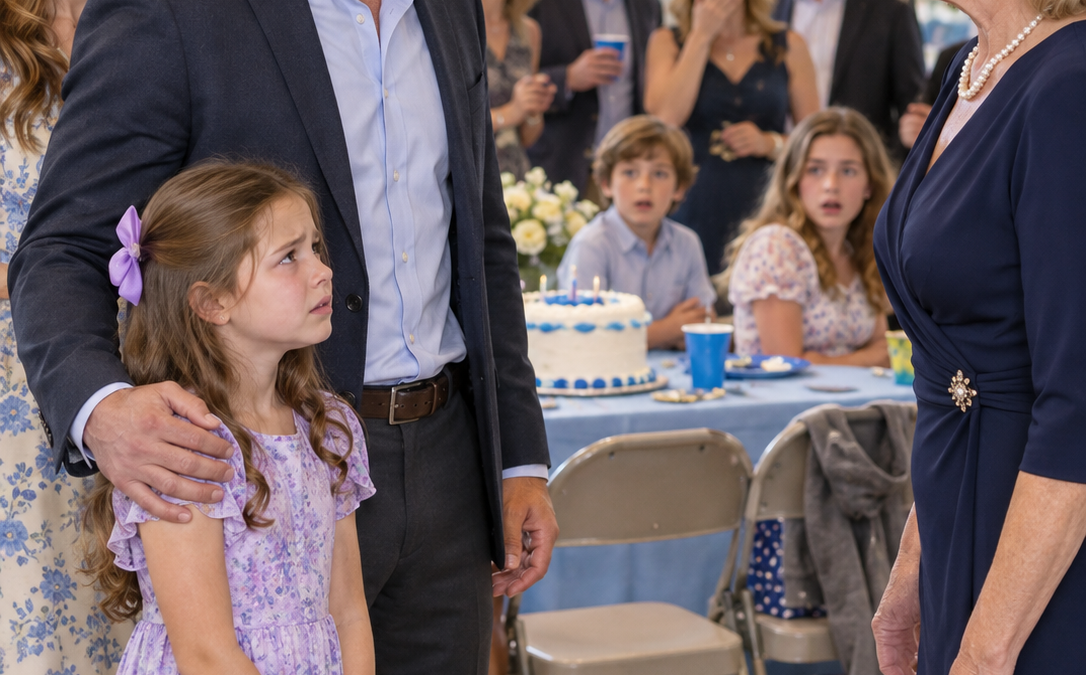
At my husband’s birthday party, our seven-year-old daughter was asked to sit in a different room to make space for his “real” children. His mother physically pushed her out the door. When my husband realized what was going on, he said something in front of everyone that made both of his parents go pale.
The first thing I noticed at my husband Greg’s birthday party wasn’t the cake, the banner, or the relatives crowded around the gift table.
It was the empty chair beside the children’s plates.
Our seven-year-old daughter, June, wasn’t at the table. She wasn’t missing from the rented function room exactly. She was simply missing from the place where all the kids were supposed to be.
Greg’s fifteen-year-old daughter, Amber, and his twelve-year-old son, Mason, from his first marriage, were sitting together in the main room, laughing with their cousins and passing around a basket of rolls. They looked comfortable. They looked claimed.
A blue balloon ribbon dragged across Amber’s sleeve while Mason stole chips from her plate. June’s paper cup was still beside an untouched slice of pizza, and the purple napkin she had folded into a triangle was waiting beside her fork.
I had watched her choose that seat five minutes earlier, proud to be sitting next to the big kids.
I touched the back of her chair as if it might explain something.
“Where’s June?” I asked.
Mason looked under the table as if she might be hiding there. Amber glanced over, confused.
“I thought she was with you.”
That was the first wrong note.
The party was being held in one of those rental halls that tries hard to look cheerful with beige carpet and fluorescent lights. There was one main room, one smaller side room, and enough folding chairs to make the whole thing feel half birthday dinner, half budget town-hall meeting.
I moved past the dessert table and checked the hallway, expecting to find June washing her hands or staring at the vending machine.
Instead, I saw the side-room door pulled nearly shut.
Through the gap, I could see one small sneaker swinging beneath a chair. It swung once, then stopped when she heard me in the hallway.
June was sitting alone at a round table meant for overflow coats and extra napkins. Someone had placed a stack of paper plates in front of her like a little wall, as though storage supplies could make isolation look accidental.
She wasn’t crying. She wasn’t pouting.
She sat very still with both hands flat in her lap, which was somehow worse.
Seven-year-olds are usually only that still when they’re asleep, guilty, or trying very hard not to be noticed.
I pushed the door open gently.
“Hey, Bug,” I said. “What are you doing in here?”
She looked up quickly, as though she had been caught taking up space.
That look changed the room.
I crouched beside her chair, keeping my voice soft because the main room was only about ten feet away.
“Did you want a break from the noise?”
June shook her head.
“Did someone tell you to sit here?”
She pressed her lips together, then nodded once.
“Grandma Janet said I should.”
My mother-in-law, Janet, had been circulating through the party in a navy dress, smiling at people as if she owned the building.
I felt my entire body go quiet.
“Why would Grandma say that?”
June looked toward the door before answering.
“She said the other room was for Daddy’s real children.”
She said it carefully, as though she had practiced getting the sentence exactly right.
Then she added, “I tried to go back with Amber and Mason, but she held my shoulders and moved me out. Then she closed the door.”
June lifted her hands and placed them on her own shoulders to show me. Her fingers pressed too hard for a demonstration, and I hated that she knew exactly where Janet’s hands had been.
For a second, the hum of the main room disappeared.
Then June asked, “Mom, am I not Daddy’s real child?”
The party kept going without realizing that it had just cracked open.
I took both of June’s hands before I trusted myself to stand.
“You are Daddy’s daughter,” I said slowly. “You are his real child. You are mine. You belong at that table.”
She watched my face, searching for the part adults hide from children, so I made certain she saw only certainty.
If I flinched, she would read it as confirmation.
Inside, I was furious in that special way where a person becomes very calm because the alternative is being escorted out of a birthday party by security.
I wiped a crumb from her sleeve.
“Did Grandma hurt you when she moved you?”
June shook her head, but her shoulders remained tucked up near her ears.
That was an answer, too.
I moved the stack of paper plates away from her because even that little wall bothered me now. Then I kissed her forehead.
“Stay right here for one minute. I’m getting Daddy.”
She grabbed my wrist.
“Is he going to be mad at me?”
I leaned closer.
“No, sweetheart. Not at you.”
Her fingers loosened, but only a little.
When I stood, I didn’t look toward Janet first.
I looked for Greg.
And when I found him, my voice was already steady.
Greg was near the cake table, laughing while his father, Steve, told the same fishing story everyone had already heard twice. My father-in-law had one hand on Greg’s shoulder and the other pointing with a fork as if the trout might still be visible somewhere in the frosting.
I touched Greg’s arm.
“I need you for a second.”
He saw my face and stopped smiling.
He knew that face. It was the one I used when politeness had officially stopped helping.
We stepped behind a stack of extra chairs, close enough to see the side-room door but far enough away that no one could hear us.
“June is in there,” I said. “Your mother told her the main room was for your real children.”
Greg blinked once.
That was all.
I kept going before the family habit could rush in and smooth the edges.
“June says Janet put her hands on her shoulders, moved her out, and closed the door when she tried to come back.”
Greg didn’t say, “Maybe she misunderstood.”
He didn’t say, “It’s my birthday.”
He looked past me toward that nearly closed door, and something in his face went still.
Not shocked.
Recognizing.
“She said that to June?”
“Yes.”
His jaw tightened. He put his plate down on the nearest chair.
“Show me.”
We walked into the side room together, and Greg didn’t storm in like a hero entering a movie. He slowed down before he reached June, pulled out the chair beside her, and sat so his face was level with hers.
“Junie,” he said softly, “your mom told me Grandma said something that hurt you. Can you tell me what happened?”
He didn’t feed her the words. He didn’t ask the question as though he had already decided the answer would be inconvenient.
June looked at me, then at him.
“Grandma said the other room was for your real children.”
Greg’s hand moved over hers on the table.
“What did she do after that?”
June swallowed.
“She pushed me by my shoulders and shut the door.”
His expression barely changed, but I saw the muscle in his cheek jump. He looked once at the closed door, then back at her, choosing his next words carefully.
He held her hand gently.
“Listen to me. You are my daughter. You are my real child. Nothing anyone says can change that.”
June stared at him for one long breath.
She searched his eyes the way children do when words are too big to trust by themselves.
Then she nodded.
Greg stood.
His voice stayed low.
“Come with me.”
Greg walked June back into the main room holding her hand. Not behind him. Not tucked away.
Beside him.
People glanced over because the birthday boy had suddenly stopped circulating. He picked up his glass and tapped it with a fork.
The clink was small, but it cut straight through the chatter.
“Can I have everyone for a second?”
Smiles turned toward him. A few people lifted their cups, expecting a joke or a thank-you toast.
Janet stood near the coffee urn, already watching too closely.
Greg thanked everyone for coming. He mentioned Amber and Mason, said he was proud of them, and smiled at both of them so they wouldn’t think this was some test they had failed.
Then he placed his hand on June’s shoulder.
“And I’m grateful for my youngest daughter, June, who should never have to wonder whether she belongs in a room with her family.”
The silence shifted.
Greg looked directly at Janet.
“A few minutes ago, my mother told my daughter to sit in another room because she was not my real child.”
He paused long enough for every fork to stop moving.
Even the kids at the back table went quiet.
“Mom, I’m going to have to ask you to leave.”
To understand why that sentence landed like a dropped plate, you have to go back eight years, before June was born and before Janet decided I was a permanent stain on her family history.
I met Greg when he was still legally married, which sounds awful if you stop the sentence there.
I know how that sentence lands. I knew it then, too.
Janet stopped it there professionally for nearly a decade.
The truth was less dramatic and considerably less useful to her.
Greg and his ex-wife, Michelle, were already separated in every meaningful sense when I met him. He lived in a small apartment above a dentist’s office. Michelle had the house during the school week. They shared a calendar, not a bedroom.
On our third coffee, Greg said, “I need to be clear. My divorce isn’t final. I have two kids. I’m not looking for a secret.”
He said it before he ever reached for my hand, which mattered to me.
That should have scared me off, and for a while, it did.
I told him, “Then we go slow, or we don’t go at all.”
He nodded.
“Slow is fair.”
Janet later compressed that whole beginning into one dirty word.
Betrayal.
I met Michelle at a school concert six months later, and she didn’t throw a drink at me or pull me into a bathroom for a warning speech.
She shook my hand, stiff but civil, while Amber adjusted a sparkly headband and Mason tried to untie his dress shoes.
“The kids know who you are,” Michelle said. “I just need adult behavior from everyone.”
“That’s what I want, too.”
It was awkward, but it was honest.
Greg paid child support, showed up for practices, packed lunches on his weekends, and answered Michelle’s texts even when the tone was all business and no warmth.
He didn’t abandon his first family.
He didn’t trade two children for a new start.
Amber and Mason were never my enemies. They were children standing in the doorway of a situation none of them had chosen.
I learned their snack preferences and school pickup routines slowly because that was the respectful speed. I didn’t force “bonus mom” language or pretend history had no weight.
The first time Mason asked if I knew where his hoodie was, I counted it as progress and said nothing dramatic.
Janet saw none of that.
Or maybe she saw it and refused to let it count.
Her version had already been printed.
The first time Janet met me, she smiled with only the bottom half of her face. Greg introduced me as his girlfriend at a backyard barbecue, and she said, “Oh, your friend. How nice.”
She handed me a paper plate without looking at me, then immediately turned toward Amber.
“Sweetheart, I saved you the corner brownie.”
It was small enough to deny, which was Janet’s specialty.
The point wasn’t the brownie.
The point was the ranking.
Later, when Greg put his hand on my back, Janet watched it as though a crime were being committed in broad daylight.
“Some people move on quickly,” she said to her sister, loud enough for me to hear but soft enough to pretend she hadn’t aimed it.
“Mom,” Greg said.
Janet lifted both hands.
“What? I didn’t mean anything.”
That became the family weather pattern.
She said a thing. Greg objected. She insisted the thing had never really been a thing. Everyone moved on because the food was ready, the kids were tired, or Steve changed the subject with the reflexes of a trained hostage negotiator.
By dessert, Janet would be serving Greg coffee as though she had personally been insulted by gravity.
The grudge learned that it could survive in corners.
When I got pregnant with June, Janet didn’t soften. She treated the news like a suspicious receipt she wanted to dispute.
Greg called her from our kitchen, smiling so hard his eyes shone.
“Mom, we’re having a baby.”
I could hear the pause through the phone.
Then Janet said, “Well, that was fast.”
Greg’s smile fell before he turned away from me.
“We’re happy,” he said.
“You can be happy for us.”
She sighed.
“Of course. Don’t be sensitive.”
After June was born, Janet brought a pale yellow blanket and made certain everyone heard that Amber’s baby blanket had been hand-crocheted by a great-aunt.
It was kind on paper.
Her voice turned it into a comparison.
At June’s first birthday, Amber and Mason were squeezed close beside Greg for photographs. June was passed back to me when she reached for Janet’s necklace.
“She’s fussy,” Janet said.
June was smiling.
I kept a list in my head longer than I should have: better cakes for the older kids, warmer hugs, inside jokes, and June receiving the kind of greeting that sounded like, “Oh, you’re here too, sweetheart.”
When I mentioned it, Janet tilted her head.
“You look for problems.”
Technically, they were words, not love.
Greg noticed more than Janet thought he did.
At first, he tried correcting her privately because he still believed his mother wanted to be better and simply needed help finding the door.
After one family dinner where Janet gave Amber and Mason wrapped gifts and handed June a coloring sheet from a restaurant, Greg called her the next day.
I listened from the laundry room while folding tiny pajamas.
“You don’t get to make one child feel like a guest,” he said.
Janet answered loudly enough that I caught every third word.
“Ridiculous.”
“Spoiled.”
“Your wife.”
Greg closed his eyes.
“This is not about my wife. It’s about June.”
For a few months, the visits got shorter.
If June said she didn’t want to go, we didn’t make her. We stopped dropping by without a clear starting and ending time. Greg remained in the room whenever Janet was with June.
Janet behaved when Greg stood directly beside June, but she slipped whenever he walked away.
She was careful.
Not kind.
Whenever he confronted her, she used the same polished shield.
“You’re reading into things.”
Or, “That’s not what I meant.”
Convenient, really, how nothing Janet said ever meant what it meant.
The pattern didn’t disappear.
It learned to wait.
By the time Greg’s birthday came around, he had already warned Janet more than once not to drag the past onto a child.
He had told her in our driveway after Thanksgiving, “You can dislike how my life changed, but you cannot punish June for existing.”
Janet cried just enough to make Steve uncomfortable and then said, “I love all my grandchildren.”
Greg replied, “Then act like it when nobody is applauding.”
That sentence cost us three quiet months, which were honestly peaceful.
Then Janet returned with polite texts, holiday emojis, and a promise to move forward.
Greg wanted his birthday party simple, mostly because Amber and Mason were with us that weekend and he didn’t want separate celebrations dividing the children.
I agreed, but I watched Janet at the rental hall.
She hugged Amber first.
She asked Mason about basketball.
She touched June’s shoulder and said, “You’re getting tall.”
I told myself that “tall” was at least neutral.
I watched Janet walk toward the coffee urn with June trailing near the other kids, and I let myself breathe.
I even told Greg, “Maybe she’s trying.”
He squeezed my hand.
“We’ll watch.”
I was wrong.
Because ten minutes later, June’s chair was empty.
And Greg didn’t need a courtroom, three witnesses, and a PowerPoint presentation.
He believed his daughter.
Back in the main room, Janet went pale before she went red.
Steve, standing a few feet behind her, went pale, too, his fork hovering above a paper plate.
Pale came first because every person in that rented hall had heard Greg say exactly what she had done.
Red came next because embarrassment arrived before shame, and Janet was mostly angry that the curtain had been opened while she was still standing onstage.
She gave a small, confused laugh and looked around as if someone else might explain the strange noise her son was making.
“What?” she said. “I didn’t say it like that.”
Greg didn’t raise his voice.
He didn’t remove his hand from June’s shoulder.
Amber stared at her plate. Mason looked between the adults, his face tight with that awful knowledge children get when grown-ups finally say the hidden part out loud.
Michelle wasn’t there. Amber and Mason were with us that weekend.
That mattered because Janet couldn’t blame the ex-wife or some old divorce tension.
It was just Janet, her son, and the child she had sent away.
One uncle placed his cup down very carefully.
The relatives waited for Greg to soften the sentence for them.
He didn’t.
“Mom,” Greg said, “please get your purse.”
Janet’s smile twitched.
Nobody laughed with her.
The silence refused to work for her.
She tried again, switching from denial to management.
“There wasn’t enough space at the children’s table,” she said, turning slightly toward the relatives instead of Greg. “I thought June would be more comfortable in the other room.”
It was a sentence built for witnesses.
Polite words.
Clean edges.
No fingerprints.
I looked at the table behind Greg.
There were two empty folding chairs at the end, one holding a gift bag and the other holding Mason’s hoodie.
The kind of detail every family pretends not to notice.
Greg looked at them, too.
He still didn’t argue.
That was the strangest part.
In the past, he might have corrected every detail, dragged the truth out piece by piece, and given Janet more fabric to twist.
This time, he let the room see the chairs.
He let them see June leaning against his side.
He let them remember whether Janet had seemed confused when June disappeared.
Aunt Carol lowered her eyes.
One cousin reached for the gift bag without thinking, then froze because even that small movement admitted there had been space all along.
A paper plate slid off a nearby stack and slapped against the floor.
Nobody bent down to pick it up.
Greg said, “Please leave.”
The second version was softer.
It landed harder.
Steve stepped forward because marriage apparently comes with a clause requiring public defense even when the defense has no case.
My father-in-law was still holding a plastic fork and paper plate, and he looked at both as though they had betrayed him.
“Greg,” he said, “don’t speak to your mother like that.”
It sounded rehearsed and exhausted at the same time, like a man reading terms and conditions because someone had handed him the paper.
Janet seized the opening.
“Exactly. This is humiliating. At your own birthday party.”
Greg looked at Steve, not Janet.
That mattered because Steve had always been her escape hatch.
“Please don’t make this harder.”
Five words.
No threat. No speech.
Steve’s mouth opened, then closed.
He glanced at June, and for the first time that day, I saw something like regret move across his face.
It didn’t make him brave.
But it made him quiet.
Janet waited for him to continue.
He didn’t.
His choice became the choice of the room.
That was the second front collapsing before it could turn into a war.
Greg turned back toward his mother.
“Purse, Mom.”
Steve looked down at his plate.
Janet looked alone.
And June, still holding Greg’s hand, stopped shrinking.
For another few seconds, no one moved.
It was the longest pause I have ever heard.
The coffee urn clicked.
Somebody’s toddler whispered, “Can I have frosting?” and was shushed so quickly the poor kid almost levitated.
Janet’s face settled into a hard, glossy calm.
“Fine.”
She reached for her handbag from the back of a chair, then looked at Amber and Mason.
“I hope you two know I love you.”
She aimed the sentence like an arrow.
Amber’s eyes filled, which made me want to step between all of them and build a wall out of folding tables.
Greg stepped in faster, without touching either of the older children.
“Amber and Mason are not part of this,” he said. “Do not use them to make yourself look wounded.”
Amber looked up at him, startled.
Mason stopped picking at the corner of his napkin.
Janet’s lips parted, but no sound came out.
Nobody rushed to comfort her, and nobody corrected Greg for refusing the bait.
It was the first time I had ever seen Greg protect all three children in one sentence without making any of them compete for that protection.
Across the room, one of Greg’s cousins nodded once, almost imperceptibly.
That was when people truly understood what he was doing.
Janet made a slow performance out of gathering her coat from the chair, checking the pockets, and smoothing the sleeves as though dignity could be folded back into fabric.
Steve placed his plate down and followed her, his ears red but his feet still moving.
Not because he believed she was right, but because he had to go home with her and apparently wanted to survive the car ride.
At the door, Janet turned one last time.
“You’ll regret doing this in front of everyone.”
Greg’s face didn’t change.
“No,” he said. “I regret not doing it sooner.”
That sentence took the last bit of air out of the room.
Janet’s hand tightened around the strap of her purse.
Steve opened the door, and the hallway light cut around them.
For a moment, June pressed closer to Greg’s leg. He lowered his hand to the top of her head, steady and ordinary, as if that was exactly where she belonged.
Janet looked at June then.
Not with apology, but with the sharp surprise of someone discovering that the small person she had targeted had witnesses.
Then Janet and Steve walked out.
The door clicked shut behind them, and every person still inside had to decide what kind of silence they were standing in.
The party didn’t restart all at once.
Nothing does after someone drops the truth in the middle of a sheet cake.
For a minute, people stared at their plates, the balloons, the floor—anywhere except the family standing in the center of the room.
Then Aunt Carol cleared her throat.
“Who wants coffee?” she asked too brightly.
A cousin moved the gift bag off one of the empty chairs. Amber pulled June’s own chair out for her without being asked. Mason pushed the basket of rolls in her direction.
June climbed onto the seat, still quiet but no longer hidden.
I sat beside her, and Greg cut the cake with hands that were steady but not relaxed.
The knife scraped across the cardboard tray like a tiny saw.
“Chocolate corner?” he asked June.
She nodded.
He gave her the first slice.
Not as a reward.
As a correction.
Around us, conversation returned in careful pieces. Someone asked Amber about school. Someone asked Mason about basketball.
Nobody mentioned Janet.
That absence said plenty.
Before we left, Amber leaned toward June.
“You can sit by me next time,” she whispered.
June nodded without looking up from her frosting.
When we finally packed the leftovers and birthday cards, Greg carried June’s coat himself.
His voice had become very calm.
And very final.
At home that night, revenge was not the first item on the list.
June was.
We left the leftovers on the kitchen counter, let the balloons sag in the hallway, and sat with her on the living-room rug while she changed her doll’s dress without really looking at it.
Greg sat cross-legged beside her, still wearing his birthday shirt.
“Junie,” he said, “I want to say it again now that it’s quiet. You are my daughter. You are Amber’s sister and Mason’s sister. You belong with us.”
June kept working one tiny plastic shoe onto the doll’s foot.
“Grandma sounded sure,” she said.
Greg’s throat moved.
“Grandma was wrong,” I added. “Adults can be wrong loudly.”
That got the smallest almost-smile from her.
Greg opened his arms, but he didn’t pull her in.
He let her choose.
After a few seconds, she crawled into his lap and tucked her face beneath his chin.
He held her and looked at me over her hair.
Later, June asked whether she had to call Janet the next day.
Greg said, “No. You don’t have to fix what an adult broke.”
No speech passed between us.
We both understood the same thing.
The public sentence had mattered.
The private one had to keep happening.
It had to become a routine, not a rescue scene.
After June fell asleep, Greg went to the small desk in our bedroom and opened his laptop.
I thought he was checking work email until I saw the banking screen and his list of recurring payments.
For the previous year, ever since Janet and Steve retired, Greg had been sending them money every month to help cover the mortgage they still hadn’t paid off.
They called it temporary help.
Then temporary became routine.
He had never missed a transfer, even when we had to move our own bills around.
They were always stretched, which was interesting because they were apparently never stretched enough to cancel their two vacations a year.
Those, apparently, were protected by international law.
Greg stared at the payment line with his hands folded beneath his chin.
“I kept telling myself it was for Dad, too,” he said. “And because they’re my parents.”
I sat on the edge of the bed.
“What are you thinking?”
He clicked once and opened the details.
The next payment was scheduled for the first of the month.
The memo line still said FAMILY HELP, which suddenly looked like a bad joke.
“I’m thinking my daughter got removed from a room by someone whose mortgage I helped pay.”
He didn’t sound angry anymore.
He sounded done.
The quiet move took less than five minutes.
Greg canceled the recurring transfer, downloaded the confirmation, and saved it in a folder with a boring name because that is what real consequences often look like.
No shouting.
No dramatic paragraph.
No family-wide announcement with screenshots and fireworks.
Just one boundary delivered where it would be felt.
Then he opened a message to his parents and typed:
“After what happened today, I will no longer be covering any portion of your mortgage. I need space, and June will not have unsupervised contact with Mom. Any visits with June will be supervised for now.”
He read it twice, deleted one unnecessary sentence, and sent it.
The screen showed “Delivered” before either of us breathed.
The silence afterward felt heavier than a fight.
My phone didn’t ring.
His phone didn’t ring.
For once, Janet didn’t have an immediate script ready.
Greg closed the laptop and leaned back.
“She’s going to say I’m using money to control her.”
I looked toward June’s closed bedroom door.
“She used a door to control a child.”
He nodded once.
Then he switched off the desk lamp, and the room went dark except for the hallway night-light.
That was the entire discussion.
The payment was stopped.
The access was changed.
The old arrangement ended in a bedroom without applause.
The calls started the next afternoon, but not the way I expected.
Steve called first.
Greg let it go to voicemail, then played it on speaker while we folded laundry at the kitchen table.
Steve sounded tired.
“Your mother is upset,” he said, which was not news.
Then came a long breath.
“What she said was wrong. I should have said that yesterday.”
Greg didn’t call him back immediately.
He sent one text.
“I’m willing to talk to you later. The boundary stands.”
After that, cousins and aunts checked in quietly, which told me they had been carrying their own private opinions for a while.
Nobody staged an intervention.
Nobody demanded that we apologize for embarrassing Janet.
One cousin wrote, “I saw the chairs. You did the right thing.”
Aunt Carol left a message saying, “June can sit by me at every party from now on.”
After Amber and Mason went back to Michelle’s house, Amber texted Greg.
“June okay?”
Greg showed the message to June the next morning, and June asked whether she could send a heart back.
Michelle texted me, too.
Just one line.
“Tell Greg I’m glad he handled it without putting the older kids in the middle.”
The family narrative had shifted without a speech from me.
Janet had not been misunderstood.
She had been seen.
A year later, the new normal isn’t perfect.
But it is safe.
Greg still doesn’t pay the mortgage.
His parents never seriously asked again because they know the answer, and the vacation money now goes where it apparently should have gone all along—to the house they wanted to keep.
Steve reaches out on his own now.
He takes June for ice cream only when Greg or I are there, and he has never once asked us to “just let it go.”
Janet is kept at a careful distance.
Public visits.
Supervised contact.
No closed doors.
No separate rooms.
She never gave the kind of apology people imagine in movies.
But the little digs stopped.
The unequal gifts stopped.
The old home-wrecker energy disappeared from her mouth, if not necessarily from her soul.
Amber and Mason still come over, and June still saves seats for everyone.
Sometimes Greg sees her doing it and goes quiet for a second.
Then he says, “Thanks, kiddo,” and sits wherever she points.
I don’t call it forgiveness.
I call it a boundary that held.
June is eight now, and she walks into family rooms like she has a right to the chair.
Because she does.
And honestly, what would you have done if it were your child? Let me know in the comments, and subscribe for more.
Thank you so much for watching. I’m genuinely curious—what did you think about the main character? Did she do the right thing? Let me know in the comments.
I also have another announcement, and this is for the people who don’t mind me narrating my own stories.
I know that seems to be a controversial topic with my audience. Some people absolutely hate it, which is fine. I know my voice and narration style are very different from what you’re used to.
So if you’re here only for that voice, that’s completely fine. You don’t have to watch me narrating. That’s why it’s on a different channel.
But if you’re open to the idea, if you’re interested, and if you enjoy it, then this announcement is for you.
We actually have some really big news and some major updates on the other channel.
We’re upgrading from me simply narrating the story in character to me narrating the story and acting it out—playing different characters, wearing wigs, and doing all of that.
I don’t want to spoil too much.
I just want to make one thing clear: none of it is AI. It isn’t AI-generated. All the acting you see on the screen is real.
I don’t want to give too much away, so just check it out if you’re interested.
Again, thank you so much, and I’ll see you in the next one.








