At my 18th birthday party, i quietly transferred my $3m dollar inheritance from my grandparents into a trust just as a precaution, thank god i did, because the next morning, my parents said…
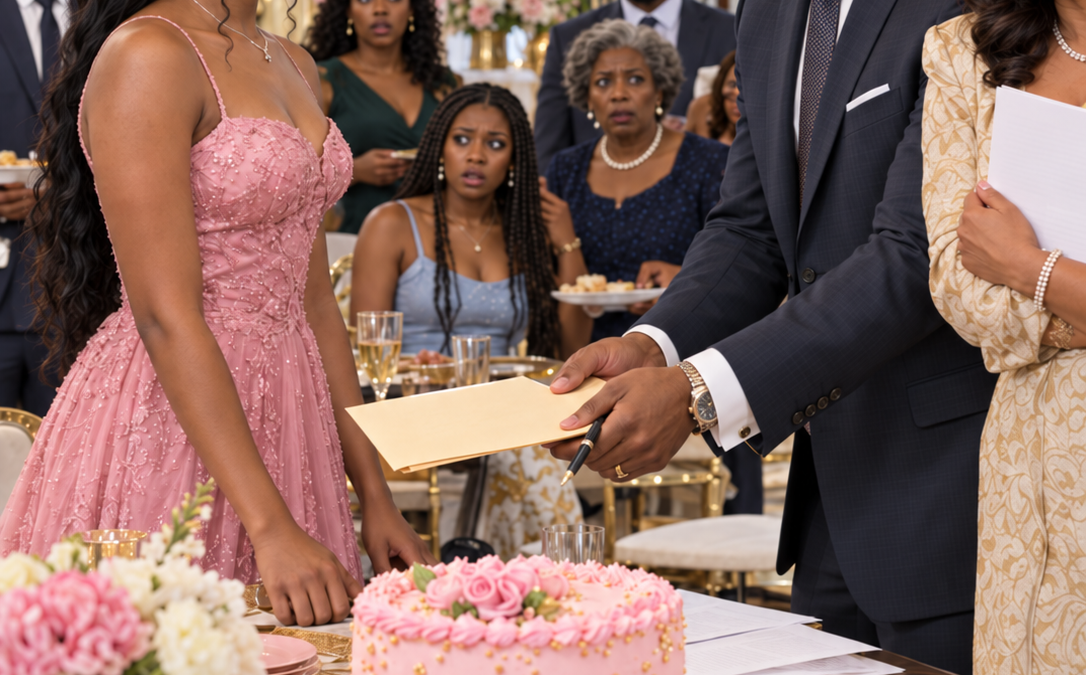
At 12:03 yesterday morning, three minutes after I legally became an adult, I signed the papers that moved my grandparents’ inheritance into a protective trust.
At 12:05, my attorney sent notice that the power of attorney my father thought he had over me had been revoked.
At 8:14 that same morning, my father sat across from me at the kitchen table, slid a stack of papers over my cereal bowl, and said, “Just sign this, Immani. Let the family handle the money.”
I looked at the pen first. Then I looked at him.
“Which family?” I asked. “The one that put my name on a conservatorship petition before the birthday cake was even cut?”
His face changed in a way I had never seen before.
My father had many faces: warm adviser, proud husband, concerned parent, church-basement gentleman. The one I saw then was underneath all of those.
It was fear.
My name is Immani Turner. I am a Black eighteen-year-old from St. Louis. And by breakfast, my parents had already learned that the birthday they had been waiting for was not going to open the door they thought it would.
My parents had spent four months planning how to take control of the money my grandparents left me: a brokerage portfolio, a Craftsman house, a small rental building on Delmare Avenue, with a total value a little over $3.4 million.
They had a hidden power of attorney. They had a lawyer friend. They had a story ready for the court, for the relatives, and for my sixteen-year-old sister.
That story was simple.
Immani was too young.
Immani was grieving.
Immani asked too many questions.
Immani could not be trusted.
What they did not have was the one thing my grandfather taught me to respect before any smile, promise, or family title: the fine print.
And by the time my father tried to hand me that pen, the fine print had already beaten him to the bank.
If you have ever watched a family dress control up as concern, stay with me. Tell me in the comments the first paper you wish you had read sooner. And subscribe if you know the fine print can save your life before anyone believes your voice.
I want to take you back before the kitchen table, before the birthday party, before the courthouse and the judge, and before the moment my mother realized her tears were not going to save the plan.
Because this story did not start with three million dollars.
Money was only the thing that made everybody stop pretending.
It started in a greenhouse.
My grandmother Kora kept it attached to the back of the Craftsman house, behind a door that swelled in summer and stuck in winter. When I was little, I thought that room was magic. The glass fogged every morning. The floor smelled like wet clay and leaf rot. There was a Meyer lemon tree in a wide blue pot near the far wall, grown from a cutting she said she got the year my father was born.
She let me touch everything.
That is what I remember most.
At home, touching the wrong paper, opening the wrong drawer, or asking the wrong question could change the air in the room. At my grandparents’ house, questions were useful.
My grandmother would hand me pruning shears and say, “Tell me what you see.”
When I was twelve, I told her one branch looked dead.
“Maybe,” she said. “Or maybe it is waiting.”
“How do you know?”
“You look closer.”
So I did.
She taught me the difference between a thirsty leaf and a drowning leaf. They look almost the same if you only glance—yellowing edges, tired shape, droop. But the soil tells the truth if you put your finger in it.
“Most people look at the leaf and make a speech,” she said. “You check the root.”
My grandfather Arthur taught me the same lesson in a different room.
He had a brass lamp on his desk with a green glass shade and a pull chain that clicked like a tiny lock. He loved that lamp. He said it made every paper look serious, which was his idea of beauty.
Under that lamp, he taught me numbers. Not school numbers. Real ones.
He showed me how a mortgage amortization schedule worked. He showed me why a fee buried at the bottom of a page could matter more than the interest rate at the top. He showed me how compound interest could either grow a life or swallow it, depending on which side of the equation you stood on.
“People sign the big letters,” he told me once, tapping a document with his fountain pen. “The truth lives in the small ones.”
One evening, my father walked into the room while I was reading a mock investment statement out loud. I was twelve, sitting too straight, trying to sound older than I was.
My father smiled, but the smile did not reach his eyes.
“Dad, she is a child. Let her be one.”
Grandpa Arthur did not move the paper. He clicked the lamp off, then on again.
“A child who can read is harder to fool later.”
My father laughed.
“Fool? Who is fooling anybody?”
My grandfather finally looked at him.
“People fool who they think they own.”
The room went cold.
I did not understand all of it then. I understood enough to remember.
Later that same night, while my grandmother was washing dishes and I was drying, I saw my father standing in the front room by Grandpa’s desk. He had his phone out. He was taking pictures of papers spread under the lamp.
He saw me see him.
For half a second, neither of us moved.
Then he put the phone in his pocket and said, “Your grandfather leaves things lying around.”
I said nothing.
Silence was a skill I learned early.
In our house, my younger sister Simone was the easy child. I do not mean she was bad. She was just easy in the ways my parents rewarded.
She smiled when adults expected smiling. She did not ask why my father’s client dinners cost nine hundred dollars if they were only lunches. She did not wonder why my mother opened certain envelopes and then walked them straight to the garage.
I asked.
That made me difficult.
When I was fourteen, I found a credit-card statement on the kitchen counter and saw a charge at a downtown restaurant for almost nine hundred dollars. My father had told my mother it was a client lunch.
The charge time was 10:48 p.m.
“That is a late lunch,” I said.
My mother set her fork down with care.
“Immani, do not embarrass your father at the table.”
“I am asking a question.”
“Exactly.”
In my family, those two things had become the same crime.
My father ran a small wealth-advisory practice called Turner Capital Planning. His name was on frosted glass. His suits fit well. He could sit across from a widow at a conference table and make her believe he was the safest man in the world to trust with a retirement account.
At home, he talked about responsibility, legacy, discipline.
He used those words like furniture, placing them around a room until everyone had to walk carefully.
But sometimes his phone would buzz at dinner, and his jaw would tighten before he walked to the garage. Sometimes my mother would turn the television up after he left. Sometimes I heard words through the door.
Compliance.
Custodian.
Review.
Shortfall.
I did not know enough then to put those words together.
But Grandpa Arthur had taught me that a thing can be wrong before you can prove it.
My grandfather died when I was fifteen.
It was a Tuesday morning. His heart stopped while he was sitting in the chair by the front window, newspaper folded in his lap, brass lamp still on.
At the reception after the funeral, my father and one of his cousins stood near the hallway talking about the estate while people were still eating pound cake off paper plates.
I heard my father’s voice drop low.
“Dad had accounts Rochelle doesn’t even understand.”
Rochelle is my mother.
The cousin said, “You think your mother knows where everything is?”
My father said, “Kora knows plants. I know money.”
My grandmother was standing three feet behind them with a napkin in her hand.
She heard every word.
She did not cry.
She walked to the greenhouse, and I followed her because I did not know what else to do. She put both hands on the edge of the pot where the lemon tree grew and breathed in through her nose.
“Your granddaddy saw more than he said,” she told me.
“About Dad?”
“About everybody.”
Two years later, she was gone too.
Cancer took her slowly enough for us to watch and fast enough that none of us could catch up. Near the end, she asked for the greenhouse door to stay open so she could smell the soil.
My mother said it made the room damp.
My grandmother said, “Then bring me a blanket.”
I sat beside her the afternoon before she died. Her hand felt like paper around mine.
“Do not let people make you smaller because they are scared of your size,” she said.
“Grandma—”
“Listen.”
So I listened.
“Your questions are not the problem. Your eyes are not the problem. The people who need you blind will always call you difficult.”
I cried then because I knew she was saying goodbye and giving me homework at the same time.
She squeezed my wrist.
“When the lemon leaves curl, check the root.”
That was the last full sentence she said to me.
After she died, my parents changed.
Not in a dramatic way. That would have been easier to spot.
They got gentle.
My father asked about my college applications. My mother brought tea to my room. Simone stopped rolling her eyes when I walked into the kitchen.
For a few weeks, grief made our house almost quiet.
Then one evening in November, four months before my eighteenth birthday, my mother came upstairs with a blue folder.
“Adult paperwork,” she said.
I was sitting on my bed surrounded by college brochures I had not opened. The house still smelled faintly like the lilies people had sent after the funeral.
My father stood in the doorway behind her.
“Health insurance,” he said. “College permissions, emergency contacts, a few forms so we can help after you turn eighteen.”
My mother smiled.
“Boring grown-up stuff. Sign where the flags are.”
I looked at the folder. There were little yellow tabs on several pages. My name was typed at the top.
I was seventeen, tired, and raw. Part of me wanted so badly to believe they were taking care of me that I ignored the cold feeling in my stomach.
I signed.
I skimmed the headings.
I did not read the small print.
The exact thing Grandpa Arthur had warned me about.
When I handed the folder back, my mother kissed the top of my head.
“See? Not everything has to be hard.”
For one evening, I let myself feel like maybe I was not the difficult one anymore.
That feeling lasted until February.
The call came from a number I did not know. I was in the school library during study hall, pretending to read a government chapter while actually making a list of scholarships.
“Immani Turner?” a woman asked.
“Yes.”
“My name is Paula Langford. I am the trustee your grandparents named in their estate documents. I need you to come to my office this Saturday. Alone, if you can.”
My heart started beating so hard I could hear it.
“Is something wrong?”
There was a pause.
“Something may become wrong if we do not talk.”
Paula’s office was downtown in an old building with marble floors and an elevator that smelled like dust and lemon cleaner. She was in her early sixties, with silver hair cut sharp at the jaw and a voice that did not waste words.
She did not offer me a cookie or call me sweetheart.
I liked her immediately.
She slid a folder across the desk.
“Your grandparents established a trust six years ago,” she said. “It includes a brokerage portfolio, the Craftsman house, and a small rental property on Delmare Avenue. As of the most recent valuation, the total is roughly $3.4 million. You are the sole beneficiary.”
I stared at her.
“Sole?”
“Yes.”
“Not my father?”
“No.”
“Not Simone?”
“No.”
The room got very still around me.
I had known my grandparents were comfortable. I knew they owned the house and the rental building. I knew Grandpa had invested.
But $3.4 million is not a number you understand the first time someone says it. It floats above the room like it belongs to somebody else.
Paula continued.
“Under the original distribution terms, the assets would come under your direct control when you turn eighteen.”
“On my birthday?”
“Yes.”
She folded her hands.
“Your grandfather also left instructions for me to contact you early if your father made inquiries about managing the trust.”
My throat went dry.
“Has he?”
“Repeatedly.”
She opened another file.
“He asked whether he could be named investment manager. Then whether he could act under a family management agreement. Then whether you had executed any authority giving him control over your finances.”
I thought of the blue folder.
My hands went cold.
Paula watched my face.
“Immani, did you sign a durable financial power of attorney?”
“I signed college papers.”
“That is not what I asked.”
I swallowed.
“I don’t know.”
She did not scold me.
That was worse and kinder.
“Find out.”
When I got home, I waited until everyone was asleep. Then I took the blue folder from my desk drawer and sat on the floor with my door locked.
Health-insurance form.
Emergency contact.
College billing release.
Medical proxy.
Then, behind a page about tuition access, I found it.
Durable Financial Power of Attorney.
My initials were at the bottom of each page. My signature was on the last page.
The document appointed Isaac Turner, my father, as agent with broad authority over bank accounts, brokerage accounts, real-property contracts, and financial transactions.
It became fully effective on my eighteenth birthday.
I read the words three times.
Broad authority.
Effective on my eighteenth birthday.
I had signed a door and handed my father the key.
For a minute, I could not move.
Then I heard Grandpa Arthur’s lamp in my memory.
Click off.
On.
The truth lives in the small ones.
I called Paula the next morning from the school parking lot.
“I found it.”
“Bring it.”
“Should I tell my parents?”
“No.”
She answered too quickly for comfort.
“Why?”
“Because if your father is asking the questions I think he is asking, warning him gives him time to find another route.”
“Another route to what?”
“Your money.”
That afternoon, Paula introduced me to Samuel Benton, my grandfather’s CPA for nearly thirty years.
He was seventy, blunt, and wore suspenders under a tweed jacket like he had made peace with being exactly himself. We met at a diner outside town, the kind of place with sticky menus and coffee that tasted like it had been working since dawn.
Samuel read the power of attorney and sighed through his nose.
“This is broad as a barn door.”
“Can he use it?”
“If it is valid and not revoked, yes. Once you are eighteen, he can present this and try to move money in your name.”
I wrapped both hands around my coffee cup.
“Why would he need to?”
Samuel looked at Paula.
Paula nodded once.
He turned back to me.
“Your father’s practice is under FINRA examination.”
I knew the word FINRA from Grandpa’s lessons.
Financial Industry Regulatory Authority. The people who look over brokers and advisers.
Samuel continued.
“I prepare returns for two of your father’s former clients. Their statements stopped matching custodian records last year. I cannot tell you everything because some of it is not mine to tell, but there appears to be a shortfall.”
“How much?”
“I have heard numbers near nine hundred thousand.”
I felt the booth tilt under me.
“He stole from clients.”
“I am saying money that should be in accounts does not appear to be where it should be. The examination will decide what happened.”
Paula spoke then.
“Your grandparents feared something like this. Your grandfather’s notes were specific. If Isaac tried to gain control near your eighteenth birthday, I was to move fast.”
“They knew?”
Samuel looked down at the power of attorney.
“They knew your father read people for value. They hoped that did not mean what they feared it meant.”
That sentence hurt in a place I did not have a name for, because it meant my grandparents had protected me not from strangers, but from the man who taught me to ride a bike in the church parking lot.
The man who checked the doors at night.
The man who corrected my math homework in red pen and told me accuracy mattered.
Accuracy did matter.
It was about to save me from him.
Paula brought in an attorney named Brianna Hail.
Brianna was thirty-six, quick-eyed, and carried two phones, both of which seemed annoyed at her. She talked fast but explained cleanly, which I needed.
We met in Paula’s conference room with a whiteboard full of arrows.
“Here is the danger,” Brianna said. “At 12:01 a.m. on your birthday, you are an adult. Under the current terms, the trust can distribute outright. If the assets land directly in your name while this power of attorney exists, your father can try to act before anyone stops him.”
“So we revoke it before then.”
“We revoke it the moment we can. But we also keep the assets from landing in a place the POA can reach.”
Paula pointed to a paragraph in the trust.
“Your grandfather built in a continuance provision. If, in my judgment as trustee, outright distribution would expose the beneficiary to undue influence, fraud, or exploitation, I can continue the trust or decant assets into a protective trust. Once you are an adult, your written consent makes the position stronger.”
“So instead of me taking the inheritance outright, I consent to keeping it in trust.”
Paula nodded.
“I remain trustee. You are the beneficiary. Your father cannot use a power of attorney over you to command me to move trust assets.”
Brianna added, “Then we revoke the POA in writing and notify the brokerage, the bank, and anyone else he might contact. Timestamped. Clear. No fog.”
“When?”
“12:01 a.m. on your birthday.”
“That is dramatic.”
Brianna gave me half a smile.
“It is precise. Dramatic is what your family is doing.”
For three weeks, I lived two lives.
At home, I was the almost-eighteen-year-old daughter my parents suddenly wanted close. My mother made breakfast before school. My father offered to help with college decisions. Simone watched me from doorways like she had been told to notice things.
At Paula’s office, I was the beneficiary of a trust, the signer of a revocation, and the subject of a legal strategy I had to understand line by line.
I read everything.
Every clause.
Every definition.
Every signature block.
I asked so many questions that Brianna started bringing an extra legal pad just for me.
“You know,” she said once, “most adults twice your age do not ask this much.”
“Is that bad?”
“It is why you still have money.”
The week before my birthday, my father started testing the walls.
He found me at the kitchen table one evening while I was reviewing scholarship deadlines. He sat down across from me with a mug of tea he had made for himself and did not drink.
“Can we talk father to daughter?”
That phrase always meant he wanted me to forget he had an agenda.
“Sure.”
“Your grandparents left you a lot. More than any eighteen-year-old should have to carry.”
“I know what they left.”
His eyes sharpened.
“Do you?”
“Enough.”
He leaned back.
“Money changes people. It makes them suspicious. Isolates them. I do not want that for you.”
“What do you want?”
“I want to help. Just at first. Let me manage it until you finish college. You can be a kid a little longer.”
I almost laughed, because I had not been allowed to be a kid since I learned how to make my own questions smaller.
“I can learn to manage it.”
“Immani, grief makes people reckless.”
There was the first brick.
Reckless.
“I am not reckless.”
“You are emotional.”
Second brick.
“My grandmother died.”
“Exactly.”
He said it gently.
That was what made it ugly.
He was taking my grief and shaping it into evidence.
After he left the room, I texted Brianna.
He used reckless and emotional.
She answered almost immediately.
Document date, time. Do not argue. They are building language.
My mother built softer.
At Aunt Hattie’s church luncheon, I heard her near the dessert table talking to two cousins.
“We are worried about Immani,” she said. “She has not been herself. Ever since Mama passed, she gets suspicious over everything.”
One cousin clucked her tongue.
“That kind of grief can twist a young mind.”
My mother sighed like a saint carrying a private cross.
“We are just trying to protect her.”
Protect.
That was the word they were going to use to steal from me.
I did not confront her there.
I waited until we got home and she was rinsing plates in the sink.
“Are you telling people I am unstable?”
She turned off the water slowly.
“I am telling people I am concerned. That is not the same thing.”
“It is when you are my mother.”
From the hallway, Simone said, “Mom says you are trying to keep everything from us.”
I turned.
My sister stood there in pajama pants, hair tied back, phone in her hand, her face full of the kind of certainty only a teenager can have when adults have been feeding it to her.
“Keep what from you?”
“Grandma and Grandpa’s money. Mom said you think you are better than everybody now.”
I looked at my mother.
She did not look ashamed.
That was the part I remember.
She looked prepared.
“Simone,” she said. “Go upstairs.”
“No,” I said. “Let her hear.”
My mother’s eyes hardened.
“Do not drag your sister into this.”
“You already did.”
Simone looked between us, suddenly less sure.
I wanted to tell her everything—the trust, the power of attorney, the regulatory examination, the way Mom had turned concern into a weapon.
But she was sixteen, and she had been living inside their version of me for years.
So I only said, “If someone tells you I am greedy, ask them what they are trying to get.”
Simone rolled her eyes.
But not as hard as usual.
That was something.
Two days before my birthday, my mother tried the school route.
I found out because Mrs. Ellis, my guidance counselor, asked me to stop by after fourth period. She had known me since sophomore year and had written one of my college recommendation letters.
She was the kind of woman who kept peppermints in a glass jar and could tell when a student was lying about being fine before the student finished the sentence.
When I stepped into her office, she closed the door.
“Your mother called this morning,” she said.
My stomach tightened.
“About college?”
“About your emotional state.”
I sat down.
Mrs. Ellis folded her hands on the desk.
“She said the family was concerned that you were making sudden financial decisions because of grief. She asked whether I had noticed anything unstable.”
Unstable.
There it was again.
Not just at church. Not just with relatives.
They were taking the word into school now, laying it like a trail.
“What did you say?”
“I said you are a grieving student with excellent grades, a clear college plan, and no behavioral record that would support that word.”
My eyes burned.
Mrs. Ellis slid a tissue box closer but did not make a show of it.
“Immani, if adults around you are using professional-sounding words, make them produce professional evidence. Concern is not evidence.”
I almost laughed because Brianna had said almost the same thing in lawyer language.
“Can you write that down?”
Mrs. Ellis studied me.
“For what purpose?”
“I might need proof that I am not what they are saying.”
She opened her drawer, took out school letterhead, and wrote a short note confirming my academic standing, scholarship applications, attendance, and absence of any disciplinary or mental-health crisis reported through the school.
She did not diagnose me.
She did not overreach.
She simply wrote facts.
When she handed it to me, she said, “This is not a weapon. It is a record.”
I put it in my backpack beside the draft revocation.
That was the first time I understood how many ordinary adults my parents had expected to stay vague for them.
A counselor who would say concerned.
Relatives who would say poor thing.
A lawyer who would say protection.
All of them soft words.
All of them useful if no one asked what they meant on paper.
That evening, Simone knocked on my bedroom door.
She did not usually knock.
“Did Mom call your school?”
I looked up from my laptop.
“Yes.”
She leaned against the doorframe.
“She said she was just checking on you.”
“Do you believe that?”
Simone looked down the hall, then back at me.
“I don’t know.”
It was the first honest thing she had said to me in weeks.
“Then keep not knowing,” I said. “It is better than believing too fast.”
She stood there another second, then left.
That small crack in her certainty would matter later.
The night before my birthday, I went to the Craftsman house.
It sat empty under the trust, waiting. Paula had given me permission and a key.
I told my parents I was studying at a friend’s house.
That was the closest I came to lying, and I did not feel guilty.
The house smelled closed up, but the greenhouse still smelled alive.
I carried Grandpa Arthur’s brass lamp from the front room to the potting bench. The cord barely reached the outlet. When I pulled the chain, green light spread across the wood, the papers in my bag, and the lemon tree.
I checked the soil.
Thirsty.
Not drowning.
I watered it.
Then I opened the folder Paula had prepared.
Protective-trust consent.
Revocation of power of attorney.
Notices to the brokerage and bank.
Trustee certificate.
Contact list.
Instructions.
I read every line twice.
At 11:55 p.m., I opened the video call.
Paula appeared first, sitting in her office with the same silver glasses and the same still face.
Brianna joined from her kitchen, hair pulled back, laptop balanced on a stack of books.
“Happy birthday in five minutes,” Brianna said.
“Feels weird.”
“Good,” Paula said. “You are paying attention.”
At midnight, my phone buzzed with texts.
My mother:
Happy birthday, baby. Big day tomorrow.
My father:
- Proud of you. Do not make any big decisions before breakfast.
I stared at that one.
Do not make any big decisions before breakfast.
Too late.
At 12:01, Paula walked me through the consent. I signed with Grandpa Arthur’s fountain pen.
The pen felt heavier than it should have.
At 12:03, Brianna sent the revocation notices by secure email and fax, because lawyers trust nothing that only travels one way.
At 12:05, the brokerage compliance desk sent confirmation of receipt.
At 12:07, the bank confirmed receipt too.
Paula looked into the camera.
“Immani, the assets are held in protective trust. I am trustee. You are beneficiary. Your father’s power of attorney over you cannot command trust assets. And the POA has been revoked on record.”
I let out a breath I did not know I had been holding for four months.
In the greenhouse, the lemon tree did nothing dramatic.
It just stood there in the green light.
That helped.
Brianna stayed on the call a few minutes after Paula signed off.
“One more thing,” she said. “Your father may try to use speed. He may call early, act like there is confusion, ask the brokerage to process first and clean up later. If anyone contacts you, do not explain over the phone. Send them to me.”
“What if he says it is urgent?”
“It is urgent for him. That does not make it your emergency.”
I wrote that down on the back of an envelope because I knew I would need it.
At 12:24, I received another email.
This one was from the brokerage compliance desk, copied to Paula and Brianna. It confirmed the account retitling, the trustee authority, and the revoked-POA notice.
The language was dry enough to put most people to sleep.
To me, it read like a locked door.
Before I left the greenhouse, I printed the confirmation on the little printer in my grandfather’s study. It made a grinding sound like it resented being awake after midnight.
I stood there with the warm page in my hand and read the timestamp again.
12:05 a.m.
That timestamp mattered because my father was a morning person when money was involved.
He liked to act before other people finished breakfast.
I slid the confirmation into my backpack, not because I planned to show it at the kitchen table, but because my grandfather had taught me never to walk into a room with only the truth in my mouth if I could carry it on paper.
If you are listening from somewhere quiet, tell me where you are. City, state, country—whatever you are comfortable sharing. I always wonder where stories like this land, especially with people who learned the hard way that a family smile can still come with paperwork.
The next morning, I came home before seven.
My mother was already in the kitchen making pancakes. She had hung a little HAPPY 18TH banner over the window. Simone sat at the island scrolling her phone.
My father was at the table with a manila folder beside his coffee.
Nobody asked where I had been.
That told me they thought they already knew enough.
“Birthday girl,” my mother said too brightly.
My father waited until I sat down. Then he slid the folder toward me.
“Just a few things to sign before your party,” he said. “Nothing heavy.”
I opened the folder.
Family management agreement.
Investment authorization.
Consent to father as adviser on trust-related assets.
A statement acknowledging that I wanted my parents to assist because I was still adjusting to recent grief.
That last one made my vision sharpen.
“You want me to sign that I am not thinking clearly?”
My mother set a plate in front of me.
“Do not say it like that.”
“That is what it says.”
My father pushed a pen closer.
“It says we are helping you.”
“Which family?” I asked.
He frowned.
“What?”
“Which family is handling the money? The one eating pancakes, or the one that had Carlton Vaughn draft a petition saying I am incompetent?”
Simone looked up.
My mother’s hand froze on the syrup bottle.
My father did not speak for one second.
His face opened, and I saw the panic behind the polished adviser.
Then it closed.
“I do not know what Paula has been filling your head with.”
“She filled my head with the trust agreement Grandpa wrote.”
“You are too young to understand what you are doing.”
“Then why did you hide a power of attorney in college forms and wait for me to turn eighteen?”
My mother whispered, “Immani.”
Not warning.
Not apology.
Damage control.
I stood up.
“I am not signing anything in this folder. Not before breakfast, not at the party, not ever.”
My father stood too.
“You will regret making enemies out of the only people who love you.”
“People who love me do not need legal authority over me before pancakes.”
I picked up my bag and left the kitchen.
Behind me, Simone said, “Mom.”
My mother did not answer.
The birthday party was that afternoon.
It was supposed to be at my parents’ house, but by the time I arrived, I understood it was not a party.
It was a stage with cake.
My mother had invited more relatives than she admitted—aunts, uncles, cousins, neighbors from our old block, two women from her church committee, and Carlton Vaughn, my father’s lawyer friend, wearing a sport coat to an eighteen-year-old’s birthday party like that was normal.
There were gold balloons and a sheet cake with pink flowers.
Somebody had put old pictures of me on the mantel.
Baby Immani in a yellow dress.
Seven-year-old Immani missing both front teeth.
Twelve-year-old Immani in the greenhouse with Grandma Kora’s hand on my shoulder.
My mother had chosen that photo.
It made me angry in a way that forced me to sit down before I walked inside.
Aunt Hattie caught my eye from near the dining room.
She was my mother’s older sister, and she had never liked my father’s smooth voice. When I was little, she used to say, “That man could sell smoke to a chimney.”
She looked at me, then at Carlton, then back at me.
The look said, Be careful.
I already was.
My father acted relaxed, but he kept checking his phone.
I knew why.
At market open, he had likely tried the brokerage. He was waiting for someone to tell him the transfer had worked or the account was available.
But the account had been retitled overnight, and the POA notice had hit compliance before he could move a dollar.
Every time his phone stayed silent, his smile got tighter.
My mother moved through the room praising me loudly.
“Our Immani is so bright. She has always been special. We are just trying to guide her through this next season.”
Guide.
Protect.
Help.
Soft words with locks inside them.
Before the cake, my father tapped a spoon against his glass.
The room turned toward him.
“I want to say something about family,” he began.
Of course he did.
“Kora and Arthur left us with more than property. They left us with responsibility. And responsibility is not something a young person should carry alone.”
Several relatives nodded.
Simone stood near the cake, arms folded, watching me.
My father continued.
“Immani has been through a lot. We all have. Her mother and I believe the best thing right now is for the family to manage things together while she finishes growing into the woman we all know she can be.”
Finishes growing.
I almost smiled.
He looked at me.
“Sweetheart, come here.”
My mother stepped to the side table and picked up the folder from that morning.
Carlton moved closer.
There it was.
The same trap, now with witnesses.
I walked to the table because I wanted everyone to see my feet move by choice.
My father put his hand on my shoulder.
I stepped away from it.
He looked startled.
Then annoyed.
“No,” I said.
The room heard it.
My mother smiled with her teeth.
“No what, baby?”
“No, I am not signing. No, Dad will not manage my inheritance. No, I am not unstable, reckless, or too grief-stricken to understand my own documents.”
A cousin near the doorway whispered, “What documents?”
My father lowered his voice.
“Do not do this here.”
“You brought the folder here.”
My mother stepped in, tears already gathering.
“Everyone, this is what we have been worried about. She is so suspicious since Mama died. We are only trying to protect her.”
I turned to the room.
“They filed a petition asking a court to put my father in control of my money by saying I am incompetent.”
The room changed.
You could feel it.
People stopped holding plates midair.
A little cousin quit laughing in the hallway.
Aunt Hattie took one step forward.
My mother said, “That is not fair.”
“It is true.”
Carlton cleared his throat.
“Immani, legal matters should be discussed privately.”
“Then you should not bring legal papers to my birthday party.”
My father’s phone rang.
He looked down.
For the first time all day, he did not answer smoothly.
He stared at the screen like it had betrayed him.
“Take it,” I said.
“This can wait.”
“No. I think that is the call you have been waiting on.”
He walked toward the hallway and answered, turning his back to the room.
I could not hear every word.
I heard enough.
“That is not possible.”
Pause.
“I have authority.”
Longer pause.
“Since when?”
Then silence.
His shoulders changed.
That is the only way I can describe it.
They dropped and hardened at the same time, like something inside him had been pulled loose and locked in place.
He turned back toward me.
“What did you do?”
Not confused.
Accusing.
“I read the papers you hid from me,” I said. “Then I signed better ones.”
My mother stopped crying.
Simone looked from him to me, her mouth slightly open.
My father crossed the room slowly.
“You think you are clever?”
“No. I think Grandpa was.”
His face went dark.
“You have no idea what you are playing with.”
“I know enough. The trust did not distribute outright. Paula continued it into a protective trust. I revoked the POA at 12:03 this morning. The brokerage and the bank have notice. You cannot move the money.”
Someone gasped.
I still do not know who.
My father looked at the relatives and saw, maybe for the first time, that his audience was no longer under his control.
So he reached for the only story he had left.
“She is proving the petition,” he said. “Listen to her. Listen to how paranoid she sounds.”
Aunt Hattie spoke before I could.
“Isaac, a child who knows what you filed is not paranoid. She is informed.”
My mother turned on her sister.
“Hattie, stay out of this.”
“You invited me.”
That shut the room up in a different way.
Carlton gathered his folder.
“This has become inappropriate.”
I looked at him.
“You drafted the POA. You drafted the petition. You know exactly what this is.”
He did not answer.
The party ended without cake.
People left in small groups, whispering by the door and pretending not to stare. My father stayed in the hallway on his phone. My mother sat at the dining table with her hands folded so tightly her knuckles changed color.
Simone stood by the mantel staring at the greenhouse photo.
After most people left, Aunt Hattie came into the foyer where I was buttoning my coat.
“Your grandma warned me once,” she said.
I looked at her.
“About what?”
“About Isaac. She said if money ever made him too sweet, I should look for the knife.”
That sounded so much like Grandma Kora that I had to grip the coat button.
Aunt Hattie reached into her purse and took out a folded church bulletin.
On the back, she had written three dates.
“Your mama called me on these days,” she said. “Same story each time. You were volatile. You were acting greedy. They might need legal protection. I wrote the dates down because Kora taught me not to trust a worried voice when money is nearby.”
“Why didn’t you tell me?”
Her face tightened.
“Because I wanted to believe your mama would stop before court.”
That was honest enough to hurt both of us.
She handed me the bulletin.
“Give that to your lawyer if it helps.”
It did help.
Not because Aunt Hattie knew the whole plan.
She did not.
But because it showed the story had been seeded before the party, before the public refusal, before my father could claim my reaction had made him concerned.
The concern had come first.
My reaction was just what they hoped to provoke.
When I picked up my coat, Simone said, “They told me you were taking everything.”
“I know.”
“Are you?”
“No.”
“Grandma and Grandpa left it to you?”
“Yes.”
“Why?”
That question hurt, but not because she asked.
Because nobody had ever let her know there could be an answer besides greed.
“Because they trusted me to protect it from us.”
I looked toward the hallway where my father was still arguing with someone who could not help him.
“From whoever tried to take it.”
She did not follow me when I left.
But she did not look away either.
The conservatorship petition went forward anyway.
Pride can make people file papers even after the facts have gone bad.
My parents had already paid Carlton. They had already told relatives I was unstable. They had already built a story where court was the responsible next step.
Backing out would mean admitting the story was false.
So ten days after my birthday, I walked into probate court with Brianna on one side and Paula on the other.
Samuel sat behind us with a folder in his lap.
Aunt Hattie sat two rows back.
I did not know she was coming until I turned and saw her.
She gave me a small nod, the kind that does not ask for thanks.
My parents sat at the other table with Carlton.
Simone sat behind them, shoulders hunched, phone in her lap. She looked like she wanted to disappear into the bench.
Before we went in, my father caught me in the hallway.
He looked older than he had at the party.
Not weak.
Just exposed.
“It is not too late,” he said.
“For what?”
“Let me manage it quietly. I will withdraw the petition.”
There it was.
Not concern.
Not protection.
A trade.
“How much is the hole?”
His eyes flickered.
“Do not talk about things you do not understand.”
“Nine hundred thousand.”
He went still.
That was enough.
“I am not giving you my grandparents’ money to cover what is missing from client accounts.”
His voice dropped.
“You would ruin your own father.”
“No. I am refusing to fund what already ruined you.”
Brianna touched my elbow.
“Immani.”
I walked into the courtroom.
Probate court did not look dramatic.
No grand wood walls. No movie lighting.
Just a bright room, a judge with reading glasses, a clerk with a stack of files, and a long table where adults sat down to say ugly things in polite language.
Carlton spoke first.
He called me a grieving young woman.
He said I had become volatile since my grandmother’s death.
He said I was suddenly distrustful, combative, and unable to appreciate the size of the inheritance.
He said my parents were seeking limited conservatorship only to protect me.
Limited.
Only.
Protect.
Three soft words carrying a theft.
I sat still.
Brianna had told me not to react unless the judge asked me a question.
“Let him build it,” she had said. “Then we ask where the foundation is.”
So I let him build.
Then Brianna stood.
She did not start with my feelings.
She started with dates.
“Your Honor, Ms. Turner turned eighteen on March eighteenth. At 12:03 a.m. that morning, a durable financial power of attorney naming her father was revoked, and formal notice was transmitted to the relevant financial institutions. Before that, trustee Paula Langford exercised the trust continuance provision, with Ms. Turner’s adult consent, to keep the assets in an independent protective trust. There are no assets for Mr. Turner to manage through conservatorship.”
The judge looked at Carlton.
“Is that accurate?”
Carlton shifted.
“There is disagreement as to whether that was wise.”
“That is not what I asked.”
Brianna continued.
“The petition also relies on claims that Ms. Turner is unstable, reckless, and not herself. We have no medical diagnosis, no treating physician, no school discipline issue, no financial mismanagement, and no evidence of incapacity.”
She paused.
“We have adjectives.”
She set a document on the table.
“We also have concern about motive.”
My father’s chair creaked.
Brianna looked at the judge.
“Mr. Turner is a wealth adviser currently under regulatory examination concerning a substantial client-account shortfall. We believe the attempted control of Ms. Turner’s inheritance is tied to that liquidity issue.”
My father stood.
“That is a lie.”
The judge looked over her glasses.
“Sit down, Mr. Turner.”
He sat.
For the first time in my life, someone told my father to be quiet, and he had to obey.
The judge asked Carlton a simple question.
“Where is the evidence that this young woman is incapacitated?”
Carlton opened his mouth.
Closed it.
Opened a folder.
“She is eighteen.”
“Eighteen is not incapacity.”
“She has suffered family losses.”
“Grief is not incapacity.”
“Her parents are concerned.”
“Concern is not evidence.”
The room was quiet enough to hear Simone sniff behind me.
The judge reviewed the trust documents, the revocation notice, the timestamp confirmations, and the petition.
Then she looked at my parents.
“What I see here is a young adult whose grandparents placed assets under professional oversight, a power of attorney obtained from a minor in a folder of unrelated paperwork, and a petition filed immediately after that power was revoked and the assets became unreachable.”
My mother started crying.
The judge did not soften.
“This court does not exist to give parents access to an adult child’s inheritance because they disagree with how that child protected it.”
She denied the petition with prejudice.
That meant they could not simply come back next week and try again with new adjectives.
Then she directed the clerk to refer the circumstances of the power of attorney and the petition to the appropriate authorities.
She also noted the conflict issue involving Carlton’s role.
I did not smile.
It would have been easy to think victory should feel bright.
It did not.
It felt like standing in a room after a storm and seeing which windows were gone.
My mother put both hands over her face.
My father stared at the table.
Carlton looked like a man mentally calculating how much trouble had his own name at the top.
Simone found me in the hallway afterward.
She held her phone in both hands.
“Mom told me to say you threatened to run away with the money,” she said.
I looked at her.
“Did you say it?”
She shook her head.
“I was going to. Before court. Then at the party, when Dad got that call, he looked…”
She stopped.
“Scared?”
“Cornered.”
That was a better word.
She looked toward the courtroom doors.
“They lied to me.”
“Yes.”
“About you?”
“Yes.”
“About Grandma and Grandpa?”
“Yes.”
That one hurt her most.
I could see it.
My parents had not just used me.
They had stolen the real shape of our grandparents from her and replaced it with something useful.
I reached into my bag and took out a copy of a letter Paula had given me the morning after my birthday.
It was from Grandma Kora, written before she got too sick to hold a pen.
“Read this when you want to know what Grandma actually said.”
Simone took it with both hands.
We did not hug.
People want sisters to hug in hallways after truth comes out.
Real life is not that clean.
There were years between us.
Years of her being praised for softness and me being punished for questions.
Years of my mother telling her I was greedy, cold, difficult.
But Simone stepped closer to me when our parents came out.
Not much.
Enough.
The fallout did not happen in one clean wave.
It came in letters, notices, calls, and silences.
Within six weeks, my father was barred from the securities industry.
Turner Capital Planning closed.
His name came off the glass door.
The office furniture was sold.
The clients who had trusted his calm voice learned what shortfall meant in plain English.
The civil case came next.
Then the district attorney’s review.
I did not follow every filing.
Paula told me what I needed to know and no more.
That was one of the first boundaries I chose for myself.
My father’s last call to me came after his license was gone.
“I hope you are proud,” he said.
I was in the greenhouse, holding the phone in one hand and a watering can in the other.
“Proud of what?”
“You destroyed me.”
I looked at the lemon tree.
Some leaves were curling near the bottom.
Not thirsty this time.
Too much water from the automatic drip line.
Drowning can look like need.
“No,” I said. “I refused to drown with you.”
He hung up.
My mother’s punishment was quieter.
The relatives stopped calling her for advice.
Aunt Hattie stopped pretending.
Simone stopped repeating what she was told without checking first.
In a family like ours, losing the story is sometimes worse than losing money.
My mother had spent years being the woman who held everything together.
After court, people saw the thread in her hand and the knot around my wrist.
She sent me one letter in May.
It was four pages long and said very little.
A lot about fear.
A lot about not knowing who to trust.
A lot about my father being under pressure.
Near the end, she wrote, I only wanted to keep the family from falling apart.
I wrote one sentence back.
You tried to keep it together by taking me apart.
I did not send it.
Not everything true needs to be delivered.
I folded it and put it in my desk drawer.
Paula called in June to close the loop.
“The protective trust is secure,” she said. “The POA is dead on record. The conservatorship petition cannot be refiled on the same grounds. The brokerage portfolio, the Craftsman house, and the Delmare building remain under trust management.”
“So it is over.”
Paula paused.
“The legal part is contained. Family is rarely over.”
That was the most emotional thing I ever heard her say.
Then she added one more thing.
“There is a separate education fund. Your grandfather opened it when you were twelve. He seeded it with fifty thousand dollars. It has grown to about sixty-three thousand.”
I had to sit down.
“He did that when I was twelve?”
“Around the time he started teaching you balance sheets.”
Of course he did.
Grandpa Arthur did not give speeches when paper would do.
That fall, I enrolled at the state university to study finance and accounting.
I know that sounds too neat, but sometimes the obvious road is obvious because it has been waiting for you.
I moved into the Craftsman house.
The first night, I carried Grandpa Arthur’s brass lamp back to his desk.
The green shade was dusty.
I cleaned it with a soft cloth.
Then I pulled the chain.
Click off.
On.
The desk looked awake again.
In the top drawer, Paula had left another envelope.
Grandpa’s handwriting was on the front.
For when the room is quiet.
I sat down before I opened it.
His letter was three pages.
The loops got looser toward the end, the way his writing did when his hand got tired.
He wrote that he had watched my father learn the wrong lesson about money.
Not stewardship.
Control.
Not service.
Access.
He wrote that he and Grandma Kora had argued about leaving so much to me so young, not because they doubted me, but because they knew what other people would do when they saw it.
Then he wrote:
We chose you because you asked about the root before you asked about the fruit.
I sat with that line for a long time.
Not because it was pretty.
Because it was accurate.
My grandmother’s letter was shorter.
Paula gave it to me after Simone got her copy.
Grandma wrote about the lemon tree and the greenhouse and how a plant can be overwatered by someone who swears they are saving it.
At the bottom, she wrote:
Do not confuse control with care.
I taped that line inside the drawer where no one else could see it.
Simone came to the house in July.
She texted first, which I appreciated.
Can I see the greenhouse?
I almost said no.
Not because I hated her.
Because the greenhouse felt like the one room my parents had not touched, and I was not sure I wanted anyone carrying their voice into it.
Then I remembered she had been a child inside their house too.
I wrote back:
Yes. Sunday at two.
She arrived at 1:57 with a grocery-store bouquet she clearly did not know what to do with.
We stood awkwardly on the porch for a few seconds.
“These are for you,” she said.
“Thank you.”
“I know flowers for a greenhouse is weird.”
“A little.”
She almost smiled.
That was the first normal sister moment we had had in years.
In the greenhouse, she looked at the lemon tree like it might judge her.
“Grandma writes different than Mom talks about her,” she said.
“Because Grandma was different than Mom’s version.”
Simone touched one leaf carefully.
“How do you know if it needs water?”
I showed her.
“Finger in the soil. Not the leaf first. The root.”
She listened.
Really listened.
Then she said, “I am sorry. I believed them. I wanted to make it easy for her. I almost did.”
The old family training rose up in me, ready to smooth the room, ready to say it was fine.
It was not fine.
So I said, “I know.”
She nodded.
“Can I still come back?”
“Yes. But we do not pretend.”
“Okay.”
“And you do not bring messages from Mom.”
“Okay.”
“And if you have questions, you ask me. Not them about me.”
She looked at the tree.
“Okay.”
That was how we started.
Not with a hug.
Not with a big apology.
With rules in a warm room.
I met my parents once after that at a coffee shop halfway between their house and mine.
I chose public, but quiet.
I chose a table near the window.
I arrived first and paid for my own coffee before they got there.
My father looked smaller without the good suits.
My mother looked tired in a way makeup could not cover.
For a few minutes, we talked about nothing.
Weather.
College.
Simone.
The kind of conversation people use as bubble wrap around the thing they are afraid to touch.
Finally, my father said, “Are you going to hold this over us forever?”
“No.”
He looked relieved too soon.
“I am going to remember it accurately.”
My mother closed her eyes.
“Immani, we were scared.”
“So was I.”
“We thought you would make mistakes.”
“You filed to have me declared incompetent.”
My father stared at his coffee.
“Carlton said it was the best route.”
“You chose the destination.”
He did not answer.
I set both hands on the table.
“Here are the terms if you want any relationship with me. No money requests. No management requests. No telling relatives I am unstable, greedy, confused, or manipulated. No using Simone as a messenger. No surprise papers. No family meetings where I am expected to sign anything.”
My mother started crying.
I waited.
When she realized I was not going to rescue her from the tears, she wiped her face herself.
“And if we agree?” she asked.
“Then we can have Sunday calls. Short ones. We can see if honesty can hold anything.”
“And if we do not?”
“Then the door closes.”
My father looked at me.
“You sound like Arthur.”
For once, he did not say it like an insult.
“Good,” I said.
That meeting did not fix us.
I do not want to lie to you and say it did.
Some stories end with people crying and hugging because that feels good from the outside.
Mine did not.
We left with rules.
Sometimes rules are the kindest thing left.
Now I wake up early in the Craftsman house.
I make coffee in Grandma Kora’s kitchen. I take it to the greenhouse while the glass is still fogged and the neighborhood is quiet.
The lemon tree blooms when it wants to.
I keep Grandpa Arthur’s lamp on the desk, and sometimes I study there at night, accounting textbook open, calculator beside me, the green shade throwing light over the bottom of the page.
I am eighteen.
I am still young.
There are things I do not know.
There are mistakes I will make because every life has some.
But I know this now.
Being young does not make you property.
Grieving does not make you incompetent.
Asking questions does not make you unstable.
And family does not get to call a takeover protection just because they say it softly.
My grandparents left me money.
Yes.
But more than that, they left me a way to stand still while people tried to move me.
They left me a lamp.
They left me a tree.
They left me the habit of reading the fine print.
And when my parents tried to turn my eighteenth birthday into the day I handed everything over, I had already signed a different future before breakfast.
That is my story.
If you have ever had someone call you difficult because you would not stay easy to control, tell me in the comments what you would have done.
Share this with someone who needs to read the small print before they sign away their peace.
And if you want more stories about quiet people who finally protect themselves, subscribe.
I will see you in the next one.








