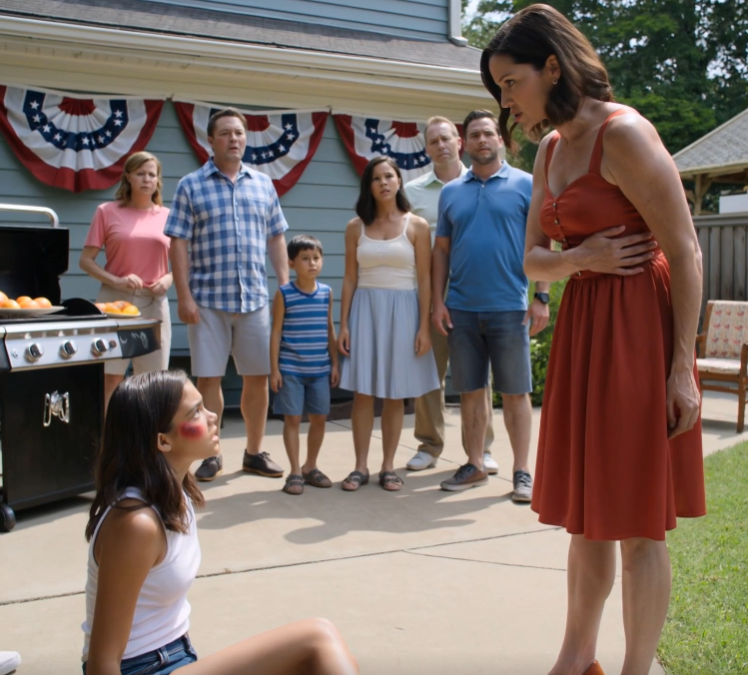
At family’s fourth of july party, i accidentally bumped into my sister; she slapped me off my feet, then shrieked, “don’t ever touch me again!” mom said coldly, “apologize to her or leave”; my husband helped me stand, “how do you want to handle this?” i looked at them, “do it your way”; he lifted his phone, “option two”; the table went dead silent…
Bristol is two years older than me. From the moment I could walk, I understood that she was the sun our family orbited around. When Bristol wanted the last slice of pie, I gave it to her. When Bristol wanted my new bicycle for a weekend, my father made me hand over the keys to my own little lock. When Bristol broke my ceramic horse collection in a fit of temper at age nine, my mother told me to sweep up the pieces and stop crying because I was upsetting my sister.
I learned early that peace in our house cost something, and I was always the one paying.
By high school, the pattern had a shape. Bristol was the pretty one, the popular one, the one who got the corsage and the crown and the college fund. I was the quiet one, the studious one, the one who worked two part-time jobs and paid for community college with my own tips from waiting tables at Denny’s.
When I graduated with an accounting degree and got hired at a regional firm in Columbus, my parents mailed me a congratulations card. When Bristol dropped out of cosmetology school for the second time, they threw her a party and gave her $20,000 to start her own salon.
The salon closed within 18 months. Nobody in my family ever mentioned it again.
I met Sawyer Whitfield in 2013 at a coffee shop on 4th Street in Columbus. He was reading a book about bridges, which I found charming, and I was crying quietly into a latte because I had just left my parents’ house after another humiliating dinner where Bristol had announced in front of company that I looked like I had gained weight.
Sawyer did not ask what was wrong. He simply slid a napkin across the table and said in the softest voice I had ever heard from a stranger that whoever put that look on my face was not worth my mascara.
We were married 18 months later in a small ceremony at the courthouse. My parents came. Bristol did not. She said she had a hair appointment.
Sawyer is a structural engineer, 41 years old now, with tired, kind eyes and the patience of a monk. He runs a small firm that consults on public infrastructure, and he is very good at what he does, though he never brags. He also happens to record almost everything on his phone, a habit he picked up years ago after a client tried to lie about a contract in court.
He always says the truth does not need protection, but it does not hurt to keep the receipts.
I did not know that Fourth of July that his phone had already been recording for almost four minutes before Bristol’s hand made contact with my face.
The barbecue was at my parents’ house. It was the same barbecue they threw every year, with the same folding tables covered in the same red gingham cloth. The same potato salad my mother had been making since 1987. The same aunts and uncles and cousins gathering in the same backyard under the same enormous oak tree.
My cousin Presley had flown in from Denver with her twin boys. My uncle Harlon had brought his new girlfriend, a woman named Clemens, who kept complimenting the deviled eggs. My father was manning the grill in an apron that said “Grill Sergeant.”
Sawyer and I arrived at 1:00 carrying a tray of my grandmother’s blackberry cobbler, still warm from the oven. I had baked it that morning in our kitchen in Dublin, a suburb about 40 minutes from Ridge View, humming to myself, feeling something almost like hope.
Bristol and I had barely spoken in eight months, ever since a fight over our grandmother’s engagement ring at Christmas, and I had told myself that today would be a fresh start. Today would be different. Today we would all be adults.
I should have known better.
My mother had called me the night before to remind me not to bring up the ring, not to bring up Bristol’s ex-husband, not to bring up the money I had loaned Bristol in 2022 that had never been repaid, not to bring up anything at all, really.
“Just come and smile and eat,” she said, “and let your sister have her day.”
Her day.
It was the Fourth of July. It was America’s day. But in our family, every day was Bristol’s day.
I remember walking through the side gate, holding Sawyer’s hand, and feeling that familiar tightening in my stomach. Bristol was already there, sitting in the shade with a plastic cup of white wine, wearing a red sundress that showed off her tan.
She looked up at me with the same flat expression she had been giving me since we were children, the one that said, Your existence is an inconvenience I am tolerating.
I waved.
She looked away.
Sawyer squeezed my hand.
“Breathe,” he murmured near my ear.
I breathed.
The afternoon crawled forward the way family afternoons do, in a slow loop of small talk and burnt hot dogs and children shrieking under a sprinkler. I helped my mother carry a bowl of coleslaw from the kitchen. I chatted with my aunt Roslin about her hip surgery. I complimented Clemens on her necklace.
I stayed out of Bristol’s way.
Around 4:00, the food was ready and everyone started moving toward the long buffet table my father had set up along the edge of the patio. I was carrying two paper plates, one for me and one for Sawyer, and I was turning back toward the table to grab napkins when it happened.
Bristol stepped into my path, suddenly reaching across me for a bottle of ranch dressing. I did not see her. My shoulder brushed hers, the kind of contact you would apologize for at a grocery store and immediately forget.
The plates flew out of my hands.
I remember her face before I remember the pain.
Her eyes went wide, then narrow, then something dark and hungry moved through them. And I understood in that instant that she had been waiting for a reason. Any reason.
I had just handed her one.
Her hand came up so fast I did not have time to flinch.
The slap landed square across my cheek. Hard enough to snap my head sideways. Hard enough to send me stumbling backward over the edge of the patio. Hard enough that I felt my ankle twist and my legs give out and the stone rise up to meet me.
The world went quiet in that strange underwater way it does when something impossible happens in front of witnesses.
I heard a woman gasp. I heard a child ask what happened. I heard my own heartbeat in my ears.
Then I heard Bristol shriek loud enough that the neighbors probably heard her over their own fireworks preparations.
“Don’t ever touch me again!”
My cheek was already swelling when I opened my eyes and saw the sky above me. That impossibly blue July sky with a single white cloud drifting past like it had somewhere better to be.
For a strange, floating second, I thought about how blue meant so many things. Sadness and calm and freedom. And how, in this exact moment, it just meant that I was flat on my back in my parents’ yard while my sister stood over me screaming.
Then the pain came.
My tailbone throbbed. My ankle burned. My face felt like someone had pressed a hot iron against it.
I heard footsteps rushing toward me across the patio, and I knew without looking that they belonged to Sawyer. He knelt beside me the way he always knelt beside things that were broken, carefully, with his hands hovering before he touched, as if he needed my permission to help.
His face was pale. His jaw was locked, but his voice, when it came, was as gentle as it had ever been.
“Can you sit up, sweetheart?” he asked me.
I nodded, even though I was not sure.
Bristol was still shrieking above us. She had launched into a full performance now, arms flying, wine cup abandoned somewhere on the grass, telling anyone who would listen that I had shoved her, that I had always been jealous of her, that I had ruined this day just like I ruined everything.
I turned my head slowly and looked at the ring of faces around us.
My cousin Presley had her hand over her mouth. Her twin boys had stopped playing and were staring at me with the wide, serious eyes of children who understand that a rule has been broken but do not yet know which one.
My uncle Harlon was frozen with a hot dog halfway to his mouth. Clemens, the girlfriend, had one hand pressed to her chest.
And then there was my mother.
Delphine Prescott stood at the edge of the patio with her arms crossed over her floral apron, her lips pressed into that thin line I had known my whole life, the line that meant she had already made up her mind about who was to blame.
She did not move toward me.
She did not ask if I was hurt.
She did not even look at the red handprint spreading across my cheek.
She looked at Bristol. She sighed. Then she turned her eyes on me the way a judge turns eyes on a defendant.
“Marlo,” she called across the patio, her voice cool and even and terrible.
I could not answer. My throat was closed.
“Marlo,” she repeated, louder now. “Apologize to your sister. Right now, or leave my house.”
Somewhere in the yard, one of Presley’s twins whispered, “But Aunt Bristol hit her.”
Presley shushed him with a hand on his shoulder.
Sawyer had gotten one arm under my back and one under my knees, and he was helping me sit up slowly, carefully, the way you might help an elderly woman rise from a pew.
I could feel his hands trembling, not with fear, but with something colder and more controlled than fear. I had felt that tremor in him exactly twice before in 11 years of marriage, and both times had ended with him quietly, permanently ending relationships with people who had crossed a line.
I looked up at him. His eyes met mine, and I saw the question there before he asked it out loud.
“How do you want to handle this?” he asked, so quietly that only I could hear.
The whole yard was watching us.
Bristol had gone silent, waiting, her chest still heaving. A small, triumphant smirk was beginning to tug at the corner of her mouth because she assumed, as she had always assumed, that I would fold. That I would apologize. That I would crawl the way I had been crawling since we were children.
My mother’s arms were still crossed.
My father, I noticed, was still standing at the grill with his back half turned, pretending to flip a burger that was already burnt to charcoal, refusing to intervene the way he had refused to intervene every single time in 36 years.
Something inside me went very still.
Not calm. Still.
The way a lake goes still before a storm changes direction.
I thought about the ceramic horses. I thought about the bicycle. I thought about the $20,000 for the salon. I thought about my wedding day and the empty chair with Bristol’s name on it.
I thought about the $8,000 I had wired her in 2022 when she said she was about to be evicted. Money that Sawyer and I had been saving for a down payment on a bigger house. Money she had spent on a trip to Cabo two weeks later.
I thought about my grandmother’s engagement ring, the one Grandma Opal had explicitly left to me in a handwritten note tucked inside her jewelry box. The ring Bristol had taken anyway with my mother’s blessing.
I thought about every apology I had ever given for existing.
And then I looked at my husband and said very softly, “Do it your way.”
Sawyer’s whole body seemed to exhale. Not with relief. With release.
Like a man who had been holding a door closed for years and had finally been given permission to let it swing open, he helped me the rest of the way to my feet.
He steadied me against his side. He turned so his body was between me and my sister, then pulled his phone out of his back pocket with his free hand.
He held it up.
“Option two,” he announced calmly, loud enough to carry across the whole patio.
The table went dead silent.
Even the crickets seemed to stop. Even the cicadas in the oak tree. Even the little American flag stuck in the potato salad had stopped fluttering, though that might have been my imagination.
My mother uncrossed her arms.
My father finally turned around at the grill.
Bristol’s smirk faltered.
“What?” she demanded. “What does that mean? Option two? What are you talking about?”
Sawyer did not answer her.
He turned the phone screen toward the crowd, thumbed something, and a video began to play. I could hear the tiny sound of my own voice coming out of the speaker. I could hear Bristol’s voice too, sharper and louder.
Then I could hear the unmistakable crack of a hand against skin.
He had been recording the whole time.
I would learn later that he had started recording the moment we stepped through the side gate because he had a bad feeling in his chest that he could not shake. The kind of feeling a structural engineer gets when he looks at a bridge and sees a hairline crack no one else can see.
He had propped the phone in the chest pocket of his linen shirt, the lens peeking just above the fabric, the way he had once shown me journalists doing in dangerous countries.
He had not told me.
He had not told anyone.
He had simply pressed record and waited to see if his bad feeling would prove itself right.
It had.
The video played for maybe 15 seconds before Bristol lunged for the phone. Sawyer stepped back smoothly, one arm still supporting me, and lifted the phone out of her reach.
“That is not the only copy,” he informed her without raising his voice at all. “It is already uploaded. Three places. Cloud, laptop, and a friend I trust. So sit down.”
She sat down.
She actually sat down right there on the edge of the patio like a puppet whose strings had been cut.
My mother took two steps forward. Her face had gone from cold to something I had never seen on her before.
Something almost like fear.
“Sawyer,” she began, her voice trying to find its old authority. “This is a family matter.”
He looked at her.
Just looked.
And whatever she saw in his face made her stop talking.
“Delphine,” he replied.
Hearing him use her first name instead of Mom, which he had called her for over a decade, made the whole yard shiver.
“This stopped being a family matter the moment your daughter assaulted my wife in front of 11 witnesses. This is now a legal matter, and you’re going to want to be very careful about what you say next.”
I want to tell you what my mother did next. But first, I need you to understand what kind of woman Delphine Prescott is, because otherwise her reaction will not make sense.
My mother is 63 years old, 5’2″ tall, and has never in her life admitted to being wrong about anything.
She grew up the youngest of six children on a dairy farm in western Pennsylvania, and she carries the ferocity of someone who had to fight for every scrap of attention at a crowded dinner table. She built her flower shop from nothing in 1989 with a small loan from my grandmother, and she takes enormous pride in the fact that Petal and Stem is the only place in Ridge View where you can get a proper funeral arrangement on short notice.
She is respected in town. She sings alto in the Methodist choir. She organizes the Christmas cookie exchange. She has a reputation to protect, and she protects it the way a mother bear protects a cub.
The problem is, the cub she has been protecting my whole life has never been me.
When Sawyer said the word legal, I watched my mother’s face do something I had never seen it do before.
It cracked.
Not visibly, not in a way anyone else at the barbecue would have caught, but I saw it. The tiny muscle beside her left eye twitched. Her hand rose to the collar of her blouse and pressed against her throat. Her nostrils flared.
And then, because Delphine Prescott is nothing if not a survivor, she pivoted.
“Oh, honey,” she cooed, suddenly rushing toward me across the patio with her arms outstretched.
Her whole voice transformed into syrup.
“Oh, sweetheart, are you all right? Let me look at you. Let me see that pretty face.”
I stepped back into Sawyer. He tightened his grip around my shoulders.
My mother stopped three feet away, arms still outstretched, and I could see the calculation happening behind her eyes.
She was recalibrating.
She had misread the room.
She was trying to salvage it.
“Don’t,” I whispered. “Don’t touch me.”
She blinked.
“Marlo,” she pressed on, her voice climbing an octave. “Sweetheart, this is a misunderstanding. Your sister did not mean to hit you that hard. She was startled. We all get startled. Come inside and let me put some ice on that.”
Behind her, Bristol was still sitting on the edge of the patio, but she was recovering. I could see it. Her spine was straightening. Her chin was lifting.
She was rebuilding the story in her head the way she had rebuilt every story since we were children, casting herself as the victim of my clumsiness, my jealousy, my perpetual mistake of existing near her.
“She did not mean to hit me that hard,” I repeated slowly.
I was surprised by how steady my own voice sounded.
Everyone in the yard heard me, even the twins, who were still standing very still beside their mother.
“She did not mean to hit me that hard,” I continued. “So what you’re telling me, Mom, is that there is an appropriate amount of hard for my sister to hit me.”
My mother’s mouth opened, closed, opened again.
“That is not what I meant,” she huffed.
“That is exactly what you meant,” I corrected her.
I felt Sawyer’s fingers press gently into my shoulder.
A small, silent yes.
A small, silent go on.
My cousin Presley took a step forward.
Presley is 34, a nurse practitioner in Denver, and she has always been the closest thing I have to an ally in this family. She reached out and put a hand on my aunt Roslin’s arm, and I saw Roslin nod slightly.
I understood that a small, quiet coalition was forming in real time.
“Aunt Delphine,” Presley spoke up, her voice steady, the way nurses’ voices are steady. “I think Marlo needs to go to urgent care. Her ankle is already swelling, and she may have hit her head. I’m happy to drive her.”
Sawyer nodded. “Thank you, Presley. That would help.”
My mother whipped around toward Presley.
“Nobody is going to urgent care,” she snapped. “We are going to sit down as a family and work this out. We are not going to blow this out of proportion. We are not going to involve doctors. We are not going to involve—”
And here her voice dropped.
“We are not going to involve anyone else.”
She meant police.
She could not bring herself to say the word, but she meant police.
Uncle Harlon cleared his throat.
Harlon is my mother’s older brother, 67, retired from the postal service, a quiet man who has spent his whole life watching his little sister run the show and never once challenged her until that day.
“Delphine,” he began softly. “The girl needs a doctor.”
“The girl is fine,” my mother snapped without looking at him.
“She is not fine,” Harlon continued in the same quiet voice. “And Sawyer is right. What Bristol did was assault. I saw it. Clemens saw it. Presley saw it. The boys saw it. Everybody in this yard saw it, and I am not going to sit here and pretend I didn’t.”
The silence that followed was different from the silence after the slap.
That silence had been shock.
This silence was collapse.
This was the sound of a family myth cracking down the middle.
Bristol stood up.
“Uncle Harlon,” she began, her voice wobbling into little-girl mode, the mode she used to get out of every consequence since we were toddlers. “You don’t understand. She pushed me first. She has been trying to start a fight all day. She’s jealous because I got Grandma’s ring, and she has been holding a grudge for months.”
Uncle Harlon did not look at her. He kept his eyes on my mother.
“Delphine,” he continued, “I have watched you protect that girl for 38 years. I have watched what it did to Marlo, and I have kept my mouth shut because Bennett is your husband and it wasn’t my place. But it is my place today because I am the oldest one here, and I am telling you this ends now. Either you take Marlo to a doctor and you call the sheriff and you let Bristol face what she did, or I do it myself.”
My father, still standing at the grill, finally set down his spatula.
Bennett Prescott is 65 years old, a big man with a soft belly and calloused hands. He has spent 42 years of marriage to my mother choosing the path of least resistance in every single situation.
He is not cruel. He is not unkind.
He is just tired.
And he has always been tired.
Tiredness in a man like my father looks a lot like cowardice when you are the child getting sacrificed to keep the peace.
He walked across the patio slowly. He stopped between my mother and me.
He looked at my swelling face.
He looked at Bristol.
He looked at Sawyer’s phone, still in Sawyer’s hand.
“Take her to urgent care,” he told Presley without turning around. “Take my daughter to urgent care right now.”
“Bennett,” my mother hissed.
“Delphine,” he replied.
There was something in his voice I had never heard before. Something old and heavy and final.
“Not one more word.”
Presley moved to my other side. She and Sawyer supported me between them, and we walked slowly because of my ankle, across the yard toward the side gate.
Bristol was crying now, loud theatrical sobs, but nobody was going to her. My aunt Roslin was gathering her purse. Clemens was already texting on her phone. The twins were staring at the ground.
At the gate, I paused.
I turned back.
I looked at my mother one last time across the ruined afternoon, across the melting potato salad and the little flags and the smoke from the burnt burgers.
“I loved you,” I told her. “I really did.”
I did not wait for her answer.
There was no answer she could give.
The urgent care clinic on Route 33 smelled like antiseptic and cold coffee. The fluorescent lights buzzed the way fluorescent lights always buzz, and I sat on a paper-covered table in a small examination room and cried for the first time all afternoon while Sawyer held my hand and Presley filled out paperwork on a clipboard.
The nurse who examined me was a kind woman in her 50s named Dileia, who took my blood pressure and looked at my ankle and pressed gently around my cheekbone. Then she asked me, in the practiced neutral tone of someone who has asked this question a thousand times, whether I felt safe going home that night.
Sawyer answered before I could.
“She is safe with me,” he confirmed. “Her husband didn’t do this.”
Dileia nodded once, made a note, and asked gently whether I would be willing to speak with a social worker and allow her to photograph my injuries for the record.
I looked at Sawyer.
He nodded slowly.
I looked at Presley.
She nodded too.
“Yes,” I agreed. “Photograph everything.”
They took pictures of my cheek, which had bloomed into a purple-and-yellow bruise the size of a grapefruit. They took pictures of my ankle, which was sprained but not broken. They took pictures of the scrape on my elbow and the bruise on my tailbone. They took pictures of the small cut on the back of my head where the patio stone had broken the skin.
The social worker was a young woman named Amara with locs pulled back in a low bun. She sat on a stool across from me and did not rush me and did not judge me. She simply asked me to tell her what happened in my own words.
I told her.
She wrote it all down.
When I got to the part about my mother telling me to apologize or leave, Amara’s pen paused for the first time.
She looked up.
“And when your mother said that,” Amara asked, “was that the first time she has chosen your sister over you in a moment of physical harm?”
I laughed.
It came out cracked and wet.
“No,” I confessed. “It was not the first time. It was just the loudest.”
Amara nodded. She wrote something else.
Then she handed me a small stack of paperwork and a card with her direct number on it. She told me that no matter what I decided to do next, whether I pressed charges or did not press charges, whether I spoke to my family again or did not, she wanted me to know that what happened to me was not my fault, and that a slap that knocks a grown woman off her feet is not a family disagreement.
It is a crime, and I was allowed to treat it like one.
I put the card in my wallet.
I still have it.
We left the clinic around 7:00. Sawyer helped me into the passenger seat of our car. Presley followed us in her rental because she had already decided, without asking anyone, that she was staying at our house that night instead of at my parents’ place.
Her twin boys had been picked up by my aunt Roslin, who had also decided without asking anyone that she was taking the boys back to her own house for a sleepover because their mother had grown-up work to do.
The drive from Ridge View back to Dublin took 43 minutes. I watched the sky turn orange and pink and finally deep blue through the passenger window.
Sawyer’s hand rested on my knee the whole way.
He did not speak.
I did not need him to.
When we pulled into the driveway of our little brick house on Wildwood Court, the porch light came on automatically. Our old orange cat Marmalade was sitting in the front window waiting for us the way she always waited for us.
I burst into tears again at the sight of her because home was still home, and home was intact, and home was mine and Sawyer’s, and no one in that yard 43 minutes away could take home from me.
Sawyer carried me inside.
Actually carried me up the two steps of our porch and through the front door and down the hallway to our bedroom.
Presley followed with a bag of groceries she had somehow acquired on the way because Presley is the kind of woman who feeds people when they are sad. She made us grilled cheese sandwiches and tomato soup while I lay on the couch with an ice pack on my face and Marmalade purring on my chest.
We did not talk about the barbecue for a long time.
We ate.
We watched an old episode of a baking show.
Sawyer answered a few texts on his phone quietly.
Presley refilled my water glass twice.
Finally, around 10:00, Presley cleared her throat.
“Marlo,” she began carefully. “I need to tell you something. Something I probably should have told you a long time ago.”
I turned my head.
Sawyer set down his soup spoon.
Presley took a breath.
“In 2019, at Grandma Opal’s funeral reception, I heard your mother and Bristol talking in the pantry. I was going in to get more napkins. They didn’t know I was there.”
I went very still.
“They were talking about Grandma’s ring,” Presley continued. “Grandma had already left the note saying it was yours. Your mother knew. She had read the note, and I heard her tell Bristol, ‘Don’t worry about Marlo. She won’t fight you on it. She never fights us on anything. That’s what makes her useful.’”
The room got very quiet.
“Useful?” I repeated.
“That’s what she said,” Presley confirmed. “And I have carried that for six years, Marlo. And I have hated myself for carrying it. And I’m so sorry I didn’t tell you sooner. I told myself it would only hurt you. I told myself you already knew. I told myself it wasn’t my business. But after what I saw today, I can’t keep it inside anymore.”
Sawyer’s jaw was locked again. He set his hand on my back and rubbed a slow circle.
I did not cry this time.
I thought I would, but I did not.
Instead, something in my chest went very calm.
The way a room goes calm after all the doors have been shut and all the loud people have gone home.
Useful.
That word explained everything.
It explained why I had been the one to sweep up the horses. It explained why I had been the one to give up the bicycle. It explained why my college fund had gone to Bristol’s salon. It explained why I had wired her $8,000 in 2022 without ever expecting to see it again. It explained why my mother had said apologize or leave.
I was not the daughter she loved.
I was the daughter she used to keep her real daughter comfortable.
I thanked Presley.
I meant it.
I hugged her.
She stayed on our pullout couch that night and slept with all her clothes on because she had left her overnight bag at my parents’ house and had no intention of going back to get it.
That night, after Sawyer helped me change into pajamas and settled me under the quilt his mother had made us for our wedding, I lay awake for a long time staring at the ceiling.
My cheek throbbed. My ankle throbbed. My tailbone throbbed.
But my mind was clearer than it had been in years.
I turned toward Sawyer in the dark.
“I want to press charges,” I whispered.
He turned toward me.
“Okay.”
“I want to press charges,” I continued. “And I want to talk to a lawyer. And I want the ring back. And I want the $8,000 back. And I want the $20,000 that was my college fund back. And I want every dollar my parents ever gave to Bristol at my expense back. And I want it in writing. And I want it now.”
“Okay,” Sawyer echoed. “Then that is what we will do.”
He kissed my forehead very softly.
“I love you,” he added. “And Marlo, I have been waiting 11 years for you to say those words.”
I did not sleep well that first night, but I slept.
When I woke up on the morning of July 5th to sunlight coming through the curtains and Marmalade curled against my hip and Sawyer already in the kitchen making coffee, I knew something in me had shifted permanently and could not shift back.
My phone had 47 missed calls and over a hundred text messages.
Sawyer had turned the ringer off before he came to bed. He handed me a mug of coffee, sat on the edge of the mattress, and told me gently that I did not have to look at any of it today if I did not want to.
Presley, still in yesterday’s clothes, poked her head in and offered to screen the messages for me.
I agreed.
She sat at our kitchen table with my phone and a legal pad and sorted through the calls and texts in the same methodical way she probably charted patients at the clinic.
Forty-one of the calls were from my mother.
Three were from my father.
Two were from Bristol.
One was from my aunt Kitty, my mother’s older sister, who lived in Sarasota and had not called me in four years.
The texts were worse.
My mother had cycled through every stage of manipulation in a single night.
The first messages from around 8:00 in the evening had been furious.
How dare you leave?
How dare your husband threaten me?
How dare you humiliate this family in front of Harlon and Clemens?
By midnight, the tone had shifted to injured. She was so worried about me. Why was I not answering? Was I trying to hurt her on purpose?
By 3:00 in the morning, we had reached the guilt phase.
She was too old for this.
Her blood pressure was climbing.
She needed her family.
By 7:00, the last text had been a single line.
Please call me. I am so sorry.
I had waited 36 years to read those four words from my mother.
They did not feel the way I thought they would feel.
I set the phone down. I finished my coffee.
Then I asked Sawyer if he knew a lawyer.
He did.
Of course he did.
Sawyer’s college roommate, a man named Ephraim Nakagawa, was a partner at a firm in Columbus that handled civil and family matters. Sawyer called him at 8:30 on a Saturday morning, and Ephraim, without hesitating, told us to come in at 11:00.
We drove downtown together, the three of us, because Presley refused to leave my side and I did not have the energy to argue.
Ephraim met us in a small conference room on the 14th floor of a glass tower on High Street. He was a compact man in his early 40s with wire-rimmed glasses and a way of listening that made you feel like you were the only person in the world.
I told him everything from the ceramic horses to the ring, from the bicycle to the $8,000, from the college fund to the slap.
Sawyer showed him the video.
Presley confirmed what she had heard in the pantry in 2019.
I handed him Amara’s card and the paperwork from the clinic.
He took notes for almost two hours.
When I finished, Ephraim removed his glasses, polished them on his tie, and put them back on.
“Marlo,” he began, “I want to be honest with you about what is realistic and what is not.”
I nodded.
“The assault,” he continued, “is clear. You have a video. You have medical records. You have witnesses. If you want to press criminal charges, we can walk into the Ridge View Sheriff’s Office on Monday morning and file a report. Given the severity, I expect the prosecutor to at least charge a misdemeanor battery, possibly aggravated depending on how they view the injuries. Your sister will not go to prison for a first offense, but she will have a record, a fine, likely probation, and potentially anger management. That is the criminal side.”
“Okay,” I whispered.
“The civil side,” he went on, “is more interesting. You can sue her personally for damages, medical bills, pain and suffering, emotional distress, lost wages if you miss work. In Ohio, we can also potentially pursue a claim against your parents if we can show that they contributed to the environment that enabled the assault. That is a harder argument, but not impossible, particularly given your mother’s statement to apologize or leave, which the video appears to capture.”
He paused.
“The money is the hardest part. The $8,000 you loaned Bristol in 2022. Do you have any documentation? A text, a Venmo memo, a bank record?”
“I have the wire transfer,” I confirmed, “and texts where she promised to repay it by December of that year.”
“Good. That is recoverable in small claims or as part of the larger suit. The college fund and the ceramic horses and the bicycle, those are gone. Those were gifts from your parents to you that they redirected to your sister when you were a minor, and there is no legal remedy for that. I’m sorry.”
I nodded.
I had expected that.
“The ring, however,” Ephraim added, “is different. If your grandmother left a handwritten note specifying that the ring was to go to you, and if that note still exists, we may be able to recover it under Ohio probate law, particularly if the note was witnessed or if there are other documents establishing your grandmother’s intent.”
“The note exists,” Presley spoke up. “I have a photograph of it. I took it at the funeral because I thought something like this might happen. I can send it to you today.”
Ephraim’s eyebrows lifted.
He looked at Presley with something close to admiration.
“Miss Prescott,” he told her, “you are a very good cousin.”
We spent the next hour talking about strategy.
Ephraim recommended, and I agreed, that we would proceed on three simultaneous tracks.
Track one, we would file a criminal report on Monday morning.
Track two, we would send a formal demand letter to Bristol for the $8,000 plus interest.
Track three, we would send a separate letter to my parents demanding the return of Grandma Opal’s ring, with the photograph of the note attached and a deadline of 30 days to comply before we filed a probate challenge.
He did not recommend, and I did not ask for, a lawsuit against my parents for enabling the assault.
Not yet.
He said we would keep that in our back pocket.
We would see how the family responded to the first three letters.
Sometimes, he explained, the threat of a lawsuit is more useful than the lawsuit itself.
I signed the retainer.
Sawyer wrote the check.
$1,500 for the initial engagement, with a promise that Ephraim would keep his rate reasonable because we were friends and because, in his words, he had a low tolerance for family bullies.
We left his office around 1:30.
I felt lighter than I had felt in years and also heavier in a strange new way. The way you feel when you finally set down something you did not realize you had been carrying and your muscles do not quite know what to do without the weight.
On the drive home, my phone buzzed with a new text.
My mother again.
Marlo, please. I am begging you. Just call me. Whatever your husband is planning, whatever this lawyer thing is, we can talk about it as a family. Please.
Word travels fast in Ridge View.
She had already heard somehow that we were talking to an attorney. My guess was Aunt Kitty or maybe my father. Someone in the family had a source somewhere in Columbus, and my mother had been alerted.
She was panicking.
I read the message aloud to Sawyer.
He glanced at me from the driver’s seat.
“Do you want to answer?” he asked.
I thought about it for a long time.
I watched the interstate slip past.
I thought about my mother sitting in her kitchen in Ridge View, in the yellow house on Sycamore Lane, with her phone in her hand, waiting for a daughter to forgive her the way she had forgiven Bristol a thousand times.
I typed one sentence back.
Your lawyer will be in touch with mine.
I hit send.
I set the phone face down on the console.
Sawyer reached over and squeezed my hand.
Presley, in the back seat, laughed.
Not a mean laugh.
A relieved laugh.
A laugh that said, Finally. Finally. Finally.
Monday morning, July 7th, I walked into the Ridge View Sheriff’s Office at 9:00 with Sawyer on my left and Ephraim on my right.
I was wearing sunglasses because the bruise on my cheek had turned an ugly shade of green at the edges, and I was walking with a slight limp because my ankle was still wrapped.
I felt, for the first time in my life, like a woman who was not asking permission to be believed.
The deputy who took my statement was a man in his late 20s named Deputy Akerly. He was polite and professional and, importantly, he had grown up in the next town over and had no personal loyalty to my family.
He watched the video twice. He looked at the clinic photographs. He read Presley’s written statement, which she had signed and notarized that morning.
He asked me a series of careful questions, most of which Ephraim let me answer directly.
When we finished, Deputy Akerly told me that he would be forwarding the case to the county prosecutor and that Bristol would likely be contacted for a statement within a week.
He also mentioned, almost casually, that assault of this nature, on video with injuries documented, was rarely dropped by prosecutors in this county and that I should prepare myself for the process to move forward whether I later changed my mind or not.
I told him I would not be changing my mind.
We left the sheriff’s office at 10:45.
Ephraim went back to Columbus to file the demand letters. Sawyer took me to a small diner on the edge of town for pancakes because he said I needed sugar and grease and something to remind me that the world was still made of small good things.
I ate two pancakes.
I drank three cups of coffee.
I cried once quietly in the booth, and Sawyer handed me a paper napkin and did not try to fix it and did not try to talk me out of it. He simply sat across from me being present, which was the only thing I needed anyone to be.
The letters arrived at my parents’ house on Wednesday, July 9th.
I know the exact day because that is the day my mother showed up at our front door in Dublin.
She came alone.
She drove her old blue Buick the 40 minutes from Ridge View, parked crookedly at the curb, walked up to our porch, and rang the doorbell three times in quick succession, the way she had rung doorbells my whole life, as if the world was required to answer her on her schedule.
I was in the living room when I saw her through the window.
Sawyer was at his office in Columbus. Presley had flown back to Denver on Tuesday but had promised to fly out again if I needed her.
Marmalade was on the back of the couch, tail twitching, staring at the door.
For a second, I considered not answering.
Then I decided that I was not going to be a woman who hid from her own mother in her own house.
I opened the door.
Delphine Prescott stood on my porch in a lavender blouse and white capri pants and her Sunday sandals, holding a Tupperware container of what appeared to be her banana bread.
The sight of that banana bread almost broke me because banana bread was what my mother had made every time I was sick as a child.
And she knew.
She knew that it would work on me if anything would.
She held it out.
I did not take it.
“Mama,” I told her flatly. “You cannot come inside.”
Her face crumpled.
“Marlo, please,” she begged. “Just five minutes. Just let me sit with you for five minutes.”
“No.”
“Please. I drove all this way. I am your mother.”
“I know who you are,” I replied. “And you cannot come inside.”
She lowered the banana bread.
She looked at me.
Really looked at me.
I saw her eyes travel over the bruise on my cheek and the wrap on my ankle, and something in her face shifted.
For the briefest moment, I thought I saw guilt there.
Real guilt.
Not the performative kind, but the kind that comes when a person finally sees what they have done and cannot look away from it.
Then it passed.
It always passed with her.
And she was Delphine again, chin up, spine straight, hurt.
“You did not have to send lawyers,” she informed me, her voice tightening. “You did not have to involve outsiders. This could have been handled inside the family.”
“It was handled inside the family for 36 years,” I responded. “Handling it inside the family is what got me here.”
She flinched.
“Marlo, your sister is devastated. She has not slept in three nights. She is having panic attacks. She loves you. She never meant for it to go that far.”
“The lawyer will be in touch with your lawyer,” I stated.
“Marlo—”
“Mama.”
She stood there on my porch for a long time.
The banana bread was starting to sweat in the July heat. A neighbor across the street was watering her hydrangeas and pretending not to watch.
Somewhere down the block, a lawn mower started up.
“Your father,” my mother finally revealed quietly, “has moved into the guest room.”
I blinked.
“What?”
“He has not spoken to me since Friday,” she continued, her voice cracking for the first time. “He will not eat with me. He will not look at me.”
Then her voice broke fully.
“He said I have ruined his family. He said I chose the wrong daughter.”
I did not know what to do with that information.
Part of me wanted to feel bad for her.
A larger part of me thought, Good.
A third part of me, the smallest and quietest and most honest part, thought that my father was 36 years too late.
“I’m sorry about Daddy,” I told her, and I meant it. “But that is between you and him.”
“Marlo, if you drop the charges,” she pleaded. “If you just drop the charges, we can fix this. We can fix all of it. I will make Bristol give the ring back. I will make her pay you the money. I will do whatever you need me to do. But please, please do not do this in a courtroom. Do not do this in front of the whole town.”
There it was.
The whole town.
The choir.
The cookie exchange.
The reputation.
That is what she was afraid of.
Not losing me.
Not losing Bristol.
Losing her image.
I looked at my mother standing on my porch with her banana bread, and I felt something clean and quiet and final settle in my chest.
“Mama,” I finally said. “If Bristol gives the ring back and pays me the money and pleads guilty to the charge and completes anger management, I will not testify to more than what the video already shows. That is the best offer you will get from me. Take it to your lawyer.”
She stared at me.
“That is not mercy,” she whispered.
“No,” I agreed. “It is not. It is a settlement. Mercy is what I gave you for 36 years for free. This one has terms.”
I closed the door.
I stood behind it for a long time with my forehead pressed against the wood, listening to her breathing on the other side.
Eventually, I heard her footsteps go down the porch stairs, and her car door open, and her engine start, and her Buick pull away from the curb.
I sat down on the floor in the entryway and cried for maybe an hour.
Marmalade came and curled up in my lap and purred against my chest and let me get tears in her orange fur without complaint.
When Sawyer got home at 6:00, I was still on the floor, but I was calm.
He sat down next to me.
He did not ask what happened.
He just waited.
“She came,” I explained after a while. “She brought banana bread.”
He nodded.
“I gave her terms,” I added.
“Good terms?” he asked.
“Fair terms,” I clarified. “Not kind ones.”
He kissed the top of my head.
“That is exactly right, sweetheart. Fair, not kind. Those are the terms of a grown woman.”
Bristol did not accept my terms.
Not at first.
Her lawyer, a woman named Karine Vasquez out of a small firm in Ridge View, sent a response to Ephraim on Friday, July 11th, that was almost comical in its arrogance.
Bristol denied assaulting me.
She claimed the video was misleading.
She claimed I had shoved her first, that she had reacted defensively, that my injuries were the result of my own clumsiness.
She refused to return the ring on the grounds that our mother had given it to her and my mother had the right to redistribute family heirlooms as she saw fit.
She refused to repay the $8,000 on the grounds that it had been a gift, not a loan.
She offered, generously, to consider a mutual no-contact agreement if I dropped all charges and made a public statement withdrawing my allegations.
Ephraim called me at 11:00 that morning to read the letter aloud.
When he finished, there was a long pause.
“Well,” he stated calmly. “I think we know how this is going to go.”
He filed the civil complaint that afternoon.
He also, at my request, forwarded the letter from Bristol’s lawyer to the prosecutor’s office because Bristol’s denial of the assault was going to make it a lot harder for her to plead down when the video was played in open court.
The prosecutor’s office scheduled Bristol’s arraignment for August 4th.
Sawyer and I marked the date on the calendar in our kitchen.
In the meantime, life kept happening, which was the strangest part.
I went back to work at my accounting firm in Columbus on July 14th. My colleagues noticed the fading bruise on my cheek.
Nobody asked.
I would not have known what to say if they had.
I did tell my direct supervisor, a woman named Yolanda Christiansen, that I might need some flexibility for court dates in August and September.
Yolanda, who has known me for eight years, closed her office door and asked if everything was all right.
I gave her a short version.
She listened without interrupting.
Then she opened her desk drawer, pulled out a business card, and handed it to me.
“That is the therapist I see,” Yolanda explained. “She is very good. She specializes in family estrangement. I have been going for six years, since my own mother passed. Consider it.”
I put the card in my wallet next to Amara’s.
The therapist was a woman named Dr. Ivo Howerin, and I saw her for the first time on July 22nd.
Her office was on the second floor of an old brick building near the Short North. She had two green armchairs and a box of tissues and a small white sound machine that hummed softly in the corner.
She listened to my whole story in our first session, all 90 minutes.
At the end, she asked me one question that I have thought about almost every day since.
“Marlo,” Dr. Howerin spoke gently, “if your sister apologized to you tomorrow, a real apology, and returned everything you have asked for, and your mother did the same, would you want them back in your life?”
I opened my mouth to answer yes automatically, reflexively, the way I had answered every question in my life about my family.
Then I stopped.
I closed my mouth.
I sat with the question.
I really sat with it.
“I don’t know,” I finally admitted.
Dr. Howerin nodded.
“That,” she assured me, “is the most honest answer you have ever given about your family, I would guess. And it is the right place to start.”
I started seeing her every week.
On July 30th, my father called me.
Not my mother.
My father.
I let it go to voicemail the first time.
He called back an hour later.
I answered.
“Marlo,” my father began, and his voice sounded old, older than I had ever heard him sound. “Honey, I am not going to ask you for anything. I just want to tell you something. Can I tell you something?”
“Yes.”
“I have been thinking,” he continued slowly, “about every time I stood at that grill or sat at that table or drove past that store and looked the other way when your mother and your sister did something to you. And I want to tell you that I know I did that. And I want to tell you that I have no excuse for it. And I want to tell you that I am sorry. Not because I want you to drop the charges. Not because I want you to come home for Thanksgiving. Just because it is true. I am sorry, Marlo. I was a coward.”
I sat down on the edge of our bed.
I had not expected this.
I had never in 36 years heard my father use the word sorry in relation to me.
“Daddy,” I whispered.
“I know it is late,” he added. “I know it does not undo anything, but I wanted you to hear it from me before whatever comes next comes next. And I wanted you to know that whatever you decide to do, I am on your side. Not your mother’s. Not your sister’s. Yours.”
I could not speak for a long time.
“Are you okay?” I finally asked him.
He laughed.
A small, tired laugh.
“No, honey. I am not okay. I have not been okay for a long time. But I am starting to think that being okay was maybe the wrong thing to aim for in the first place.”
We talked for another 20 minutes.
He told me that he had moved out of the guest room and into a small apartment above the hardware store. He told me that he had asked my mother for a separation, not a divorce, not yet, but a separation so that he could think without her voice in his ear every night.
He told me that Bristol had been calling him every day and that he had stopped answering.
He told me that he had contacted a lawyer of his own, not to fight my mother, but to make sure that when everything shook out, whatever was fair to me was preserved.
“I want to leave you something,” he told me at the end. “Not a lot, but something. And I want your mother’s hands off it before I go.”
“Daddy, do not talk like you’re dying.”
“I am not dying,” he chuckled softly. “I am just finally waking up. There is a difference.”
We hung up.
I sat on the edge of the bed for a long time.
Marmalade wandered in and stared at me.
Sawyer came home. I told him what my father had said.
He held me while I cried for the second time that day, but they were different tears this time, and I did not entirely know how to name them.
The next morning, August 1st, Ephraim called me with an update.
Bristol’s lawyer had contacted him overnight.
She wanted to talk about a settlement.
Apparently, the reality of the arraignment, which was three days away, had begun to sink in for my sister. Apparently, the prospect of standing in front of a judge and watching that video played in open court had shifted something in her.
Ephraim scheduled a settlement conference for August 2nd at 10:00 in the morning at his office in Columbus.
Both parties would be present.
Both parties would have counsel.
The prosecutor’s office had been informed and would consider any resolution as a factor in charging, though they were not obligated to.
I asked Ephraim whether I had to be there.
He said no, but he thought it would be useful.
He said sometimes the most powerful thing a person can do in a settlement conference is be in the room quietly, letting the other party see the face of what they did.
I told him I would be there.
I hung up.
I looked at Sawyer.
“Saturday morning,” I told him. “Ephraim’s office. She wants to talk.”
He nodded.
“Are you ready?”
I thought about it.
I thought about the 36 years.
I thought about the ring and the horses and the bicycle and the salon and the wire transfer and the potato salad and the sky above the patio.
I thought about the word useful.
I thought about my father in his apartment above the hardware store.
I thought about my mother alone in the yellow house on Sycamore Lane.
“I am ready,” I confirmed.
And for the first time in my life, when I said the words out loud, I actually believed them.
The conference room on the 14th floor smelled like new carpet and the mint candies Ephraim kept in a small dish at the center of the table.
I sat with my back to the window.
Sawyer sat on my left.
Ephraim sat on my right.
Across from us, three empty chairs waited.
They walked in at 10:03.
Bristol first, then her lawyer, Karine, then, to my surprise, my mother.
Ephraim glanced at me.
“Mrs. Prescott,” he asked evenly, “are you attending in a legal capacity or as an observer?”
My mother, who had clearly rehearsed her entrance, lifted her chin.
“I am attending as my daughter’s support person.”
“Which daughter?” Ephraim asked pleasantly.
The silence that followed that question was, I think, the moment my mother realized that this room was not going to work the way her yard had worked.
This room had rules.
And none of them were hers.
She sat down without answering.
Bristol did not look at me.
She looked at the table.
She looked thinner than she had at the barbecue. Her hair was pulled back into a low ponytail without her usual highlights done. She was wearing a plain gray blouse.
She had, I realized with a strange little pang, made an effort to look small.
Karine Vasquez took control of the room the way lawyers do.
She laid out her client’s proposal in a calm, professional voice.
Bristol was prepared to return the ring.
Bristol was prepared to repay the $8,000 plus a reasonable interest of 5%.
Bristol was prepared to enter a plea of no contest to a reduced charge of disorderly conduct, provided the prosecutor agreed, and to complete an anger management program of the court’s choosing.
In exchange, Bristol asked that I sign a mutual non-disparagement agreement and drop the civil suit for emotional distress.
Ephraim listened.
He took notes.
When Karine finished, he set down his pen.
“Ms. Vasquez,” he replied, “my client will accept the return of the ring and the repayment of the $8,000 at 8% interest calculated from the date of the wire transfer. My client will not accept a reduction of the criminal charge to disorderly conduct. That is not our decision to make. As you know, that decision belongs to the prosecutor, and my client has already communicated to the prosecutor that she will accept whatever charge the state deems appropriate, up to and including the original battery.
“My client will accept a non-disparagement agreement provided it is mutual and provided it does not prevent her from truthfully answering questions in any legal proceeding, professional context, or—and I want to be very clear here—therapeutic setting.”
He paused.
“My client will not drop the civil suit for emotional distress. She will, however, agree to defer it pending your client’s completion of the anger management program and pending your client’s full compliance with the return of the ring and the repayment of the money, at which point my client will consider withdrawing that portion of the suit at her discretion.”
Karine wrote something down.
Bristol still had not looked up.
“There is one more term,” Ephraim continued. “My client requests a written apology from your client addressed to my client directly, acknowledging the assault, acknowledging the pattern of behavior over multiple decades, and acknowledging that the assault was not caused by my client’s actions. This letter will not be published. It will not be shared. It is for my client’s personal records, but it must be written and it must be honest.”
Bristol’s head came up for the first time.
“I am not writing that,” she snapped.
Karine put a hand on her arm.
“Bristol—”
“I am not writing that letter,” she repeated, her voice climbing. “I already said I was sorry. I already agreed to give the ring back. I already agreed to pay the money. What more does she want? What more does she possibly want from me?”
I looked at my sister across the table.
She was 38 years old, and she looked like a child in that moment, a furious, defiant child who had never once in her life been told no and had it stick.
My mother had been about to put a hand on her other arm, but Bristol shook her off.
Karine murmured something in her ear.
Bristol did not respond.
I leaned forward slightly.
“Bristol,” I began, and my voice was calmer than I would have believed possible. “I do not want any more from you than what I have asked for. I want the ring, which is legally mine. I want the money, which is legally mine. I want you to face the consequence of what you did, which is legally required. And I want a letter, not because I want to hurt you, but because I want to be able to read it one day when I am doubting my own memory. So I can remember that it was real.”
She stared at me.
“You always do this,” she hissed. “You always make yourself the victim. You have been doing it your whole life. You have been the martyr your whole life. You know why Mom likes me better? You know why? Because you are so miserable to be around. You are so joyless. You suck the air out of every room. Nobody wants to be around you, Marlo. Nobody. Your husband will figure it out one day too.”
The room went still.
Sawyer set down his pen very slowly.
He did not look at Bristol.
He looked at my mother.
“Delphine,” he stated quietly. “Do you have anything you would like to say to your daughter right now?”
My mother’s eyes flicked from Bristol to me and back.
Her mouth opened.
Her mouth closed.
She looked at her hands folded in her lap.
She did not speak.
Sawyer nodded once.
“That is what I thought.”
Ephraim cleared his throat.
“Ms. Vasquez,” he continued, as if none of that had happened, “I think we have a working framework. If your client can put her feelings aside long enough to write the letter, we will accept your other terms with the modifications I have outlined. If she cannot, we will see you at the arraignment on Monday morning, and we will let the prosecutor decide how to proceed with a defendant who denies the video evidence in front of a judge. Your call.”
Karine asked for a recess.
They left the room.
My mother followed them, though she paused at the door and turned back to look at me.
Her lips parted.
She did not speak.
She closed the door.
We sat in silence for a moment.
Then Sawyer reached over and covered my hand with his.
“You okay?” he asked me.
I nodded slowly.
“She is never going to write that letter,” I told him.
Ephraim smiled slightly.
“She will write it. Watch.”
They came back in 22 minutes.
Bristol’s face was red.
Her eyes were swollen.
Karine looked exhausted.
“My client,” Karine informed us, “will write the letter.”
Ephraim nodded.
“Excellent. We will draft the settlement paperwork this week. It will be conditional on the letter, the return of the ring, the repayment of the money at 8%, and your client’s compliance with whatever the prosecutor decides on Monday.”
Bristol did not look at me as she stood.
She walked out.
Karine followed her.
My mother lingered again in the doorway, then turned back one more time.
“Marlo,” she began.
“Mama,” I replied. “Please just go.”
She went.
The door clicked shut behind her.
Ephraim exhaled slowly. He looked at me across the table with something that might have been respect.
“Marlo,” he told me, “that was one of the cleanest settlement conferences I have ever run. And I have been doing this for 16 years.”
I laughed.
It came out shaky.
“I have been practicing my whole life,” I admitted. “I just did not know it until this month.”
The letter arrived on August 19th in a plain white envelope with no return address.
I sat with it at our kitchen table for a full hour before I opened it.
Marmalade sat on the table across from me, tail curled around her paws, watching me with her small, serious green eyes as if she understood exactly what the paper meant.
I opened it.
I read it.
It was three pages long, written in my sister’s cramped, angular handwriting on lined notebook paper.
And it was, to my surprise, not a bad letter.
It was not a good letter either.
It was not warm.
It was not tender.
It did not say, “I love you.”
It did not say, “I want you back.”
But it said the things Ephraim had required it to say, and it said them in a voice that sounded, for the first time in my adult life, like Bristol’s actual voice, not the performance she had been running since we were children.
She acknowledged that she had slapped me.
She acknowledged that I had not shoved her first.
She acknowledged that our mother had told me to apologize when I was the one bleeding.
She acknowledged that she had taken the ring knowing it was mine.
She acknowledged that the $8,000 had been a loan.
And in the last paragraph, she acknowledged in a single stiff sentence that she had been cruel to me for most of our lives, that she did not entirely know why, and that she was going to try to figure it out in therapy, which the court had ordered her to attend.
That was it.
No warmth.
No apology to the depth I had been imagining for weeks.
No promise to be different.
But it was real.
I could tell it was real because a fake apology would have been prettier.
I folded the letter.
I put it in a manila envelope.
I put the manila envelope in the fireproof box in our closet where we kept the passports and the marriage certificate and the deed to the house.
I did not read it again for a long time.
The ring arrived by certified mail two days later in a small velvet box wrapped in brown paper with a receipt to be signed.
I signed it.
I opened it.
Grandma Opal’s ring.
A small round diamond in an old rose-gold setting sat exactly where I had last seen it in her jewelry box in 2019.
I put it on my right hand.
It fit.
The wire transfer for $8,640 arrived in our checking account on August 27th.
Sawyer showed me the notification on his phone.
I looked at it for a long time.
Then I logged into my banking app and moved the entire amount into a savings account we had opened years ago called Simply the Fund.
Sawyer opened a family emergency fund on our wedding day.
I finally knew its purpose.
My therapy.
Visiting Presley.
A bigger house.
And the future my sister almost ruined.
Bristol pleaded no contest to misdemeanor assault in August.
She received 12 months’ probation, a fine of $2,500, anger management, and community service.
Her career was damaged, but that was no longer my problem.
I signed the deferred civil suit paperwork in September.
My lawyer, Ephraim, praised my honesty and reduced his fees since we were now friends. I sent him a plant, and he joked about me no longer being useful.
My therapist, Dr. Howerin, and I discussed this.
I admitted that not being useful felt terrifying, but quiet.
She assured me the quiet was just mine.
My father and I started talking weekly.
He was working less, exercising, and seeing his own therapist to stop being conveniently small.
Bristol and I maintained strict no contact, which I appreciated.
My mother sent letters.
I eventually stopped opening them.
She later left a pumpkin on our porch with a note about learning to change.
I kept the pumpkin but kept my distance.
Realizing I did not have to decide our future today, I was finally allowed to just wait and enjoy a peaceful autumn.
By Thanksgiving, I knew I was not going back.
My aunt Roslin hosted the holiday in Cincinnati. She invited our extended family and my father but intentionally excluded my mother and Bristol to ensure the table felt safe.
I cried when she asked me.
Roslin cried too.
We cried together on the phone for almost 10 minutes, and then we laughed about how ridiculous it was that we had spent decades pretending things were fine.
I told her yes.
We drove down on the Wednesday before Thanksgiving, Sawyer and Marmalade and me, Marmalade in her little carrier in the back seat, meowing plaintively for the first 30 minutes and then falling asleep for the rest of the trip.
We stayed at a small hotel near Roslin’s house because she did not have room for everyone.
I did not mind, because being able to close a hotel room door at the end of the day and be alone with my husband felt like a luxury I had not properly appreciated before.
Thanksgiving dinner at Roslin’s was the best meal of my life.
That is not hyperbole.
I have thought about this a lot, and it is the simple truth.
There were nine of us at the table.
Roslin and her husband Owen.
Uncle Harlon and Clemens, who were still dating and, I was quietly informed, considering moving in together.
Presley and her twin boys, who were seven and full of enormous, serious opinions about the size of the turkey.
My father, wearing a sweater I had never seen him in before, looking calmer than I had ever seen him.
Sawyer.
Me.
Nobody said anything cruel at the table.
Nobody made a passive-aggressive comment.
Nobody rolled their eyes.
Nobody had to be handled.
Nobody had to be soothed.
We passed dishes and talked about the weather and told small, funny stories about our weeks.
Presley’s boys asked me if I liked being a grown-up.
I told them it was better than I had expected.
They asked me why.
I told them because, as a grown-up, you get to pick who sits at your table.
They thought about that very seriously and then asked for more mashed potatoes.
After dinner, my father found me in the kitchen where I was drying dishes.
He set down a stack of clean plates and stood next to me for a moment.
“Marlo,” he began, “I want you to know something.”
“Okay.”
“I have started to think,” he continued slowly, “that the best thing I ever did as a father was probably nothing, which is a hard thing to sit with because a man wants to think the best thing he ever did was something. But when I look back at your life, the best thing I ever did was probably the day I set down the spatula.”
I stopped drying the plate.
“You mean at the barbecue?”
“Yes. At the barbecue, when I told Presley to take you to urgent care. It took me 65 years to do one right thing, but I did it. And I want you to know that I know I did it, and that I know why it mattered, and that I intend to do more right things going forward, however many years I have left.”
I set down the plate.
I hugged my father.
He hugged me back.
He smelled like Old Spice and the same faint hardware-store smell he had smelled like my entire life.
And I remembered suddenly that when I was six years old, he had let me pick out my own tool set from the store shelves, a little pink one with a real tape measure.
He had taught me to hammer a nail in the back workshop.
And I had loved him with everything a six-year-old had in her body.
I still loved him.
It was a different love now.
A quieter one.
An adult one.
One that came with clear eyes and no more excuses.
But it was there.
It was still there.
We drove home on Friday morning.
Marmalade slept the whole way.
Sawyer held my hand across the console.
The trees along Interstate 71 were bare now, the last of the leaves gone, the fields brown and waiting.
I watched them slip past, and I thought about everything that had happened since the Fourth of July.
I thought about the slap.
I thought about the sky above me on the patio.
I thought about Sawyer saying, “Option two.”
I thought about my mother’s face when he said the word legal.
I thought about the ring in the velvet box.
I thought about the wire transfer.
I thought about the letter in the fireproof box in my closet.
I thought about Amara and Dr. Howerin and Ephraim and Yolanda and Presley and Uncle Harlon and Aunt Roslin and my father in his sweater at Roslin’s table.
I thought about all the people who had shown up, and I thought for the first time in my life that I had not been alone.
I had never been alone.
I had just been looking for love in one specific place, and there had been so many other places all along, standing ready, waiting for me to look up.
If you are watching this and something in it sounds familiar to you, if you have a person in your life who has been slapping you down literally or otherwise and telling you to apologize for existing in their path, I want to tell you something.
You do not have to keep apologizing.
You do not have to keep being useful.
You do not have to keep being the one who sweeps up the broken pieces.
You are allowed to say, “Do it your way,” to the person who loves you the right way.
You are allowed to press record.
You are allowed to press charges.
You are allowed to send the letter.
You are allowed to sit on your own porch with your own husband and your own cat and your own quiet Saturday morning.
You are allowed to build a table where nobody has to be handled.
You are allowed to walk out of the yard.
The people who love you will not ask you to apologize for being hurt.
They will kneel down beside you the way Sawyer knelt down beside me.
They will ask you how you want to handle this, and they will let you decide.
My name is Marlo Prescott.
I am 36 years old.
I live in a little brick house on Wildwood Court in Dublin, Ohio, with a good man and an orange cat and a garden that needs weeding and a savings account that is finally, finally mine.
My cheek healed.
My ankle healed.
My tailbone healed.
And slowly, day by day, the part of me that had been bruised for 36 years is healing too.
If this story meant something to you, if any part of it looked like something in your own life, I would love it if you liked this video and subscribed to hear more stories like it.
And if you have your own moment when you finally said, “Do it your way,” or when you finally walked out of the yard, please share it in the comments.
There is somebody scrolling past who needs to read what you write.
There is somebody who needs to know that the quiet on the other side of the closed door is not empty.
It is just theirs.
And it was worth every step it took to get there.








