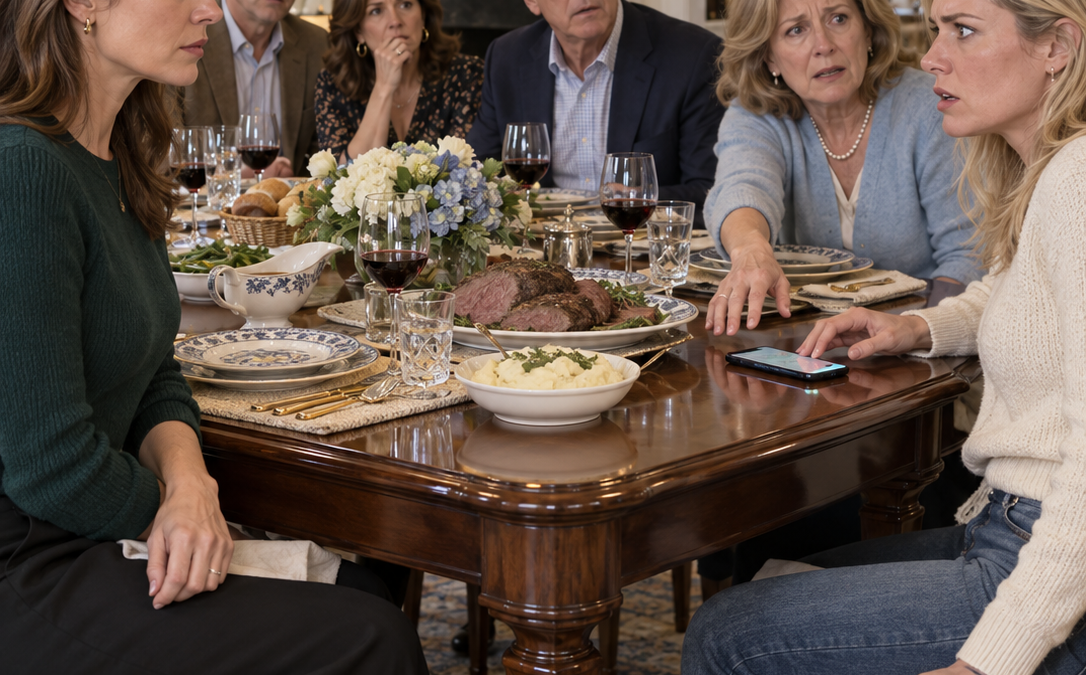
At dinner, my sister pointed at me and shouted, “she’s a liar! she stole my money!” everyone stared; i asked, “then why is your phone showing a $12,000 transfer to you?” she froze and grabbed it back, “that’s none of your business!” i replied, “if i’m lying, why are you so scared?” then her phone lit up again—and this time, i saw the secret…
My father worked as a regional manager for a printing company in Stamford, and my mother taught fourth grade at the same elementary school Reagan and I attended. Money was not tight exactly, but it was not loose either. There were choices to be made about who got the new shoes and who got the hand-me-downs, who got piano lessons and who got told that music was a nice hobby, but not a career.
The choices always went to Reagan.
I remember being 14 and finding a shoe box under my parents’ bed while I was looking for wrapping paper. Inside were receipts. Ballet slippers, $140. Voice coach, $200 a month. A summer arts program in the Birkshars, $3,200.
That same year, I had asked for a used clarinet so I could join the school band. My mother had told me we could not afford it and suggested I try out for the choir instead, which was free.
I did not tell anyone I found that box. I put it back exactly where I found it, and I went to my room and sat on my bed and made a decision. I decided that I would build my own life without asking them for anything, and I would do it so well that one day they would look at me and finally see me.
That was the plan a 14-year-old girl made in 1998, and I stuck to it for the next 26 years with the kind of grim determination usually reserved for saints and marathon runners.
I got a full academic scholarship to the University of Connecticut. I studied accounting because it was practical and stable and nobody could tell me it was a nice hobby. I graduated in 2010, took a job at a mid-sized firm in Hartford, and worked my way up through pure stubbornness.
By 2025, I was a senior audit manager at a boutique consulting firm in downtown Hartford, making just over $140,000 a year. I owned a small townhouse. I had a retirement account. I had, against every prediction my family had ever made about me, become a person.
Reagan, meanwhile, had followed a different path. She had gone to a private arts college in Boston that my parents took out a second mortgage to pay for. She had studied theater and dropped out in her third year. She had moved to Los Angeles to become an actress in 2013 and returned to Connecticut in 2016, broke and heartbroken, and moved back into my parents’ spare bedroom, where she had lived ever since.
She was 33 years old and worked part-time at a boutique yoga studio in Westport. My parents paid her car insurance, her phone bill, and what my mother called a little help with groceries.
I never begrudged Reagan any of it. That is the truth. I had made peace with the way our family worked, and I lived my own life. I came home for holidays and birthdays and the occasional Sunday dinner. I smiled and asked about everyone’s week and went home to my quiet townhouse and my cat, a gray tabby named Wednesday.
And I did not think too hard about what any of it meant.
Then, in October of 2024, my grandmother Vivien died.
Vivien Prescott had been my father’s mother, and she had been, without question, the one person in my entire extended family who saw me clearly. She lived in a small cottage in Rhode Island on a piece of land that had belonged to her family for three generations. Every summer growing up, I had spent two weeks with her, just her and me, while Reagan went to whatever camp my parents were paying for that year.
Viven had taught me to bake bread and identify birds and change the oil in a car. She had told me more than once that being unseen by the people who should love you is not a failure of yours, but a failure of theirs. She had said it in a matter-of-fact voice, like she was telling me what the weather was going to do.
Viven died in her sleep at the age of 89.
The funeral was on a cold Saturday in late October, and I cried harder than I had ever cried in my life. My mother patted my shoulder and told me I was making a scene. Reagan wore a black dress that cost more than my mortgage payment and posted a photo of herself at the graveside on Instagram with a caption about grief and grace.
She got 411 likes.
The will was read three weeks later in the office of a lawyer named Bernard Coyle in Providence. My parents were there. Reagan was there. I was there. My father’s brother, my uncle Ellis, was there with his wife.
We sat in a row of leather chairs, and Bernard opened a folder and began to read. Most of the estate went to my father, as expected: the cottage, the land, a modest investment account. But there was a specific bequest at the end of the document that made my mother sit up very straight in her chair.
“To my granddaughter, Marlo Prescott,” Bernard read, “in recognition of the woman she has become and the summers we shared, I leave the sum of $95,000 to be transferred from my personal savings account within 60 days of the reading of this will.”
The room went silent. I felt my face get hot. I felt Reagan turn to look at me, and I did not look back. My mother made a small sound in her throat, something between a cough and a protest. My father stared at his hands.
Bernard continued, “And to my granddaughter, Reagan Prescott, I leave my collection of costume jewelry and my copy of the family photo albums with love.”
The drive back to Connecticut that afternoon was the longest two hours of my life. My mother did not speak to me. Reagan sat in the backseat of my parents’ car, and I sat in my own car behind them and watched the trees go by and thought about Viven. I thought about how she had known, somehow, exactly what she was doing.
I had no way of knowing then that $95,000 was going to become the match that burned my entire family down. But looking back now, I think Viven knew. I think she had been waiting a long time to strike that match, and she trusted me to hold it steady when the flames finally came.
The first phone call came on a Tuesday, three days after the will was read. I was in my office reviewing a compliance report when my mother’s name lit up my screen. I let it go to voicemail. Then she called again, then a third time. On the fourth call, I picked up.
Denise Prescott had a specific voice she used when she wanted something. It was warm and slightly breathless, the voice of a woman about to ask you for a small favor that was actually enormous. I recognized it before she finished saying hello.
“Marlo, sweetheart,” she began, “I have been thinking about your grandmother’s gift, and I wanted to talk to you about something important.”
I closed my office door. I sat down at my desk. I told her I was listening.
She started with a long preamble about family and love and how proud she was of the woman I had become. She talked about Viven and how much Viven had cared about all of us equally. She mentioned twice that Vivien had been very ill at the end and had not always been thinking clearly.
Then she got to the point.
“Your sister is struggling,” she confessed. “You know that she has been struggling for years, and your father and I have done what we can, but we are not getting any younger. Reagan needs a real chance to get on her feet. Viven would have wanted us to help her. I know she would have.”
I asked what she was proposing.
“Well,” my mother continued, her voice going even softer, “we were thinking that perhaps you could split the inheritance with Reagan. Not down the middle necessarily, but a meaningful portion. $20,000, $30,000, something that could help her start over. She wants to open her own yoga studio. She has such vision, Marlo. She just needs the seed money.”
I stared at a water stain on my ceiling and counted to 10 in my head.
Then I asked my mother a question I had been holding inside me for 26 years.
“Did Reagan share her inheritance from Grandma Ida with me when Ida died in 2015?”
Grandma Ida had been my mother’s mother. She had left Reagan $20,000 specifically earmarked for her acting career. Reagan had spent it in 14 months on a new car, a set of head shots, and a trip to Chalum with her boyfriend at the time.
I had received a needle point pillow and a set of my grandmother’s teacups.
I had not complained. I had said, “Thank you,” and I had put the teacups on a shelf in my kitchen, where I still kept them.
My mother was silent for a moment, then she snapped, “That is a completely different situation, Marlo. Do not be petty.”
I told her I would think about it. I told her I loved her. I hung up the phone and sat in my office for a long time, looking at the framed photo on my desk.
It was a picture of me and Vivien taken the summer I was 12. We were standing in her garden, both of us wearing straw hats, both of us squinting into the sun. Vivien had her arm around my shoulder. She looked in that photo like a woman who knew exactly who she was and was not asking anyone for permission.
The calls kept coming.
My father called on Thursday, his voice heavy and disappointed, telling me that he expected better from me. My uncle Ellis called on Saturday, having apparently been recruited into the family lobbying campaign, and told me that Viven would be ashamed.
Reagan herself did not call. Reagan sent text messages, long and emotional, full of memories of our childhood that had never happened the way she described them.
“Remember when you used to braid my hair before school?” one message read. “We were so close then, and I miss that, Marlo. I miss my big sister. I need you now more than ever.”
I had never braided her hair. Reagan had learned to braid her own hair when she was six and had refused to let anyone else touch it because she said other people did it wrong.
I read the text three times and did not respond.
On November 15th, 60 days after the reading of the will, the money hit my account. $95,000 transferred cleanly from an account in Providence to my checking account in Hartford. I moved most of it into a high-yield savings account, left the rest in checking, and made an appointment with my financial adviser to talk about what to do with it long-term.
I was thinking quietly about buying a small piece of property somewhere north of the city, a place with a garden, a place I could go on weekends, a place that would be mine.
I did not tell my family the money had arrived. I did not tell them anything.
Thanksgiving that year was tense. I went to my parents’ house because I had gone every year since I moved out at 18, and I did not know how to break that pattern without starting a war I was not ready to fight.
My mother was cold. My father barely looked at me. Reagan was theatrical in her hurt, sighing loudly whenever I entered a room, dabbing at her eyes during grace.
Uncle Ellis was there with his wife Colette, and Colette gave me a long hug at the door and whispered that she thought I was doing the right thing. I almost cried right there in the foyer.
Colette had married into the family in 2008. She was a nurse who worked in the pediatric oncology ward at Yale New Haven. She had watched over 17 years exactly how my family operated, and she had never once pretended not to see it.
She was, other than Viven, the only adult in my life who had ever told me the truth without softening it first.
After dinner, when everyone else was watching football in the living room, Colette pulled me into the kitchen on the pretext of helping with dishes. She leaned against the counter and asked me how I was really doing.
I told her the truth. I told her I was tired. I told her that a part of me wanted to just give Reagan the money to make them all stop, and another part of me knew that if I did, I would never respect myself again. I told her that Viven had left me that money for a reason, and I was trying to be worthy of it.
Colette listened without interrupting. When I finished, she was quiet for a long moment. Then she looked at me and asked something I did not expect.
“Marlo,” she began carefully, “has your mother ever asked you for money before? Not for Reagan. For herself.”
I thought about it.
“Actually, once,” I admitted. “Back in 2019, she said she needed help with a home repair. I gave her $3,000. She thanked me, and I never heard about it again.”
Colette nodded slowly. She looked like she wanted to say something else, then like she had decided not to, and then like she had changed her mind again.
“There are things happening in this family,” she murmured, “that you do not know about. I am not going to be the one to tell you because it is not my place and because I could be wrong. But I want you to pay attention over the next few months. Watch what your mother does. Watch where the money moves. And Marlo, whatever your grandmother left you, do not touch it until you understand what is really going on.”
I asked her what she meant.
She shook her head.
“Just watch,” she urged. “And be careful.”
I went home that night and lay in bed with Wednesday curled against my hip and stared at the ceiling until 3:00 in the morning.
Something in Colette’s voice had unsettled me in a way I could not put into words. She was not a dramatic woman. She was not a woman who whispered warnings for fun. If Colette was telling me to watch, there was something to watch.
The next morning, I did something I had never done before in my life. I called my bank and asked to set up transaction alerts on my checking and savings accounts. I asked them to notify me by text of any transfer over $1,000, incoming or outgoing.
The customer service representative sounded slightly puzzled, but she did what I asked.
I hung up the phone and made myself a cup of coffee and sat at my kitchen table looking at the teacups my grandmother Ida had left me.
Something was coming. I could feel it in the air the way you can feel a storm before the sky changes. I did not know yet what it was, but I knew I needed to be ready.
December of 2024 passed in an uneasy quiet. My family had apparently decided to try a new strategy, which was pretending nothing had happened. My mother called on Sundays to talk about the weather. My father sent me a birthday card in early December with a $50 bill inside and a note that said, “Love you, kiddo,” in his careful handwriting.
Reagan posted photos of herself on Instagram doing yoga in various expensive outdoor locations and did not text me at all.
I went home for Christmas because my mother cried on the phone when I suggested I might not. It was a smaller gathering than usual. Uncle Ellis and Colette had gone to visit her sister in Vermont. My father’s cousin from Delaware was supposed to come but had cancelled at the last minute.
It was just the four of us sitting around a table that had been set for eight, eating a ham that was too big and pretending we were a family.
Reagan gave me a scented candle. I gave her a cashmere scarf that cost me $120 because I was still apparently incapable of breaking the pattern of trying. She looked at it for about three seconds and set it aside and did not thank me.
My mother watched this happen and said nothing.
I drove home on Christmas night with a knot in my stomach, and I promised myself for the hundredth time that I would build a different kind of life in the coming year. I would spend Christmas with friends. I would take a trip somewhere warm. I would stop showing up for people who did not see me.
I did not know, driving home that night, that within eight weeks I was going to receive a text message that would change everything.
It came on a Wednesday afternoon in mid-February of 2025. I was in a meeting with a client reviewing quarterly numbers when my phone buzzed on the table. I glanced down at it out of reflex, expecting spam, and I saw a notification from my bank.
Outgoing transfer of $12,000 from savings account ending in 4291 to external account. If this was not you, please contact us immediately.
I stared at the screen. I stared at it for so long that my client, a man named Grantly who ran a small manufacturing company, asked if everything was all right.
I told him I needed to step out for a moment.
I walked to my office and closed the door and sat down and opened my banking app with shaking fingers.
The transfer was real.
$12,000 moved that morning at 10:47 from my grandmother’s inheritance account to an external account I did not recognize. The receiving account was listed only as external transfer, with a partial number and no name.
I called the bank immediately. I sat on hold for 18 minutes. When a representative finally came on the line, I explained what had happened.
She pulled up my account and confirmed the transfer. Then she paused.
“Miss Prescott,” she informed me, “the transfer was authorized through our online banking system using your login credentials. It was initiated from a device we have on file as one of your recognized devices. Are you sure you did not make this transfer?”
I told her I was sure. I told her I had been in a meeting all morning.
She asked me to hold, and she transferred me to the fraud department. A man named Isidor came on the line. He asked me a series of questions. He asked if anyone else had access to my banking passwords.
I told him no.
He asked if any of my devices had been out of my possession recently.
I said no.
Then he told me the transfer had originated from an IP address in Ridgefield, Connecticut.
“I live in Hartford,” I whispered.
Isidor was quiet for a moment.
“Miss Prescott,” he suggested carefully, “do you have family in Ridgefield?”
I did not answer him right away. I could not answer him. My mouth had gone dry. My hands were shaking so badly I had to set the phone down on my desk and switch it to speaker.
Ridgefield was where my parents lived.
Ridgefield was where Reagan lived in the spare bedroom she had occupied for nine years.
I asked Isidor what my options were. He explained that I could file a fraud claim, which would trigger an investigation. He explained that if the investigation determined that a family member had made the transfer using credentials I had shared, even inadvertently, the recovery process would be complicated.
He explained very gently that in situations like this, many customers chose to handle the matter privately first before involving law enforcement.
I told him I needed to think. I told him not to reverse the transfer yet. I asked him if there was any way to trace the receiving account.
He indicated that he could not give me the full account details, but he could confirm certain things if I asked the right questions.
“Is the receiving account in the name of a family member?” I asked.
He was silent for a moment.
“I cannot confirm or deny specific names,” he replied. “But I can confirm that the last name on the receiving account matches the last name on your account.”
Prescott.
I thanked him. I hung up.
I sat at my desk in my office and looked out the window at the gray February sky, and I felt something I had not felt in a very long time.
I felt clear. Absolutely, perfectly, coldly clear.
Someone in my family had stolen $12,000 from me.
They had used my banking login, which meant they had gotten it from somewhere, which meant they had been planning this. And they had been so certain I would not notice or would not act that they had done it in broad daylight from an IP address that could be traced back to their own house.
I thought about the last time I had used my banking app at my parents’ house. It had been Christmas Day. I had checked my balance in the guest bedroom before dinner, sitting on the bed. I had logged in using face recognition. I had logged out. I was sure I had logged out.
But I had left my phone charging in the kitchen during dinner.
I remembered that clearly because my mother had commented on how everyone was always on their phones, and I had made a point of leaving mine in the other room. It had been sitting on the counter for over two hours.
That was how it had happened.
Somebody had picked up my phone during those two hours and had gotten into my banking app. My phone had a passcode, but I sometimes let facial recognition unlock it if the angle was right. And it was possible somebody had held it up to my face at the dinner table when I glanced at it or had watched me type my passcode at some other point.
It did not matter exactly how.
What mattered was that they had gotten in, and they had waited seven weeks, and then they had made the transfer.
Seven weeks of waiting. Seven weeks of thinking about it. Seven weeks of deciding that they deserved my grandmother’s money more than I did and that I would not have the spine to fight for it.
They were about to find out how wrong they were.
I spent the rest of that afternoon making phone calls. I called Isidor back and asked him to send me full documentation of the transfer, including timestamps and the receiving account information in whatever form he legally could.
I called my attorney, a woman named Petra Howerin, who had drafted my will two years earlier, and I made an appointment for the following morning.
I called Colette.
I asked her if she could meet me for coffee that weekend. I told her I had something to tell her, and I thought she might already know what it was.
Colette came to Hartford on Saturday. We met at a small cafe near my townhouse, and she sat down across from me and looked at my face. Her eyes filled with tears before I even opened my mouth.
“Oh, Marlo,” she whispered. “What did they do?”
I told her everything.
She listened. When I finished, she reached across the table and took my hand, and she gave me the piece of information she had been holding back at Thanksgiving.
“Your mother has been giving Reagan money for years,” she confided quietly. “Not just a little. A lot. Ellis found out last summer when he was helping your father with some paperwork. Your mother has drained almost her entire personal savings account over the past four years. $40,000, $50,000. We do not know the exact number, and it has all gone to Reagan. Your father does not know. Ellis has not told him. He did not know how to tell him.”
I sat back in my chair.
The pieces were starting to fit together, and the picture they were making was uglier than I had let myself imagine.
I asked Colette one more question. I asked her if she thought my mother had known about the $12,000 transfer.
Colette looked at me for a long time.
“Marlo,” she confided, “I think your mother may have helped plan it.”
I did not sleep that Saturday night.
I lay in bed with Wednesday curled against my side and let myself feel, for the first time in my adult life, the full weight of what my family had done to me.
Not just the theft.
The theft was almost a relief in its clarity.
It was everything before it. Every hand-me-down, every canceled birthday, every clarinet I did not get. Every time my mother had looked past me to smile at Reagan across a room, every small daily choice she had made over 37 years to teach me that I was less.
I got out of bed at four in the morning and made coffee and sat at my kitchen table and started writing things down.
I wrote a list of every gift I had ever given my sister. I wrote a list of every time I had loaned money to my parents that had never been mentioned again. I wrote a list of every family event where I had picked up the check because Reagan had forgotten her wallet.
I wrote for two hours until my hand cramped and the sky outside my window began to turn gray.
When I was done, I looked at the pages and understood that I had been quietly paying for the privilege of being included in a family that did not want me.
That was the truth of it, and I was done paying.
On Monday morning, I met with Petra Howerin in her office in downtown Hartford. Petra was a woman in her early 50s with iron-gray hair and a way of listening that made you feel like the most important person in the room.
I laid out everything I knew and everything Colette had told me. Petra took notes on a yellow legal pad in tight, precise handwriting.
When I finished, she set down her pen and considered me for a moment.
“You have several options,” she explained. “The simplest is a fraud claim through your bank, which will trigger an internal investigation and likely a police report. That will get your money back, but it will also create a criminal record for whoever made the transfer, and it will make future family relationships effectively impossible.
“The second option is to confront your family privately and demand the money be returned with documentation before you decide whether to escalate. The third option is to do nothing and simply cut ties.”
I asked her what she would do.
Petra gave me a small smile.
“I would confront them,” she confessed. “But I would do it with all my evidence ready, and I would do it in a way that made the truth undeniable. And I would decide before I walked into that room what outcome I could live with. If they apologize and pay you back, can you accept that? If they double down, are you prepared to press charges? If they cry and beg, will you hold your line?
“Know your answers before you go in, Marlo. Do not decide in the moment.”
I thought about her advice for a full week.
I went to work. I audited a nonprofit’s books. I had dinner with a friend from college who did not know anything about my family and made me laugh so hard I forgot for two hours who I was. I fed Wednesday. I watered my plants.
I lived my life while my family sat in Ridgefield believing they had gotten away with something.
On the following Saturday, I called my mother.
I told her I wanted to come to Sunday dinner the next day. I told her I had something important to discuss with the family. I asked her to make sure Reagan was there, and I asked casually if Uncle Ellis and Aunt Colette could come too.
My mother was delighted.
She heard in my request for a family meeting the sound of me giving in. She heard the money coming her way. Her voice went bright and warm, and she chatted for 10 minutes about what she would cook.
I hung up the phone and sat with my hands flat on the kitchen counter and breathed slowly. I let myself feel exactly what I was feeling, which was a strange combination of grief and readiness.
This was the last time, I understood, that I would ever drive to Ridgefield believing I had a family there.
Whatever happened at that dinner, my life was going to be different afterward.
That afternoon, I made copies of everything: the bank documentation Isidor had sent me, the screenshots of the transfer, the IP address information, the partial account number that matched the last name Prescott.
I put everything in a plain manila folder. I put the folder in my purse.
I did not tell Colette what I was planning because I did not want her to have to lie to Ellis, but I trusted that she would follow my lead when she saw what was happening.
I also did one more thing.
I called Isidor on Friday afternoon and asked him a question. I asked whether, if I logged into my banking app during dinner on Sunday and initiated a small transfer from my checking account to my savings account, that transfer would generate a notification on any other device that had been used to access my account recently.
Isidor paused.
“Technically,” he replied slowly, “if another device has your credentials saved and receives push notifications from our app, that device could receive a notification about account activity. It would depend on whether the notifications are still enabled on that device.”
I thanked him.
I hung up.
I sat in my kitchen and understood what I was going to do.
I drove to Ridgefield on Sunday afternoon in a light rain. The trees along the parkway were bare and the sky was the color of pewter. I had dressed carefully in a dark green sweater my grandmother Vivien had given me for my 35th birthday and a pair of black slacks.
I had put on the small gold earrings Vivien had left me in her will, the only piece of jewelry from her estate that had come to me directly.
I looked in the rearview mirror at a stoplight and saw a woman I did not entirely recognize.
She looked, for the first time in her life, like she was not sorry.
My parents’ house was warm and smelled like roast beef and rosemary. My mother greeted me at the door with a tight, expectant hug. My father was watching the news in the living room.
Reagan was in the kitchen pouring herself a glass of wine, wearing a cream-colored sweater and jeans and looking, as always, like a magazine advertisement for a life she did not actually live.
Uncle Ellis and Colette arrived 20 minutes after I did. Colette caught my eye across the room and gave me a small, careful nod.
Dinner was served at 6:30.
My mother had put out the good china, the pieces that had come down from her own mother, the ones she brought out only for occasions she considered important. She had made a roast, mashed potatoes, green beans with almonds, and a chocolate cake for dessert.
She sat at one end of the table, and my father sat at the other. Reagan was across from me. Ellis and Colette flanked Reagan and my father respectively.
For the first 15 minutes, the conversation was pleasant and hollow. Ellis talked about his golf league. Colette asked about my work. My father commented on the weather.
Reagan said very little, but she watched me steadily over the rim of her wine glass, and I felt her attention like a small pressure against my skin.
Then, when everyone had food on their plates and the initial small talk had run its course, my mother cleared her throat and set down her fork.
“Marlo mentioned she had something to discuss with the family,” she announced brightly. “I think this is a good moment.”
Everyone looked at me.
I set down my own fork. I took a sip of water. I made eye contact with my sister for a long, silent second.
Then I reached into the pocket of my slacks, took out my phone, and set it face up on the table beside my plate.
“I do have something to discuss,” I began evenly. “I want to talk about the $12,000 that was transferred out of my grandmother’s inheritance account on February 19th of this year.”
The room went very still.
My mother’s face went through three expressions in about two seconds, arriving finally at a strained, confused smile. My father looked up from his plate. Ellis frowned. Colette very slowly set down her wine glass.
Reagan went pale.
“I do not know what you’re talking about,” my sister uttered flatly.
I picked up my phone. I opened my banking app. I initiated a transfer of $50 from my checking account to my savings account.
And I hit confirm.
Then I set the phone back down on the table, face up, and looked at Reagan.
“I put that on speaker so we can all hear it,” I remarked calmly, “because I think somebody at this table has notifications about my bank account on their phone, and I think we are about to see who.”
Reagan’s phone, which was sitting on the table beside her wine glass, buzzed.
Reagan’s hand shot out toward her phone with the speed of a woman grabbing something on fire.
But my mother was closer, and my mother, without thinking, put her hand on top of Reagan’s phone first in the automatic gesture of a woman who has been covering for her daughter for so long she does it on reflex.
That reflex was the mistake.
Because it told everyone at the table, in a way no denial could undo, that my mother knew exactly what was on that phone and knew exactly why it should not be seen.
Ellis saw it.
Colette saw it.
My father saw it.
I watched my father’s face change in real time. I watched his eyes move from his wife’s hand to his younger daughter’s face to me, and I watched him do the math I had already done. I watched the answer land in his chest like a stone.
“Denise,” he demanded softly. “What is going on?”
My mother pulled her hand back like the phone had burned her. She began to speak, something about a misunderstanding, something about how these were private matters.
And Reagan, seeing an opening, snatched her phone off the table and shoved it into the pocket of her jeans.
Then she stood up.
She pointed at me across the roast. Her face was red and her eyes were bright, and she looked in that moment like a cornered animal.
“She’s a liar!” my sister shouted. “She stole my money, and now she’s trying to make it look like I did something. She has always been jealous of me. She has always tried to make our family hate me. This is what she does. This is what she has always done.”
The words hit the room like a slap.
Uncle Ellis actually flinched. Colette’s face went hard. My father did not move.
I looked at my sister across the table. This woman I had grown up with. This woman I had bought a cashmere scarf for two months earlier. This woman I had defended for 33 years.
And I felt something inside me that had been holding on for a very long time finally, quietly, let go.
“Then why is your phone showing a $12,000 transfer to you?” I inquired.
Reagan froze.
She had already put the phone in her pocket. She had not, in her panic, actually checked what notifications were on the screen when my mother had touched it.
She did not know that all I had shown was a $50 transfer notification.
She did not know I had been bluffing about the $12,000 appearing on her screen.
But her face in that split second told me everything I needed to know.
Because if she had been innocent, she would have laughed. She would have pulled out her phone and shown it to me. She would have demanded to know what I was talking about.
Instead, her hand went to her pocket, protecting the phone. Her eyes darted to my mother, and she uttered the words that ended her.
“That’s none of your business,” my sister snapped.
The table went dead silent.
I met her eyes across the roast beef and the mashed potatoes, and I said very quietly, “If I’m lying, why are you so scared?”
Reagan opened her mouth.
She closed it.
She looked at my mother, and my mother would not meet her eyes. She looked at my father, and my father was looking at his plate. She looked at Ellis, and Ellis was looking at her like he had never seen her before in his life.
Then her phone, still in her pocket, buzzed again.
She jerked.
Everyone at the table heard it.
In the silence of the dining room, that small vibration was as loud as a gunshot.
And then, before Reagan could stop it, before she could get her hand into her pocket to silence it, the phone buzzed a second time, and a third, and I saw the top of the screen light up faintly through the fabric of her jeans.
Colette, sitting closest to her, saw it too.
And Colette, who had spent 17 years watching this family lie to itself, made a decision.
“Reagan?” my aunt asked gently. “Can you show us your phone?”
“No,” my sister spat. “I do not have to show you anything. This is my private phone. This is a violation.”
“Reagan,” my father spoke for the first time, and his voice was low and steady and terrible. “Show us the phone.”
The whole table watched her.
Reagan’s hand shook.
She reached into her pocket and pulled out the phone, and she was going to try, I could see, to unlock it and delete something before we saw. But her hands were shaking too badly, and she fumbled it.
The phone hit the edge of her plate and skidded across the table and came to rest face up in the middle of the roast platter.
The screen was lit.
The screen was still lit because a series of notifications were arriving on it, one after another, in real time.
The first notification was from my bank confirming the $50 transfer I had just made.
The second notification, which had arrived a moment later, was from a banking app that was not mine.
It was a notification of a completed deposit to Reagan’s account.
The amount was $3,000.
The sender name was visible on the notification because Reagan had never bothered to hide the previews on her lock screen.
The sender name was Denise Prescott, my mother.
The third notification, which arrived while we were all still staring, was a text message.
It was from a contact saved in Reagan’s phone as Mom, and the preview showed the first line of the message.
That first line was clearly visible to everyone at the table.
The message read, “That should be the last one for a while. I told your father I needed the money for the roof. Please do not spend it all at once and do not post anything expensive on Instagram this week. Love you.”
Nobody moved.
Nobody breathed.
The only sound in the dining room was the small hum of the refrigerator in the kitchen and the distant ticking of the grandfather clock in the hallway.
My father very slowly reached out and picked up the phone. He turned it toward himself. He read the notifications. He read the message.
He read them again.
Then he set the phone down on the table face down and looked at my mother.
“Denise,” he questioned, and his voice was not angry, which was somehow worse than if he had shouted. “How long has this been going on?”
My mother began to cry.
It was not a beautiful cry. It was ugly and raw and desperate.
She reached for my father’s hand, and he pulled it away.
She began to speak in fragments about how Reagan had always needed more help, about how she had only wanted to keep the family together, about how she had planned to pay everyone back.
Ellis was staring at the tablecloth. Colette was watching my mother with an expression that was almost pity, but not quite.
I looked at Reagan.
My sister was sitting very still, her face gone from red to white.
She had realized, I could see, that the $12,000 was no longer the biggest problem at the table.
The bigger problem was the pattern. The years of transfers. The lies about the roof. The whole invisible economy that had been running through our family while my father sat at his desk at the printing company and while I sat at mine in Hartford and while both of us thought we knew what our lives were.
My father turned to me.
His eyes were wet, and he looked, for the first time in my adult life, like a man who was actually seeing me.
“Marlo,” he requested quietly. “Tell me exactly what happened. Everything you know from the beginning.”
I took a breath.
I picked up my water glass. I drank slowly. I set the glass down.
Then I opened my purse and took out the manila folder and laid it on the table beside the roast.
“I have documentation,” I informed him. “I have bank records. I have IP addresses. I have transfer times. And I have some information from Aunt Colette that I think you also need to hear.”
I began to speak, and for the next 35 minutes, while the roast went cold and the candles burned down and the rain tapped against the dining room windows, I told my father the truth.
All of it.
The theft. The years of hidden transfers. The pattern of favoritism that had shaped every day of my life since I was old enough to remember.
I did not raise my voice. I did not cry.
I laid it out the way I would have laid out an audit report for a client, in clean, factual, undeniable pieces.
When I was done, my father was staring at his hands. My mother was still crying quietly now. Reagan was staring at the wall. Ellis had his arm around Colette’s shoulders.
My father lifted his head.
He looked at Reagan.
Then he looked at my mother.
Then he looked, finally, at me.
“I am so sorry, Marlo,” he whispered. “I have been such a fool.”
The dinner did not end that night.
It transformed.
It became something else, something I had never experienced at my parents’ dining table before.
It became honest.
My father asked Reagan to go to her room. She started to protest, and he uttered her name once, just her name, in a voice that was so unlike his usual mild tone that she stopped mid-sentence and stood up and walked out of the dining room.
We heard her feet on the stairs. We heard her bedroom door close.
Then we heard, faintly, the sound of her crying.
My mother remained at the table. My father asked Ellis and Colette to stay.
He turned to my mother and asked her, in that same terrible quiet voice, to tell him everything.
She did not want to.
She tried at first to spin it. She talked about how Reagan had been fragile since Los Angeles. How the acting career had broken something in her. How she needed extra support to get on her feet.
She talked about how she had used only her own personal savings and had never touched joint accounts. She talked at length about how she had done it out of love.
My father let her talk for a while, then he held up his hand.
“Denise,” he cut her off. “How much money have you given her over the past five years? Not why. How much?”
My mother went quiet.
She looked at her hands.
She admitted finally, in a small voice, that she thought it was around $60,000.
Ellis exhaled sharply. Colette closed her eyes.
My father did not react at all.
He just nodded slowly, like a man confirming a diagnosis he had already suspected.
“And the $12,000,” he asked, “from Marlo’s account. Whose idea was that?”
My mother started to say it had been Reagan’s idea.
Then she stopped.
She looked at me across the table.
Something in her face broke.
“It was both of us,” she admitted. “I told her about the inheritance. I told her, when Marlo was at the house at Christmas, that Marlo always leaves her phone in the kitchen during dinner. I did not know she was going to actually do it. I thought she was just angry. I thought it was talk.
“But when she came to me a week before and told me she had done it, I did not stop her. I did not tell your father. I helped her figure out how to explain it if Marlo noticed.”
I sat with that for a moment.
It was somehow worse than I had imagined.
My mother had not just failed to stop the theft.
She had provided the reconnaissance.
She had told Reagan exactly when and how to do it.
She had known for two months and she had said nothing.
I asked her one question.
It was the only question I had left.
“Mom,” I asked, “why did you hate me so much?”
My mother looked up at me. Her eyes were red and swollen.
And for a moment, I thought she was not going to answer.
Then something in her collapsed, and she began to speak.
And what came out of her mouth was, I think, the first truly honest thing she had said to me in 37 years.
“I did not hate you,” she confessed. “I was afraid of you. You were always so competent, Marlo. You did not need me. From the time you were four years old, you could dress yourself and pack your own lunch and read on your own.
“Reagan needed me. She needed me every minute. She would cry if I left the room. She would climb into my bed at night. She would call me at college and tell me she could not do her laundry.
“I was a mother who needed to be needed, and you never needed me, and it made me feel like a failure. So I put all of my mothering into your sister. I told myself you were fine because you seemed fine. I told myself you did not want the things she wanted. I made up a story about who you were so I did not have to feel guilty for not showing up for you.
“And by the time I understood what I had done, you were already grown. And I did not know how to fix it. So I kept doing what I had always done.”
Nobody said anything for a long moment.
The rain outside had grown heavier. I could hear it on the roof of the sun porch.
I did not forgive her.
It was too soon and the wound was too deep, and I did not know if I ever would.
But I heard her.
For the first time in my life, I heard my mother say something true about our relationship, and I let it land. I did not immediately try to reassure her that everything was going to be okay.
I turned to my father. I asked him what he wanted to do.
My father was quiet for a long time.
When he finally spoke, his voice was steadier than it had been.
“The $12,000 will be returned to you by the end of this week,” he stated. “If your mother and your sister do not have the funds to return it, I will return it from our joint account, and your mother and I will work out the details of that later.
“I will need to see all the bank records. Everything. I will need to understand where every dollar has gone for the past five years. Ellis, will you help me with that?”
“Of course,” Ellis promised.
My father turned to my mother.
“And you, Denise, you and I are going to have a very long conversation. Not tonight. I am too tired tonight. But this week.
“And it is going to include the question of whether we continue as we have been. I want you to be prepared for that conversation. I want you to think about what you would say if I asked you to leave this house or if I told you I was leaving.”
My mother made a small sound.
She did not argue.
She just nodded.
Then my father looked at me.
“Marlo,” he confessed, “I know this does not fix anything. I know I have 37 years to answer for, but I want you to know that I see it now. I see what you have carried. I see what I let happen, and I am so, so sorry.”
I did not know what to say.
I just nodded.
My eyes were burning.
Colette reached across the table and took my hand, and I let her hold it.
I left my parents’ house at 10:30 that night. My father walked me out to my car in the rain, holding a large black umbrella over both of our heads.
Before I got into the driver’s seat, he hugged me.
It was a real hug.
He held on for a long time, longer than he had held me in decades. And when he finally let go, his face was wet, and I did not think it was only from the rain.
“Drive safely,” he insisted. “Please text me when you get home.”
I told him I would.
I got in the car.
I drove home to Hartford in a downpour so heavy the wipers could barely keep up.
When I got to my townhouse, Wednesday met me at the door and rubbed against my ankles. And I sat down on my living room floor in my wet coat and cried until my chest hurt.
I texted my father that I was home.
He replied within a minute.
Good. Sleep well, kiddo. I love you.
I stared at the message for a long time.
Then I put my phone down and went to bed.
I woke up the next morning and discovered that the ground of my life had shifted.
Not because I felt suddenly happy or free or resolved.
I did not.
I felt hollow and tired and old. But something had ended, and I could feel the ending, and I understood that whatever came next was going to be different.
The following Friday, my father wire transferred $12,000 into my savings account. He did it from his personal checking account, not the joint account he shared with my mother.
There was a note attached to the transfer.
The note said, from Dad, with love and apologies.
But that was not the end of it, because the same week something else happened.
Something I had not expected.
And it changed the shape of everything that came after.
Colette called me on Wednesday afternoon. She sounded strange.
“Marlo,” she confided, “Ellis and I have been going through your father’s records. There is something else, something big, and you need to come down here as soon as you can.”
I drove to Ridgefield that Saturday morning.
Ellis and Colette were staying at my parents’ house temporarily, ostensibly to help my father sort through the financial mess, but really, I suspected, to make sure the household did not collapse before he was ready.
My mother had been sleeping in the guest room. Reagan had not left her bedroom in six days except to eat, and even then only when nobody else was in the kitchen.
My father had, on Monday morning, requested a two-week leave from the printing company.
The house felt different when I walked in.
Quieter.
Colette met me at the door and hugged me and led me into the dining room, where Ellis and my father were sitting at the table surrounded by boxes of paperwork.
My father looked like he had aged five years in a week. There were dark circles under his eyes, and his hair, which had been neatly combed for as long as I had known him, was standing up in tufts as if he had been running his hands through it.
He rose when I came in and hugged me again.
Then he gestured to a chair.
“Sit down, Marlo,” he requested. “There is something you need to see.”
Ellis pushed a stack of documents across the table toward me. Colette poured me a cup of coffee.
I sat down and picked up the top document.
It was a life insurance policy, a term life policy taken out in 2019 on my father’s life. The policy holder was my mother.
The beneficiary listed on the second page was Reagan Prescott.
The face value was $250,000.
I looked up at my father.
He nodded grimly.
“Keep going,” he urged.
The next document was a copy of my parents’ most recent will, drafted in 2021. In this version of the will, upon the death of either of my parents, the surviving spouse inherited everything.
Upon the death of the second spouse, the entire remaining estate, which included the house, my father’s retirement accounts, and any other assets, was to be divided as follows: 70% to Reagan Prescott, 30% to Marlo Prescott.
I stared at the number 70/30.
I turned the page.
There was a handwritten note attached in my mother’s handwriting, dated the same day the will had been signed.
The note read, “Marlo is financially independent and does not need the same level of support. Reagan will always need more help. This division reflects our long-term intention to ensure Reagan is cared for.”
I set the document down.
I did not know what to feel.
It was not surprising exactly. It confirmed something I had always half known, but seeing it in writing, in my mother’s careful handwriting, was still a specific kind of blow.
“There is more,” my father spoke quietly.
He handed me another document.
This one was a beneficiary designation form for his retirement account, a fund with just over $400,000 in it.
The form was dated 2022.
The primary beneficiary was listed as my mother, Denise Prescott.
The contingent beneficiary, in the event my mother predesceased my father, was listed as Reagan Prescott only.
I was not on the form at all.
I looked up at my father.
His face was ashen.
“I did not sign this,” he asserted. “Marlo, I swear to you, I did not sign this. That is not my signature.”
Ellis leaned forward.
“We had a friend of mine look at it yesterday,” my uncle informed me. “He is a document examiner. He said the signature is a very careful forgery, but it is definitely not your father’s hand. It appears to have been traced from another document.”
I sat back in my chair.
My hands were cold again.
I had thought, driving down that morning, that I had already seen the worst of what this family was capable of.
I had been wrong.
My mother had not just funneled money to Reagan for years.
She had not just helped Reagan steal $12,000 from me.
She had also, at some point in the past few years, forged my father’s signature on a legally binding document to cut me out of a retirement account worth over $400,000.
I asked my father what he wanted to do.
He looked at Ellis.
Ellis looked at Colette.
Colette looked at me.
“Marlo,” my father resumed, “this is your decision as much as mine. What your mother did to that beneficiary form is a crime. Forgery. Financial fraud.
“If we take this to the police, she will likely be charged. If we take it to a civil attorney, we can undo it quietly, but it will still mean the end of my marriage.
“If we do nothing, we protect her and we let her keep doing what she has been doing, and we teach both of your children, my two daughters, that these actions have no consequences.”
I thought about it.
I thought about my mother crying at the dinner table. I thought about Reagan pointing at me and calling me a liar. I thought about Viven in her garden in Rhode Island telling me that being unseen by the people who should love you is a failure of theirs, not yours.
Then I thought about something else.
I thought about my father and about who he had been before all of this, and about how a marriage of 43 years does not end easily, even when it should.
I told my father I did not want to press charges, but I wanted the will and beneficiary forms corrected.
I also demanded my mother write and sign a detailed confession of her forgeries and secret transfers, with copies given to my lawyer and our family.
My father agreed.
Over lunch, my aunt Colette helped me process my conflicting feelings of grief and relief, reminding me I could feel both at once.
I hired my attorney to draft strict boundary documents for my family.
Over the next six weeks, my father fixed the legal papers, splitting his estate evenly. My mother wrote an 11-page confession detailing every lie and the $63,400 she secretly gave my sister Reagan.
I filed the signed confession away, satisfied just knowing the truth existed.
Reagan reacted with denial, rage, and finally sullen silence.
My father gave her until June to move out.
Meanwhile, my father and I began a tentative new relationship, talking on the phone weekly while I ignored my mother.
In late April, Beatatri Coyle, the granddaughter of my late grandmother’s attorney, delivered a sealed envelope from my grandmother, Vivien.
It was to be given to me only if I kept my inheritance.
Inside was a letter from Viven expressing her pride and confessing she had known about my mother’s emotional neglect but failed to stop it. She explained the $95,000 she left me was to make up for the money my mother spent only on Reagan.
The package also included a sealed letter for my mother, leaving the delivery entirely up to me.
I cried, finally feeling completely loved and seen.
I locked the letter for my mother in my desk to decide on later.
In mid-May, my father asked to see me alone.
He revealed he and my mother were separating. He confessed he did not know who he was after 43 years of being married to a woman he never truly saw.
He also told me that Reagan had found a job.
A real job.
She had been hired as a receptionist at a chiropractor’s office in Danbury. It paid $22 an hour, and it came with health insurance.
She was, at the moment, still living at the house, but she had started looking at studio apartments, and she had told my father that she was going to move out by August.
I did not know how to feel about that.
Part of me was skeptical. Part of me hoped it was real. Part of me understood that Reagan’s life was, from now on, not my problem to solve.
My father reached across the table and took my hand. His hand was thinner than I remembered. He was a man who had spent his whole life not eating enough when he was upset.
“Marlo,” he confided, “I want to tell you something, and I want you to hear it even though I do not deserve to be heard.”
I waited.
“I have been thinking,” he continued, “about what kind of father I was to you. Not the big things. The little things.
“I have been thinking about the clarinet you wanted when you were 14 and about how I never asked why you stopped mentioning it and about how I let your mother tell me you had lost interest.
“I have been thinking about the time you got straight up pluses in eighth grade and I let your mother send you to the store to pick up a cake for Reagan’s dance recital that same night.
“I have been thinking about every time I told myself that you were the strong one and how convenient that story was because it meant I did not have to actually show up for you.”
He stopped.
He wiped his eyes with the back of his hand.
“I cannot fix any of that,” he acknowledged. “I know I cannot. But I want you to know that I see it now.
“And I want you to know that from here on out, whatever time we have left, I am going to try to be the father I should have been from the beginning. Not because I expect you to forgive me, but because I want to. Because you deserve at least that.”
I held my father’s hand across the kitchen table.
I did not know what to say.
I had waited, I realized, 37 years to hear something like this from him, and now that I was hearing it, I did not feel the triumph I had expected.
I felt only a quiet, exhausted sadness, and underneath the sadness, something warmer.
Something like the beginning of the beginning of a possibility.
I thanked him.
I told him that I would try too. That whatever came next was going to take time, and I could not promise how much of my heart I could put back on the table right away.
But I was willing to see.
I was willing to try to build something new slowly with him.
We sat in the kitchen and drank our coffee.
Then, before I left, I did something I had not planned to do.
I went out to my car.
I got the envelope Vivien had left for my mother out of my bag. I brought it back into the kitchen. I set it on the table.
“Dad,” I explained, “this is a letter Grandma Vivien wrote for Mom. She left it with the attorney to be delivered to me after her death. And she said I could decide whether to give it to Mom.
“I have not opened it. I have been thinking about it for a long time. I want you to have it. Not to give to her right away, just to hold.
“And when you decide, or when she decides that she is ready, you can give it to her or not. It is up to you.”
My father picked up the envelope.
He looked at it for a long time.
Then he nodded and put it in the inside pocket of his sweater, and he said only, “Thank you, Marlo.”
I drove home to Hartford that evening in the long spring twilight.
The sky was pink and gold behind me and blue and deepening in front of me, and I drove with the windows cracked and the radio off and let myself think about Vivien, and about what she would have thought of what her granddaughter had just done.
I thought she would have approved.
The summer of 2025 was the strangest summer of my life.
My father called me every week, sometimes twice.
My mother stayed in New Hampshire, and in July, she sent me a letter.
She had chosen not to text or email, and I appreciated the choice. She wrote to me about her time at her sister’s house, about the walk she was taking, about a therapist she had started seeing.
She apologized again in different words, and she asked at the end of the letter whether we could have a phone call sometime when I was ready.
I did not respond immediately.
I put the letter in a drawer for two weeks.
Then, in late July, I called her.
The conversation was awkward. It was full of long pauses. It was, in some places, painful.
But it happened.
And when it was over, my mother wept and thanked me for picking up the phone.
I told her I was not making any promises about the future, but that I would think about talking to her again.
Reagan moved out of my parents’ house in the second week of August.
She rented a studio apartment in Danbury. She did not invite me to see it, and I did not ask.
She sent me one text message on a Wednesday afternoon in the middle of August that said only, “I know I do not deserve to say this, but I am sorry and I hope one day you can hear it.”
I read the message.
I did not respond, but I did not delete it either.
At the end of August, I did something I had been thinking about for months.
I called a realtor.
I told her I was looking for a small property an hour or so north of Hartford with some land, something with a garden, something I could go to on weekends.
She had a listing to show me the following Saturday.
The property the realtor showed me was a small stone cottage on three acres of land in a town called Ashford, about 45 minutes northeast of Hartford.
It had been built in 1934 by a couple who had raised chickens and grown vegetables and, from all appearances, been reasonably happy on this small square of the world for the better part of 40 years.
The current owners were an older couple who were moving to be closer to their grandchildren.
I walked through the cottage on a bright Saturday morning in early September of 2025.
There was a stone fireplace in the living room. The kitchen was small and had a window over the sink that looked out onto an overgrown garden.
Upstairs, there were two small bedrooms and a bathroom with a claw foot tub.
Outside, there were three apple trees and a raspberry patch and a small shed that had once been a chicken coop.
I stood in the garden and looked at the apple trees, and I understood, in the way you understand things when you are exactly where you are supposed to be, that this was where I was going to spend the second half of my life.
I made an offer that afternoon.
It was accepted the following Tuesday.
I closed on the property in mid-October, two weeks before the one-year anniversary of my grandmother Vivian’s death.
I used the $95,000 she had left me for the down payment.
Every single dollar of it.
I signed the closing papers in a small office in Willilamantic on a Thursday afternoon, and I drove out to the cottage afterward and sat in the empty living room on the hardwood floor and called my father.
“Dad,” I confided. “I bought the place. It is mine now.”
He asked me to describe it.
I described it.
I told him about the apple trees. I told him about the stone fireplace. I told him about the window over the kitchen sink.
He listened, and he laughed in the right places.
And at the end, he told me he was proud of me.
And I let those words in because he had earned the right over the past seven months to say them.
He asked if he could come see it sometime.
I told him yes.
I told him he could come see it whenever he wanted.
That fall was the most peaceful fall of my life.
I drove out to Asheford almost every weekend. I painted the walls. I refinished the floors in the small back bedroom.
I planted garlic and daffodil bulbs in October in the beds my grandmother would have called the fall garden.
I put up bird feeders.
I bought a set of white curtains for the kitchen window.
I brought Wednesday out with me on the weekends, and she took to the cottage like a cat who had been waiting her whole life for it, curling up on the windowsill in the sun and watching the leaves fall.
My mother came home from New Hampshire in mid-September.
She and my father were, in a tentative and careful way, trying again.
They were seeing a therapist together. They were sleeping in separate bedrooms. They were, as my father put it, learning how to be married to each other for the first time.
My mother had, at their therapist’s suggestion, started volunteering three days a week at a food pantry in Danbury.
She told me in one of our slow, careful phone calls that it was the first time in her life she had done something for people who could not do anything for her in return, and it was changing her in ways she was still figuring out.
I was cautious about her.
I did not rush the relationship.
I let her prove herself in small ways over time, and I noticed when she did.
Reagan and I did not reconcile in 2025.
I do not know if we ever will.
She stayed at the chiropractor’s office, and in November she was promoted to office manager.
She started dating a man named Griffin who worked as a physical therapist in the same office.
My father told me, when we talked, that she seemed different. Quieter. Less theatrical.
He said he thought she might, for the first time in her life, be starting to become an actual adult.
I hope so.
Not for my sake.
For hers.
But I did not open the door to her yet.
There would be time eventually to see whether that was something I wanted.
For now, the boundary was closed, and I did not feel guilty about it.
Thanksgiving of 2025 was different.
My father drove out to my cottage in Asheford on the Wednesday before, and he stayed for four days. He helped me put up the last of the storm windows.
He cooked a small turkey with me on Thursday afternoon.
He sat with me in front of the stone fireplace on Thursday evening, and we ate pumpkin pie, and he told me stories about his mother Vivien that I had never heard before.
He told me about the summer she taught him to drive when he was 15 years old in the same field where I had planted my daffodils.
He told me she had made him practice for six hours a day. And by the end of the summer, he could parallel park better than any other boy in his high school.
On Friday morning, before he drove back to Ridgefield, he stood on the porch of the cottage with his hands in his pockets and looked out at the frost on the apple trees.
He told me that Vivien would have loved this place.
“I know,” I whispered. “That is why I bought it.”
He nodded.
He hugged me.
He got in his car.
I stood on the porch and watched him drive down the long dirt driveway until his car disappeared into the trees.
And I understood that I had, at almost 38 years old, gained a father.
The letter I gave to my father for my mother, the one Vivien had written, was delivered to my mother in early December of 2025.
My father gave it to her at the kitchen table on a Sunday evening after their therapy session.
She read it alone in the guest bedroom.
She came out an hour later with red eyes, and she went to my father and held him for a long time.
My father told me all of this on the phone the next day.
He also told me that my mother had asked him whether she could send me a copy of Viven’s letter so that I would know what my grandmother had said to her.
I told him yes.
My mother mailed me a copy that week.
I read it once.
Viven had not been kind to my mother in the letter.
She had been honest and specific and unflinching.
And she had told my mother exactly the things she should have been told 40 years earlier by anyone who loved either of us enough to say them.
At the end of the letter, Viven had written one line that stopped me cold.
She had written, “Denise, if you want to know the woman your daughter Marlo has become, look for the parts of her that you did not make. That is who she really is.”
I put the letter in the same folder in the same filing cabinet as my mother’s confession, and I closed the drawer, and I did not open it again.
Christmas of 2025 was quiet.
I spent it at the cottage.
My father drove out on Christmas Eve and stayed for two nights.
My mother stayed in Ridgefield.
Reagan went to Griffin’s family in Rhode Island.
Uncle Ellis and Aunt Colette came out to the cottage for Christmas dinner.
Colette brought a green bean casserole and a small potted rosemary plant, and we ate at my grandmother Ida’s teacups, which I had brought out from Hartford and put on the shelf in the cottage kitchen.
And we laughed and told stories.
At the end of the evening, when everyone had gone home and it was just me and Wednesday and the fire, I sat in front of the fireplace and thought about the year that had just happened.
I had been robbed.
I had been called a liar in front of my whole family.
I had discovered a level of betrayal I had not thought my mother capable of.
I had lost the illusion of the family I had grown up believing in.
I had gained a father, tentatively and slowly.
I had built a fence around my life and decided who came through the gate.
I had bought a small stone cottage with three apple trees, and I had made it mine.
I had learned something over the course of that year that I want to share with you now.
If you have made it this far in the story, the people who love you do not need you to be smaller so they can feel bigger.
The people who love you do not steal from you.
The people who love you do not point at you across a dinner table and call you a liar to protect their own lies.
And the people who love you, in the end, are the ones who see you exactly as you are and stay.
Sometimes those people are your family.
Sometimes they are not.
Sometimes you have to learn at 37 or 47 or 27 that the family you were born into is not the family you get to keep.
And that the family you build for yourself out of the people who show up for you when it costs them something to do so is the family that matters.
I have my cottage.
I have my father.
I have Wednesday.
I have Colette and Ellis.
I have my grandmother Viven’s memory and her teacups and her daffodils coming up in the spring.
I have, most of all, myself.
The self I had to fight my whole life to keep.
And the self I finally, at almost 38 years old, get to live inside without apology.
If you have been in a family like mine, if you have been the invisible one, if you have been the one who paid for everyone else, I want you to hear me.
You are allowed to leave the table.
You are allowed to build the fence.
You are allowed to love the people who hurt you from a safe distance or not at all.
And neither choice makes you a bad person.
Your grandmother Vivien, or whoever your Viven is, wherever she is, would want you to know that.
Thank you for listening to my story.
If it moved you, if any part of it felt like your story too, please like this video and subscribe to the channel so you do not miss the next one.
And if you feel like sharing, I would love to hear your own story in the comments below.
Tell me about your Vivian.
Tell me about the moment you learned to stop apologizing for existing.
Tell me what you built for yourself on the other side of the table you finally








