At a family dinner, my sister, an army lieutenant smirked. “you’re in the navy? must be nice playing sailor on paid cruises.” then grandpa set down his fork… “vanessa… you’d better be very careful what you say next.” she begged for forgiveness in tears…
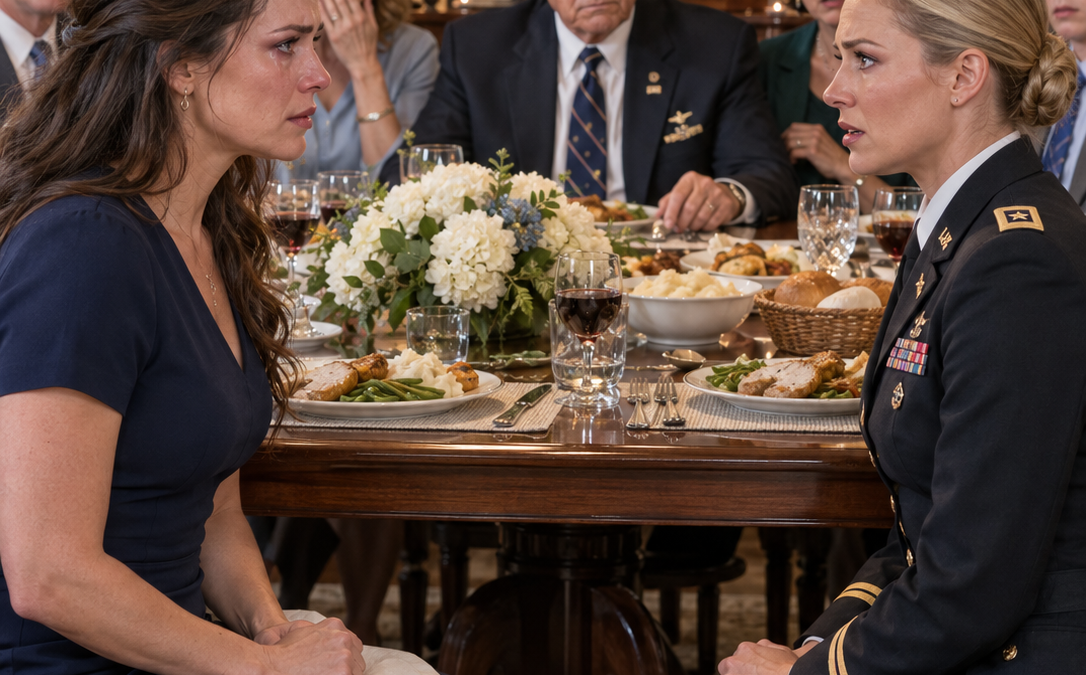
I set down my fork. I told her I had just come back from a nine-month deployment in the Red Sea, that our ship had been part of the operations against the Houthi missile attacks on commercial shipping, and that I had personally flown three combat search-and-rescue missions.
She laughed—actually laughed, threw her head back and everything.
“Combat search and rescue,” she repeated, like she was tasting the words. “Marlo, come on. You’re in the Navy. Must be nice playing sailor on paid cruises while the rest of us do real soldiering.”
The dining room went quiet.
Not the polite quiet where people are waiting for the joke to end. The other quiet. The one where every adult at the table suddenly realizes something has gone wrong.
My mother’s fork froze halfway to her mouth. My father stared into his water glass. Aunt Delphine put her napkin down slowly like she was defusing a bomb. My cousin Terrence, who is 15 and worships Vanessa like she hung the moon, actually snickered.
And Grandpa Reginald set down his fork.
He did not slam it. He did not throw it. He placed it beside his plate with the same careful precision he used for everything, and the small metallic click of that fork on porcelain was the loudest sound I have ever heard in that house.
“Vanessa.”
His voice was low, steady—the voice he used when I was nine and he caught me lying about breaking a window.
“Vanessa, you’d better be very careful what you say next.”
My sister’s smile faltered for just a second. Then, because she has always been the kind of person who doubles down when she should back off, she recovered and gave him her most charming grin.
“Oh, Grandpa, come on. It’s just a joke. Marlo knows I’m kidding.”
“I don’t recall asking what you meant,” he replied. “I asked you to be careful what you say next.”
Silence again, deeper this time.
I want to explain something before I go any further. Grandpa Reginald raised us—not just Vanessa and me, but our whole family, in the sense that everything we are came from him. My father is his only son, and my father learned how to be a father from him. My mother married into this family and adopted his rules like scripture.
When Vanessa and I were little and our parents worked long hours, Grandpa was the one who picked us up from school. He taught me how to tie my shoes, how to swim, how to change a tire, and how to hold a door open for a lady, even if you are a lady yourself, because a door held is a door held.
He never once told me to join the Navy. He never once pressured me.
When I came home from my sophomore year at Old Dominion in 2011 and told him I was thinking about ROTC, he simply asked me why.
I told him I wanted to serve.
He nodded once, poured me a cup of black coffee, and said, “Then serve well, and do not do it for me. Do it because there is a person somewhere out there who’s going to need you, and you have decided to be the kind of person who shows up.”
I have carried that sentence with me for 14 years.
Vanessa, on the other hand, decided on West Point when she was 12. She wanted the prestige. She wanted the ring weekend photos. She wanted people to look at her the way they looked at Grandpa when he walked into a room in his dress blues. And when she got in, she made sure everyone knew forever that she was the West Point one and I was just the state-school one.
Back at the table, Vanessa was scrambling.
“Grandpa, I really was joking. Marlo knows the Navy and Army have this whole rivalry thing. It’s a tradition, right, Marlo?”
She looked at me for backup.
I looked at my plate.
“Tradition,” Grandpa repeated.
He picked up his water glass, took a small sip, and set it down.
“You know what tradition is, Vanessa? Tradition is my father coming home from the Pacific in 1945 with shrapnel in his hip that never came out. Tradition is me leaving Da Nang on a stretcher in 1969 with a piece of a rocket in my shoulder.
“Tradition is your sister, who I have watched grow up in this house, coming home three weeks ago from nine months at sea in a war zone and not even telling any of us she was awarded a Navy Commendation Medal with a Combat V because she is that private about her service.”
My head snapped up.
I had not told anyone about the medal. I had gotten the paperwork on a Tuesday, put it in a drawer, and gone to bed.
“How did you—?” I started.
“Your commanding officer is Captain James Thornberry,” Grandpa answered without looking at me. “James’s father served with me on the USS Providence in 1968. He called me the day the citation was written. He wanted me to know.”
Vanessa’s face had gone the color of the tablecloth, white with two spots of pink on her cheeks that I recognized from every time we had been caught doing something wrong as kids.
“I didn’t know,” she whispered.
“That is the problem,” Grandpa answered. “You did not know, and you did not ask. You just decided.”
He picked up his fork again, and for a moment I thought the storm had passed. I thought he was going to let it go. I thought Vanessa was going to get away with it the way she always got away with everything because she was the pretty one, the West Point one, the one who never rocked the boat with our mother.
Then Grandpa set the fork right back down.
“No,” he said quietly. “We are going to have this conversation, all of us, right now, because this has been going on for too long, and I have been too polite for too long, and I am too old to keep being polite about things that matter.”
Vanessa opened her mouth. She closed it. She looked at our mother for rescue.
Our mother, for the first time in my entire life, did not rescue her.
The clock on Grandpa’s mantel ticked in the silence. It was an old brass thing his own mother had given him in 1958, and it had the loudest second hand of any clock I have ever heard.
Tick, tick, tick.
Nobody at that table moved.
“Reginald,” my mother finally began, using her careful voice. “Maybe we should let the girls sort this out on their own. Family dinner isn’t the place for—”
“Colette,” Grandpa interrupted, and my mother’s mouth closed. “With all respect, this is my house. This is my table, and it is exactly the place.”
My mother looked at her plate.
My father, sitting to her left, still had not lifted his eyes from his water glass. I have loved my father my whole life. And I have also known my whole life that when Grandpa speaks, my father becomes a small boy again.
It is not weakness. It is respect so deep it has weight.
Grandpa turned to Vanessa.
“Do you know what your sister does on that ship?”
Vanessa did not answer.
“I asked you a question, Lieutenant.”
The word lieutenant landed like a slap. She flinched.
In our family, Grandpa had never once used one of our ranks. Not mine, not hers. To him, we were Marlo and Vanessa, and the uniforms came off at the door.
“She flies helicopters,” Vanessa managed.
“She flies MH-60 Romeo Seahawks off a moving deck in every weather condition God has ever invented,” Grandpa corrected. “She is qualified in anti-submarine warfare, surface warfare, and combat search and rescue. Do you know what combat search and rescue means, Vanessa?”
“It means she pulls people out of—”
“It means,” Grandpa cut in, “that when a pilot gets shot down over water, when a sailor gets blown off a deck, when a merchant mariner is drowning while missiles are still in the air, your sister is the person who flies toward that water instead of away from it.
“It means she hovers a 15,000-pound aircraft over waves that are trying to kill her in the middle of a fight. And she does not leave until every person who can be saved has been pulled up on that hoist. That is what she does. That is what she was doing three weeks ago while you were writing your promotion packet in Georgia.”
Vanessa was crying now. Not loudly, just the slow, silent kind. The tears sliding down without her being able to stop them.
“I’m sorry,” she whispered.
“You are not sorry yet,” Grandpa answered. “You are embarrassed. There is a difference. You will be sorry later, when you understand what you did. Right now, you are just embarrassed that I said it out loud.”
He turned to my mother.
“Colette, I love you. You are my daughter-in-law, and you have been the mother of these two girls for 34 years. But you have raised one daughter to think she is better than the other. And tonight is the night we stop pretending that isn’t true.”
My mother’s face crumpled.
My father finally lifted his eyes.
“Dad—” my father began.
“Nathaniel, let me finish.”
My father nodded.
Grandpa looked at me then, really looked at me. And for the first time that night, his voice softened.
“Marlo, sweetheart, I want you to hear me say something out loud because I do not think you have ever heard me say it out loud, and that is my failure, not yours. I am proud of you.
“I have been proud of you since the day you told me you wanted to serve. I have been prouder of you every year since. When you got your wings in 2015, I flew to Pensacola and I sat in that hangar and I cried in front of 200 strangers because I could not believe the little girl who used to color at this table was going to fly aircraft off a warship.
“I am proud of you. Do you hear me?”
I could not speak. I nodded.
“Say it back to me, Marlo, so I know you heard it.”
“I hear you, Grandpa.”
He nodded once sharply and turned back to Vanessa.
“Now about you.”
Vanessa braced.
“I am proud of you too.”
Her head came up.
“I am proud that you got into West Point. I am proud that you commissioned. I am proud that you wear that uniform. But I am not proud of what you have become inside that uniform. And I am going to tell you why. And you are going to listen. And you are not going to interrupt me one single time. Are we clear?”
“Yes, sir,” she whispered.
“When you were 19 years old, you came home for Christmas from your first year at the academy, and you told your sister she was wasting her potential at Old Dominion. Do you remember that?”
Vanessa’s eyes closed.
“When you were 22, at your commissioning, you told a room full of my friends that your sister took the easy road because she was scared to compete with real soldiers. Do you remember that, too?”
She nodded.
“When you were 26, at your grandmother’s funeral, when your sister flew in from her deployment in the Persian Gulf on emergency leave, you told her the Army had sent flowers, but the Navy had not, and asked whether her chain of command even knew our family. Do you remember?”
The tears were falling faster now. She was not wiping them.
“I remember every one of them, Vanessa, because after every one of them, your sister came to me and asked me if she had done something wrong. Not if you had done something wrong. If she had. She thought it was her fault you kept doing it. Do you understand what that means?”
I had not known Grandpa knew any of that. I had never told him.
Vanessa had always done it in front of other people, and she had always done it with a smile, and I had always let it go because I did not want to be the one who ruined the moment. But I had gone to Grandpa afterward more than once, and I had asked him what I was doing wrong, and he had never once told me it was her.
He had just listened.
Now I understood why he had been waiting. Grandpa never fought a fire while it was still small. He waited until he could put the whole thing out in one motion.
“It means,” Grandpa continued, “that for over 10 years I have watched you try to make your sister feel smaller so you could feel bigger. And I have watched her let you because she loves you and because she believed if she just kept being patient, you would grow out of it.
“Tonight I realized you are not going to grow out of it on your own. So we are going to have a family conversation about it. And if certain people at this table are uncomfortable, they can leave, but I would prefer they stay.”
Nobody moved.
My cousin Terrence, the 15-year-old, had gone completely still. Aunt Delphine, his mother, had her hand over her mouth.
Grandpa took a long breath.
“Now, Vanessa, do you know why you do this?”
She shook her head.
“Yes, you do. Think. Take your time. But answer honestly, because I will know if you lie.”
The clock ticked.
Ten seconds. Twenty.
Vanessa stared at her plate, and I watched my sister, who has always had an answer for everything, actually think.
“Because,” she finally began, and her voice broke, “Mom always told me I had to be the best one. Because when we were kids, whenever Marlo did something good, Mom would tell me I needed to do something better. She used to say, ‘The Hastings girls do not settle for second place.’
“And Marlo was first because she was older. So I had to be first in every other way. I had to have the better school, the better career, the better fiancé, the better everything.”
My mother made a small sound like the air had been punched out of her.
“And when Marlo joined the Navy,” Vanessa continued, “Mom said the Navy was fine, but the Army was harder, and I needed to go where it was harder, so I did. And I got into West Point, and Mom told everyone I had gone somewhere real.
“And then Marlo kept doing things, and everyone kept talking about them, and I…”
She stopped. She wiped her nose with her napkin.
“I started to feel like I was disappearing. And so I made her small so I could stay big. And I knew what I was doing. I knew every time, and I did it anyway.”
Nobody spoke.
Grandpa nodded slowly.
“That,” he began quietly, “is the first honest thing you have said in a very long time. Thank you.”
He turned to my mother.
“Colette.”
My mother’s hands were shaking. She had them folded in her lap, but I could see her wedding ring catching the light in little jumps as her fingers trembled.
“Reginald, please,” she whispered. “Not in front of the children.”
“The children,” Grandpa answered, “are grown women, and Terrence is 15, which is old enough to hear the truth about how families work. I am not going to embarrass you, Colette. I am going to ask you three questions, and you are going to answer them honestly. Can you do that?”
My mother nodded without looking up.
“Did you tell Vanessa more than once that she had to be better than her older sister?”
A pause.
Then, very softly, “Yes.”
“Did you tell her, in the specific words she just used, that the Hastings girls do not settle for second place?”
“Yes.”
“Did you ever tell Marlo she needed to be better than her younger sister at anything?”
The pause was longer this time, long enough that I already knew the answer.
“No.”
The word sat in the middle of the table like a broken plate.
“Why not?” Grandpa asked. Not cruelly. Just honestly.
My mother finally looked up. Her mascara had run in two dark lines under her eyes. She looked at me, and for a second I saw something on her face I do not think I had ever seen before.
Fear.
Not of Grandpa. Of me. Of what I might say next.
“Because,” she began, and her voice cracked, “Marlo never needed pushing. Marlo just did things. Marlo was born knowing who she was. And Vanessa was… Vanessa was the one who needed the push. She was the softer one. The one who cried more.
“And I thought if I did not push her, she would never become anything. So I pushed, and I compared, and I…”
She pressed her fingers into her eyes.
“And I told her that her sister was the yardstick. Not because I thought her sister was better, but because I thought her sister was the closest thing she would have to a competitor she could not run away from.”
I had not known this either.
I had spent my whole life thinking my mother preferred Vanessa because Vanessa got the parties, the tuition help, the graduation trips. Vanessa got the wedding fund at 24 even though she was not engaged, just so it would be there.
I never got a wedding fund. I never got a graduation trip. I got a used Honda Civic when I was 17 and a hug at my commissioning.
But now, listening to my mother, I was starting to understand something.
She had spent so much time trying to shape Vanessa that she had never spent any time actually seeing me. She had assumed I did not need her. She had made me into a scoreboard.
I did not know if that was worse or better than what I had thought before.
“Colette,” Grandpa began gently. “Do you know what happens to the older child when you make her a yardstick?”
My mother shook her head.
“She stops feeling like a person. She starts feeling like a measurement, and she spends the rest of her life trying to figure out if anyone in her family actually knows her or if they only know her as the thing they compare the other one to.”
My mother let out a small, broken sound.
“And do you know what happens to the younger child?”
“She learns to hate her sister.”
Vanessa answered before my mother could. Her voice was flat.
“She learns that the only way to matter is to make her sister matter less. And then she grows up and she cannot stop doing it even when she wants to because it is the only game she knows how to play.”
Grandpa nodded.
“You two,” he began, and his voice softened again, “have been played against each other for 30 years. Not by malice, but by fear. Your mother was afraid, and your father let her be afraid. And I saw it happening and I did not stop it because I thought you would figure it out on your own.
“That was my mistake. So tonight I am fixing my mistake.”
He reached into the inside pocket of his cardigan and pulled out a folded piece of paper. He set it on the table.
“This is my will,” he began simply. “I updated it two weeks ago after I got the phone call from James Thornberry about Marlo’s medal. I want to read one section of it out loud because I want everyone at this table to hear it while I am still alive to explain it.”
My father’s head came up sharply.
“Dad—”
“Nathaniel, let me finish.”
Grandpa unfolded the paper. He put on his reading glasses. He cleared his throat.
“To my son Nathaniel and his wife, Colette, I leave the house on Willow Bend, the vehicles, and the contents of my checking account. To my sister, Delphine, I leave the family cabin in the Blue Ridge Mountains and $100,000.
“To my grandson, Terrence, and my two other grandchildren, I leave $20,000 each for their education. To my granddaughter, Vanessa, I leave $20,000 and my father’s Bible.”
He paused.
He looked up.
He looked at me.
“To my granddaughter, Marlo, I leave the remainder of my estate, including the Naval Investment Portfolio, the two rental properties in Virginia Beach, and the contents of the safety deposit box at First National. The estimated value of this bequest is approximately $1,400,000.”
The silence that followed was not silence. It was a vacuum. It sucked the air out of the room.
“Dad—” my father tried again.
“Nathaniel.”
Grandpa cut him off.
“I love your daughters equally. I want to be very clear about that. This is not about love. This is about repair. For 30 years, this family has poured its resources into one daughter and asked the other one to be grateful for scraps.
“I am not going to leave this earth without balancing that ledger.”
Vanessa was staring at her hands.
“Vanessa,” Grandpa continued, “I am not punishing you. I am simply not going to reward the pattern. You have received, over the course of your life, approximately three times what your sister has received from this family.
“West Point was free, yes, but the summers in Europe were not. The car at 16 was not. The wedding fund was not. The down payment your mother gave you on the townhouse in Georgia in 2023 was not. Your sister has received one Honda Civic and a hug. Tonight, we are going to stop that.”
Vanessa did not argue. She did not protest. She simply nodded once and said in a very small voice, “That is fair.”
I stared at her.
In 32 years, I had never heard my sister say something was fair when it did not benefit her.
Grandpa folded the paper and put it back in his pocket.
“Now,” he continued, “I want to say one more thing, and then we are going to eat this meal because your aunt Delphine spent three hours on this roast and it deserves to be eaten while it is warm.”
He looked at Vanessa.
“You are going to apologize to your sister. Not tonight. Tonight, you are too raw. And an apology given while you are still bleeding is not an apology. It is a bandage.
“You are going to go home. You are going to think, and you are going to write your sister a letter, a real one, on paper, and you are going to bring it to her in person within 30 days. Do you understand me?”
“Yes, sir.”
He looked at me.
“And Marlo, you are going to let her write it. You are not going to tell her it is not necessary. You are not going to tell her you forgive her before she has earned it.
“You have spent your whole life letting her off easy because you thought that was the kind thing to do. It was not kindness. It was avoidance. You are going to sit with the discomfort of receiving a real apology because you deserve one. Do you understand me?”
I nodded, unable to speak.
“Good,” Grandpa concluded.
He picked up his fork.
“Now pass the potatoes.”
The rest of that dinner is a blur.
I remember Aunt Delphine passing the potatoes with both hands like she was passing a live grenade. I remember Terrence eating with his head down and his eyes darting around the table like he was watching a tennis match.
I remember my father finally looking at me, really looking at me for what might have been the first time in years, and mouthing the words, “I am sorry,” from across the roast beef.
I did not answer him. I could not. If I opened my mouth, I was going to say things that I would regret.
We finished the meal in near silence.
Grandpa asked Aunt Delphine about her garden. She talked about tomatoes. Nobody heard a word she said, but she kept talking anyway, and I loved her for it.
Sometimes the kindest thing a person can do at a broken table is keep talking about tomatoes.
When dessert came, Vanessa asked to be excused. She kissed Grandpa on the forehead, whispered something to him I could not hear, and left through the front door.
I heard her car start. I heard her drive away.
I did not look up from my pie.
My mother left 10 minutes later, saying she had a headache. My father followed her.
I stayed.
I helped Aunt Delphine and Grandpa clean up. We loaded the dishwasher in silence. When the kitchen was clean, Aunt Delphine hugged me for a long time and left with Terrence, who gave me a small, awkward wave from the passenger seat like he did not quite know what to do with his hands.
Grandpa poured two cups of coffee. He handed me one.
We sat at the kitchen table, the small one, the one with the wobble in the fourth leg that he had been meaning to fix since 1993.
“Are you angry with me?” he asked.
I had to think about it.
“No,” I finally answered. “I am overwhelmed. I am confused. I am a lot of things, but I am not angry with you.”
“Are you angry with your sister?”
“I have been angry with my sister since I was 12. Tonight did not change that. Tonight just gave me permission to know it.”
He nodded. He sipped his coffee.
“I did not do this for the money, Grandpa. You know that, right? I do not need—”
“I know,” he cut in gently. “That is why I did it. The people who need it least are the ones you can trust with it most. If I had left it to Vanessa, she would have spent it proving something. If I leave it to you, you will use it to build something.”
“What am I supposed to build?”
He smiled. The first real smile I had seen from him all night.
“Whatever you want. That is the point.”
I sat with that for a long moment.
“Grandpa, can I ask you something?”
“Anything.”
“Why now? Why did you wait until tonight? You could have said something years ago.”
He set his cup down. He took off his glasses and rubbed the bridge of his nose. When he looked at me again, he looked older than I had ever seen him look.
“Because I have prostate cancer, Marlo.”
The kitchen went sideways.
“It is stage two. The doctors think we caught it early. I start radiation in June. The prognosis is good, but I sat with the news for three weeks before I told anyone. And in those three weeks, I asked myself what I had left undone.
“And the biggest thing on the list was you. Not because you had failed. Because you had never been told. And I decided I was not going to leave this earth, whenever that turns out to be, without you knowing exactly who you are and exactly what you are worth.”
I could not breathe.
I set the coffee down very carefully so I would not spill it.
“Does Dad know?”
“He will know tomorrow. I am telling him and your mother in the morning. I told you first because I wanted you to hear it from me at this table, on a night when everything else in this family was already on the table.”
I reached across and took his hand.
It was thinner than I remembered.
When had my grandfather’s hands become thin? When had I stopped looking closely enough to notice?
“I love you, Grandpa.”
“I love you, too, sailor.”
He had never called me sailor before. Not once. He had always been very careful to keep our uniforms out of the house.
But that night, in that kitchen with the wobble in the fourth leg of the table and the coffee going cold between us, he called me sailor, and I understood it was not a nickname.
It was a promotion.
He was telling me, for the first time in my life, that he saw the uniform on me, that he had always seen it, that he had just been waiting for the right moment to say so.
I drove home that night with the windows down and the radio off. I lived 20 minutes away in a small townhouse near the base. My roommate was already asleep.
My cat, Pilot, met me at the door and rubbed against my legs.
I sat on my kitchen floor in my Sunday dress with my cat in my lap, and I cried for 45 minutes. Then I got up, took a shower, and slept the deepest sleep I had slept in a decade.
The next morning, I had 37 text messages.
Six were from my mother.
Please call me. We need to talk. Please, Marlo. I did not know. Please.
Twelve were from my father. He had written them all in one sitting at 3:00 in the morning, and reading them was like watching a man try to build a bridge out of matchsticks.
I am sorry. I should have said something. I saw it and I did not stop it. I am not asking you to forgive me yet. I am asking you to let me try.
Nineteen were from Vanessa, all at different times throughout the night.
The first one, sent at 9:42 the night before, was three words.
I am sorry.
The second, sent at 10:15, was four words.
I know that is not enough.
The third, sent at 11:03, said, “I am going to write the letter Grandpa asked me to write, and I am going to earn the right to give it to you, and I will not text you again until I have it in my hand. I am sorry.”
The next 16 messages were from her phone, but they were not from her. They were from her fiancé, David.
David is a good man. He is a captain in the Army, too, stationed at the same base as Vanessa. I had met him twice. I liked him.
In the messages, he explained that Vanessa had come home in tears, told him everything, and then locked herself in their guest room and started writing. She had not come out. She had not eaten.
She had asked David to text me so I would know she was alive, but that she would not contact me herself until the letter was done.
I read the messages twice.
Then I put the phone face down on the counter, made myself a cup of coffee, and drove to the base to fly for four hours because there are some things in life that only a helicopter and an empty sky can help you think about.
The next three weeks were strange in a way I did not have language for.
My mother called every day. I did not answer for the first four days. On the fifth day, I picked up.
She cried.
I let her.
I did not say much. I told her I loved her, that I was not ready to have a real conversation yet, and that I would tell her when I was.
She accepted that.
That in itself was new.
My mother had never accepted a boundary from me in my entire life. She had always talked past them. That week, for the first time, she did not.
My father drove over on the second Saturday. He knocked on my door with a bag of bagels from the place I liked when I was in high school.
He did not ask to come in.
He just stood on the porch holding the bagels and said, “I brought these. I will leave them here. If you want to sit on the porch with me for 10 minutes, I would like that. If you do not, that is okay, too.”
I let him in.
We sat at my kitchen counter and ate bagels. He did not try to explain himself. He told me two stories about his own father, my grandfather, that I had never heard.
He told me about the time Grandpa had missed his high school baseball championship because he was at sea, and how he had spent 20 years pretending it did not bother him and then finally admitted at 43 that it had broken something small in him that never quite grew back.
“I did the same thing to you,” my father said. “Not with baseball. With Vanessa. Every time your mother compared you two, I told myself it was harmless. I told myself you were tough. I told myself you would understand. And I never once asked you if you did.”
“I did not,” I answered. “For a long time, I did not.”
“I know.”
He stayed for an hour.
When he left, he hugged me at the door. And it was the kind of hug my father had never given me before. Long. Full.
The kind of hug where a father is telling his daughter with his arms and not his words that he has been standing on the wrong side of the room her whole life and he is walking over to the right side now.
Grandpa started radiation in early May.
I drove him to his first three appointments. My father took the next two. Vanessa flew up from Georgia on a Friday and took the sixth.
She and I did not overlap.
She had asked David to text me in advance so I would know she would be at the hospital that day and to check whether I would be there, too, so we would not accidentally cross paths before she was ready.
I appreciated it.
It was the most thoughtful thing my sister had ever done for me.
On the 21st of May, three weeks and two days after the dinner, there was a knock on my door.
I opened it, and Vanessa was standing on my porch.
She was in civilian clothes, jeans and a plain gray sweater. Her hair was pulled back. She looked thin.
She was holding a manila envelope in one hand and a small potted plant in the other. The plant was a rosemary bush.
“Grandpa said an apology needs a gift that grows,” she began quietly. “I did not know what to bring you. I thought about flowers, but flowers die. I thought about wine, but you do not drink much.
“I remembered you told me once that you wanted to plant an herb garden on your balcony, so I brought you a rosemary bush. I know it is small.”
I looked at her. Really looked.
She had lost weight. The circles under her eyes were dark. Her hands were shaking just slightly, the way our mother’s had shaken at the dinner table.
“Come in,” I answered.
She came in.
She set the rosemary bush on my kitchen counter. She held out the envelope. Her hands were still shaking.
“I wrote it three times,” she began. “The first time was too defensive. The second time was too apologetic. I threw both of them away. Grandpa told me the third one would be the right one, and he was right.
“Will you read it now while I am here? I know that is a lot to ask, but I need you to have questions I can answer if you have them, and I do not want you to sit with it alone.”
I took the envelope.
I looked at her.
“Sit down, Vanessa.”
She sat on my couch, her hands folded in her lap like she was in a job interview.
I opened the envelope.
There were four pages inside, handwritten in my sister’s neat, careful writing. She had been writing that way since she was 12.
I read it.
I am not going to reproduce the whole letter here because some things belong only to the two people in the room where they are read, but I will tell you what she said in the parts that mattered most.
She began by telling me that everything Grandpa had said at the dinner table was true and that she was not going to try to explain it away.
She said she had spent 32 years trying to make herself the important daughter, and she had done it at my expense, and she was not going to pretend she had not known what she was doing.
She said she had known.
She said she had done it anyway.
She said the reason she had done it anyway was not something I owed her the effort of understanding, but that if I ever wanted to know, she would tell me the whole truth about the small hollow place inside her that had made her that way, and she would sit still and let me ask her anything.
She said she was sorry for the specific things Grandpa had named at the table.
She listed them by year.
2013, when I was at Old Dominion. 2018, at her commissioning. 2022, at our grandmother’s funeral.
She named others I had not remembered, and she had.
She said she remembered every one of them because she had known every time that she was making the memory ugly on purpose, and she had done it anyway.
She said she was sorry for the “paid cruises” comment specifically.
She said she had known when she said it that it would hurt. She said she had said it because she had been sitting at the table listening to me talk about the Red Sea and feeling herself disappear.
And she had reached for the oldest tool in her toolbox, which was to make her sister small.
She said she had not thought about what it would cost me. She had only thought about what it would cost her not to say it.
She said she was going to therapy.
She had started the Monday after the dinner. She had already been to five sessions.
Her therapist had told her that the work she needed to do was going to take years, and she was prepared to do it, and she was not asking me to wait for her to finish.
She was asking me to let her come back into my life slowly, to let her prove herself in small ways, and to walk away again if she showed signs of falling into the old pattern.
She said she had told her chain of command, in a private conversation with her battalion commander, that she had a history of making inappropriate interservice comments about the Navy and that she was going to stop, and that if he ever heard her make one again, he had permission to counsel her formally.
Her battalion commander had told her he respected her more for saying it than he would have if she had never done it in the first place.
She said she loved me.
She said she had always loved me.
She said she was sorry it had taken her 32 years and a family dinner and a grandfather with cancer to finally say it in a way she could stand behind.
I set the letter down.
I looked at my sister.
She was crying, but she was not looking away.
She was letting me see her.
“Vanessa,” I began.
“You do not have to say anything yet,” she cut in gently. “I know I have not earned a response yet. I just needed you to have it in your hands. If you want me to leave, I will leave.”
I shook my head.
“Stay,” I answered. “Please.”
She stayed for four hours.
We sat on my couch, and we talked about things we had not talked about in 20 years.
I told her about the deployment. Not the operational parts, but the human parts.
The 18-year-old sailor who had gotten a Dear John letter in the middle of the Red Sea and had come to my office in tears because he did not know who else to talk to.
The night we had lost power on the flight deck during a launch, and I had watched three of my crew members almost slide into the water.
The Somali fishermen we had rescued from a burning dhow, one of whom had handed me his baby daughter as I hoisted him up, and how the weight of that baby in my flight suit had made me cry into my mask for the entire flight home.
She listened.
She did not try to match me. She did not tell me a story of her own to balance mine.
She just listened.
When I was done, she told me things I had not known about her.
About the promotion board she had failed the first time in 2023 and how she had lied to our mother about it because she could not stand the idea of our mother knowing.
About the panic attacks she had started having in 2024.
About the fact that she and David had almost broken up in January because he had told her that she talked about me too much and always in the wrong way, and he could not marry a woman who could not stop competing with her own sister.
“He gave you an ultimatum?” I asked.
“He gave me a mirror,” she answered. “He told me he was not going anywhere, but that he was not going to be silent about it anymore. He told me that if we got married while I was still like this, our children would grow up thinking that is how you love a sister. And he refused to teach our children that.”
I liked David more in that moment than I had ever liked him before.
“When is the wedding?” I asked.
“October, if we still have one.”
“You still have one?”
She looked at me, startled.
“You do not have to.”
“I want to. And I want to be there.”
Her face broke.
“Marlo, I did not put you in the wedding party.”
“I know. Mom told me a year ago. I was hurt. I did not say anything.”
“I was going to ask you to be my maid of honor, and I lost my nerve. I told myself you would say no. I told myself it would be easier to just have my roommate from West Point. I have regretted it every day since.”
I took a breath.
I thought about it for a long moment.
“Do you still want me to?”
She nodded.
She could not speak.
“Then I will.”
We hugged for the first time in maybe 15 years.
Not a family Christmas hug.
A real one.
The kind of hug where two grown women who have wasted 20 years being wrong about each other decide in the same moment to stop being wrong.
Grandpa Reginald finished his radiation in early July.
His scans came back clean. Not cured, they cautioned. Watched, but clean for now.
We threw him a dinner.
Aunt Delphine cooked. My father grilled. My mother made her famous pecan pie, which I had not eaten in six years because I had been out of the country for every Christmas since 2019.
Vanessa flew up with David.
Terrence was there, older somehow, quieter, watching all of us with the eyes of a boy who had learned something at that April dinner and had not stopped thinking about it.
Grandpa sat at the head of the table.
He said grace.
He thanked God for his family, for his doctors, for his sister, for his son, for his daughter-in-law, for his two granddaughters, for his three grandchildren, for his fiancé-to-be.
He named us all.
He did not skip anyone.
Halfway through dinner, my mother stood up.
“I have something I want to say,” she began, “and I want to say it out loud in this house, at this table, because that is where the last one got said, and this is where this one needs to happen, too.”
She turned to me.
“Marlo, I did not see you for 34 years. I have not seen you. I have loved you. I have been proud of you, but I have not seen you. I saw a strong daughter who did not need me, and I let that be an excuse to stop looking.
“I have been going to therapy, too. My therapist told me two weeks ago that I owe you an apology that is not just words. She told me I need to change the pattern, not just name it.
“So I am going to tell you what I am going to do differently, and then you can tell me if it is enough or if it is not, and I will keep working either way.”
She listed things. Small things, mostly.
She was going to call me every week, not to check in on Vanessa, but to actually ask about me.
She was going to come visit me in Norfolk twice a year, not to see the base, but to see my life.
She was going to stop telling people at church that Vanessa was the West Point one and Marlo was the Navy one, as if those were our full names.
She was going to start telling people that Marlo flew helicopters and Vanessa ran a signal battalion. And if they wanted to know which was harder, they could figure it out themselves.
She was going to give me the same amount of money she had given Vanessa in 2023, retroactively, out of her own savings.
Not because Grandpa had shamed her into it at the dinner, but because she had done the math herself and she had realized that a mother who gives one daughter a down payment and does not offer the same to the other is a mother who has told the other daughter, without words, that she matters less.
She was not going to tell that daughter that anymore.
I did not know what to say.
I told her I did not know what to say.
I told her that I needed time. I told her that I appreciated the list and that I would probably appreciate the actions more than the list and that I was going to hold her to it.
She said she understood.
She said she wanted me to hold her to it.
Grandpa was smiling. Not in a self-satisfied way. In the way an old sailor smiles when he sees a ship come in safe after a storm.
After dinner, I found him on the back porch.
He was looking at the sky.
Norfolk skies in July are a strange color, orange and purple at the edges from the harbor lights.
“How are you holding up, sailor?” he asked.
“I do not know,” I answered honestly. “I am happy and I am tired and I do not quite trust that any of this is real yet.”
“That is the right response,” he began. “When something has been broken for a long time and it finally starts to heal, you should not trust the healing right away. You should watch it. You should test it. You should let time do its work.
“But you should also let yourself feel the healing while it is happening because healing is a gift, and you are not required to be suspicious of gifts. You are only required to be patient with them.”
I leaned against him.
He put his arm around my shoulder.
He smelled the way he had always smelled—of aftershave and coffee and pipe smoke from a pipe he had not smoked since 1987, but whose scent had never quite left his cardigans.
“I love you, Grandpa.”
“I love you too, Marlo. I love you the same as I have always loved you, which is the most a man can love a granddaughter without breaking his own heart.”
The wedding was in October at a small chapel on the base in Georgia.
Vanessa wore our grandmother’s dress, altered to fit her.
I wore a dark green bridesmaid dress that she had chosen specifically because she said green was my color and she had never told me before.
I stood beside her as her maid of honor.
I gave the speech.
I will tell you what I said in the speech because it mattered.
I stood up in front of 200 people, most of them Army, and I raised my glass.
“My name is Marlo Hastings,” I began. “I am a lieutenant commander in the United States Navy. I am the older sister of the bride.
“Six months ago, at a family dinner in Norfolk, my sister called my career a paid cruise. Six months ago, I did not think I would ever be standing here giving this speech.”
The room went very still.
“I am telling you this,” I continued, “not to embarrass her, but because the story of how we got here matters more than the story of what she said.
“My sister was raised and I was raised in a family that loved us both, but did not always know how to see us both. It took our grandfather sitting at the head of a table with two Purple Hearts on the wall behind him, telling my sister to be very careful what she said next, for our family to finally start telling the truth.
“And it took my sister, in the weeks after that dinner, doing the hardest thing a person can do, which is to look at the ugliest parts of themselves and refuse to look away.”
I raised my glass toward Vanessa.
“My sister is not the person who said that thing at that dinner anymore. She is the person who wrote me a four-page letter by hand, who started therapy the next Monday, who told her own battalion commander she needed to be held accountable, and who asked me three weeks after the worst moment of our relationship to be her maid of honor because she was not going to spend the rest of her life pretending the person standing next to her at her wedding did not have to be me.”
Vanessa was crying.
So was David.
So was our mother.
So was I.
“To my sister, Vanessa. To her husband, David, who I now understand loved her enough to hold up a mirror when she needed one. To our grandfather, who taught us both what service means in uniform and out of it.
“And to every family out there who is still waiting for someone brave enough to say, ‘Be careful what you say next.’ May we all be that person for someone we love.
“Cheers.”
The whole room stood up.
The bride’s side and the groom’s side.
Army officers who had never met me before were shaking my hand for the next 20 minutes.
Vanessa’s battalion commander pulled me aside and told me my speech had made him cry and that if I ever wanted to be an interservice liaison officer, he would write me a letter.
I laughed.
I thanked him.
I meant it.
The rest of the wedding was ordinary in the way weddings are ordinary.
Cake. Dancing.
Someone got too drunk and had to be helped to a cab. Someone else caught the bouquet.
Terrence, who had turned 16 the week before, danced with me for one whole song.
And when it was over, he told me very seriously that when he graduated high school in two years, he was thinking about joining the Navy, and would I be willing to talk to him about what that was like.
I told him I would love to.
He nodded, adult in the way only 16-year-olds can be adult, and walked back to his mother’s table.
Grandpa did not dance.
He sat at the head table and watched.
When the DJ announced the father-daughter dance, my father took Vanessa out to the floor, and after a minute Vanessa waved me over.
My father held out one hand to me and the other to her.
“I have two daughters,” he began into the microphone the DJ handed him. “I have loved them equally my whole life, and I have shown it unequally, and tonight I would like to dance with both of them at the same time because I have 34 years of catching up to do.”
We danced, the three of us in an awkward triangle.
My father was not a good dancer.
My sister and I laughed until our stomachs hurt.
When the song was over, my father kissed both of us on the forehead and walked us back to our seats.
Grandpa was watching.
He nodded once, slowly, in the way only Master Chiefs can nod.
And I understood in that nod that the balance had finally been restored.
Not because anyone had won.
Because everyone had finally shown up.
I drove home to Norfolk the next day.
I had a deployment coming up in November, only three months this time, a shorter workup cycle in the Mediterranean. I was scheduled to leave the second week of November and be home before Valentine’s Day.
Grandpa’s cancer stayed clean through the fall. His scan in November was still stable.
My mother started calling me every Sunday, and she did not talk about Vanessa unless I brought her up first.
My father started sending me articles about naval aviation history, which he had begun reading in his spare time because he had realized he did not actually know very much about what his own daughter did for a living, and he had decided that was unacceptable.
Vanessa called me twice a week, not to fix anything, just to talk.
She told me about her work. I told her about mine.
Sometimes we talked about nothing.
Sometimes we talked about our mother.
Sometimes we just complained about traffic.
It was the kind of sister relationship I had watched other women have my whole life and had never understood how to build for myself.
I deployed in November as planned.
It was a quiet cruise by our standards.
We ran flight ops. We did presence patrols. We stopped in Naples and Souda Bay.
I flew 52 sorties and did not lose a single crew member, aircraft, or piece of equipment.
It was, in the language of naval aviation, a boring deployment, which is the highest compliment you can give a boring deployment.
I called home more than I usually did.
On satellite phone once a week, I rotated calls between Grandpa, my parents, and Vanessa.
Grandpa’s calls were the shortest. He did not like phones.
He would ask three questions, tell me one story, tell me he loved me, and hang up.
My father’s calls were the longest.
He asked me detailed questions about the aircraft and the mission and the weather, and I answered him, and I could hear him taking notes on the other end of the line.
Vanessa was pregnant.
She told me over the phone in early December. She was 10 weeks along. She and David had been trying since the wedding. She was due in July.
“I want to name her after you if it is a girl,” Vanessa said. “Not exactly, but something close. What is your middle name? Elise?”
“Elise,” I answered.
“Elise. Marlo Elise. That is a beautiful middle name. Can I use Elise?”
I told her she could.
I came home in February.
Elise was going to be born in July.
The baby’s room in Vanessa’s house in Georgia was going to be painted pale yellow with a small watercolor of a helicopter over the crib that Vanessa had commissioned from an artist on the internet.
I flew to Georgia for a long weekend in April on the one-year anniversary of the dinner.
Vanessa was showing. David was nesting.
Grandpa flew down with me.
He was thinner than he had been the year before, but he was walking well. And his scans were still clean.
We sat on Vanessa’s back porch on a Saturday afternoon.
Grandpa had a beer. Vanessa had lemonade. I had coffee.
David was inside cooking. We could smell the ribs on the grill.
“One year ago today,” Vanessa began.
“One year ago today,” Grandpa echoed.
“I have thought about that dinner every single day for a year,” she continued.
“I have too,” I admitted.
“Do you know what I have thought about the most?” she asked me.
“What?”
“That I was so close to losing you, and I did not even know it. If Grandpa had not spoken up, if he had let me get away with it one more time, I would have kept doing it.
“I would have done it at my wedding. I would have done it at Elise’s baptism. I would have done it at my own children’s graduations. I would have died a woman who had ruined her relationship with her sister and never once understood what I had done.”
Grandpa took a long sip of his beer.
“That is the thing about waiting too long,” he began. “Sometimes the longer you wait, the smaller the fix has to be, and sometimes the longer you wait, the bigger it has to be.
“I waited a long time with you two. I hoped it would fix itself. When I realized it would not, I had to be big about it because small was not going to work anymore. I am not proud of the waiting, but I am at peace with the fix.”
“I am at peace with the fix, too,” Vanessa answered.
I reached over and squeezed her hand.
“Me, too.”
Elise Marlo Hastings Cartrite was born on the 14th of July, 2025, at 4:17 in the morning in a hospital in Georgia.
She weighed 7 pounds, 2 ounces. She had a full head of dark hair.
She had, according to her mother, the exact same slightly wrinkled forehead that I had in my newborn photos.
Vanessa named her Elise Marlo, not the other way around.
I asked her why.
She said it was because Elise was her name to give, and Marlo was mine, and she wanted her daughter to grow up understanding that her aunt’s name was carried in the middle of her own name on purpose, for a reason.
And someday, when she asked why, Vanessa would sit her down and tell her the whole story.
I flew down to meet her when she was two days old.
I held her in the hospital room.
She was so small.
She was so warm.
She was breathing against my flight suit, which I had worn on the plane because I had come straight from a training day and had not had time to change.
“Hello, Elise Marlo,” I whispered. “I am your aunt Marlo. You are going to have the most complicated last name in your entire class in kindergarten. I am so sorry about that. I promise to make it up to you in birthday presents.”
Vanessa laughed from the hospital bed.
David took a photograph.
Grandpa, who was sitting in a chair by the window, watched all of it with the small, quiet smile of a man who had seen more of this life than he had ever expected to see.
August of 2025 brought a storm we did not expect.
Grandpa’s scan in August came back with a shadow.
Not a big one. A small one.
But it was on his liver, and it had not been there in May.
His oncologist ordered a biopsy.
The biopsy took four days.
During those four days, I did not sleep more than three hours a night.
The results came in on a Wednesday afternoon.
I was in the ready room at the base when my phone buzzed.
It was my father.
His voice was steady in the way voices are steady when men are trying very hard not to break.
“It has metastasized,” he began. “The cancer. It is in his liver. Two spots. They are small, but they are there. His oncologist wants to start chemotherapy next week.”
I sat down on the ready-room floor.
My squadron mates walked around me without asking.
That is one of the mercies of squadron life.
When someone sits down on the floor, everyone knows why, and everyone leaves them alone.
“How long?” I began.
“They will not say,” my father answered. “You know how they are. But he is 81, Marlo, and it has moved once. He is going to fight it, but he is not going to win forever.”
“I know.”
“Come home this weekend. He wants to talk to you.”
I flew to Norfolk on Friday.
Vanessa flew up with Elise, who was one month old and slept for the entire flight.
Terrence came over with Aunt Delphine.
My whole family sat in Grandpa’s living room on the same couches we had sat on for 30 years.
And we listened to Grandpa lay out the next chapter of his life the way he had once laid out patrol routes.
He was going to do the chemotherapy.
He was going to fight it.
He was not going to be dramatic about it.
He was going to keep going to church, keep tending his garden, keep watching the Norfolk Tides play baseball on Wednesday nights.
He was going to hold his great-granddaughter as often as she would let him.
He was going to attend one more Thanksgiving and, if he was lucky, one more Christmas, and if he was very lucky, one more Easter after that.
He was not scared.
He said so plainly.
He had made his peace with dying a long time ago.
He had made his peace with his life and with his family and with his God.
The only thing he was not at peace with was the idea of leaving before he had said everything he needed to say.
So he told us he was going to say things over the next months, slowly, one person at a time.
He was going to write letters.
He was going to record videos.
He was going to leave nothing important unsaid.
And he wanted each of us to know right now that if there was anything we wanted from him before he was gone, all we had to do was ask.
Vanessa asked him to write a letter to Elise to be opened on her 18th birthday.
He agreed.
Terrence asked him to teach him how to tie a Navy tie knot, which Terrence had seen him wear his whole life and had never learned.
Grandpa agreed.
They spent the next hour in front of the mirror in the front hall, and Terrence walked out with a perfectly tied tie and eyes that were red at the edges.
Aunt Delphine asked him to help her go through their mother’s letters, which had been in a box in his attic since 1994 and which she had never been able to bring herself to look at.
He agreed.
My father asked him to go fishing one more time.
Grandpa agreed.
They set a date for the following Saturday.
My mother, when it was her turn, sat very still and said, “I do not know what to ask for.”
Grandpa smiled at her.
He reached over and put his hand on hers.
“Colette,” he began, “you are the mother of my granddaughters. You are the wife of my son. You have been my daughter-in-law for 36 years. What I want from you is what I have always wanted from you, which is that you love them the way I have loved them—fiercely, fairly, and loudly enough that they can hear you when I am not around anymore to say it, too.”
My mother wept quietly, the tears tracing silent paths down her cheeks.
She gave a slow, deliberate nod, accepting the heavy weight of his words, and made a solemn promise to him.
The air in the room felt incredibly thick with unspoken goodbyes and the quiet realization of the end.
Then Grandpa shifted his gaze away from her and turned his attention entirely to me.
His eyes, though tired and sunken, still held that familiar, sharp clarity that always made me feel seen.
“Marlo,” he said, his voice a gentle, raspy whisper. “Your turn.”
I had been thinking about this exact moment all day long.
My mind had been racing since dawn broke.
I had rehearsed the question over and over again in the shower that morning, letting the hot water wash over me while I tried to find the perfect words.
I had practiced it again in the car on the way over, watching the trees blur past the window while I muttered under my breath.
I had not been able to settle on just one single thing to ask him because there were simply so many things I wanted to know.
I wanted to ask about his first command, or how he handled the fear, or what it felt like to see the curvature of the earth from high above the clouds.
I took a deep breath, studying my trembling hands against my knees.
“Grandpa,” I began, my voice barely above a whisper. “I want you to write me a letter. I want to be able to carry it in my flight suit.
“It does not need to be long. Something small. Something I can fold up neatly and keep safe in the chest pocket. I want it there so that when I fly, you are with me even after you are gone.”
He did not say anything for a long moment.
The silence stretched between us, heavy and profound, as he considered my request.
He looked at me with a depth of understanding that made my chest ache.
Then he nodded just once, a firm and resolute movement.
“Yes, sailor,” he said, his voice filled with a quiet, enduring pride. “I will do that. I will have it written and ready for you before I go.”
He wrote it exactly two weeks later.
He handed it to me in a small sealed white envelope.
My name was written on the front in his careful, deliberate handwriting, the dark ink pressed firmly into the thick paper.
He looked me in the eye and gave me strict instructions.
He told me not to open it until I was on my next deployment.
Specifically, he told me to open it at the exact point in the deployment when I felt farthest from home, when the distance and the loneliness became too much to bear.
He smiled faintly and said I would know exactly when that moment arrived.
I took the envelope and placed it carefully in the chest pocket of my green flight suit.
I zipped it shut, feeling the slight bulk of the paper resting against my heart.
It has been there ever since, a constant, comforting presence through every mission and every flight.
Grandpa Reginald passed away peacefully on the 2nd of December in the year 2025.
He died in his own bed, surrounded by the familiar comforts of the house on Willow Bend.
My father was there, holding his right hand gently, and my mother was there holding his left.
Vanessa and I were standing quietly in the room, keeping a silent vigil.
Little Elise was there too, resting in a crib, completely asleep and peacefully sleeping through the entire event.
According to my father, who was leaning in close to hear him, Grandpa’s very last words were a simple request.
He whispered for us to tell the girls he was proud of them.
He truly did not need to tell us that.
We had already spent the last eight months hearing him tell us exactly that to our faces over and over again.
But my father told us anyway.
He shared the message at the funeral.
He delivered a eulogy that he read from a single piece of yellow legal-pad paper.
His hands trembled so violently that the paper shook the whole time he was holding it, rustling loudly in the quiet church.
The funeral took place a few days later, on the 8th of December.
It was a grand service, complete with full military honors.
The ceremony was beautiful and heartbreaking.
A crisp flag was folded into a tight triangle and formally presented to my father as the next of kin.
However, in a moment I absolutely did not know was coming, my father did not keep it.
Instead, he turned and walked straight across the aisle.
He approached me and presented the folded flag to me instead.
He leaned in and said quietly, so that only I could hear his words, “He wanted you to have this one.”
His voice was thick with emotion.
“Not the family one. The one from him. He told me last week about his wishes. He said, ‘Give it to Marlo. She will know what to do with it.'”
I did know what to do with it.
It sits on the mantel in my townhouse in Norfolk next to a framed photograph of him at my winging ceremony in 2015, crying in front of 200 strangers.
I flew a training mission on the 10th of January, 2026, over the Atlantic about 70 miles east of Cape Hatteras.
It was a routine flight.
A three-hour sortie dropping sonobuoys, running a mock anti-submarine tracking problem.
Nothing special.
The weather was clear. The sea was calm.
The sun was setting on the way home.
At the halfway point, when we were farther from land than we would be at any other moment in the flight, I remembered Grandpa’s letter.
I had not opened it.
I had carried it in my chest pocket for four months on every flight I had flown, but I had not opened it because I had not felt far enough from home yet.
That evening, over the Atlantic, watching the sun go orange and purple over the water the way the Norfolk sky used to go orange and purple in July, I felt it.
I told my co-pilot I was going to read a letter.
He nodded.
He did not ask.
Aviators know when to ask and when not to.
I pulled the envelope out of my chest pocket.
I opened it with one hand, keeping the other on the collective.
The letter was short.
Grandpa had never been a long-letter kind of man.
Marlo, if you are reading this, you are somewhere over water, farther from home than you have been in a while. And you are thinking about me.
I am with you.
I have always been with you.
I was with you the day you were born. And I was with you the day you told me at 19 that you wanted to serve. And I was with you at your winging. And I was with you on every deployment you flew.
And I am with you right now in the pocket over your heart.
The same pocket my father’s father carried his own father’s watch in during two wars.
That pocket has always been for the people we love.
Do not ever fly without something in it.
I have three things to tell you.
The first is that I am proud of you.
I have told you this many times in the last eight months, and I want you to keep hearing it after I am gone.
When you doubt yourself, and you will, I want you to reach into that pocket and remember that a man who fought in two wars and raised your father and buried his own wife and lived 81 years on this earth thought you were one of the finest human beings he had ever known.
That is not a small thing.
Do not treat it as one.
The second is that your sister loves you, and she is going to keep loving you, and she is going to fall short sometimes.
And when she does, I want you to remember that a person who has done the work of coming back from where she was is not the same person she used to be.
Give her grace.
Not endlessly. Wisely.
But give it.
And accept it back from her when she gives it to you because you are going to fall short too, and she is going to be the person on the other side of the phone when you do.
The third is that a sailor is a person who has decided to go to sea.
It does not matter what other people call it.
It does not matter if they call it a paid cruise or a taxi or a boat ride.
What matters is that you have chosen to go to a place most people will not go and to do a thing most people will not do and to come back changed by both.
That is what your grandfather did.
That is what my father did.
That is what you do.
You are the third generation of Hastings sailors, Marlo.
When you die, whenever that is, I hope you are as proud of the life you lived as I am of the one you have already given us.
I love you,
Grandpa.
I folded the letter.
I put it back in my pocket.
I flew the rest of the sortie without saying much of anything.
My co-pilot did not ask.
When we landed, I went to my car in the parking lot, sat behind the wheel for 20 minutes, and cried the kind of crying that only happens once or twice in a life.
Then I drove home.
I fed the cat.
I called my sister.
Elise was six months old.
She was starting to laugh at things in that new-baby way where the laugh sounds like a surprised hiccup.
Vanessa held her up to the camera.
I said hello to my niece.
My niece said something that sounded almost like a word.
Vanessa cried.
I cried.
We both laughed at ourselves for crying.
We hung up.
I stood in my kitchen in my flight suit, and I looked at the folded flag on the mantel, and I understood for the first time that a family is not a fixed thing.
A family is a decision you make every day.
You can decide to make one person the yardstick and the other one the disappearance.
You can decide to let a comment at a dinner become the comment that ends everything.
Or you can decide, when someone you love says a thing that hurts, to be the person who tells them to be careful what they say next.
And you can decide, when someone you love has been hurt for a long time, to walk over to the right side of the room and tell them out loud that you see them.
My grandfather was that person for our family.
He was the one who told my sister to be careful.
He was the one who told my mother to see me.
He was the one who told my father to catch up.
He was the one who told me, in a letter I carry in my chest pocket, that I am the third generation of Hastings sailors and that a paid cruise is only a paid cruise if you have never been on one.
He is gone now, but he taught me how to be the one who says, “Be careful what you say next.”
He taught my sister how to be the one who apologizes on paper.
He taught my parents how to be the ones who show up late but show up anyway.
He taught Terrence how to tie a tie.
He left Elise a letter for her 18th birthday that Vanessa keeps in a fireproof safe in her closet.
And he taught me that boundaries are not walls.
They are doors that only open from the inside.
You do not have to keep letting people in who have hurt you, but you also do not have to keep them out forever.
Sometimes the bravest thing a person can do is knock on the door with a rosemary bush in one hand and a letter in the other and wait for you to decide.
My sister knocked.
I opened the door.
Our grandfather made both of those things possible.
If you have a sister or a brother or a parent or a grandparent or anyone in your family who has spent too many years making you feel small, I want you to know two things.
The first is that you are allowed to say something.
You do not have to wait for the person at the head of the table to say it for you.
You can be the one who sets down the fork.
The second is that people can change.
Not all of them.
Not always.
But sometimes.
And when they do, you are allowed to let them back in on your terms, at your pace, in your time.
My name is Marlo Elise Hastings.
I am 34 years old.
I am a lieutenant commander in the United States Navy.
I am a sister.
I am a daughter.
I am a granddaughter.
I am an aunt.
I am, above all, the person my grandfather taught me to be, which is the person who shows up when someone out there needs her.
Thank you for listening to my story.
If any part of this reached you, if you have your own family story like mine, if you have your own Grandpa Reginald or your own Vanessa or your own dinner table where everything finally came out, I would love to hear about it in the comments.
Please like this video if it meant something to you. Subscribe if you would like to hear more stories like it, and share it with someone who needs to be reminded that they are allowed to be seen.
Be careful what you say next, and be careful what you let go unsaid.
Both of them.








