At 4 in the morning, my half-brother shoved a screwdriver into my shoulder; i felt the warmth of the blood while my parents laughed—“you’re so dramatic”; trembling, i sent an sos before everything went dark; what followed left the courtroom silent; the judge’s face said it all…
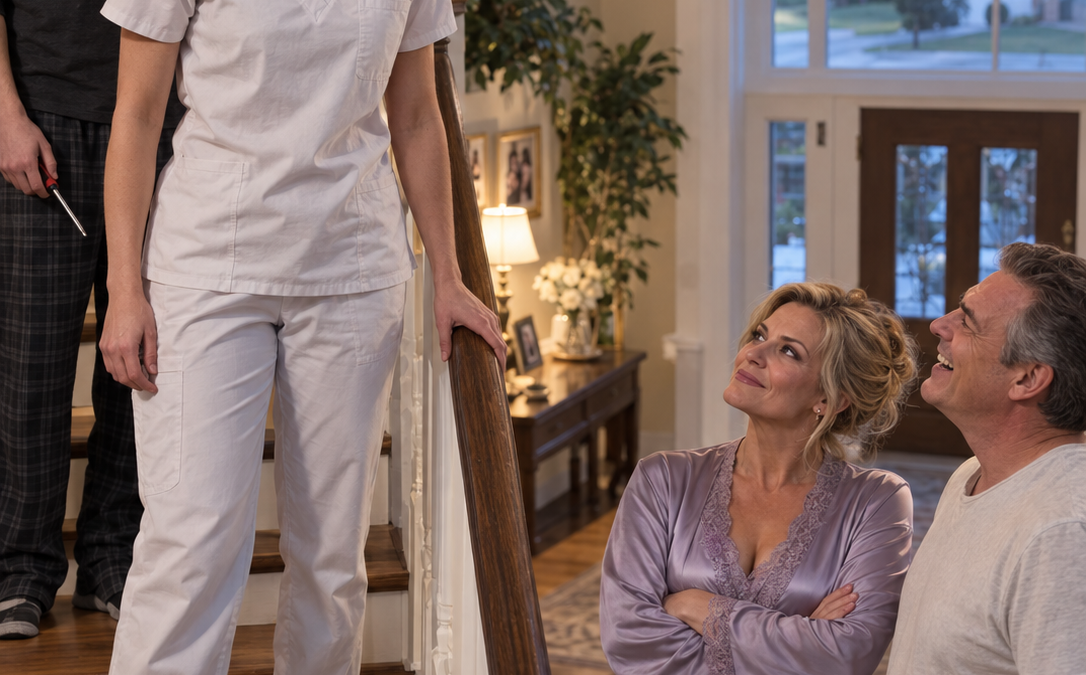
I asked them politely if they could please move the party somewhere else because I had another shift at 6:00 in the morning. Renick looked at me like I was a stranger who had wandered in off the street. He was tall, taller than me by almost a foot, and he leaned back against my couch with a smirk that I will remember for the rest of my life.
“You need to relax, Marlo,” he muttered. “This is our house now, Mom said.”
So I asked him what he meant by that. He shrugged like the answer was obvious. According to him, my mother had told him that anything I had he was entitled to because that is what family does. He said family shares. He said I had always been selfish, keeping my little house to myself while he had nowhere to go.
His friends laughed. One of them, a kid with a chipped front tooth, raised his beer at me like a toast. I felt the heat climb up my neck. I told them all to get out. I told them if they were not gone in 10 minutes, I would call the police.
That was when Renick stood up.
He was not drunk yet. Not really. And I have thought about that fact a thousand times since. He knew exactly what he was doing. He walked past me into the kitchen, pulled open the drawer where I keep my little household tools, the one with the tape measure and the batteries and the small red screwdriver I used to tighten the handle on my cabinet door.
And he took the screwdriver out.
He held it up like he was showing me something interesting he had found.
“Go to bed, Marlo,” he warned, still smiling. “Go to bed before something happens.”
I did not call the police.
That is the part I hate admitting because everyone always asks why. Why didn’t you call right then? Why didn’t you leave the house?
The truth is complicated. The truth is that when your mother has spent 34 years telling you that you overreact, that you are too dramatic, that you make problems out of nothing, a little part of your brain starts to agree with her. A little part of your brain sits down in a chair and folds its hands and says, “Maybe he is joking. Maybe I am being dramatic. Maybe if I just go upstairs and lock my door, everything will be fine in the morning.”
So that is what I did. I went upstairs. I locked my bedroom door. I lay down on top of the covers in my scrubs because I was too tired to change, and I listened to them laughing downstairs until somehow I fell asleep.
The humming woke me up first, that low 4 in the morning quiet. Then I heard my bedroom door click open.
I had locked it. I know I had locked it. But Renick at some point during those 19 days had figured out that the lock on my door was one of those cheap ones you can pop open with a coin from the outside.
He was standing over my bed. He still had the screwdriver in his hand. His eyes were glassy and mean the way I had seen Bram’s eyes get a hundred times when I was a little girl, and he was breathing through his nose like a bull.
“You embarrassed me,” he whispered. “In front of my friends, you made me look small in my own house.”
I tried to sit up. I got as far as my elbows.
He brought his hand down.
I want to be careful how I describe this part because I know some people cannot handle it. And honestly, I still cannot fully handle it either. What I felt was not pain. Not at first.
What I felt was pressure. A hard blunt pressure into the top of my left shoulder and then a strange popping sensation and then a heat that spread down my arm so fast I thought I had knocked over a glass of water in my sleep. I looked down and my white scrub top was turning red in a circle that grew wider while I watched it.
I screamed. I know. I screamed because my throat hurt for three days afterward.
Renick stepped back. He looked at the screwdriver in his hand like he had never seen it before. And then he did something I will never forget.
He laughed.
A short, nervous, surprised laugh, like a kid who has just broken a lamp.
Downstairs, I heard footsteps. I heard my mother’s voice calling up, sleepy and annoyed, asking what all the noise was about. I had forgotten she was even in the house. She had driven over the night before to drop off some of Renick’s mail, and she had ended up staying because it was late. Bram was with her. They were both in my downstairs guest room.
I stumbled out of bed. I made it to the top of the stairs.
My mother was standing at the bottom in her night gown, her hair flat on one side, squinting up at me, and Bram was behind her in a stained white t-shirt, scratching his stomach.
“Mom,” I begged. “He stabbed me. He stabbed me with a screwdriver. Mom, please call an ambulance, please.”
My mother looked at my shoulder. She looked at Renick, who had come out of my bedroom behind me and was still holding the screwdriver at his side. She looked back at me and she smiled.
She actually smiled, the same tight little smile she used to give me when I was 7 years old, and I would come to her crying because Renick had broken one of my toys.
“Marlo,” she sighed. “For God’s sake, you’re so dramatic. It’s a screwdriver, not a knife. Go clean yourself up and stop scaring the neighbors.”
Bram started laughing behind her. A real laugh from the belly. Renick joined in a second later, still nervous, still uncertain, but taking his queue from them the way he had always taken his queue from them.
My whole family stood there in my own house at 4:00 in the morning and laughed at me while blood ran down my arm and dripped off my fingertips onto the hardwood floor I had refinished myself two summers before.
That was the moment something inside me finally broke. And finally, for the first time in 34 years, decided to stay broken.
My phone was on the nightstand. I remember thinking about it the way a drowning person thinks about a rope. It was 6 ft away on the other side of my bed, and it might as well have been on the moon because my left arm was not really working anymore, and my knees were starting to shake in a way I had never felt before.
Shock, a part of my brain informed me calmly. That is shock. You are going into shock. Move.
I backed away from the top of the stairs. My mother was still saying something. Something about how I always had to make everything into a scene. How she had driven all the way over here and now she could not even get one night of sleep.
And Bram was still laughing that low, wet laugh of his. Renick had gone quiet.
I did not look at him. I did not want to see his face.
I made it back into my bedroom. I shut the door. There was no way to lock it anymore. Not really. So I dragged my dresser in front of it with my right hand, one screaming inch at a time. The dresser weighed maybe 80 lb.
On any normal day, I could shove it around like it was nothing. That night, I thought my heart was going to explode in my chest before I got it in place.
I grabbed my phone. My first instinct was to call 911. My thumb was actually on the nine when I stopped.
I do not know how to explain what happened next except to say that a very cold, very clear voice spoke up inside my head. And it said, “If you call 911 right now, your mother will tell them you fell. She will tell them you are on drugs. She will tell them you are having a mental episode. She has been rehearsing that story about you your entire life, and she will use it. You need proof first.”
So instead, I opened my camera. I turned on video. I set the phone down on my dresser, propped against a candle, angled so it caught me from the chest up, and I hit record.
“My name is Marlo Kestrel,” I whispered into the lens.
My voice did not sound like mine. It sounded like somebody underwater.
“It is April 15th, 2025. It is 4:17 in the morning. My halfb brotherther Renick Vale just stabbed me in the left shoulder with a Phillips head screwdriver in my own home at 2847 Larkwood Avenue in Akran, Ohio. My mother, Delphine Vale, and my stepfather, Bram Vale, are in the house. They are refusing to call an ambulance. They are laughing at me. I am bleeding. If something happens to me tonight, this video is my statement.”
I turned my shoulder toward the camera. I pulled the collar of my scrub top down. The wound was small, about the size of a pencil eraser, but the skin around it was already turning a color I had only ever seen in the ER on other people, never on myself. Blood was still coming out in a slow, steady seep, dark and thick.
Then I did the thing that saved my life.
I opened my text messages. I found the name Yalanda Priest.
Yolanda was my best friend since nursing school, a labor and delivery nurse at the same hospital where I worked, and she lived four streets away from me. She was also, and this mattered, the daughter of a retired police lieutenant. Yolanda had a spare key to my house. Yolanda always answered her phone.
I typed with one thumb. My fingers were slippery.
“Yo, Renick stabbed me. Screwdriver, left shoulder. Mom and Bram here laughing. Please come. Please call 911. Don’t let my mom talk to them first. 2847 Larkwood. Front door unlocked.”
I hit send.
Three little dots appeared under my message almost instantly. Yolanda worked overnight shifts, too. She was probably awake.
Then her reply: “On my way. Calling now. Do not open the door for anyone but me. Stay on the phone.”
She called me 2 seconds later. I answered. I did not say anything. I just held the phone against my good ear and listened to her breathing and her car door slamming and her voice, low and steady, telling me over and over, “Marlo, you are okay. You are okay. I am 4 minutes away. Stay with me. Stay with me. Keep your eyes open.”
Downstairs, I could hear voices. My mother was talking to Renick in a hard, fast whisper. I could not make out the words, but I knew the rhythm of it. That was her damage control voice. That was the voice she had used when she found out Renick had stolen from his high school. That was the voice she had used when Bram had put a hole in the wall the Christmas I was 16.
She was cleaning it up. She was writing the story.
Then I heard her feet on the stairs. Slow, deliberate.
She knocked on my bedroom door. Soft. The way she knocked when I was a little girl and she wanted me to come out and apologize for something I had not done.
“Marlo, honey,” she cooed. “Sweetheart, open the door. Let me look at it. I am sure it is not as bad as you think. You know how you get.”
I did not answer.
“Marlo, do not be like this. Renick feels terrible. He was startled. You snuck up on him. He thought you were an intruder. That is what happened. That is what we are going to tell people. Do you understand me? He thought you were an intruder.”
Into the phone, I whispered, “Yolanda, did you hear that?”
“I heard it,” Yolanda confirmed, her voice tight as wire. “I am recording this call, honey. Keep her talking if you can. I am 2 minutes out. My dad is calling the dispatcher directly.”
My mother rattled the door handle. Then she pushed. The dresser scraped an inch across the hardwood.
“Marlo, do not make me get your father up here.”
Bram, she meant Bram.
The man who was not my father, who had never once in 22 years of being married to my mother remembered my birthday, who had made me sleep in the basement the winter I was 13 because Renick wanted my bedroom for his toys.
Something in me went very still.
“He is not my father,” I heard myself say through the door.
My voice was clearer now, sharper.
“He has never been my father, and I am not opening this door. The police are on their way, Delphine. They are already on their way.”
There was a long silence.
Then my mother’s voice changed. It dropped about 20°. All the sweetness poured out of it like water out of a cracked glass. And what was left underneath was something I had heard maybe three or four times in my whole life. Always right before she did something cruel.
“You ungrateful little witch,” she hissed. “After everything I have done for you, after I let you use my last name, after I fed you and clothed you and put up with your dramatics for 34 years, you are going to send my son to jail over a scratch. Over a scratch, Marlo.”
I did not answer.
I pressed my back against the dresser and slid down to the floor because my legs would not hold me anymore. The room was starting to do a slow, soft spin at the edges.
“Yolanda,” I whispered. “I don’t feel good. I don’t feel good.”
“Yo, I am pulling on to Larkwood right now. I see your house. I see your mother’s car. Marlo, stay with me. Stay with me. Do not close your eyes.”
Downstairs, I heard the front door bang open.
I heard Yolanda’s voice, loud and hospital sharp, cutting through the house like a scalpel.
“Deline, step away from the stairs. Bram, sit down. Renick, put your hands where I can see them. The police are two blocks away. Do not touch anything. Do not move.”
My mother started shouting. Bram started shouting. Renick started crying. Actually crying. The same fake tears he had cried at 12 when he broke my violin and blamed it on the cat.
I heard Yolanda’s feet coming up the stairs two at a time.
“Marlo, it’s me. Open the door, honey. It’s just me.”
I reached up. I could barely feel my fingers. I pushed at the dresser. It moved maybe an inch. Yolanda pushed from the other side. Together, we got it open enough for her to slip through.
And then she was on her knees next to me, her hands already ripping open a clean towel she had brought from her car, pressing it hard against my shoulder. And her face when she saw the amount of blood on my floor was a face I will never forget as long as I live because Yanda Priest was a woman who had seen everything. And she looked in that moment like she wanted to kill someone.
The sirens started outside. Red and blue light began to pulse against my bedroom wall.
And somewhere between one heartbeat and the next, my eyes finally closed.
I woke up to the sound of a heart monitor and the smell of that particular hospital soap they use in every emergency room in America. And for one confused second, I thought I had fallen asleep at work.
Then I tried to move my left arm and a bright white pain lit up my whole body and everything came rushing back at once.
A nurse was standing over me. Her name tag said Karine. She had kind eyes and a stud in her nose.
“Hey there, sleepy.” She smiled. “Welcome back. You are at Sama Akran City. You are safe. Do you know what happened?”
I nodded. My mouth felt like sandpaper.
“Where’s Yolanda?”
“She’s in the hallway with the detectives. She has not left this hospital in 11 hours. She has been chewing everyone out, including me, and I am one of her favorite people. Do you want me to get her?”
I nodded again.
Yolanda came in like a small hurricane. She was still in the sweatpants and hoodie she had thrown on to run to my house. Her braids were pulled back with a rubber band that looked like it had come off a broccoli stem.
She sat down on the edge of my bed and grabbed my good hand and squeezed it so hard I thought my fingers might come off.
“Don’t you ever do that to me again,” she muttered. Her eyes were red. “Don’t you ever go quiet on me on the phone like that. I aged 40 years, Marlo. 40 years.”
“I’m sorry.”
“Don’t apologize. Don’t you dare apologize.”
She filled me in slow so I could keep up.
The screwdriver had gone in almost 2 in. It had missed the artery by about half a cime. If it had gone in a little to the left, or if Yolanda had gotten there 10 minutes later, I would have bled out on my bedroom floor.
They had done surgery on me for 3 hours. I had a drain in my shoulder. I would need physical therapy for months, but I was going to keep my arm and I was going to keep my life. And those were the two things Yolanda kept saying over and over like she needed to hear them out loud to believe them.
Then she told me the other part.
Renick had been arrested at the scene. He had been charged with aggravated assault with a deadly weapon and a couple of other things she could not remember the names of.
My mother had been detained, too, for interfering with a police response and for tampering with evidence because when the officers arrived, she had been in my bedroom trying to wipe the screwdriver clean with the hem of her night gown.
Bram had been questioned and released.
“They put your mother in the back of a squad car, Marlo. She was screaming that you set the whole thing up. She was screaming that you have always hated Renick. She told them you are mentally ill. She said you are on medication for delusions.”
“I’ve never been on any medication in my life.”
“I know that. The police know that too now because I told them I have been your best friend for 11 years and I have never once seen you take anything stronger than an ibuprofen. But you need to know she said it. She said it in front of witnesses. That’s the story she’s going to keep telling.”
I stared at the ceiling. The ceiling tile above my bed had a water stain shaped like the state of Florida.
“Do you have the video?” I asked.
Yalanda pulled out her phone. She turned it around and showed me. She had air dropped my recording to herself while I was in surgery. She had also given a copy to the detective in charge of my case, a woman named Detective Morraine, and she had made sure the detective saw her do it, so there could be no question about chain of custody.
“You saved yourself, Marlo. You saved yourself with that video. I want you to understand that before I even got there, before the police got there, you saved your own life.”
I closed my eyes for a second because I did not want to cry in front of her.
And then I opened them and I cried anyway.
Detective Marine came in about an hour later. She was in her 50s, gray at the temples, with the kind of face that had heard every lie a human being can tell. She sat down in the visitor chair and she pulled out a small notebook and she asked me to tell her everything from the beginning in my own words as clearly as I could remember.
I told her about the 19 days. I told her about the frozen lasagna and the friends on the porch and the drawer with the tools. I told her about my mother’s phone call in March, the begging, the promise of two weeks. I told her about the bedroom door and the coin lock and the dresser.
I told her about the laughing. She wrote it all down.
When I got to the part about my mother laughing, her pen stopped moving.
She looked up at me.
“Miss Kestrel,” she said, “I want to make sure I have this right. You are telling me that your mother, while you were actively bleeding from a stab wound, told you that you were being dramatic.”
“Yes.”
“And your stepfather laughed.”
“Yes.”
“And your half-brother laughed, too.”
“Yes.”
She wrote three more words in her notebook. She closed it. She looked at me for a long moment.
“I’ve been doing this for 26 years,” Detective Marine said quietly. “I have seen a lot of families. I want you to know something. What happened in that house last night is not your fault. What your mother chose to do when she saw you bleeding is not your fault. You did not cause this. And you do not owe anyone in that family a single thing after what they did. Not forgiveness, not silence, not a phone call, nothing. Do you understand me?”
I nodded. I did not trust my voice.
“There will be a trial. If we go to trial, your brother’s lawyer will try to make you look unstable. Your mother will testify against you. She has already indicated to us that she intends to. You need to be ready for that. But I want you to know from where I am sitting and from what I saw in that video and from what your friend Yolanda has told me, you have a very strong case. Very strong.”
“Okay.”
“Okay.”
She stood up to leave. At the door, she paused.
“One more thing, there is a woman named Simon Alcarez. She is a victim advocate. She works with our office. I am going to have her come see you tomorrow. She will help you with the restraining order, with the housing, with everything. You do not have to figure any of this out alone. Are you comfortable with that?”
I said yes.
She left.
The room was very quiet after she was gone. Yolanda had gone to get coffee. The heart monitor beeped in that slow, steady way.
I lay there and I thought about my mother in the back of a squad car. I thought about the smile she had given me at the bottom of the stairs. I thought about all the years I had spent apologizing to her, softening things for her, making myself smaller and smaller so that Renick could be bigger, and how at the exact moment I had needed her most, she had chosen to protect the son who had just tried to kill me.
Something clicked into place inside my chest.
It was not anger exactly. It was quieter than that. It was more like a door closing. A door that had been hanging half open my entire life, letting in a cold draft I had learned to live with. And now, finally, someone had walked over and shut it, and the room was warm for the first time in 34 years.
That someone was me.
Yolanda came back with two coffees. She handed me one. I could not drink it because of the surgery, but I held it in my good hand and let the warmth soak into my palm.
“Yo,” I whispered.
“Yeah, baby.”
“I’m not going back to that family. Not for anything, not ever.”
She looked at me for a long moment. Then she reached over and clinkedked her paper cup gently against mine.
“About time,” she smiled.
The next morning, Simon Alcarez walked into my hospital room and changed the direction of my life.
She was a short woman, maybe 5’2, with silver hair cut sharp against her jawline and a leather folder tucked under her arm that looked like it had been through wars.
She sat down without being invited, and she opened the folder and she said without wasting a single second, “Miss Kestrel, I have been doing this work for 31 years. I am going to walk you through the next 6 months step by step and I promise you that on the other side of this you will still have a life and it will be a better life than the one you had before. Are you ready to get to work?”
It was not really a question. I nodded anyway.
Simone had a checklist. She had a checklist for everything. She had a list of documents I needed to gather, a list of numbers to change, a list of accounts to lock, a list of witnesses to identify.
She had already, in the 12 hours between when Detective Marine called her and when she walked into my room, spoken to my hospital’s HR department, my landlord. I was still paying the mortgage on my house. But I also owned a rental duplex, which she had learned from Yanda, my bank, and a family law attorney named Everett Bishop, who had agreed to take my case at a steep discount because he owed Simone a favor from a case in 2018.
“You are going to file for a 5-year civil protection order against Renick, Delphine, and Bram Vale,” Simone informed me, sliding a form across the tray table.
“All three, not just the brother.”
“All three. We are going to argue that your parents were active participants in the assault by refusing to render aid and by attempting to obstruct the investigation. Judge Aeronson usually handles these. She is fair. She is also a woman, which does not always matter, but in this case I think it will.”
She kept going. She barely paused for breath.
“You are going to give notice to your mother that you are legally changing your last name back to your biological father’s name. What was his name?”
“Kestrel. My mother took his name when they got married and she never changed it back after he died. She just made all of us go by veil after she remarried Bram. But I kept Kestrel on my paperwork whenever I could.”
Simone’s eyebrows went up.
“You were smart. That is going to help us. You have a paper trail of using your legal name. Good. Next. You are going to file a lean on your own house to make sure no one can claim any interest in it, especially since your mother has, according to what your brother told the officers, been telling him that the house belongs to the family, which it does not.”
“Yes.”
“Yes. You are going to have your locks changed, not just rekeyed, changed, full new hardware on every door. Yolanda has already arranged this. A locksmith will be at your house at 2 this afternoon, and Yolanda will supervise. You are also getting a security system installed on Thursday. Yolanda has arranged that, too. She is a bulldog. I like her.”
“Everybody likes her.”
“Good. Now, the hardest part. Are you ready?”
I brace myself.
“You are not going to answer any calls, texts, emails, or messages of any kind from your mother, your stepfather, your half-brother, or anyone acting on their behalf from this moment forward until the criminal case and the protection order are both resolved. Not one, not a word, not a voicemail listened to. Nothing. If they contact you, you screenshot it, you send it to me, and you delete it. Can you do that?”
I hesitated. Not because I wanted to talk to them. I did not. But because 34 years of training was fighting back inside my chest, the trained part of me that said, “If you go silent, she will only get angrier. If you go silent, she will punish you worse later.”
Simone saw it on my face. She leaned forward.
“Marlo, listen to me. Every single word you say to that woman between now and the trial, she will twist and use against you. Everyone, every I love you, every I forgive you, every I just want to understand. She will take it into a courtroom and she will hold it up like a weapon. The only way to win this is silence. Total complete boring strategic silence. Do you understand?”
“Yes.”
“Say it back to me.”
“I will not respond to any of them. I will screenshot everything. I will send it to you.”
“Good.”
Simon stayed for two more hours.
By the time she left, I had signed nine documents, one of which was the paperwork to change my name officially to Marlo Iona Kestrel, dropping Veil forever.
She had also quietly, without making a big deal of it, arranged for a therapist named Dr. Priya Renfro to come visit me at the hospital the next day. And she had told me, matter of fact, that most people who survive what I had survived develop symptoms of trauma within the first 6 weeks, and that we were not going to wait for that. We were going to get ahead of it.
Nobody had ever gotten ahead of anything for me before. I did not know how to react. I just nodded and signed where she pointed.
That night, in the quiet of the hospital, I opened my phone for the first time. I had told Yolanda to keep it and screen everything, but I wanted to see for myself.
There were 47 missed calls from my mother.
There were 16 from Bram. There were three from Renick, from the jail phone, which had been rejected automatically because he had not been added to my approved list.
There were voicemails, dozens of them.
I took a breath. I opened the first voicemail from my mother.
“Marlo, honey, it’s mom. I hope you’re okay, sweetheart. I know things got out of hand last night. I have been worried sick. The police took Renick, honey. They took him. He is just a boy, Marlo. He is your brother. Please, please call me back. We need to figure out what to tell them so we can bring him home. We are a family. Families protect each other. Call me back, sweetheart. I love you.”
I opened the second one.
“Marlo, this is your mother. It has been 6 hours and you have not called me back. This is unacceptable behavior. Your father and I are worried sick. Renick is in jail because of your video. Do you understand what you have done? Do you understand? Call me back right now.”
I opened the third one.
“Marlo, I swear on my life if you do not call me back within the hour, I am going to come to that hospital and I am going to drag you home by your hair. You are still my daughter. Do not forget that.”
I open the fourth one.
“Marlo, honey, I am sorry about the last message. I was upset. Please call mommy back. Please, I am so scared. I do not know what to do. Renick’s lawyer says if you drop the charges, he can come home. Please, sweetheart. Please. He is your brother. Do this for me.”
There were 43 more.
I put the phone face down on my chest. I stared at the ceiling. The Florida stain looked more like a shoe tonight if I turned my head to the side.
I thought about the little girl I used to be, the one who would have crawled through broken glass for a phone call from her mother that started with the word honey.
I thought about how many times I had said sorry to her for things I had not done. I thought about how many times I had watched Renick smash something of mine while she stood there and told me that boys will be boys.
I did not call her back.
I did not call any of them back.
Yanda came in the next morning with muffins. Dr. Renfro came in that afternoon with tissues. Simone came in the day after that with more forms.
And little by little, one signature at a time, one silence at a time, one boundary at a time, I started to build a wall between me and the family I had been born into, brick by brick, with my own two hands.
Well, one hand, the other was in a sling, but it was enough.
I was released from the hospital on the sixth day. Yanda drove me home. Her cousin Marcus had scrubbed my bedroom top to bottom. The whole hardwood floor, the walls, the mattress had been taken away and a new one delivered. I had asked for that. I could not sleep in that bed again.
Marcus had also, without me asking, painted my bedroom a soft pale green because Yolanda had mentioned once years ago that I loved that color and he had remembered.
I stood in the doorway of my own bedroom in the middle of the afternoon on April 21st, 2025, and I cried for 10 minutes straight while Yolanda made me tea in my kitchen and pretended not to hear.
The next 6 weeks were the strangest of my life.
The criminal case against Renick was moving forward. He had been denied bail because Detective Morraine and Simone had presented the video, the text messages, and my mother’s 47 voicemails as evidence that Renick, if released, would be pressured by his family to intimidate or harm me. The judge had agreed.
He was staying in county lockup until his trial.
My mother had not been so lucky.
Her charges were lower, and she had gotten out on bond within 2 days. Bram had picked her up.
And even though there was now a temporary protection order in place, the same one Simone was working to make permanent, my mother had immediately started testing it.
She drove past my house twice a day at first, then five times a day. My new security system caught her every time.
Simone told me to save every clip and to not, under any circumstances, wave, honk, gesture, or make eye contact if I saw her. Just log it, send it, move on.
She sent people.
My aunt Melisand, who I had not spoken to in 9 years, showed up on my porch with a casserole and a pinched expression, saying she just wanted to talk.
Yolanda, who happened to be there, opened the door 2 in, told her the protection order applied to her too now as a proxy contact under Ohio law, and closed the door in her face.
That was a bluff. It did not apply to her, not technically. But my aunt did not know that. She left.
My mother’s pastor called. The pastor of a church I had not attended in 11 years and had never particularly liked called my personal cell phone and left a 9-minute voicemail about forgiveness and Christian duty and the sanctity of the motheraughter bond.
Simone had me forward it to Everett Bishop, my lawyer, who sent the pastor a very short letter reminding him that he was potentially in violation of an active protection order by making contact on behalf of a restricted party.
The pastor stopped calling.
My cousin Odelise posted on Facebook that I was tearing the family apart. She was 30 and had two kids and had never once in my entire life called to check on me.
She wrote a paragraph about how I was self-centered and how it was disgusting that I was letting my baby brother rot in jail over a misunderstanding.
Yolanda screenshotted it and sent it to me with the words, “Do not read the comments. Do not respond. We are collecting these.”
I did not read the comments, but I read Odel’s post. I read it three times and I noticed something.
Not one single person in my whole extended family in the 6 weeks since Renick had stabbed me had asked how I was doing. Not when it asked about my shoulder. Not when it asked if I could still do my job, which required both arms. Not when it asked if I was scared. Not when it asked if I was okay.
They were all worried about him, about what would happen to him, about how sad my mother was, about how ashamed the family looked.
That was when the last piece of the little girl inside me, the one who had still been hoping quietly in the back of my chest that someone in that family would surprise me, finally packed her bag and walked out of the house for good.
I threw myself into the case.
Everett Bishop was a tall, thin man with a shaved head and a voice like a cello, and he ran his practice out of a converted Victorian on the east side of town. His office smelled like old paper and peppermint. He had a habit of tapping his pen against his teeth when he was thinking.
He was, according to Simon, the best trial lawyer within a 100mile radius when it came to family violence cases. And he had won three cases in a row against the same prosecutor’s office that was now handling Renick’s case.
We met twice a week.
He wanted to know everything about my childhood, not just the assault. And at first, I resisted because I did not see the point, but he explained it patiently.
“Marlo, the defense is going to build a story about your family. In that story, you are the difficult daughter, the dramatic one, the one who never got along with your brother. They will paint your mother as a saint and your brother as a lost boy and you as the villain who could not let a small mistake go. We need our own story, a truer one. And that story starts long before April 15th.”
So I talked.
I talked for hours over multiple sessions into a small silver recorder.
I talked about being seven and having my birthday cake given to Renick because he was crying. I talked about being 10 and being told to give up my bedroom because he needed more space. I talked about being 13 and being made to sleep in the basement one whole winter because Renick wanted my room for his toy collection.
I talked about being 16 and paying for my own school clothes with money from a summer job at a diner while Bram bought Renick a new dirt bike.
I talked about being 22 and asking my mother for a small loan of $2,000 to help me finish nursing school and being told no, but 3 months later watching her write Renica a check for $4,000 to buy a used car.
Everett wrote it all down.
He said at one point very quietly, “Marlo, you understand this is a pattern that lasted three decades.”
“I understand.”
“And you understand that the assault in that context is not an isolated event.”
“I understand that too now.”
“Good. We are going to make sure the court understands it.”
The one thing I refused to do was talk to my mother. Not in mediation, not in a phone call, not in a written letter.
Simone had prepared me for the moment when the defense would offer some kind of family reconciliation meeting framed as a way to resolve things quietly. It came on May 18th in the form of a letter from Renick’s public defender.
Everett read it, snorted, and dropped it in a manila folder marked denied.
The trial was set for July 22nd, 2025.
In the meantime, I did physical therapy three times a week. My therapist was a former Marine named Paloma, who did not let me feel sorry for myself for even one second.
She had me lifting a 2 lb weight the first week, 5 lb the second. By June, I could reach above my head with my left arm again, though it hurt and I could not sleep on that side without pain.
Paloma told me I would probably always have weather sensitivity in that shoulder. Rain would find me forever.
I told her that was fine. My body would remember what happened.
Good. I wanted it, too.
I went back to work part-time in early June. My co-workers at the hospital had heard everything.
There is no way to keep something like that quiet in a small city. Especially when you work with 200 nurses.
The first day I walked back onto my unit in a sling, they had put a card on my desk the size of a poster board. 56 signatures, little notes, one from the head of surgery, one from a janitor named Miguel, who I had eaten lunch with maybe three times in 6 years.
Miguel had written, “We are your family here.”
That is what he wrote.
I put the card in a frame. It is still on my wall.
And I waited for July 22nd.
The courthouse in downtown Akran is an ugly gray building from the 1970s with a fountain out front that never works and a metal detector at the entrance that beeps at everyone even if you have nothing on you.
On the morning of July 22nd, I walked through those doors in a navy blue dress that Yolanda had picked out for me, with my hair pulled back, with my hands cold, with Everett Bishop on my left and Simone Alcarez on my right, and my heart beating so hard I could hear it in my ears.
The trial was for Renick alone. My mother’s case had been separated out and was set for October.
But she was there.
Of course, she was there.
She was sitting in the second row behind the defense table, wearing a lavender cardigan and pearls, a rosary wrapped around her left hand. She had never once in her life owned a rosary. She was not even Catholic.
Bram was next to her in an ill-fitting suit that pulled tight across his stomach. He was staring at me like he was trying to set my forehead on fire.
Renick was already at the defense table when we walked in. He had lost weight in jail. His face looked thinner, meaner. He was wearing a gray suit his mother had brought him.
He glanced at me exactly once when I walked past. He looked away fast.
Everett had prepared me for the opening statements.
The prosecutor was a woman named Anise Cardardoza. She was maybe 45, sharp featured, wore a plum colored suit. She spoke to the jury like she was telling them a bedtime story.
She walked them through the events of April 15th slowly, carefully, in a voice that never rose above conversational.
“On the morning of April 15th, 2025, the defendant, Renick Vale, entered the locked bedroom of his halfsister, Marlo Kestrel, at approximately 4 in the morning. He entered that bedroom carrying a Phillips head screwdriver. He plunged that screwdriver into her left shoulder while she was lying in her bed. He did this because, in his own words to responding officers, she had embarrassed him.
“Ladies and gentlemen, the state will prove that this was not an accident. This was not a startled reflex. This was not a mistake. This was an intentional violent act committed by a grown man against his sleeping sister in her own home at 4:00 in the morning.”
The defense attorney was a heavy set man named Cyrus Wend. He got up next.
He tried very hard.
He talked about a troubled young man. He talked about a chaotic household. He talked about a sister who had been quote hostile to him from the moment he moved in. He talked about a startle response and a misunderstanding.
He never once used the word screwdriver in his opening. He called it the object.
Then Anise called her first witness.
May I walked to the stand.
I had practiced this with Everett a dozen times. I sat down. I put my good hand on the Bible and my other weaker hand on my lap. I swore to tell the truth. I sat.
Anise walked me through it.
Every detail.
I did not cry. I had cried it all out in the six weeks leading up to that day in Dr. Renfro’s office, in Yolanda’s kitchen, in my new pale green bedroom.
And by the time I sat on that stand, my tear ducts had run dry. My voice was steady.
I told the jury about the 19 days. I told them about the lasagna. I told them about locking my bedroom door. I told them about waking up with the pressure on my shoulder.
And then Anise showed the video, the one I had recorded at 4:17 in the morning.
It played on a large monitor in the middle of the courtroom. I watched my own face on that screen, pale, half in shadow, blood on my scrub top, voice underwater.
I heard myself say my name. I heard myself say the address. I heard myself say, “My mother, Deline Vale, and my stepfather, Bram Vale, are refusing to call an ambulance. They are laughing at me.”
There was total silence in that courtroom while the video played.
When it ended, I looked at the jury. Two of them were crying. A woman in the back row had her hand over her mouth. A man in the second row was staring at the floor.
I looked at my mother.
She was not crying.
She was smiling.
That same tight little smile from the bottom of my stairs.
She caught my eye and she gave a tiny, almost invisible shake of her head, the same way she used to do at church when she wanted me to sit up straighter, like I was still seven, like she still owned me.
I looked away from her.
I looked at Judge Aeronson.
Judge Aonson was a black woman in her 60s with silver locks pulled into a low bun and reading glasses on a beaded chain.
Simone had told me she was fair. Simone had told me she did not tolerate nonsense in her courtroom.
I could see it in her face.
She was watching the defense table. She was watching my mother in the second row. She had not missed the little smile. She had not missed the headshake.
She was writing something down.
Cyrus Wend stood up for cross-examination.
He tried to trip me up. He tried a lot of things.
He asked me if I had ever had a bad relationship with my brother. I said yes.
He asked me if I had ever wished my brother did not exist.
I paused. I told the truth.
“When I was a little girl, yes. When I was seven or eight, yes, because he was allowed to break my things and I was punished for crying about it. As an adult, no. I wished he had gotten help. I wished my parents had made him get help. I did not wish him harm.”
Cyrus tried again.
“Isn’t it true, Miss Kestrel, that you invited my client into your home?”
“My mother asked me to let him stay for 2 weeks. I said yes as a favor to her.”
“So, you invited him in.”
“I let him stay as a favor to my mother. Yes.”
“And once he was there, isn’t it true that you began treating him with hostility?”
“I asked him to stop eating all of my food. I asked him to not have parties in my house at midnight when I had to work at 6:00. I asked him to lock the front door at night. If that is hostility, then yes.”
There was a small ripple of quiet laughter in the jury box. Cyrus’s neck turned pink.
He asked a few more questions.
He tried to introduce a theory that Renick had come into my room because he heard a noise and thought I was an intruder.
I told the jury calmly that my bedroom door had been locked, that Renick had picked the lock with a coin, that he had brought the screwdriver with him from downstairs, that intruders do not typically break into their own bedrooms.
In almost smiled at me from the prosecutor’s table. Cyra sat down.
In called her next witness, Detective Morraine, then Yolanda, then the surgeon who had operated on me, Dr. Idris Kain, who explained in careful medical language exactly how close the screwdriver had come to my brachial artery.
He used the word millime.
He used it twice.
The jury did not miss it.
Then on day two, the defense called their witnesses.
They called Renick’s friend with the chipped tooth, the one who had raised his beer at me. His name was Trace and he was a terrible witness.
He contradicted himself twice on the timeline. He admitted under Anise’s questioning that he had been drinking that night. He admitted he had left before the assault.
He admitted he had not seen anything.
They called Bram.
Bram lumbered up to the stand and swore his oath and sat down.
In let Cyrus lead him through his testimony first.
Bram said I had always been jealous of Renick. He said I had never accepted him as a stepfather. He said I had a habit of exaggerating.
Then Anise got up.
She was gentle at first. She asked Bram to describe the morning of April 15th in his own words.
Bram said he had come out of the guest room, seen me at the top of the stairs, seen that I was upset, and decided the situation was under control.
“Under control?” In repeated.
“Yes.”
“Mr. Veil. Your stepdaughter had a screwdriver wound in her shoulder. She was bleeding onto her floor. She was asking you to call an ambulance, and your testimony to this court is that the situation was under control.”
“She was fine. She was standing up.”
“She was standing up,” In echoed.
She let that hang. She turned to the jury for exactly one second. Then she turned back to Bram.
“Mr. Veil, did you laugh at your stepdaughter that morning?”
“I did not.”
“You did not?”
“No.”
Inise walked to her table. She picked up a small remote. She pointed it at the monitor.
The video played again.
My voice, my blood.
And in the background, faint but unmistakable, the low, wet belly laugh of a heavy man. Then a second higher laugh. And then a woman’s voice.
“Marlo, for God’s sake, you’re so dramatic.”
In let it play.
She let it play the entire 90 seconds.
Then she paused it.
“Mr. Mr. Veil,” she asked softly. “Is that not your laugh in that recording?”
Bram’s face went a color I did not know a face could go.
He did not answer.
“Mr. Veil?”
“I do not remember.”
“You do not remember laughing while your stepdaughter bled from a stab wound.”
“I said, I do not remember.”
Judge Aeronson leaned forward just slightly. Just enough.
“Mr. Veil,” she said, “you will answer the question.”
The courtroom went quiet in that way rooms do when everyone in them realizes at the same time that something important is happening.
I watched Judge Aeronson’s face while she waited for Bram to answer.
She was not angry, not visibly.
She was something more dangerous than angry.
She was interested.
She was paying very close, very careful attention.
Bram opened his mouth. He closed it. He opened it again.
“Your honor,” he tried. “I have already said I do not remember.”
“You do not remember an event from 3 months ago in which your stepdaughter was stabbed with a screwdriver in your presence and you allegedly laughed.”
“Correct.”
“And when you say you do not remember, are you saying you did not laugh or are you saying you have no recollection either way?”
Cyrus Wend jumped to his feet.
“Your honor, I would object to the court questioning.”
Judge Aeronson turned her head about 3 in in his direction.
“Mr. Wend, sit down. I am clarifying an answer that your witness gave. That is within my discretion. Sit down.”
He sat down.
“Mr. Veil?”
“I do not know if I left.”
“You do not know.”
“That is what I said.”
“Very well, Miss Cardardoza. Please continue.”
Anise continued.
She spent the next 40 minutes taking Bram’s testimony apart piece by piece. She showed him the phone records that indicated no call had been made to 911 from that house at any point between 4:00 in the morning and 4:22, when Yolanda called from her car.
She showed him the medical records that indicated I had lost approximately two units of blood between the moment I was stabbed and the moment paramedics arrived.
She asked him how, in his professional opinion as a stepfather, he thought a person who had lost two units of blood was quote fine.
He did not have a good answer.
He mumbled. He shifted in his seat.
By the time Anise released him, he looked like a man who had been slowly deflated.
He walked back to the second row.
He did not sit next to my mother. He sat two seats away.
The defense called my mother next.
I want to describe what happened when my mother walked to the witness stand because it is important.
She did not look at me.
She did not look at Renick. She did not look at Bram. She walked with her chin tilted up, her rosary still wrapped around her left hand, and she took the oath in a small trembling voice that I recognized instantly because I had heard her use it my whole life.
It was her hurt little bird voice.
It was the voice she used at family dinners when Bram would say something cruel and she wanted the whole table to feel sorry for her.
She sat down. She dabbed at her eyes with a tissue.
Cyrus led her through her testimony.
She talked about what a difficult child I had been. She talked about my dramatic tendencies. She said I had been diagnosed with an anxiety disorder as a teenager, which was a lie, one Everett had already prepared me for and one in ease would eventually dismantle.
She said Renick was the sweetest boy in the world.
She said the night of April 15th had been the worst night of her life because her family had been ripped apart.
She said, and here she looked directly at the jury for the first time, that she loved both of her children equally and that she was here today because she just wanted the truth to come out.
Cyrus sat down.
In stood up.
She walked slowly to the witness stand. She stopped about 6 ft away from my mother.
She did not raise her voice.
She did not need to.
“Mrs. Veil,” she began. “You said you love both of your children equally.”
“I do.”
“When was the last time you visited your daughter in the hospital after the assault?”
“I was not permitted to visit her because of the protection order.”
“Yes. Which was filed on April 17th?”
“Yes.”
“So between April 15th, when the assault occurred, and April 17th, when the order was filed, you had 2 days during which you could have gone to the hospital. Did you go?”
Silence.
“Mrs. Vale. Did you go to the hospital to see your daughter during those two days?”
“I was very upset. I was dealing with my son.”
“Your son who had just stabbed your daughter.”
“He is my son. He needed me.”
“Your daughter did not need you?”
“I did not know how badly she was hurt.”
In walked back to her table. She picked up a manila folder. She flipped it open.
“Mrs. Vale, I have here the phone records for your cell phone between April 15th and April 17th. During that 48 hour window, you made 47 phone calls to your daughter’s cell phone. Is that correct?”
“I was worried about her.”
“You were worried about her, but you did not go see her.”
“She would not answer my calls.”
“Because she was in surgery for 3 hours and then in recovery.”
My mother did not answer.
“Mrs. Vale, I would like to read from one of the voicemails you left your daughter on April 15th at approximately 10:00 in the morning. Do I have your permission to read it aloud?”
“I do not remember what I said.”
“That is all right. I have the transcript. Quote, Marlo, I swear on my life if you do not call me back within the hour, I am going to come to that hospital and I am going to drag you home by your hair. You are still my daughter. Do not forget that. End quote.”
My mother’s face changed.
“Did you say that, Mrs. Veil?”
“I was upset. I did not mean it literally.”
“You threatened to drag your recently stabbed daughter home by her hair from a hospital, but you did not mean it literally.”
“Objection,” Cyrus tried. “Argumentative.”
“Overruled,” Judge Aronson replied evenly.
An ease kept going.
She read from three more voicemails, each one worse than the last. Each one confirmed as authentic by my mother, who could not seem to figure out how to deny them.
By the end of the reading, the woman on the stand did not look like a grieving mother anymore.
She looked like exactly what she was, a woman who had spent 48 hours screaming at her bleeding daughter to protect the son who had done it.
Anise had one more thing.
“Mrs. Vale,” she asked quietly now, “when your daughter came to the top of the stairs on the morning of April 15th, bleeding from her left shoulder, and asked you to call an ambulance, what did you say to her?”
My mother said nothing.
“Mrs. Vale.”
“I do not remember.”
Anise nodded slowly. She picked up the remote.
The video played again.
This time she isolated the audio.
My mother’s voice, crystal clear, filled the courtroom.
“Marlo, for God’s sake, you’re so dramatic. It’s a screwdriver, not a knife. Go clean yourself up and stop scaring the neighbors.”
Anise paused the recording.
“Mrs. Veil, is that your voice?”
“Yes.”
“And you told your daughter while she was bleeding that she was being dramatic.”
“I did not know how bad it was.”
“You told her she was scaring the neighbors.”
“I did not want the neighbors to worry.”
“You were more concerned about the neighbors than about your daughter’s stab wound.”
“That is not what I said.”
“That is exactly what you said, Mrs. Vale. It is on the recording. The jury just heard it.”
An ease turned. She walked back to her table. She sat down.
“Nothing further, your honor.”
Judge Aeronson’s eyes had not left my mother’s face for a full minute. When she finally spoke, it was to Cyrus.
“Redirect, Mr. Wend?”
Cyrus stood up. He looked at his witness. He looked at the jury. He looked at the judge. He appeared to weigh his options for a full 5 seconds.
“No redirect, your honor.”
“You may step down, Mrs. Vale.”
My mother stood up.
She walked in her lavender cardigan with her rosary, past the defense table, past Renick, past Bram, and back to the second row.
She sat down.
She did not cry. She did not dab her eyes with a tissue.
She sat perfectly still, and she stared at the back of Cyrus Wen’s head, and I realized, watching her from across the courtroom, that I did not know this woman.
I had never known this woman.
The woman I had thought was my mother had been a story I told myself, a soft, warm version of the real thing.
And the real thing was a stranger in a lavender cardigan who had just been publicly exposed and did not seem even now capable of feeling shame about it.
The judge called a recess.
Everett leaned over to me.
He whispered, “Marlo, how are you doing?”
I did not answer right away.
I was watching my mother across the room.
She had finally turned her head and was looking at me. Her eyes were flat. There was no love in them.
There was no sadness. There was no regret.
There was only anger, cold and hard, as if I had done something unforgivable to her, as if I were the one who had brought a screwdriver into her bedroom at 4:00 in the morning.
I met her eyes.
I did not look away.
And for the first time in 34 years, I did not feel small under her stare.
I turned back to Everett.
“I’m okay,” I whispered. “I’m okay.”
The trial went to the jury on the afternoon of July 25th.
In had put on a clean, careful, devastating case. Cyrus had done what he could.
His closing argument leaned heavily on the idea that Renick was a young man who had made a terrible mistake in a moment of confusion and that a lifetime in prison would not undo the damage or bring anything good to anyone.
In her closing did not raise her voice. She simply reminded the jury that Renick had picked a lock, that he had brought a weapon, that he [clears throat] had used it, that he had laughed, that his family had laughed with him, and that the woman sitting at the prosecutor’s table with a still healing wound in her shoulder had been asleep in her own bed when it happened.
The jury deliberated for 6 hours.
I spent those 6 hours in a small windowless room down the hall with Yolanda and Simone. Yolanda had brought snacks. She had brought a deck of cards. She had brought a puzzle book.
I could not focus on any of it.
I stared at the wall. I kept touching my shoulder without meaning to.
Dr. Renfro had warned me about this.
She said, “The body remembers things the mind tries to move past. The body would bring it up. The body would tap me on the shoulder, literally, and remind me.”
At 7:53 in the evening on July 25th, 2025, the baiff came to the door and told us the jury had reached a verdict.
We went back into the courtroom.
My mother was already there. Bram was already there.
Renick was brought in from the holding area. He walked past me. He did not look at me.
The jury filed in.
The four person was a black woman in her 40s, a school teacher. According to Voir Dyer, she held a piece of paper in her hands.
Her expression gave nothing away.
Judge Aeronson asked the standard questions. The four person answered and then the judge asked her to read the verdict.
“On count one, aggravated assault with a deadly weapon. We the jury find the defendant Renick Vale guilty.”
A soft sound came out of my mother in the second row.
I did not turn to look at her.
“On count two, breaking and entering, we the jury find the defendant Renick Vale guilty. On count three, obstruction of justice, we the jury find the defendant Renick Vale guilty.”
Renick did not react.
He was staring at the table. His shoulders had gone very small.
Judge Aeronson thanked the jury. She dismissed them. She set the sentencing hearing for August 19th. She had Renick remanded back into custody.
The baoiff walked him out.
He did not look at me on his way past. He did not look at anyone.
I do not really remember leaving the courtroom that day.
Everett hugged me. Simone hugged me. Yolanda did not hug me. She just took my good hand and held it very tight all the way to the parking garage.
And then when we got into her car, she started crying, the first time I had ever seen her cry.
And I sat in the passenger seat and I patted her arm and I told her it was okay.
It was okay.
We did it.
We did it.
The sentencing hearing was almost 4 weeks later.
I spent those four weeks working, sleeping, going to therapy, talking to Simone about the next phase, my mother’s trial in October, which was going to be harder in some ways because the evidence was more diffuse.
But Anise was ready, Everett was ready, Simon was ready.
On August 19th, I went back to the same courthouse, same navy dress, Yolanda beside me.
This time, I was allowed to give a victim impact statement. Everett had helped me write it, but the words were mine.
I stood at a small lectern and I turned it to face the defendant’s table where Renick sat in an orange jumpsuit.
And I read it in a voice that shook only a little.
I told him that on the morning of April 15th, 2025, I had lost more than blood.
I had lost a brother. I had lost a mother. I had lost the illusion, the story, the fantasy that I had a family who would protect me.
I told him that I was not there to ask for a longer sentence or a shorter one.
I told him that I was there so that he would hear out loud in his own hearing from my own mouth that what he did was not a mistake.
That what he did was a choice.
That he had chosen at 4 in the morning to walk up the stairs with a weapon he had gone downstairs to get and to open a locked door and to use that weapon on his sleeping sister and that the choice belonged to him and would belong to him for the rest of his life.
I told him I forgave him.
I said that word carefully.
I told him that forgiveness for me did not mean reconciliation. It did not mean a relationship. It did not mean phone calls or holidays or letters.
It meant that I was setting down the weight of him so that I could carry my own life more easily. It meant that I was choosing to walk away without hate but also without hope.
I told him I would not be visiting him in prison. I told him I would not be writing to him.
I told him that he was not from this day forward my brother.
He was a man who had done something to me.
That was all.
I sat down.
Judge Aeronson took a long breath.
She thanked me. She thanked Denise. She looked at Renick.
She sentenced him to 12 years in state prison with parole eligibility after 8.
She spoke to him directly. She told him in a voice that I will remember as long as I live that in her 22 years on the bench, she had rarely seen a case that troubled her as deeply as this one.
Not because of the physical injury alone, though it had been severe, but because of what she had heard on that recording, because of the sound of adults laughing at a bleeding young woman, because of the sound of a mother telling a wounded daughter to stop scaring the neighbors.
She said that in her experience, violence like Renex did not come from nowhere.
It was grown. It was fed. It was taught.
And she hoped for his sake that he would use his time in prison to think about who had taught him and to decide what kind of man he wanted to be when he came out.
Then she looked briefly at my mother in the second row.
“Mrs. veil,” Judge Aeronson said, “your own case is not before me today, but you should know that this court has taken a very careful record of your conduct during the events of April 15th and in the weeks that followed. The evidence in this trial has been preserved. It will be available to the court that hears your case in October. I would strongly advise you to secure competent counsel and to prepare accordingly.”
My mother did not react.
She sat perfectly still in her cardigan.
Judge Aeronson banged her gavvel.
Court was adjourned.
Outside the courthouse in the August heat on the cracked concrete of the plaza with the fountain that did not work, I stood between Yolanda and Simon and I felt something I had never felt before in my entire life.
It was not happiness. It was not relief. It was not even peace.
Not exactly.
It was a strange still feeling in the center of my chest. A feeling of being for the first time all the way inside my own body, taking up all the space I was allowed to take.
Apologizing to no one for existing.
Simon squeezed my arm.
“You did the hard thing, Marlo.”
“I did.”
“There is more hard thing coming in October.”
“I know.”
“You’re going to be okay.”
I looked at her. I looked at Yolanda. I looked past both of them at the ugly gray building where the last piece of my old life had just been finished.
“I know that too,” I whispered.
And I meant it.
My mother’s trial began on October 6th, 2025, and it was a different kind of hard from Renick’s.
Renick’s trial had been about a knife, about a wound, about a moment.
My mother’s trial was about a lifetime.
It was about a mother’s duty of care. It was about a woman who had, according to the state, actively obstructed the investigation of a violent crime against her own child.
She was charged with obstruction of justice, tampering with physical evidence, and endangering the welfare of a person incapable of self-care due to injury.
This time, there was no video of the crime itself because her crime had not been a single act.
It had been 47 voicemails.
It had been a night gown used to wipe a screwdriver.
It had been a story she had told the responding officers about me being on drugs.
It had been her calls to my aunt, to her pastor, to my cousin.
All of them documented.
All of them collected over 5 months by Everett Bishop and Simon Alcarez and preserved in a binder that was so thick it took two hands to lift.
She had hired a private attorney this time.
His name was Sterling Pace. He had a lot of hair for a man in his 60s. He was expensive.
Bram had apparently taken out a second mortgage on their house to pay for him, which I only learned later because Aunt Melisand of all people mentioned it in a text she sent me that I did not respond to.
In was still the prosecutor.
Judge Aeronson was still on the bench, which I did not know was allowed, but Everett told me it was a matter of scheduling and neither party had objected.
My mother had probably wanted Aeronson because she thought a woman would understand her.
My mother had understood exactly nothing about that judge.
The trial lasted 5 days.
I testified again on day two, and it was easier this time because I had already done the hardest version.
Yanda testified. Detective Marine testified.
Anise walked the jury through the phone records, the voicemails, the pastor’s letter, the aunt on my porch, the drivebys captured on my security cameras.
She walked them through the night gown, which had been photographed at the scene, with visible smears of what turned out to be my blood on the hem, exactly where my mother would have used it to wipe the screwdriver.
Sterling Pace tried to argue that my mother had been in shock.
He tried to argue that the voicemails were the desperate messages of a mother who had lost one child to the police and was terrified of losing the other.
He tried to argue that the night gown had been contaminated by contact with her son during a hug.
Ines took each of his arguments and sat them gently down and dismantled them one at a time.
And by day four, Sterling looked tired.
The way lawyers look when they have realized their client is going to be convicted no matter what they do.
My mother did not take the stand this time.
She had learned that lesson from July.
The jury got the case on the afternoon of October 10th. They came back in 4 hours.
Guilty on all three counts.
Judge Aeronson set the sentencing for November 3rd.
She released my mother on the same bond terms as before over Anise’s objection, and she reminded my mother in a voice that could have cut glass that any contact with me, direct or indirect, between now and sentencing would be considered a violation of the protection order and would be factored heavily into her sentence.
My mother did not respond.
She walked out of the courtroom on Bram’s arm, and she did not look at me.
November 3rd came fast.
I stood again at the small lectern. I had a different statement this time.
I had thought about it for weeks. I had written and rewritten it. Dr. Renfro had read three drafts. Simone had read four.
The one I finally settled on was short.
I told my mother that I was not there to hurt her.
I told her that I was there because for 34 years she had told me my feelings did not matter. And today I was going to say them out loud in a room full of people and she was going to have to sit and hear them one time in her whole life.
I told her that when I was seven and she gave my birthday cake to Renick, that hurt me.
I told her that when I was 13 and she made me sleep in the basement, that hurt me.
I told her that when I was 22 and she gave Renick $4,000 while telling me she could not spare $2,000 for nursing school, that hurt me.
I told her that when I called her at 19 with a fever of 104 in a college dorm and she told me to stop bothering her and hung up, that hurt me.
I told her that when I bought my house at 28 without any help from her and she came to see it and told me the kitchen was small and Renick’s future wife would need more space, that hurt me.
I told her that when Renick stabbed me and she smiled, that did not hurt me.
That did not hurt me because by then I was already gone.
She had taught me over three decades exactly how much I meant to her. And by the time I was standing at the top of my own stairs bleeding, I already knew.
I told her that I forgave her too in the same way I had forgiven Renick.
Forgiveness that was for me, not for her.
Forgiveness that meant walking away, not walking back.
I told her that she was not from this day forward my mother.
She was a woman who had given birth to me.
That was all.
I sat down.
My mother was looking at me now.
She had not looked at me during the trial. She had not looked at me when I read my statement about Renick.
But now she was looking at me and her face had cracked open finally, and I could see something underneath it that surprised me.
It was not love.
It was not shame.
It was fear.
A pure cold adult fear.
She had understood at last that I was really leaving, that I was not coming back, that the trap door she had used my entire life, the one where she would push me away and then pull me back with a phone call, had been welded shut.
She was on the other side of it now, forever.
Judge Aonson gave her four years in state prison with parole eligibility after 2 and a half.
She spoke to my mother directly at the sentencing.
She told her that motherhood was not a title, but a set of choices.
She told her that on April 15th, 2025, and in the weeks that followed, my mother had made a series of choices that had in the court’s view disqualified her from the title.
She told her that she hoped my mother would use her time in prison to think about the choices she had made and to understand why they had brought her to this room on this day in this cardigan.
She told her that this was, she hoped, an end that could also be a beginning.
She said it quietly, but she said it.
And then she banged her gavvel.
Bram sat alone in the second row. He did not have anyone with him.
He had lost the son to prison, the wife to prison, and the second mortgage to Sterling Pac’s fees.
He was 63 years old, and he was from that day forward alone in the house on Popular Street.
He looked at me once as I walked past him on my way out of the courtroom.
His eyes were wet.
I did not stop.
I walked into the hallway.
Yalanda was waiting. Simone was waiting. Everett was there too for the first time in a long time in a way that felt less like professional courtesy and more like a friend.
He hugged me.
He said, “Marlo, it is done. It is really done.”
I nodded.
I could not talk yet.
I walked out into the October afternoon.
The trees on the courthouse plaza had turned gold. There was a breeze. The fountain was still not working.
I stood in that breeze for a long time and I did not cry and I did not smile and I did not do much of anything except breathe.
Just breathe in and out, in and out, alive.
The winter after everything ended was the quietest winter of my life.
I do not mean quiet as in sad.
I mean quiet as in still.
Like a house after a storm has passed and you walk outside and the world has been washed clean and there are branches down and there is work to do but the sky is bright and the air smells new.
That kind of quiet.
I went back to work full-time in December.
My shoulder had healed as much as it was ever going to heal. Paloma had discharged me from physical therapy in November with a warning that I would always have some weakness in that arm and that on rainy days I would remember.
She was right.
Every rainy day I remember, but I also remember that I lived.
I remember that I fought.
I remember that I did not stay down.
I sold the house on Larkwood Avenue in February 2025.
Wait, I need to correct myself.
I sold it in February of 2026 in real time. But for the purposes of this story, what I want you to know is that I did not stay in that house forever.
I could not sleep in that pale green room past a certain point.
Every time the ice creaked on the roof at 4:00 in the morning, I would sit up in bed with my heart in my throat.
Yanda and Dr. Renfro both agreed.
Moving was not running away.
Moving was healing.
I bought a small blue house on a culde-sac on the west side of town.
It has a yard.
I planted lavender in the yard on purpose because I wanted to reclaim the color from my mother’s cardigan.
There is a porch. The porch faces west and in the evenings when I am off work, I sit out there with a book and I watch the sky do its slow color changes and I think about how 3 years ago I would not have been able to imagine sitting still like that without a phone in my hand, waiting for the next call from my mother, the next demand, the next crisis.
I do not wait for those calls anymore.
They do not come.
My mother is in a women’s correctional facility about 90 minutes from Akran.
She has written me two letters.
I have not opened them.
I gave them unopened to Simon who keeps them in a file in case they contain anything the court needs to see.
That is what boundaries look like for me.
That is what they look like now.
Renick has not written.
I did not expect him to.
Bram sold the house on Popler Street in the summer. He moved to Florida to live with his brother.
I heard this from Aunt Melisand, who tried to reach out to me one more time in September with an apology that I read but did not respond to.
It was not a good apology.
It was the kind of apology that spends more time explaining the apologizers’s difficulty than acknowledging the harm.
I let it sit.
Maybe someday I will write back.
Probably not.
Yanda got engaged in the spring to a man named Devant who works as a paramedic and who cried, actually cried, the first time I told him the whole story of what happened and who has never once in the two years I have known him made me feel like I was too much or too dramatic or too anything.
He is going to be a good husband to my best friend.
I am going to be a maid of honor.
I have the dress.
It is emerald green.
Simone retired at the end of 2025.
She sent me a card that said, “Some clients you carry with you, and I have carried you with me every day. I have that card on my refrigerator. I look at it sometimes when I forget who I am.”
Everett Bishop is still practicing.
He sends me a Christmas card every year.
He has a wife and three cats.
His office still smells like peppermint.
Dr. Renfro and I met every week for 2 years, and now we meet once a month.
She has taught me things I did not know a person could learn.
She has taught me that the small voice inside my head that used to say I was too much was not my voice.
It was borrowed.
She has taught me that boundaries are not walls.
They are property lines and that a healthy person does not apologize for having a fence.
She has taught me that forgiveness and reconciliation are two separate rooms and you can walk into one without ever unlocking the other.
She has taught me that the little girl who used to hide in the basement in the winter of 1998 because a grown man wanted her bedroom for his toy collection did not deserve any of it and that the woman I am now can go back to her in my mind and pick her up and carry her out.
And I do that sometimes in therapy.
I close my eyes and I walk down those old wooden stairs and I find that little girl in her sleeping bag by the water heater and I sit down next to her and I tell her, “You did not do anything wrong. None of this is your fault. You are going to grow up and you are going to survive a night that nobody should survive. And you are going to build a life on the other side of it. And it is going to be a good life. It is going to be a small, quiet, good life with a porch and lavender and a best friend and a career and a dog.”
Yes, I got a dog.
His name is Biscuit.
He is a rescue.
He sleeps at the foot of my bed.
The other night at 4 in the morning, I woke up.
Not from a nightmare, just to use the bathroom.
I sat up in bed.
Biscuit lifted his head.
The house was quiet.
That same low humming quiet, I remembered.
And for a second, for one long second, my heart started to race because my body remembered.
My body always remembers.
Then I looked around.
I saw my blue walls. I saw my dog. I saw the pale slice of street light coming through the curtain. I heard the furnace kick on.
And I understood all at once in a way I had not fully understood before that the 4 in the morning I had feared for so long was not a time.
It was a place.
It was a specific house on Larkwood Avenue where a specific family had decided together that I did not matter.
I did not live in that house anymore.
That house did not exist anymore.
Somebody else lived in it now.
A nice young couple who did not know what had happened in the upstairs bedroom.
And that was fine.
That was as it should be.
Houses forget.
Houses move on.
So do people.
I lay back down.
Biscuit put his head on my leg.
I slept the rest of the night.
If you have listened to this story, if you have followed me all the way to the end of it, I want to say a few things to you before I go.
The first is that if any part of this story sounded familiar to you, if any of it made you sit up a little straighter and think of your own mother or your own brother or your own house at 4 in the morning, please know that you are not alone.
Please know that what happened to you was not because you were dramatic or difficult or too sensitive.
Please know that the small voice inside your head that tells you it was your fault is a borrowed voice and you can give it back.
The second is that family is not the people you were born to.
Family is the people who show up when you are bleeding.
Family is the friend who breaks four traffic laws at 4 in the morning to get to your house.
Family is the victim advocate who has never met you, but treats you like a daughter.
Family is the therapist who sits with you through the ugly cries.
Family is the dog who does not know your history and loves you anyway.
Family is a choice.
You get to make it every day over and over.
The third is that walking away is not the same as giving up.
Silence is not the same as weakness.
A closed door is not the same as a cold heart.
Some rooms you leave and you do not go back to.
And the reason you do not go back is not because you are unforgiving, but because you have finally at long last learn to forgive yourself for the years you spent trying to make a home in a house that was never going to be safe.
My name is Marlo Kestrel.
I am 34 years old.
I was stabbed with a screwdriver in my own bedroom on April 15th, 2025 by my half-brother and my mother laughed.
I sent one text message to one friend and that text message saved my life.
I built a case and I stood in a courtroom and I told the truth and the truth was enough.
My brother is in prison.
My mother is in prison.
My stepfather is alone in Florida and I am on a porch on the west side of Akran, Ohio with a dog and a book and a life that belongs to me.
If this story meant something to you, if it moved you, if you saw yourself in it anywhere, I would love it if you would give this video a like and subscribe to the channel so more people can find stories like this one.
And in the comments below, if you feel like sharing, I would love to hear from you.
Tell me about the moment you set down a weight you had been carrying for too long.
Tell me about the friend who showed up.
Tell me about the boundary you finally drew.
We are all, all of us, building a family out of the pieces we have.
And there is room in this comment section for one more chair at the table.
Pull it up.
Sit down.
You are welcome here.
Thank you for listening.
Take care of yourselves.
And if you ever hear that low 4 in the morning humming and your heart starts to race, look








