At 14, my stepmom accused me of hurting her son. by nightfall, my entire family had disowned me. my dad left me alone in the hospital, saying: “don’t ever call us again.” i thought i had lost everything. two hours later, the hospital received one phone call… and the nurse suddenly started calling me “miss.”
My name is Vicky Morrage. I am 30 years old. At 14, my stepmother stood in a room full of adults and told them I had hurt her 8-year-old son. By nightfall, my entire family had erased me. My father walked me to a hospital hallway with a fractured wrist, looked at me like I was already a stranger, and said, “Don’t ever call us again.” Then he turned and left without looking back. For two hours, I was just the girl in bed four. No one used my name. I did not cry. Crying would have only proven their story. Then a phone rang at the nurse’s station. When the nurse came back, she pulled the curtain and called me miss softly, like I suddenly had people. What none of them knew was that my mother had left one quiet instruction years earlier.
That single call did not just change how the hospital saw me. It started a clock none of them could stop. Welcome back to Hidden Shadows, the place where family secrets unfold and quiet decisions change everything. If you are new here, drop a comment and be sure to subscribe so you never miss a story. Now, let us get into it. I’m Vicki. Wherever you’re listening from tonight, I’m glad you’re here because this is not a story about getting even. It’s a story about the night I found out who I really belonged to. To understand the phone call, you have to go back 16 years and before that to a kitchen and a number my mother made me learn by heart. These days, I spend most of my working hours in a small room with soft chairs and one long mirror on the wall.
The mirror is not really a mirror. It’s a window. And on the other side, there are people who need to hear a child tell the truth in her own words one time, cleanly without anyone putting words in her mouth. I’m a forensic interviewer. When something bad happens to a kid and the adults can’t agree on what, I’m the person who sits across from that child and asks careful questions. I never lead. I never promise. I let them talk and someone behind the glass writes it down. I’m good at it. People tell me that like it’s a compliment, and I let them, but I know where the skill came from. I learned this job at 14. From the other side of the chair, from the side where no one asked the careful questions. From the side where the adult with the pen was writing the wrong story.
There’s a box of tissues on the table in that room, always full. There’s a camera in the corner, red light steady. And there’s the way I greet every child who walks in. I stand up. I say their name. If they’re a little older, I say miss or I say mister. It’s the smallest kind of respect. Someone gave it to me once on the worst night of my life, and I have been handing it back ever since. A few months ago, a file landed on my desk with a name on the tab. Brandt. I didn’t take the case. It wasn’t mine and it wasn’t the boy I knew. But I sat with that name for a long minute. My coffee going cold. 16 years folding up behind my eyes. People think the worst thing my parents did was not believe me.
It wasn’t. The worst thing was that they chose not to. There’s a difference. And I’ve spent my whole adult life living inside it. So, let me start where it really starts. Not with the accusation, with a phone number. I was six the year my mother got sick. I don’t remember most of it the way you’d want to. I remember the couch moved closer to the window so she could see the yard. I remember a rotating cast of casseroles. And I remember her hands, which stayed warm long after the rest of her got tired. One afternoon, she sat me at the kitchen table and made me memorize a phone number. Not a song, not a prayer, a phone number. She said it and I said it back and she shook her head and said it again slower until I could recite it half asleep.
“That’s your Aunt Rhonda,” she said. “My sister. If anything ever happens, you call her. Always.”
I told her I already knew Aunt Rhonda. She smiled at that, the tired smile, and told me to say the number one more time. Then she wrote it on an index card in her own handwriting and slid it behind a magnet shaped like an apple on the side of the refrigerator where the light didn’t reach. She said one more thing that day, and I didn’t understand it for a long time. She looked at me and said, “Not your father, Vicki. My sister.”
I was six. I thought she was just being specific. I know now she was being careful. She knew something about who my father would become when she wasn’t there to hold the line. My mother died that fall. I was still six.
And for a while, Aunt Rhonda was everywhere. Rhonda taught fourth grade two towns over. She smelled like chalk and cheap coffee. And she was the only adult in my life who never once told me to smile. On Fridays, she’d pick me up and we’d get grilled cheese at a diner with cracked vinyl booths, and she’d let me talk or not talk, whatever I needed. She kept a copy of that phone number in her own wallet, too. I didn’t find that out until much later, but she did. My mother had put the same lifeline in two places in case someone tried to cut one.
Someone did. When I was 10, my father married a woman named Colleen. She came with a son, Tyler, who was small then, three or four, with a cowlick and a way of holding on to her leg.
On the surface, it looked like the thing everyone hopes for, a house that isn’t so quiet, a family that fills more chairs, and the Friday dinners stopped. At first, I thought Rhonda had gotten busy. Then, I thought maybe she’d gotten tired of me. The cards she used to send stopped coming. When I tried her number from the kitchen phone, a recording told me it was no longer in service. I was 10. I did the math a 10-year-old does. I assumed she forgot me. I was wrong about who forgot who. I kept the index card, though. I peeled it off the fridge before we packed for the new house, and I put it in the small zipper pocket of my backpack, and I carried it from bag to bag for years. The way you carry a key to a door you’re not sure still exists.
In Colleen’s house, there were two children, and only one of us was ever the reason. If a glass broke, it was because of me. If Tyler cried, it was something I’d done. There were two of everything. And somehow mine was always the smaller one and the later one, and the one that came with a lecture. Colleen had a voice for company, warm, bright, a little musical. She’d hand a plate of cookies over the fence to a neighbor and laugh, and the whole street thought she was the best thing that ever happened to that sad widower and his difficult girl. Then the door would close and the voice would change. I learned to hear the switch. It happened in the hinge of a sentence, a half second drop, and after that, the temperature in the room was different. She had a phrase for me, and she used it like a tool.
“She’s just jealous of Tyler,” she’d say to my father, light and sad, and he would nod like she’d told him it might rain. He nodded a lot in those years. I used to watch that nod and wonder what it would take to make him ask a question instead. I found out the year I was 11, a lamp got knocked off a table in the living room. I was in my room with the door shut. Colleen called my father in from the garage and I came out to the sound of my own name and I watched him walk right past me to her. He didn’t ask me anything. He asked her if she was okay.
That was the day I understood the arithmetic of that house. My word weighed nothing. Hers weighed everything. And my father had already decided he’d rather live in her math than do the subtraction himself.
I’d like to tell you that was the worst of it. It wasn’t because around that same time I started watching Tyler instead of defending myself and I started seeing things I couldn’t unsee. Kids get bruises. I know that better than most people alive. Bruises are part of being small and fast and careless with your own body. But bruises have a grammar, a way of adding up. And Tyler didn’t read like play. There was the long sleeve shirt in the middle of July. There was the way he went still, not loud, when a door slammed somewhere in the house. There was the flinch, not at me, at sounds I didn’t even register. The scrape of a chair, a raised voice on the TV. He was eight and he had learned to make himself smaller. And I recognized it because I was learning the same thing.
One night, I found him on the stairs with a mark on his arm that had a shape to it. And I asked him quietly, “What happened?”
He looked at me the way you look at someone you’re not sure you can trust with your life. “Don’t tell,” he said. “It gets worse if you tell.”
I was 13. I told anyway. I told one adult, a teacher I trusted, in a hallway after class, in the careful, low voice you use when you’re terrified of being heard and terrified of not being. I said I was worried about my little stepbrother. I said I thought someone was hurting him. The teacher did what she thought was the right thing. She called home. She called Colleen. And Colleen turned it around before dinner.
By the time my father got home, the story was that I was making up dangerous lies about my new family because I couldn’t handle not being the center of attention anymore. That I had problems, that maybe I needed to talk to someone about my anger. That was the whole system right there. A child says the true thing to the one adult she trusts. The adult hands it to the exact person the child is afraid of. And the child learns all the way down to the bone that telling the truth is the most dangerous thing she can do.
So I stopped telling and I started standing in the way instead. I learned to be loud at the right moment. If I could feel the house tightening, I’d knock something over on purpose or start an argument about homework or make myself the problem so the weather would break over me instead of over him. It worked more often than you’d think. I was bigger. I could take it. And every time the anger landed on me instead of on that little boy, it felt like the only useful thing I had ever done. I got good at it.
There was a night, I must have been 13, when I could feel the house winding tight around Tyler over something small, a spilled bowl, a wrong answer. So, I did the thing. I told my father loudly that I hated it here and wanted to live somewhere else. It wasn’t even a lie, which is probably why it worked. Colleen’s attention swung off Tyler and on to me like a searchlight.
And the rest of the night was about my ingratitude, my attitude, my problems. Tyler slipped upstairs while they were busy with me. He caught my eye from the landing. He didn’t say thank you. He was eight. He just nodded once. The way you nod at someone who’s standing between you and the weather. I told myself it was worth it. I still tell myself that it was the one thing in that house I ever got to choose and I would choose it again.
Meanwhile, Colleen was building something. I could feel it without being able to see the shape. She started telling relatives in that sad musical voice that I had issues, that I’d been acting out since her and my father got married. She was laying track. She was buying herself a story she could pull off the shelf the day she needed it.
That day came the summer. I was 14. Tyler was 8. It was a hot, still afternoon, the kind of quiet that isn’t peace. It’s a held breath. I remember the ceiling fan turning slow and the smell of fresh paint from the hallway my father had finally gotten around to. I remember thinking that nothing was wrong, which is the last thing I ever thought before everything was.
I won’t give you more of that afternoon than you need because some of it I have folded up and put away and because a child being hurt is not something I will turn into a scene for anyone. Here is what happened as plainly as I can say it. It happened at the top of the stairs. Colleen had a grip on Tyler that had nothing to do with keeping him safe and he pulled to get away from her.
The way any frightened kid pulls, he lost his footing. I was already moving. I reached for him. I remember the sound of my own wrist. Not his fall. A dull, wrong crack and then a heat up my arm that whited out everything else for a second. Tyler was at the bottom of the stairs and I was on the landing holding my hand against my chest and Colleen was standing above us both.
She wasn’t panicking. I want you to understand that because it’s the part that changed my life. She wasn’t screaming, wasn’t scrambling for a phone. She was still, she was choosing. I watched her look at the two of us on those stairs and pick the version of the story that got her out. Then she started yelling. Not for an ambulance first, for the neighbors. They came. Someone called for help.
And in the noise and the lights, before we ever reached the hospital, Colleen got to my father and she told him her version first. That matters more than anything. He heard her story before he saw either of our faces. Two kids went to the emergency room that night. One story went with us, and only one of us was awake to argue with it.
By the time I was in the fluorescent light of that waiting area, my wrist in a splint. The room had filled up: my father, two of the neighbors, my father’s mother and his brother, who had driven over the second the phone rang. Because in a crisis, this family showed up fast for each other.
The nurses, a security guard by the door, a room full of adults, and Colleen stood in the middle of it, and she pointed at me, at the girl with the broken arm, and she said, “She did this.”
I waited for someone to laugh. I actually waited for it because it was absurd. I was the one bleeding through a splint, but no one laughed. They looked at me the way you look at a thing that has already been decided.
My father didn’t look at me at all. He turned to Colleen and asked if she was okay. Eight years of practice and he still asked the wrong person first. I opened my mouth. I tried to say it. The real thing. The thing I’d been swallowing for a year. I said Tyler was hurt before today. I said someone had been hurting him.
I said, “Please look at his arms.”
The room didn’t want it. You can feel a room refuse a truth. It’s a kind of cold. My grandmother put her hand over her mouth. My uncle looked at the floor. And my father, who I still, God help me, expected to save me, gave the smallest shake of his head. The same nod I’d watched for years, only in reverse.
There was one person in that hospital who didn’t look away. Two doors down, a nurse was checking Tyler over. I could see her through the gap in the curtain. She wasn’t watching the show in the waiting area. She was looking at his arms, turning them gently in her hands, and she was writing something on a clipboard. She didn’t say a word to anyone. She just wrote. I didn’t know her name yet.
I didn’t know that what she was writing would outlive every lie told in that building that night. I only knew that in a room full of people who had made up their minds, one stranger was still doing her job. By nightfall, my family had made their decision. So had she.
What came next didn’t take long. That’s the thing people don’t understand about being erased. It doesn’t require a big scene. It’s paperwork and posture. It’s a hallway and a verdict. My father found me sitting on a plastic chair by the elevators. He crouched down and for one second I thought this was it. This was the part where he came back to me. He looked at the splint on my arm. Then he looked away on purpose.
That’s the detail I have never been able to forgive. Not the leaving, the on purpose. He saw exactly what I was: a 14-year-old with a broken arm and no one. And he decided not to see it.
“Don’t ever call us again,” he said.
Quiet, almost gentle, like a man returning a tool he’d borrowed and was glad to give back. Then he stood and he walked to the elevator and he didn’t look back. The doors closed on his face like a page turning.
I didn’t cry. I keep telling you that. And I need you to understand it wasn’t strength. It was strategy. I was 14 and I already knew that if I cried, they would say I was unstable. That I was proving their point. So I sat with my back straight and my broken arm in my lap and I counted the ceiling tiles and I made myself into stone.
They put me in a bed behind a curtain and for a while I stopped being a person with a name. I was bed four. I was a room number and a problem to be filed. Nurses moved past. Charts got updated. And somewhere out in the world, a father was driving home to a house where the story was already settled.
If you’ve made it this far with me and your chest is tight right now, I understand. Before I take you into what happened next, let me ask you one thing. Have you ever been decided about, judged, and sentenced by your own family before anyone asked you a single real question? If you have, tell me below. I read them. I see you.
Because two hours after that elevator closed, a phone rang and the story started to move in the other direction.
Here is what I pieced together later from the people who were there. The hospital tried to reach my father twice. Both times it went to a voicemail he had already decided not to check. You cannot simply discharge a 14-year-old into an empty hallway. A minor had been abandoned in their emergency room and that turns a wheel that most people never see turn.
An after hours social worker got called down. Her name was Gail Prescott and she was tired and kind and very good at her job. She started doing what the system does when a child has no one. She went looking for someone. She pulled my old records, the pediatric file that had followed me since I was small. And there, in a field no one had bothered to update in years, was an emergency contact, a name, a number.
My mother’s handwriting had made it into two places, after all. The card in my backpack, and this file. She had put a lifeline where even my father couldn’t reach in and cut it.
Gail dialed the number. It rang three times. Aunt Rhonda answered on a Tuesday night with the phone she kept by the bed because she was a schoolteacher and schoolteachers sleep light. A stranger told her that her sister’s daughter was alone in an emergency room an hour and a half away.
“That’s my sister’s girl,” Rhonda said. “Don’t move her. I’m on my way.”
She was in the car in under 10 minutes. It’s a long drive between us. A couple of hours if the roads are clear. She made it in less.
Back in the ER, something shifted. I felt it before I understood it. The nurse who had been moving past my curtain all night—the same one I would later learn had been two doors down writing about Tyler’s arms—stopped. She pulled the curtain back and she looked at me. Really looked. And when she spoke, her voice was different.
“You’re okay now, Miss Morrage,” she said. “Someone’s coming for you, miss.”
No one had ever called me that in my life. It was such a small word. It shouldn’t have been able to do what it did. But I had spent an entire night being she and the girl and bed four. And this stranger handed me back my own name with a title in front of it, like I was a person who mattered, like I was a person who had people.
I started to shake. Not from cold, from the sheer relief of being seen.
She sat on the edge of the bed for a minute, which I’m sure she wasn’t supposed to do. Her name tag said Dolores Hartman. She didn’t tell me it would be all right. She didn’t promise me anything. She was too honest for that.
She just said quietly, “I saw his arms, honey.”
Four words. She didn’t explain them. She didn’t have to. She was telling me that in a building full of people who had decided I was a liar, one person had looked at the actual evidence and knew. She had seen what everyone else refused to see. And she had written it down.
“The truth and what happens next,” she said, standing and smoothing the blanket, “those are two different rooms. But you hold on to tonight. You had one adult in here who saw straight.”
I held on to it. It was enough to get through until morning.
But she was right about the two rooms. I was about to learn just how far apart they are. Rhonda arrived near dawn, still in the sweatshirt she’d thrown on over her pajamas. I hadn’t seen her in four years. She crossed that waiting room like it owed her something, and she found me behind the curtain, and she didn’t fall apart, which is exactly what I needed.
She held my face in both hands and looked at me like she was checking that I was really all there. She couldn’t sign me over at a desk. That’s not how it works. And I know that now better than most. An emergency contact isn’t a guardian. What happened instead was slower and more real. Because my father had walked out on a minor, the county got involved.
And when a fit relative is standing right there ready, the system will place a child with family rather than with strangers. It’s called kinship care. The paperwork would take months. Rhonda would have to go to court, fill out forms, open her whole life to inspection. But that night, standing in that waiting room, she did the one thing that couldn’t wait.
Gail asked her for the record whether she was willing to take responsibility for me. And Rhonda said one word: “Mine.”
That was all. The paperwork took months. The word took a second. And in that second, the arithmetic of my life changed. For the first time since I was six, I belonged to someone who would answer the phone.
There was another thing that happened that night that I only understood later. Dolores’s clipboard didn’t disappear into a drawer. Her notes and Gail’s notes turned into a report. The thing I had tried to say at 13 and been called a liar for, someone finally filed it. This time an adult signed her name to it.
I want to tell you that report saved Tyler. It didn’t. Not then. This is the part I’ve had to make peace with. And I won’t lie to you about it because pretending justice is fast is its own kind of cruelty.
The county opened a case and Colleen was very, very good at being looked at. She had a company voice, remember? She had years of practice being the exhausted, patient mother of a difficult stepdaughter. She sat across from an investigator and cried the right amount. And Tyler, 8 years old, terrified, already taught that telling makes it worse, Tyler said nothing.
The word they used weeks later was unsubstantiated.
It doesn’t mean it didn’t happen. It means no one could prove it yet. And yet is a very long word when you’re a child.
Tyler went home with her. I remember the day I understood that. Rhonda had picked me up from a meeting and across the parking lot I saw Colleen’s car and I saw Tyler in the back seat, small behind the glass. I lifted my good hand. I wanted him to know I hadn’t disappeared, that I’d tried, that I still saw him. He didn’t wave back. He just looked at me and then the car pulled out and that was that.
I got out. He didn’t.
For 16 years, that was the math I couldn’t solve. The one that woke me up at three in the morning long after I was safe. Long after I had a good life, long after I should have been able to set it down.
So, I did the only thing a kid can do with a debt like that. I grew up and I made it my job.
Growing up with Rhonda was not a montage. I want to be careful here because the temptation is to hand you a highlight reel. Good grades, new town, healed heart. And none of that is how it actually went. It went in specific moments, like a courtroom a few months in on the day a judge decided where I would live.
It wasn’t dramatic the way courtrooms are on television. It was a small room too bright, a docket full of other people’s hardest days. Rhonda wore the one blazer she owned. I wore a sweater she’d bought me because I’d outgrown everything I’d come with. The judge asked me gently where I wanted to be.
I was 14 and I had spent years learning that saying what I wanted out loud was dangerous, but Rhonda squeezed my hand under the table once and I said it anyway: “With my Aunt Rhonda.”
Four words. My voice barely made it across the room.
My father had been notified. He had the right to be there. He had the right to stand up and say he wanted his daughter back. His chair was empty. I kept watching the door at the back, waiting for it to open. It didn’t. And somewhere in that waiting, a thing in me that had been holding out hope quietly closed.
The judge signed the papers. Rhonda became, on paper, what my mother had already made her years before with a number behind a magnet: mine.
In the parking lot afterward, Rhonda didn’t say anything wise. She asked if I wanted a grilled cheese. We hadn’t had one in four years. We found a diner with cracked vinyl booths and she let me not talk and I understood that the Fridays had never really been about the food.
It went in other specific moments too, like the first school event Rhonda came to, some fall open house where the folding chairs were set out in pairs, one for each parent. Rhonda took one, the other stayed empty. I spent the whole night aware of that empty chair the way you’re aware of a tooth that’s gone. For a couple of years at every event, I saved it. Then one night, I stopped saving it.
That was its own small graduation.
It went in therapy, which was not magic and did not fix me in a season. It was a woman in an office who kept showing up week after week until I started to believe in the showing up itself. That was the real work: not learning to trust her, learning to trust that a person could keep coming back because the last man who was supposed to keep coming back had gotten in an elevator instead.
It took two years before I could say the whole night out loud in that office, start to finish, without turning to stone in the middle. When I finally did, I didn’t feel lighter. I felt furious, which she told me was progress.
Stone doesn’t get angry. Stone just endures.
Anger meant some part of me had finally decided I hadn’t deserved it.
It went in the slow discovery of what I wanted to do with my life. People assume I chose this work out of some noble calling. The truth is smaller and harder. The hallway chose it for me. I had been the child no one interviewed. The child whose truth got handed to the wrong adult. And somewhere around 18, I realized I could be the adult in the room who does it right. I could be the person on the correct side of the glass.
I remember my first day years later when I finally got there, a little girl came in scared, arms crossed, and before I asked her anything at all, I stood up and I said, “Come on in. Have a seat, miss.”
And I watched something in her shoulders come down half an inch, and I understood all the way. Why a tired nurse had once done that for me. Respect isn’t a reward you earn. It’s a floor you stand on. Dolores had given me a floor.
Along the way, there was Adam. I met him when I was 26. And the thing I remember most about the beginning is that he asked me questions and then he waited for the answers. He didn’t feel the silence. He didn’t decide who I was before I told him. It took me the better part of a year to trust the waiting because in my experience, waiting was just the pause before someone chose to believe the other person. But he kept not doing that.
He’s a high school teacher. He’s patient the way water is patient. He would end up mattering more than I knew.
The first time I told him the short version of my childhood, I did it flat, watching his face for the flinch, the small recalculation people make when they decide the abandoned kid must have done something to earn it.
It didn’t come.
He reached across the table, held my hand, and said, “Your dad was a coward.”
Not “That’s so sad.” Not “I’m sure he did his best.” Just the plain true thing. I think I decided to keep him in that exact second.
And here and there over the years, letters came. They came from my father, always in his handwriting, always when it was convenient for his conscience, around the holidays, or once after I later learned my grandmother had passed. He never asked if I was okay. He wrote around the thing. He wrote about putting the past behind us and family being family. I filed those letters the way they had filed me, unopened, in a shoe box, in the back of a closet.
I told myself I was healed. Mostly I was.
But I still kept the index card in my wallet, the one in my mother’s handwriting, the one with the number. Not because I needed the number, because someone had written it for me once when I was small, to make sure I would never be alone the way they later tried to make me. You don’t throw away a thing like that. You carry it even after the door it opens has changed shape.
Then this spring, a letter came in an envelope and the handwriting on it wasn’t my father’s. It was two lines: “I remember what really happened. I’m sorry it took me this long.”
And under it, a name I hadn’t let myself think about in years.
Tyler.
I sat down on the floor of my own hallway and read it three times. He was 24 now. The boy behind the glass in that car window was a grown man. And he had done the one thing I stopped believing anyone in that family would ever do. He had told the truth. First to himself, now to me.
There was a third line at the bottom, smaller, like he’d almost not written it: “She’s telling everyone a new version. I can’t let her.”
We met at a coffee shop with too much light and not enough noise, the kind of place you pick when you’re afraid of what a quiet room might make you say. He was taller than my father now. He had my father’s tiredness around the eyes, which felt like a cruel joke. He’d been in recovery for a while. He said it plainly, no drama, the way people do when they’ve stopped performing their own lives.
And somewhere in the middle of getting sober, he’d started asking for his own records, his medical file from back then, the one that belonged to him. That a grown man has every right to request with his own name and his own birthday.
He put a folder on the table between us. He didn’t slide it toward me. He just set it down like it was heavy.
“There’s a note in there from that night,” he said. “From the emergency room. A nurse wrote it. It’s about my arms.”
He turned his coffee cup a slow half turn.
“There’s a signature at the bottom. Dolores Hartman.”
Sixteen years. And a stranger’s handwriting had waited in a file the whole time, patient as a seed.
“I tried to get the rest,” he said. “The old case, but that stuff’s sealed up. Half of it’s blacked out. They don’t make it easy to read your own childhood.”
He looked up at me.
“But the hospital note is mine. And I remember, Vicki. I remember you standing in front of me. I remember you knocking things over so she’d come after you instead of me. I thought I made it up. I spent years thinking I made you up.”
I had spent 16 years certain that no one had seen the shield I’d tried to be. And the whole time the person I’d shielded had been carrying the memory of it in the dark alone.
There was someone with him that day, waiting outside. A man about my father’s age. Weathered, careful. Neil Brandt, Tyler’s biological father. I’d never met him. I’d barely known he existed because Colleen had made sure of that. He’d been pushed out of Tyler’s life when Tyler was tiny. Cut off the same way Rhonda had been cut off from me by the same hands.
He was sober now, too. That’s how he and Tyler had found their way back to each other. Two men in the same rooms, learning to tell the truth for a living.
Neil couldn’t tell me what he never saw. He’d been gone during the worst of it by design. What he could tell me was the shape of the woman who’d done it.
“She made sure nobody who’d asked questions stayed in that house,” he said. “Including me. Especially me.”
He said it without heat, which somehow made it worse.
“I let her. That’s the part I have to live with.”
I didn’t take Tyler’s word and run with it, even though every cell in my body wanted to. I do this for a living. I know how memory works, how it bends, how a decent lawyer can take a true thing and make it look invented. Before I did anything, I needed to know the note was real, and I needed to know whether the woman who wrote it would still stand behind it.
Dolores Hartman wasn’t hard to find. There aren’t many of that name, and she’d retired from the same hospital a few years back. I called first, then I drove out to a small house with a windchime on the porch and a garden that had clearly outlived its gardener’s back.
She didn’t recognize me. Why would she? But when I said the date and the words bed four, something moved behind her eyes.
“The girl with the wrist,” she said slowly. “Whose father…”
She didn’t finish it. She didn’t have to.
We sat at her kitchen table and she made coffee neither of us drank. I asked what she remembered. She told me without my prompting. A little boy’s arms, marks that were the wrong age for the story she’d been handed. A policy that made her write down exactly what she saw and nothing she was told.
She’d written it plainly, she said, because 30 years had taught her that plain writing outlives loud people.
“I thought about you for a long time,” she said. “You were so still. Kids aren’t supposed to be that still.”
She wrapped both hands around her mug.
“I called you miss because somebody in that building needed to treat you like you mattered. And every adult who was supposed to had just walked out the door.”
I asked her the only question that mattered. If it ever came to it, a room, a family, the truth, would she say what she saw?
She didn’t hesitate.
“I already wrote it down once,” she said. “I’ll say it out loud as many times as it takes.”
So now there were four of us who knew, Tyler, Neil, Dolores, and me, and one signature in a file that had been waiting 16 years for someone to come back for it.
And Colleen felt it. She has a sense for when the ground moves under her. She reached out to me before I ever reached out to her. Her message was warm. Of course, it was. She said she’d heard Tyler and I had reconnected and wasn’t that nice. And she just wanted to make sure we didn’t reopen old wounds.
She said, “Let’s not drag everyone back through the worst time of our lives, Vicki.”
As if she hadn’t been the one holding the match.
And then near the end, the mask slipped just a little.
“Don’t let him ruin this family,” she wrote.
I read that line and I heard something I’d never heard from her before: fear. She wasn’t warning me. She was begging me. She knew what her son was starting to say, and she was afraid.
My father surfaced a few days after that, not to ask if I was all right. He asked in a careful text whether we could sit down and move forward as a family.
Sixteen years and still the wrong first question.
Still move forward, which is what people say when they want you to skip the part where they take responsibility.
I didn’t answer him. I didn’t answer her.
Instead, Colleen did the thing she does best. She took control of the room before anyone else could. She organized a dinner, a family dinner at the old house to clear the air. She invited the relatives. She invited me.
I sat with that invitation for a long time. Adam asked me if I was going to go, and he asked it the way he asks everything, like the answer was mine to find.
I wasn’t going for an apology. I’d stopped needing one somewhere around my 25th birthday. And I wasn’t going to make a scene. Scenes were her language, not mine.
I was going for one reason.
Sixteen years ago, a boy stood at the bottom of a staircase and nobody was on his side. This time when the truth came out in that house, he was not going to be alone in the room.
I brought the card. I don’t fully know why. Maybe just to remember who taught me to show up.
If you’ve ever walked back into a place that broke you on purpose with your eyes open, you know it doesn’t feel like courage. It feels like weather. You just put your coat on and go.
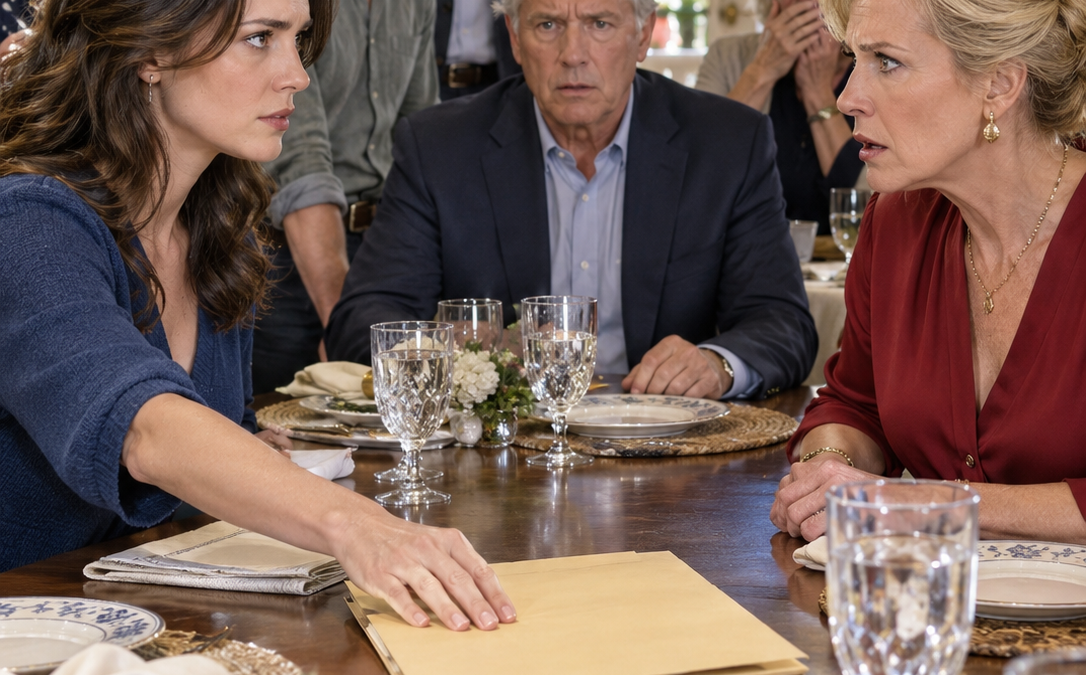
She had set the table beautifully. That’s the detail I keep: cloth napkins, the good plates, a centerpiece. She’d set the table for reconciliation, and she’d arranged the chairs so that the evening would go the way she needed it to go. Everyone facing her, everyone in range of that warm company voice.
There were nine of us, my father, quiet at the head of the table, older than I remembered, worn down to something gray; my grandmother, my uncle, a couple of cousins, an aunt by marriage, and Colleen moving around the room like a host at her own coronation.
There was one empty chair she’d set for Tyler.
When the doorbell rang, she went to answer it, wearing her best face. Tyler walked in, and behind him, Neil.
I watched her recognize him. I watched 16 years of careful architecture wobble on its foundation, but she recovered fast. She always does.
And she pivoted straight to me because I was the softer target.
“Vicki,” she said, warm, warm as pie. “I’m so glad you came. I think it’s time we all let go of the past. For your father’s sake, look at him. Hasn’t this gone on long enough?”
There it was, the request.
Forgive the story publicly so the story can stand. Give her the one thing that would make 16 years of lies retroactively acceptable.
My endorsement.
I didn’t raise my voice. I’ve learned that raising your voice hands the other person a reason to talk about your tone instead of your point.
“I’m not here to forgive a story,” I said. “I’m here for the truth.”
The fork stopped.
Colleen laughed. That bright little laugh, but her hand had found her napkin and was working the edge of it.
“There’s no truth, honey,” she said. “There’s just a sad thing that happened to two kids a long time ago. We were all doing our best.”
That was the lie right there in front of everyone: a sad thing that happened. No one’s fault. We were all doing our best.
Tyler set his coffee down. He rolled up his sleeves. He didn’t say it for effect. He said it because he needed his own hands to be honest with him.
“Vicki didn’t do it,” he said.
His voice shook and he let it.
“She never touched me. She took it for me. She always took it from me.”
He looked at his mother and then he looked at the table at all the faces that had spent 16 years believing the easy version.
“It was you, Mom. It was always you, and Vicki got blamed so nobody would ask about me.”
The room turned to Colleen. All of it at once.
She denied it. Of course, she denied it. The voice went up half an octave. Bright and wounded.
“He’s confused. He’s been through so much. He’s not well. You can all see that. He’s rewriting things. This is exactly what I was afraid of.”
And for a moment, it worked.
That’s the part no one warns you about. A good lie gets a second life the instant it’s cornered.
Colleen turned to the table and spread her hands. Reasonable, sorrowful.
“You all know what he’s been through,” she said, softer now, turning his own pain into a blade. “The addiction, the programs. He is not a reliable narrator of his own life, and that isn’t his fault. It’s an illness. I have protected this boy his entire life, and now strangers have gotten into his ear.”
I watched my grandmother’s face tilt just slightly toward doubt. I watched my uncle look at Tyler and reweigh him.
She was pulling the room back.
She was good.
Sixteen years good.
Tyler flinched, not at a sound this time, but at his own mother reaching for his recovery and using it against him.
And I understood that if I let this stay a contest of memories, hers against his, she would win. Because she had spent our whole childhoods making sure his word weighed nothing.
The same thing she’d done to mine.
So I didn’t argue about memory. I put down something that couldn’t be argued with.
I set the folder on the table. I didn’t slide it to anyone. I just set it down the way Tyler had set it down for me so it would be heavy in the middle of her sentence.
“This is Tyler’s medical file,” I said. “His. He has every right to it. There’s a note in here from that night in the emergency room.”
I found the page.
I didn’t read it dramatically. I read it flat, which is worse.
It described injuries that were older than that day: healing marks, a pattern written down by a professional in the moment before anyone had a chance to build a story over it.
“It’s signed at the bottom,” I said. “Dolores Hartman. She’s retired now. I sat at her kitchen table three weeks ago. She remembers that night better than any of us, and she told me she’d say it out loud as many times as it takes.”
I looked back at Colleen.
“This note was written that night,” I said, “before Tyler was old enough to lie, before he’d ever heard the word addiction, by a woman who had never met a single one of us and had nothing to gain from any of it. So you can’t say he’s rewriting the past. The past wrote itself down in real time in a stranger’s hand.”
Colleen’s mouth opened and nothing came out.
Neil spoke then once quietly from the doorway where he had stayed.
“I wasn’t there for the worst of it,” he said. “She made sure of that. Ask her why a father gets cut off from his own kid. Ask her who did the cutting.”
And here’s the thing about people like Colleen. In the end, no one takes them down. They take themselves down because they can’t stand to lose the room.
She looked around the table and she saw it going. The faces, the belief, the whole warm world she’d built on my back.
And instead of getting smaller, she got loud.
The company voice cracked and something older came through it.
“After everything I did for that ungrateful little girl,” she said, and her voice was shaking now with the wrong emotion entirely.
Not grief.
Fury.
“I gave her a home she didn’t deserve. And this is—”
She stopped, but it was too late.
Everyone at that table had just heard it: the contempt she’d kept behind the smile for 16 years. Out loud at last in her own voice.
She hadn’t defended herself. She’d confessed to the feeling underneath the whole thing.
My grandmother put down her fork. My uncle was staring at Colleen like he’d never seen her before, which in a way he hadn’t.
Then everyone looked at my father and for one second, one long terrible second, I was 14 again, sitting on a plastic chair by an elevator, waiting for him to say the right thing.
He looked at me. He looked at the folder. He looked at Tyler’s bare arms.
“I didn’t know,” he said.
The room waited.
I waited.
It would have been so easy even now to let those three words be enough, to let “I didn’t know” close the distance.
“You chose not to,” I said.
That’s the whole difference between us, and it fit into five words each. He said he didn’t know. I said he chose not to.
And the quiet that came after was not the quiet of a man about to make it right.
It was the quiet of a man realizing there was no version of the next sentence that would save him.
He didn’t fill it.
That was his answer.
The silence was his answer.
So I stood up. I didn’t shout. I didn’t cry. I didn’t deliver a speech about karma because karma is a word people use when they don’t trust the truth to be enough on its own.
I picked up the folder, Tyler’s folder, his to keep, and I looked at the woman who had spent 16 years teaching a whole family to disbelieve a child.
I had imagined walking out of that house a thousand times. In my imagination, it was loud.
It wasn’t.
It was quiet, and it felt like closing a file. Like a case that had stayed open too long.
Finally done.
Tyler followed me out. Neil right behind him.
On the porch, in the cool air, Tyler let out a breath that sounded like it had been in his chest for 16 years.
“What happens now?” he asked.
I didn’t have a clean answer for him. I still don’t.
But I knew what wasn’t going to happen.
We weren’t going to go back in.
If you’ve ever had to walk out of a room like that, a room full of people who share your blood and none of your side, you already know it doesn’t end with applause. There’s no music. There’s just the porch and the cold and the strange lightness of finally putting something down.
If tonight this story found you at the right moment and there’s a boundary you’ve been afraid to set, I hope you set it. That’s all I’ll ask of you.
The consequences came the way real consequences come, not in handcuffs, but in silence.
Over the next couple of weeks, the family sorted itself out. And it did not sort itself the way Colleen expected. The relatives who’d sat at that table had heard her. Really heard her. And you can’t unhear a thing like that.
The calls to her stopped. The invitations dried up. The warm little kingdom she’d built on being the good mother of a difficult girl came apart quietly, one unreturned message at a time.
No trial, no dramatic downfall.
Just a phone that went quiet in her hand and a family group text that she was no longer part of.
My father was left with what he’d chosen. Colleen’s world had been the relatives. His world had been Colleen’s approval. When hers collapsed, his did too, and he was alone in a house that had gotten very large.
About a week after the dinner, my phone lit up on the kitchen counter.
The name on the screen was Dad.
Sixteen years ago, he had told me never to call. Now he was the one calling.
I looked at it for a while.
I want to be honest with you about what I felt because it wasn’t triumph. It was something quieter and older than that.
I let it ring all the way to voicemail, not out of spite. I’d used up my spite a long time ago, out of peace.
He had gotten to make his choice by an elevator when I was 14.
This was mine, and I made it standing in my own kitchen, in a life he had no part in building.
I never listened to the voicemail. I don’t need to know what it says.
Some doors you close not by slamming them, but by simply not walking back through.
Colleen tried once more about a month later. Not warm this time, just tired. She said my father wasn’t well. She said family shows up when it counts. She used the word family the way she always had, like a debt I’d forgotten to pay.
I didn’t answer that one either.
I’d learned the difference between a person who needs help and a person who needs an audience. And I’d learned it from her.
If my father was unwell, I hoped he had someone. I just wasn’t going to be conscripted into being that someone by the woman who had taught him to throw me away in the first place.
Tyler and I are still figuring out what we are. It’s not simple, and I won’t pretend it is. Too much happened for it to be simple.
We’re not exactly family. Not in the way that word is supposed to mean.
We’re two people who were in the same fire and there’s a bond in that the healthy people in my life will never fully understand.
We get coffee. We’re awkward. We’re careful with each other because we both know how much damage a person can do without meaning to.
The last time we met, he called me Vicki.
Not my stepsister, not any word from the old house, just my name.
Level. One equal to another.
Two survivors on the far side of it.
It’s a small thing.
It’s everything.
I still have the index card. It lives in my wallet, soft at the corners now. My mother’s handwriting starting to fade.
My mother left me exactly one instruction when I was six years old, and she was running out of time.
Call my sister always.
It turned out to be the truest thing anyone ever gave me. Not the number itself, but what it meant.
That when everything falls, someone should still pick up the phone.
That no child should ever be bed four.
Now I’m the one who picks up.
I sit in a room with a mirror that isn’t a mirror across from kids who are certain no one will believe them, and I believe them. I stand up when they come in. I call each of them miss or mister the way a tired nurse once did for me when I had nothing and no one and a broken arm in my lap.
There’s still an empty chair somewhere that my father should have filled.
I don’t save it anymore.
I stopped saving it a long time ago.
I have my own table now and everyone at it answered the phone.
Some people you call and some people you finally stop calling.
It took me 16 years, a nurse, an index card, and a brave man who was once a frightened boy.








