After my spinal surgery, my sister called just to brag, “mom and dad picked my party over staying with you”; a few days later, mom said, “i hope you’re not still upset”; i calmly replied, “i’m not upset, i finally understand everything”; mom froze, her face turned pale, because…
Before I reveal what happened next, tell me where you’re listening from and what the weather is like there today. Does it match your mood? I love seeing how far these stories travel. Wherever you are in the world, I hope your day brings you something peaceful, unexpected, and good.
To understand why that phone call changed me, you need to understand that my family had never treated my sister and me equally, even though they would have denied it.
Her name was Sophie, and she was three years younger than me. Growing up, she was spontaneous, charming, emotional, and very good at making every room revolve around whatever she was feeling.
I was the opposite. I planned ahead. I remembered appointments. I solved problems before anyone noticed they existed.
Somewhere along the way, those differences became our assigned roles. Sophie was the one everyone protected. I was the one everyone depended on.
The strange thing about being considered responsible is that people can turn it into permission to neglect you. If Sophie was overwhelmed, Mom rearranged the day. If Sophie needed help, Dad drove across town. If I needed something, the answer was usually, “You’ll figure it out.”
And I usually did.
That only convinced them they were right.
The pattern became especially obvious two years before my surgery, when Sophie decided she wanted to turn her talent for hosting parties into an event-planning business. She had creative ideas but hated budgets, contracts, schedules, and paperwork.
I worked in financial operations, so she called me almost every evening for months. I built her first pricing model. I corrected vendor contracts. I showed her how to separate personal spending from business expenses. I even introduced her to a commercial landlord I knew through work when she started dreaming about renting a studio.
At her launch dinner, Dad raised his glass and called Sophie the entrepreneur of the family.
Everyone applauded.
Sophie smiled and said, “I built this from nothing.”
She never mentioned the spreadsheets open on my laptop until two in the morning, the weekends I gave up, or the calls I made on her behalf. I looked around the table and realized nobody had forgotten my help. They simply considered it so automatic that it did not deserve acknowledgment.
I said nothing.
Silence became the family’s favorite version of me.
By the time my surgery was scheduled, I was also helping Mom and Dad financially. They were not poor, but they had stretched themselves thin. Dad had reduced his hours. Mom had taken early retirement, and they had used more savings than planned helping Sophie get started.
So every month, I transferred money to cover part of their household expenses. I paid their supplemental insurance premium. When a large annual property bill arrived, I usually handled it and let them repay me slowly, if they repaid me at all.
I never announced any of it. I thought that was what family meant.
Then came Sophie’s studio.
The landlord liked her concept but wanted a stronger financial guarantor before offering favorable terms. Sophie asked me. Mom said it would mean the world to her. Dad reminded me that Sophie was finally building something serious.
I agreed in principle, but the final guarantee had not been signed. The paperwork was supposed to be completed the week after my surgery.
That detail mattered more than anyone realized.
The night before I went to the hospital, my girlfriend, Emma, came over to help me pack. She had been watching the family drama unfold with an expression somewhere between disbelief and restraint.
I showed her the party invitation.
Sophie had not simply picked the same date by accident. The invitation had been edited less than two weeks earlier. Her original reservation had been for Saturday.
My surgery was Tuesday.
She had moved the party to Tuesday afternoon.
“Did you ask her why?” Emma said.
“She said the venue gave her a better package.”
Emma stared at me. “And your parents accepted that?”
I nodded.
She waited before asking the question I had been avoiding.
“If you weren’t the dependable one, Lillian, do you think they would still leave you alone?”
I had no answer.
That question followed me into the hospital the next morning.
Surgery day stripped away every excuse I had been making for them. Mom texted at seven in the morning.
“Thinking of you. Keep us updated.”
Dad added, “You’ve got this.”
Neither one came.
Sophie sent nothing.
Emma drove me to the hospital, stayed through admission, and sat beside me until a nurse told her it was time. Before they wheeled me away, I checked my phone one last time.
Sophie had posted a photo of a wall of balloons with the caption, “Main event loading.”
I locked the screen without replying.
The procedure passed outside my awareness. When I woke, I had no idea what time it was. Everything felt slow and distant. A nurse told me the surgery had gone well. Emma had been there earlier but had stepped out briefly to speak to the doctor and get something to eat.
For several confused seconds, I kept looking toward the door, expecting my parents.
Nobody came.
Then my phone began vibrating on the tray beside me. I could barely focus on the screen.
Sophie was calling.
I answered because some stubborn part of me still assumed she might finally ask whether I was okay.
Instead, music and voices exploded through the speaker.
“You’re awake!” she shouted. “Perfect timing.”
I heard people laughing behind her.
“How did it go?” I asked, because apparently even half-sedated, I was still trained to make her the center of the conversation.
“Amazing! Mom cried during the toast. Dad stayed the whole time.”
Then she lowered her voice, though not enough to hide the satisfaction in it.
“I guess I finally got my answer.”
“What answer?”
There was a pause.
“Come on, Lillian. Mom and Dad picked my party over staying with you.”
For one second, I thought I had misunderstood her.
“You were testing them?” I asked.
She laughed. “Don’t make it dramatic. I was curious.”
Then someone called her name, and she said, “I’ll send you pictures,” before hanging up.
I stared at the dark screen.
That was the moment something inside me became very quiet.
Not broken.
Quiet.
There is a difference.
I didn’t cry. I didn’t call Mom. I didn’t send a furious message.
I opened the notes app and typed four words:
Stop making this possible.
Emma returned ten minutes later and immediately saw something had changed.
“What happened?”
I told her.
She sat down slowly. Instead of telling me I had every right to be angry, she asked, “What are you going to do?”
“Nothing today,” I said. “Today I recover.”
It was the first answer I had given that did not revolve around fixing somebody else.
Over the next two days, Sophie flooded social media with party pictures. One showed Mom holding a cake beside her. Another showed Dad helping Sophie open a gift.
The caption that caught my attention said, “When your people show you who comes first.”
I took a screenshot and put my phone away.
Three days after surgery, Mom finally called. Her voice was cheerful in the careful way people sound when they know a conversation is waiting for them.
She asked about my pain. Told me Sophie’s party had been such a success. Then she said, almost casually, “I hope you’re not still upset about us missing the hospital.”
I looked across my apartment at Emma, who was organizing my medication schedule.
“I’m not upset,” I said. “I finally understand everything.”
Mom went silent.
“What does that mean?”
“It means I understand how our family works.”
“Lillian, don’t turn this into something bigger than it was.”
That sentence finished whatever Sophie had started.
I had spent years shrinking every disappointment so nobody else had to feel uncomfortable. Now Mom was asking me to shrink this, too.
“I won’t,” I said.
Then I ended the call.
My mother had no idea that the morning before she phoned, I had already sent three emails.
One went to Sophie’s prospective landlord. One went to the company that handled my parents’ recurring household payments. The third went to my hospital to change my emergency contacts.
I did not insult anyone.
I simply removed my name, my money, and my responsibility from places where my family assumed they would always exist.
The first email was the simplest. I informed Sophie’s prospective landlord that, after reviewing my circumstances, I would not be signing the personal guarantee for her studio lease.
There was no contract to break because I had never executed the final document. I wished them both well and asked that all future negotiations go directly through Sophie.
The second change was more personal.
For nearly eighteen months, I had transferred money every month into the account Mom and Dad used for utilities, insurance, and household expenses. I canceled the recurring transfer. I also removed my card from two automatic payments that belonged to them.
I did not reverse anything already paid or demand reimbursement.
I simply stopped volunteering for future bills.
The third change was emotional rather than financial.
I removed my parents as emergency contacts and gave that responsibility to Emma. I updated my medical authorization so Emma, not my mother, would be the person doctors called if I could not speak for myself.
That one hurt more than the money.
For years, I had clung to the idea that in a real emergency, my parents would become the parents I kept hoping they were.
My surgery answered that question.
The following afternoon, Sophie called five times. I did not answer until after physical therapy.
“What did you do?” she demanded before I could say hello.
“You’ll have to be more specific.”
“The studio. The landlord says the terms changed because you backed out.”
“I didn’t back out of a signed agreement. I decided not to enter one.”
“You promised me.”
“I said I was willing to review the final papers.”
“That is basically the same thing.”
“No, Sophie, it isn’t.”
Her breathing sharpened.
“You’re punishing me because Mom and Dad came to my birthday.”
“No,” I said. “I’m making sure your business depends on you.”
She laughed without humor. “That sounds like punishment.”
“Only because you considered my support permanent.”
I ended the call before we could fall into the old pattern of her escalating and me explaining.
Ten minutes later, Mom called. Then Dad.
I let both go to voicemail.
Their messages said Sophie was panicking, that I was overreacting, that family did not use money to make a point.
I listened twice because the irony was almost impressive.
For years, my money had been considered family support. The second I stopped giving it, that same money became a weapon.
Two days later, Dad discovered the household transfer was gone.
He sent a message.
“We need to discuss what you’ve changed.”
I replied, “When I’m physically ready, we can talk.”
That was when my best friend, Jake, came over.
In the old version of my life, I would have spent hours asking whether I was being cruel. Instead, I showed him the messages and asked, “Am I responsible for problems that only exist because they assumed I would always rescue them?”
Jake read everything before answering.
“I think the more important question is whether you want revenge or separation from the role they gave you.”
“Both feelings are there,” I admitted. “But I don’t want to destroy anything. I want them to experience the natural cost of treating me like I’ll always absorb the consequences.”
Jake nodded.
“Then don’t add anything. Don’t expose them. Don’t threaten them. Don’t sabotage anything. Just stop cushioning the landing.”
That became my rule.
I would not attack Sophie’s business. I would not embarrass my parents publicly.
I would simply stop protecting them from the results of their own choices.
The next surprise arrived without my involvement.
A cousin sent me a screenshot from a private family group I had muted. Someone had shared one of Sophie’s public party posts, the one saying, “When your people show you who comes first.”
Under it, relatives were asking what she meant.
Sophie apparently tried to joke it away.
Then another cousin posted a voice message Sophie had sent before the party.
I recognized her voice immediately.
“I moved it to Tuesday on purpose,” she said. “Lillian’s surgery is that day, and I want to see if Mom and Dad still choose me. I know they will.”
I listened twice.
My stomach tightened, but the strongest feeling was confirmation.
The party had not merely landed on my surgery date.
Sophie had created a competition and used my surgery as the measuring stick.
Emma watched my face.
“Are you going to send that to your parents?”
“No,” I said. “They’re already in the group.”
Less than twenty minutes later, Mom called.
This time, when I answered, she did not tell me I was overreacting.
She said quietly, “Did you know she did this on purpose?”
“I know now.”
Mom started crying.
I did not comfort her.
Her feelings belonged to her.
She had chosen the party. Sophie had manipulated the situation, but my parents had still made the choice.
Mom asked if we could meet for dinner when I was strong enough to go out.
I agreed on one condition.
“I’m not going there to restore everything I canceled.”
She hesitated.
“Then what are we going there for?”
“For you to finally hear me without asking what I can fix afterward.”
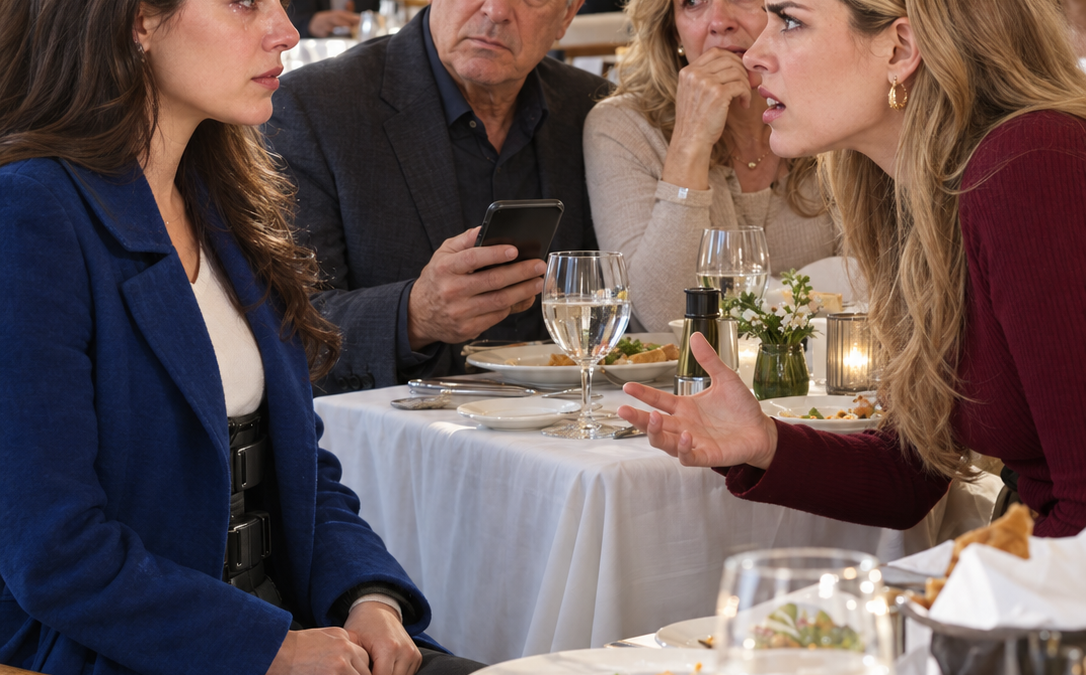
We met twelve days later at the Italian restaurant my family had used for birthdays, graduations, and anniversaries for years.
I arrived with a support brace under my coat and a strict plan from my physical therapist not to stay seated too long.
That limitation helped me.
I knew I could not spend three hours letting everyone talk in circles.
Mom and Dad were already at the table. Sophie arrived five minutes after me, placed her handbag on the chair, and did not say hello.
Mom started with an apology.
Not a perfect one, but an actual apology.
“We should have been at the hospital,” she said. “Even if we believed you would be fine, we should have been there.”
Dad nodded. “I made the wrong call.”
Sophie looked between them.
“Seriously?”
Mom turned toward her.
“You changed your party date to test us.”
“It wasn’t a test.”
Dad pulled out his phone.
“We heard the message.”
Sophie’s face changed.
For the first time in my life, I watched her lose control of the room.
She recovered quickly.
“I was joking with people.”
“You moved the date,” I said. “That part wasn’t a joke.”
Sophie looked at me as though I had betrayed her by being calm.
“You’ve already punished me enough. I lost the studio.”
“You didn’t lose it. The landlord offered different terms.”
“Terms I can’t afford.”
“Then the original plan depended on my credit, not your business.”
She leaned forward.
“Do you hear yourself? You’re enjoying this.”
The accusation would have worked on me a month earlier.
Instead, I said, “I’m not enjoying your problem. I’m refusing to solve it.”
Dad rubbed his forehead.
“Lillian, about the household payments—”
“Those are finished, too.”
His hand dropped.
“You know we adjusted our budget because you were helping.”
“Yes. And I adjusted mine because I believed we functioned like a family.”
Mom looked wounded.
“We are a family.”
“Then why was my surgery treated like an inconvenience while Sophie’s party became a loyalty test?”
Nobody answered.
“I’m not asking you to choose me over her. That’s the part nobody understands. I never wanted a competition. Sophie created one because this family spent years teaching her that being loved means winning attention, and you let her prove it using me.”
Sophie shifted.
“Don’t psychoanalyze me.”
“I’m not. I’m telling you what happened.”
Mom stared at her folded hands.
Dad looked at Sophie.
“Why did you need us to choose?”
Sophie’s expression hardened.
“Because she always gets to be the responsible one, the smart one, the one you trust. Everyone acts like I’m a disaster unless she fixes something for me.”
The honesty surprised all of us.
For one second, I saw the deeper shape of the problem.
Sophie had spent years being protected, but protection carried its own message.
Lillian is capable.
Sophie is fragile.
Instead of becoming independent, she had learned to compete for proof that she mattered more.
I could understand how that happened without excusing what she did.
“So you used my surgery to prove you were more important,” I said.
She looked away.
Mom whispered, “Sophie, I didn’t think anything would happen to her.”
Sophie snapped, “The doctor said the surgery was planned.”
I stared at her.
“Planned means they scheduled it. It doesn’t mean I didn’t need support.”
Dad spoke before she could answer.
“Enough.”
I had rarely heard that tone from him with Sophie.
“You moved a party because you wanted us to fail your sister.”
Sophie’s eyes filled, but Dad continued.
“And we did.”
That mattered.
Not because I wanted him to attack her, but because he finally included himself in the failure.
Mom did, too.
“We did,” she said.
Sophie pushed back from the table.
“So now I’m the villain and Lillian gets everything she wants.”
“What exactly do you think I want?” I asked.
“You want them to feel guilty. You want my business to fail. You want everyone to know what I did.”
“I haven’t told anyone. The whole family knows because you sent the voice message.”
“One person.”
“And you posted publicly about being chosen.”
Sophie’s face went pale.
She knew I was right.
Then her phone lit up.
She silenced it, turned the screen face down, and it buzzed again and again.
Mom asked what was happening.
Sophie said, “Nothing.”
Finally, she grabbed it and stood.
“I need a minute.”
She walked toward the entrance.
Dad watched her go.
“Two of her clients called me this morning.”
I frowned.
“Why you?”
“Because one is an old family friend. Apparently screenshots are circulating.”
“I didn’t send them.”
“I know,” he said.
Sophie’s business page was linked to her personal account. People saw the post about being chosen. Then the voice message got shared.
Mom added, “One client postponed an event consultation.”
I sat back carefully.
The consequences were finally real.
But I had not created them.
Sophie had built a public business around trust, warmth, and celebrating families, then bragged about turning her own family into a contest.
People were reacting to the contradiction.
When Sophie returned, she looked furious.
“Are you happy now?”
“No.”
“Don’t lie.”
“I’m not happy your business is struggling, but I’m not going to rescue it.”
She stared at me.
“You could call the landlord tomorrow. You could sign the guarantee and fix at least one thing.”
“No.”
One word.
No explanation.
She looked at Mom.
“Tell her.”
Mom took a breath.
“I’m not telling her to sign anything.”
Sophie blinked.
Then she looked at Dad.
He shook his head.
“Neither am I.”
For the first time, she had nowhere to redirect the problem. No parent ordering me to help. No guilt strong enough to make me volunteer.
She had wanted to know who our parents would choose.
At her party, she got the answer she wanted.
At that table, she learned that winning one choice did not give her permanent ownership of everyone else.
Dinner did not end with a dramatic exit.
That was important to me.
Real consequences are usually less theatrical and more uncomfortable.
They make you stay at the table.
Sophie sat down again because Dad told her we were not finished.
Mom asked what I needed from them.
It was the first time she had asked without immediately explaining what she needed from me.
“Consistency,” I said. “Not one apology. Not one dinner. I need you to stop assuming that because I can survive something alone, I should have to.”
Dad nodded slowly.
Mom asked whether I would reconsider the household payments if things improved between us.
“No,” I said.
Her face fell.
“Then this is punishment.”
“No. This is permanent separation between our relationship and my bank account.”
I reminded them that they had income. Their budget was tight because they had repeatedly chosen to subsidize Sophie’s plans while assuming I would fill gaps elsewhere.
If they wanted to keep helping her, that was their decision.
But I would no longer indirectly finance those choices.
Dad looked embarrassed.
“We’ll make adjustments,” he said.
Sophie gave a bitter laugh.
“Great. Everybody gets to make me the reason for everything.”
I turned to her.
“You are not the reason for everything. Mom and Dad made their own choices. So did I. That is the point. Everyone owns their part now.”
She looked at me before asking, “Why didn’t you ever say you resented helping me?”
“Because I didn’t resent helping you.”
That caught her off guard.
“I resented discovering that help was the only role in which I mattered.”
The table went quiet.
That was the question at the center of everything.
If people value your reliability mainly because it protects them from consequences, are they valuing you or the service you provide?
Dad admitted he had often expected more from me because I was stronger.
Mom said she thought giving Sophie more attention compensated for Sophie’s insecurity.
Neither explanation erased what happened, but for once they sounded like explanations rather than defenses.
Sophie kept returning to the studio.
Without my guarantee, the landlord wanted a larger deposit and a shorter initial lease.
She did not have the cash.
Dad had previously talked about taking money from savings to help her, but after the party revelation, he no longer wanted to.
“So you’re all abandoning me,” Sophie said.
Dad answered before I could.
“No. We are asking you to build something you can actually afford.”
She looked genuinely shocked.
That sentence represented a change bigger than any apology to me.
Sophie had been raised inside a system where distress triggered rescue.
Now the rescue was not arriving.
She hated it.
I understood why.
Discomfort was not the same as harm.
Over the following week, the changes became visible.
Mom and Dad canceled a planned weekend trip and met with a financial adviser. Dad picked up additional consulting hours. Mom sold a recreational membership they barely used.
None of those consequences destroyed their lives.
They simply had to manage money I had been quietly making easier.
Sophie gave up the studio and moved her business back into the spare bedroom of her apartment. She complained online until someone commented that many successful businesses started from home.
She deleted the complaint.
Two potential clients canceled consultations after the screenshot circulated. Another stayed but asked her directly whether the story online was true.
Sophie blamed the family rumor mill, but because she had posted the caption herself, there was no clean way to deny it.
She eventually removed several party posts and separated her personal account from her business page.
I never contacted a client, commented publicly, or shared the voice message.
I did not need to.
Her own choices had already traveled further than anything I could have engineered.
That mattered because I did not want my new life built around destroying hers.
Revenge can become another form of attachment if you are still arranging your days around someone else’s suffering.
I wanted my life back.
Physical therapy became the center of my routine. Emma drove me at first, then gradually I started managing short trips myself.
Every improvement reminded me how distorted my family’s expectations had become.
Recovery was hard, even with support.
About three weeks after the restaurant dinner, Sophie came to my apartment without warning.
I did not let her inside.
I stepped into the hallway instead.
She looked tired.
Actually tired.
“I had to refund a deposit,” she said.
“Why are you telling me?”
“Because before all this, you would have helped me figure out what to do.”
“Probably.”
“And now?”
“Now you need an accountant or business adviser.”
She crossed her arms.
“You really mean this?”
“Yes.”
Her voice became quieter.
“Did you know why I moved the party?”
“You said you wanted to see who they chose.”
“That was part of it.”
I waited.
She stared at the floor.
“I was angry that everybody kept asking about your surgery when it was supposed to be my birthday month.”
I almost laughed, but her face stopped me.
She was not proud of it.
“Then I thought if Mom and Dad came to the party anyway, I’d know I still mattered.”
“You could have mattered without me losing.”
“I know that now.”
It was the closest thing to accountability I had heard from her.
But then she added, “I still think you went too far with the money.”
Progress, but not transformation.
“My money is not punishment,” I said. “You just experienced it as love because I kept giving it.”
She flinched.
“That’s cruel.”
“No. It’s accurate.”
She asked if I would reconsider the guarantee once my recovery was finished.
I said, “No.”
She asked if I would at least help revise her business plan.
I said no again.
“So what happens to us?” she asked.
“I don’t know.”
“You’re my sister.”
“Then learn how to be mine without needing me to fix something.”
She left angry.
Two hours later, Mom called and asked what happened.
I told her Sophie had visited and that I would not discuss the details.
Mom paused.
Then she said, “Okay. That’s between you two.”
No pressure.
No request to call Sophie back.
No reminder that I was the older sister.
It was small, but I noticed it.
Boundaries were finally forcing everyone to develop muscles I had been exercising for them.
By the seventh week after surgery, I could walk much farther without stopping, and my life felt larger than the family crisis that had consumed the beginning of my recovery.
Emma and I started taking short morning walks. Jake came by on weekends, usually with coffee and no interest in hearing me excuse anyone’s behavior.
I returned to work gradually and accepted a project I had previously considered turning down because it required several months of additional responsibility.
In the past, I would have worried that being busier meant I could not respond whenever my parents or Sophie needed something.
Now that concern barely entered my mind.
Mom and Dad changed, too, although not magically.
Dad sometimes slipped into old habits and called me first when he had a financial question.
I started saying, “What do you think you should do?” rather than solving it for him.
Mom occasionally tried to give me updates about Sophie that were really invitations to intervene.
I stopped taking the bait, but they were trying.
They visited when I invited them. They asked before offering advice.
Most importantly, they stopped asking me to restore the old financial arrangement.
One afternoon, Mom handed me an envelope.
Inside was a check for part of the property bill I had covered the previous year.
“You don’t have to do this all at once,” I said.
“I know,” she replied. “But your father and I realized how much we let become invisible.”
I thanked her and deposited the check.
Trust, I had learned, should be rebuilt through boring things.
Showing up.
Following through.
Remembering.
Repaying.
Respecting a no.
Sophie’s path was messier.
Her event business survived, but smaller. Without the studio, she worked from home and rented spaces only when events required them.
At first, she treated that as humiliation.
Eventually, she discovered it lowered her overhead enough to make the business more stable.
Losing two clients hurt, but it did not destroy her.
What hurt more was realizing that the people who had always rushed to rescue her were no longer doing it automatically.
She had to answer uncomfortable questions herself.
She had to explain missed deadlines herself.
She had to revise budgets herself.
She had to hear no without turning it into a family emergency.
Several weeks passed before she contacted me again.
This time she texted first.
“Can I ask you something that isn’t about money or work?”
I said yes.
She called and asked, “Do you think you’ll ever forgive me?”
I stared out the window before answering.
“Maybe. But forgiveness and access are different.”
“What does that mean?”
“It means I can stop being angry without going back to being who I was.”
She was quiet.
“I really did think the party proved they loved me more.”
“I know.”
“For a few hours, that felt good.”
That admission was ugly, but honest.
“Then everything after it felt terrible.”
“That’s because you were trying to win something that never should have been a contest.”
“I know that, too.”
She apologized.
Not perfectly.
She still said she had been insecure. She still mentioned that she never expected the voice message to spread.
But she also said the words I needed to hear.
“I chose the date because I wanted to hurt you without admitting I wanted to hurt you.”
I did not rush to comfort her.
I let the sentence remain where she put it.
“Thank you for telling the truth,” I said.
We did not suddenly become close sisters.
We started smaller.
Occasional calls. No financial advice. No emergency loans. No unpaid business work.
When she complained about Mom or Dad, I refused to mediate.
When Mom complained about Sophie, I did the same.
The old family system had depended on me standing in the middle and absorbing pressure from every direction.
Once I stepped out, everyone had to speak directly to one another.
Months after the surgery, I found the original screenshot from Sophie’s party while cleaning photos from my phone.
“When your people show you who comes first.”
I stared at it for a few seconds, then deleted it.
She had believed she won that day because our parents stood beside her cake while I woke up in a hospital room.
For a while, I believed she had won, too.
I understand it differently now.
That party did not prove she was more loved.
It exposed a system that had survived only because I kept paying, fixing, excusing, organizing, and forgiving before anyone was required to change.
The moment I stopped, the system collapsed under its own weight.
My parents had to reconsider the way they treated both daughters.
Sophie had to build a life that could stand without constant rescue.
And I had to accept the hardest truth of all.
Being needed had never guaranteed that I was being valued.
I did not ruin my sister’s life.
I did not bankrupt my parents.
I did not humiliate anyone online.
I simply stopped volunteering to protect people from the consequences of treating me as optional.
That turned out to be enough.
My surgery repaired something in my spine, but the weeks afterward repaired something less visible.
I learned that boundaries do not need to sound dramatic to change a family.
Sometimes they are an unsigned guarantee, a canceled transfer, a different emergency contact, a phone call you refuse to make, a problem you leave with the person who created it.
And sometimes the strongest revenge is not making someone suffer.
It is becoming unavailable for the role that allowed them to keep hurting you without consequence.
Sophie wanted to know who our parents would choose.
She got her answer, but she never considered what would happen when I finally chose myself.
If your family proved they could treat you as optional while still expecting you to be indispensable, would you confront them or quietly stop carrying what was never yours to carry?
We appreciate your time and support until the final line. Everything in this story is fictional and made only for dramatic storytelling and educational entertainment.
We hope it reminds you that you do not have to stay in a place where every conversation becomes a reason to question yourself.
Healthy love should bring clarity, not constant confusion.








