After my car accident, my parents refused to take my 6-week-old baby, “your sister never has these emergencies, she had a cruise,” i hired care from my hospital bed, stopped the $4,500/month for 9 years – $486,000, grandpa walked in.
My name is Naomi Brooks. I was 34 years old when my mother refused to take my six-week-old baby while I was lying in a hospital bed with three broken ribs, a punctured lung, and my right arm in a cast.
My husband was six hours from getting home. Our sitter could not stay. My mother lived twenty minutes away.
Marcus called her and begged her to go to our house until he landed.
She said no.
Then she said the sentence that made me stop nine years of payments with four taps on a banking app.
“Your sister never has these emergencies.”
My sister was on a Caribbean cruise. My mother was sitting at Silver Mesa Casino. My newborn daughter, Nia, was at home needing somebody to warm a bottle, check her diaper, and hold her if she cried.
What I did from that hospital bed took less than three minutes and ended $486,000 of my money moving quietly through my family.
But that still was not the part that broke them.
The part that broke them walked into my hospital room three hours later.
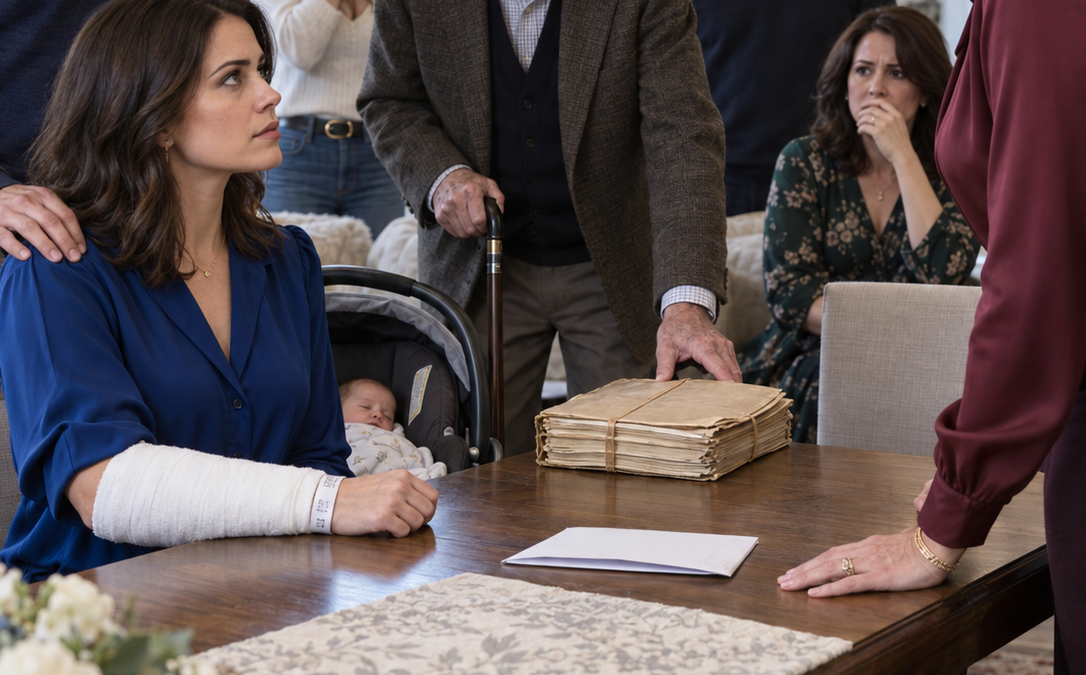
My grandfather Elias, 78 years old, carrying a worn manila folder with brittle rubber bands around it.
He set it at the foot of my bed and said, “Your grandmother was right about you.”
That folder was the reason my mother panicked two days later in a room full of relatives. And it was the reason I finally understood that being the strong one had never meant I was loved stronger.
It meant I had been easier to use.
Six weeks before that night, I had given birth to Nia. She was still small enough to fit against my chest like a warm question. Her whole life fit inside one bassinet beside our bed.
Then a delivery truck ran a red light on King Street while I was driving home from a late shift.
I remember the headlights first, then the sound, then nothing clean enough to call a memory.
When I woke up, a nurse was saying my name like she had already said it several times.
The hospital blanket was thin, but it felt too heavy. My mouth tasted like medicine and blood. Every breath felt like my ribs were trying to separate from my body.
Still, I did not fall apart.
Everybody expected Naomi to breathe through it. Naomi to figure it out. Naomi to be sensible, calm, and useful even under fluorescent lights with a plastic band around her wrist.
Before I go further, tell me where you are listening from tonight. City, state, country, whatever you want to share.
Sometimes, when I read where people are hearing these stories, I remember that being alone in a family does not mean you are alone in the world.
The phone was on the pillow beside my head, still connected to Marcus. His voice had gone flat in that careful way he used when fear was trying to crawl up his throat.
“Naomi,” he said. “I am so sorry.”
“What exactly did she say?”
He hesitated.
“Tell me.”
Behind him, I could hear an airport announcement. Behind me, I could hear a monitor beeping.
Between those sounds was the silence of my mother choosing a slot machine over my child.
Marcus said, “She said she had promised to watch Kendra’s cat because Kendra is on the cruise. She said she can’t leave the house. Then she said, ‘You always land on your feet, and your sister never has these emergencies.’”
For a second, I stared at the white ceiling and felt nothing.
Not rage. Not grief. Nothing.
Then a small, practical thought moved through me.
Nia needs care.
That was all.
With my left thumb, slow and clumsy, I opened my contacts and found the number for a licensed overnight care agency Marcus and I had vetted before Nia was born. We had added it to our emergency list because I am the sort of person who makes emergency lists before I let myself believe emergencies can happen.
A woman answered on the second ring. Her name was Marisol. Her voice was steady, and I could have cried just because she sounded competent.
“I need a licensed overnight nurse for a six-week-old infant,” I said. “My husband is flying in. I’m in the hospital after an accident. The baby is medically stable. I’m the one who isn’t.”
Marisol did not ask why my family could not help.
That was the first kindness.
She asked for the address, the pediatrician, feeding instructions, the entry code, emergency contacts, and whether there were pets.
Forty-two minutes later, she texted me a photo of Nia asleep with one fist against her cheek.
I stared at that picture until the screen blurred.
The nurse in the emergency room came to check my pain level. I told her it was a six because I had no interest in explaining that the worst pain in the room had nothing to do with my ribs.
Marcus stayed on the phone until they rolled me out for another scan.
Before they took the phone away, he said, “I’ll be there by morning.”
“I know.”
“Don’t handle everything alone.”
That was the kind of thing Marcus said because he loved me. It was also the kind of thing I never fully knew how to obey.
By the time they settled me in a room after midnight, the pain medicine had wrapped everything in cotton. My right arm was useless. My left hand shook, but my mind had become clear in that strange, cold way it does when a person has finally seen enough.
I opened my banking app.
There were four automatic transfers leaving my account every month.
One was labeled Mortgage Support.
One was labeled Medical.
One was labeled Household.
One was labeled Loan K, for Kendra.
I had set up the first transfer at 25, the night my father called me crying after what he said was a hospital bill.
Raymond Whitaker did not cry often. He had a soft heart wrapped in forty years of quiet obedience. When he cried, I answered.
At first, it was $1,200 a month.
Then $2,000.
Then $3,400.
Then $4,500 every month, spread across categories that made it easier for me to believe I was doing something honorable.
My father’s medication. My parents’ mortgage. A household account. A loan for my sister that my mother promised would be temporary.
Temporary lasted nine years.
I never added it up because the total felt like a door I could not walk through. It was easier to treat the payments like weather—something unpleasant and constant, something that happened to me because I was responsible.
But that night, with a hospital ID band biting into my wrist and a stranger caring for my baby because my mother had chosen a cat and a casino, the app did the math without mercy.
$486,000.
Almost half a million dollars had left my life one quiet transfer at a time.
I looked at the number until it stopped looking like money and started looking like years.
Delayed house repairs.
Vacations Marcus and I never took.
Extra shifts.
Frozen dinners.
The nursery dresser we bought secondhand because I told myself new parents did not need fancy things.
Then I tapped Cancel.
Mortgage Support stopped.
Medical stopped.
Household stopped.
Loan K stopped.
Four taps.
Nine years ended in less than a minute.
I expected guilt to come crashing in.
It did not.
What came instead was a quiet so wide I did not know what to do with it.
I locked the phone, turned my head toward the window, and watched my reflection in the dark glass. I looked pale under the hospital lights. My hair was pulled loose from the clip I had worn to work. My lips were cracked. My cast looked too big for the rest of me.
But my eyes looked awake.
That was new.
I need to explain how I became the person everyone called in a crisis.
I was 11 when I first learned that the easiest way to be loved in my mother’s house was to be useful.
Kendra was five then, bright and loud and already able to turn a room around herself. If she cried, my mother ran.
If I cried, my mother told me to help find a tissue.
“Naomi is fine,” she would say.
That was the family prayer.
Naomi is fine.
Naomi can wait.
Naomi understands.
My grandmother Pearl saw more than she said.
Pearl Whitaker was my mother’s mother, a woman who wore her church shoes until the heels went crooked and kept household receipts in envelopes labeled by month. She had a voice low enough to make people listen without raising it.
When I was 13, she handed me a little ledger after Thanksgiving dinner and said, “Somebody has to watch this family’s money, baby. Your mother won’t.”
I thought she meant I should be careful.
I think now she meant I should be wary.
Pearl died when I was 27.
I was told she passed peacefully. I was told she had been tired. I was told my mother and grandfather handled her affairs.
And because I was the dependable one, I accepted it.
I sent flowers.
I made casseroles.
I cleaned her kitchen after everyone left.
Nobody told me what she had done with the last clear months of her life.
Nobody told me she had been watching me, too.
After I canceled the transfers, I slept for maybe forty minutes.
Then Marcus called from a layover and told me he had spoken to Marisol, that Nia was fed and sleeping, that he would go straight home before coming to the hospital.
“Did your mother call back?” I asked.
“No.”
“Did Kendra?”
He was quiet.
“Marcus.”
“Your sister FaceTimed me from the cruise ship. I didn’t answer. She left a message asking whether the allowance was late because her card got declined at dinner.”
I closed my eyes.
Of course.
Not, Is my niece okay?
Not, Is my sister alive?
The allowance.
“Send me the voicemail,” I said.
“Naomi, you need rest.”
“I need the truth while I still have the nerve to look at it.”
He sent it.
Kendra’s face filled the screen a minute later, sunburned and annoyed, with music and glasses clinking behind her.
“Hey, Marcus, can you tell Naomi to check the family account? Mom says something is off and my card is acting weird. I’m in the middle of the ocean, so this is not cute.”
The family account.
There it was.
The lie had a name.
My sister truly believed there was some shared Whitaker money floating around behind the scenes, managed by our mother and available whenever her life needed smoothing.
She did not know it came from me.
Or maybe she had avoided knowing, because knowing would require gratitude, and gratitude would make the taking less comfortable.
I played the message twice.
Then I opened Kendra’s Instagram.
I almost never looked at it. Her page was full of resort photos, sponsored lip gloss, motivational captions, and outfits that cost more than Nia’s crib.
That night, the first post was her on a balcony with the ocean behind her, wearing a white cover-up and smiling like life had never asked her to wait.
The caption said, “Finally choosing me.”
I laughed once.
It hurt my ribs so badly that I had to press the call button for more pain medicine.
The next morning, Marcus walked into my hospital room unshaven, gray with exhaustion, carrying Nia’s car seat in one hand and the diaper bag over his shoulder.
He had gone home first, thanked Marisol, packed what we needed, and driven to the hospital with the caution of a man carrying all the world he cared about.
When he lifted Nia out and placed her against my chest, I made a sound I had never heard from myself before.
Not a sob exactly.
Something smaller.
Something that came from the place where fear had been holding its breath.
Nia rooted against the hospital gown and settled, her tiny cheek warm above my cracked ribs. Marcus stood beside the bed with his hand on her back and his other hand on my hair.
“I have you,” he said.
I believed him.
That should not have felt revolutionary, but it did.
For one minute, I was not a daughter.
I was not a bank account.
I was not the steady one everybody leaned on until I bent.
I was a mother holding my child.
Then my phone rang.
My father’s name came up.
Raymond.
I let it ring twice before answering.
“Daddy.”
His breathing sounded thin.
“Your mama says you stopped the transfers.”
He did not ask about the accident first.
That is one of those facts that looks small until you write it down.
“Yes,” I said.
“Are you all right?”
He asked it like he had suddenly remembered the correct order of things.
“I have broken ribs, a punctured lung, and a cast. Nia is fine. Marcus is here.”
“Good,” he said. “Good.”
Behind him, I heard my mother’s voice, sharp and close.
“Who is that?”
My father covered the phone, but not well enough.
Then he came back and said, “I should go. Feel better.”
That was my father in one call.
A good man, maybe. A frightened man, certainly. A man who had spent most of his adult life learning that the safest thing in Valerie Whitaker’s house was silence.
After he hung up, Marcus sat down beside the bed.
“You don’t have to decide anything today.”
“I already did.”
He looked at me.
“I stopped the money.”
He closed his eyes, and when he opened them again, there was no surprise there. Just sadness and relief tangled together.
“Good.”
That one word gave me more comfort than any speech could have.
That afternoon, he brought my laptop from home. He set it on the rolling tray and angled the screen so I could type with my left hand.
I had built budgets for work for years. I had tracked project risk, vendor spend, renewal dates, and forecast errors down to the penny.
I had never done it for the money leaving my own life.
So I did.
Line by line.
Month by month.
The picture that formed was not the story my mother had sold me.
Only about $66,000 could be matched to my father’s real medical care over those nine years.
Prescriptions.
Cardiology visits.
One procedure.
Follow-up appointments.
About $13,000 had touched the mortgage.
The rest had gone elsewhere.
Large ATM withdrawals near Silver Mesa Casino. Hotel charges in the same town. Restaurant charges attached to weekend casino trips. Cash App transfers to Kendra. Boutique purchases. Airfare. Camera equipment.
One $40,000 transfer marked Medical Bridge that landed in Kendra’s account three days before she announced an online boutique that never opened.
I sat there in the hospital bed and watched my own life arrange itself into columns.
$486,000 sent.
$66,000 for real medical care.
$13,000 for the house.
Roughly $120,000 to Kendra.
The rest swallowed by my mother’s private appetite for machines that promised she might win something back.
I printed one page from the hospital printer at the nurses’ station.
Marcus had to ask for help because I was not allowed to walk that far yet. A nurse brought it in with a careful look on her face, like she knew the page weighed more than paper.
Twelve rows.
Nine years.
One clean truth.
I folded it once and set it beside my bed.
That evening, Aunt Janice called.
Janice was my mother’s cousin, but we called her aunt because in our family, any woman old enough to correct you in public earned the title.
She had always loved the family chat too much and privacy too little.
Under normal conditions, that made her exhausting.
That night, it made her useful.
“Baby,” she said, “your mama is online saying you cut them off from a hospital bed out of spite.”
“Of course she is.”
“She said Raymond might lose his medication.”
“He won’t.”
“She said you’ve always resented Kendra.”
I looked down at Nia sleeping in the crook of Marcus’s arm.
“Aunt Janice, do you want the numbers?”
She went quiet in a way I had never heard from her.
“What numbers?”
I took a photo of the one-page summary and sent it.
The line stayed silent for so long I thought the call had dropped.
Then she said, “Naomi.”
Just my name.
Not a question.
Not a defense.
My mother had built whole rooms out of half-truths, but numbers do not care how warm your voice is when you lie.
“Can I show this to the cousins?” she asked.
“Not yet.”
“Then what do you want me to do?”
“Nothing tonight. Let her talk.”
“Why?”
“Because I want the right room.”
I did not know exactly what I meant until I said it.
But once it came out, I understood.
My mother had spent years telling her version in rooms where I was not present.
If the truth was going to enter, it was going to enter where people could not pretend they had only heard a rumor.
Janice lowered her voice then, which was how I knew someone else was near her.
“Your mama already put something in the family chat,” she said.
“Read it.”
“You need rest.”
“Aunt Janice.”
She sighed, and I heard her settle into a chair.
“She wrote, ‘I am heartbroken to say Naomi has cut off help to her father while lying in the hospital angry at the world. We do not know what we did to deserve this. Please pray for our family.’”
For a moment, I could not even feel angry.
It was too familiar.
My mother had a talent for stepping into the center of a room with ashes on her face before anyone could ask who lit the match.
“What are people saying?”
“Most are sending hearts. Your cousin Terrence asked if you need anything. Your mama ignored that one.”
“Of course she did. Did she mention Nia?”
Janice went quiet.
“No.”
That hurt more than I expected.
I could understand my mother making me the villain. She had practiced that in little ways my whole life.
But to leave my baby out of the story entirely after the whole thing began because Nia needed care told me exactly what my daughter was to her in that moment.
Not a granddaughter.
An inconvenient fact.
“Send me screenshots,” I said.
“Baby, are you sure?”
“I’m sure.”
They came through one by one.
My mother’s message.
The hearts.
The prayers.
One cousin writing, What about the baby?
And my mother replying, The baby is fine. This is about Naomi punishing us.
I saved every screenshot.
Marcus watched me do it from the chair by the window.
“You’re building a case,” he said softly.
“No,” I said. “I’m building a memory I can’t be talked out of later.”
That was important.
People like my mother did not only lie to others. They returned afterward with soft voices and tired eyes and tried to convince you that the thing you remembered had different edges.
They made you doubt tone, timing, motive, even your own pain.
I knew there would come a day when she would say she had been scared. She would say she had not understood. She would say nobody told her the baby needed care. She would say she was just worried about Raymond.
She would hand me a smaller story and ask me to live inside it.
The screenshots were not for revenge.
They were for the future version of me who might get lonely enough to believe her.
That night, after the nurses finished their rounds, I remembered a contact saved in my phone as Grandpa Elias.
I had not called him much since Pearl died, not because I did not love him, but because grief had made the family roots strange.
My mother managed access to him the way she managed everything else. She said he tired easily. She said he did not like visitors. She said not to bother him.
I sent him a text with my left thumb.
We should talk.
The three dots appeared almost immediately.
Then my phone rang.
His voice was rough and low.
“Are you hurt bad?”
Those were the first words he said.
I had to close my eyes before I answered.
“Bad enough.”
“The baby safe?”
“Yes.”
“Your mama at Silver Mesa?”
He made a sound that was not quite a laugh.
“I figured.”
I turned my head toward the dark window.
“You figured?”
There was a long pause.
I could hear television low in the background on his end, then the scrape of his chair as he turned it off.
“Naomi,” he said, “I know more than you think.”
I waited.
“Not tonight,” he said. “You have enough pain tonight.”
“I’m coming tomorrow, Grandpa.”
“I’m in the hospital.”
“I know where hospitals are.”
“You don’t have to drive.”
“I didn’t ask you what I had to do.”
That was Elias Whitaker, 78 years old, careful with his knees, stubborn as a locked door.
He arrived three hours later anyway.
The nurse came in first, smiling despite herself.
“There’s a gentleman here who says he’s not leaving until he sees you.”
Then my grandfather walked through the door in a pressed flannel shirt buttoned to the throat, a dark cap in one hand, a cane in the other.
Under his arm was a thick manila folder, soft at the corners, held together with two old rubber bands.
He looked smaller than I remembered and stronger than I felt.
Marcus stood to greet him, but Elias waved him down.
“You sit with your wife.”
Then he came to the foot of my bed and set the folder there like he was laying down something alive.
For a moment, he only looked at me.
Then he said, “Your grandmother was right about you.”
I did cry.
Quietly, carefully, because my ribs could not take much.
He put one hand on the rail of the bed.
“I knew,” he said.
“Knew what?”
“About the money. About your mother. About Silver Mesa. About Kendra getting help and pretending it came from some family pot.”
The room seemed to tilt.
“Why did nobody tell me?”
He looked at the folder instead of my face.
“Pearl tried. She ran out of time. I was slower than I should have been.”
That answer hurt, but it was honest enough to stand on.
He did not open the folder that night.
He said I needed rest. He said we would do it properly, in front of everyone, where my mother could not slip out the side door with a prettier story.
Before he left, he told me one piece.
Pearl had spent the last clear months of her life with a lawyer. She had asked questions about who was really keeping Valerie afloat.
Elias had followed the numbers as far as he could. He had spent forty years keeping books for a small freight company before he retired, and he knew how to follow money even when people tried to rename it.
“Your grandmother was not ashamed of you,” he said at the door. “Whatever your mama says later, remember that.”
“Pearl trusted me with what?”
He tapped the folder.
“You’ll know Sunday.”
I did not sleep much after that.
The next afternoon, Elias came back while Marcus had taken Nia home for a few hours. He brought coffee he was not supposed to drink and a paper bag with a blueberry muffin I could barely eat.
“Your grandmother used to say hospital food was made by people who had heard of seasoning but never met it,” he said.
I smiled, and even that hurt.
He sat in the chair beside my bed and rested both hands on the head of his cane.
“I need to ask you something,” I said.
“Ask.”
“Why Kendra?”
He did not pretend not to understand.
“Why did my mother treat her like a prize and me like a utility bill?”
Elias looked toward the hallway.
Nurses moved past. A cart squeaked somewhere. A baby cried, and my body answered before my mind did, milk letting down into the pads inside my hospital gown.
The little humiliations of motherhood do not pause for family revelations.
He waited until I had pressed a towel to my chest and looked back at him.
“Pearl was a good woman,” he said. “But good does not mean simple.”
I did not like where that sentence was going, but I listened.
“Your mama was not Pearl’s favorite. Your uncle Lawrence was. Lord rest him. He could charm a parking ticket off a windshield. Valerie was the one who remembered appointments, counted pills, cooked when Pearl worked late, kept everybody’s little messes from becoming big ones.”
“That sounds familiar.”
“I know it does.”
He rubbed one thumb along the handle of his cane.
“When Lawrence died, your mama was 19. Pearl broke in a way she never admitted. Valerie learned that being useful did not guarantee being cherished. Then she had you, and you were steady right out of the gate. Quiet. Watchful. Capable. I think it frightened her to see her own role living in her child.”
I swallowed.
“And Kendra?”
“Kendra needed out loud. Valerie understood that. Or maybe she envied it. Your sister cried and people came running. And your mama finally got to stand beside the favorite instead of being the overlooked one.”
“That doesn’t excuse what she did.”
“No,” he said. “It explains the shape. It doesn’t wash it clean.”
I looked down at my cast.
My fingers were swollen at the edges, my nails chipped from the accident.
I had spent years trying to understand my mother, as if understanding would eventually turn into being loved correctly.
But a wound with a history is still a wound.
“Did Pearl know she had done that to Mom?”
His eyes watered, but he did not look away.
“Near the end, yes. That was part of why she made the trust the way she did. She told me, ‘We cannot undo what we handed Valerie, but we can stop it from eating Naomi, too.’”
I turned my face toward the window.
Outside, late-afternoon light hit the hospital parking deck and made every windshield flash.
“I wish she had told me.”
“Me too.”
He reached into the folder and took out a small envelope yellowed at the edges.
“She wrote you something. I was supposed to give it when the papers were explained. I think you need it before Sunday.”
My name was on the front in Pearl’s handwriting.
Inside was one page.
Naomi,
If you are reading this, then I was too slow to say it myself.
You are not hard to love. You are easy to depend on, and sometimes weak people mistake that for permission.
I have been weak in my own ways.
Do not let anybody turn your good sense into a chain.
Watch the money.
Watch the story.
Trust what does not move when people cry.
Pearl.
I read it three times.
Then I folded it carefully and handed it back to Elias.
“No,” he said. “That one is yours.”
For the first time since the accident, I slept for nearly two hours.
On Friday, I was discharged with pain medicine, breathing exercises, and instructions that made being a new mother sound impossible.
Do not lift more than five pounds.
Do not strain.
Do not sleep flat.
Keep the cast dry.
Watch for fever.
Return if shortness of breath worsens.
Nia weighed almost ten pounds.
Life has a sense of humor sharp enough to draw blood.
Marcus set up the recliner in our bedroom. Marisol agreed to stay for two weeks of nights while I healed.
I hated needing help, but after what had happened, I hated less the idea of paying a professional who actually showed up.
My mother called twelve times Friday.
I did not answer.
She texted:
This has gone far enough. Your father is sick with worry. Kendra is stranded because of you. Family does not do this.
I read that last line while Nia slept on Marcus’s chest and thought of my mother sitting under casino lights while a nurse she had never met washed her hands in my kitchen and cared for my baby.
Family does not do this.
For once, she was right.
Kendra flew back Saturday and called me from the airport.
She did not ask how I felt until after she asked whether I had frozen her allowance.
“It wasn’t an allowance,” I said. “It was my money.”
“Mom said it was from the family account.”
“There is no family account.”
The silence that followed was the first honest sound I had heard from my sister in years.
“What do you mean?”
“I mean the $500 a month came from me. The trips, the camera equipment, the boutique launch money—a lot of it came from me.”
“I didn’t know.”
“You didn’t ask.”
She started crying then, but I could not tell which part hurt her most.
The loss of the money.
The embarrassment.
The possibility that she had built her life on a story that made me invisible.
“Mom said you wanted to help.”
“Mom said a lot.”
“Naomi, I’m sorry about the accident.”
It was late, but it was something.
“Thank you.”
“Can you please fix the card until I get home?”
And there it was.
The apology was not a bridge.
It was a hallway leading back to the same door.
“No.”
“Just for a few days.”
“No.”
She called me cold.
Then she said she did not mean it.
Then she asked again.
I ended the call.
On Sunday afternoon, Marcus packed the diaper bag while I tucked the one-page summary under the wipes where no one would think to look.
My ribs ached. My cast itched. I still had the hospital ID band in the side pocket of the bag because I could not bring myself to throw it away.
It felt like proof, too.
Not of the money.
Of the moment I finally understood what my life was worth to certain people when I could no longer serve them.
Elias called as we pulled into my parents’ driveway.
“I’m behind you.”
I looked in the side mirror and saw his old sedan at the curb.
He stepped out slowly, folder under his arm, cane tapping the pavement.
The house looked the same as always.
White porch rail.
Red geraniums my father watered.
A brass wreath my mother changed by season.
The front window glowed with warm light. Through it, I could see relatives gathered in the living room.
Aunt Janice.
Two cousins.
My father in his recliner.
My mother moving through the room with a coffee pot, playing Wounded Hostess.
Kendra sat on the arm of the couch with sunglasses pushed on top of her head, scrolling her phone like she had entered the wrong meeting.
Marcus carried Nia’s car seat.
I carried myself.
That was enough.
Elias reached the porch and looked at me.
“You ready?”
I was not.
But being ready had never been required of me before I was handed responsibility.
So I nodded.
He pushed the door open with the head of his cane.
Conversation stopped.
My mother’s face changed faster than I had ever seen it change.
First surprise.
Then anger.
Then the soft, wounded smile she used when witnesses were present.
“Naomi,” she said. “You should be resting.”
“I will soon.”
“And Daddy, what are you doing here?”
Elias took off his cap.
“Same thing everybody else is doing. Hearing the truth.”
That was how the evening began.
My mother was gifted.
I will give her that.
Some people lie badly.
Valerie lied like she was folding laundry—smooth and practiced, every crease pressed flat.
She started with concern.
“We’ve all been so worried. Naomi has been through a terrible accident, and pain medication can make people confused.”
Nobody looked at me right away.
Pain medication.
That was the first rope she threw.
If I sounded angry, I was medicated.
If I showed numbers, I was confused.
If I cried, I was unstable.
Marcus set Nia’s car seat near my chair and stood behind me. His hand rested lightly on my shoulder, not holding me down, just letting me know he was there.
My mother continued.
“We tried to help with the baby, of course, but things were complicated. Kendra was out of the country, and I had obligations at the house.”
Aunt Janice’s eyes moved to me.
I said nothing.
My mother grew warmer.
“Then Naomi made a rash decision from the hospital and stopped support your father depends on. I know she doesn’t mean to hurt him. She’s overwhelmed.”
My father stared at his hands.
Kendra looked up.
“Wait,” she said. “Dad’s support?”
My mother shot her a look.
Too late.
I reached into the diaper bag with my left hand, pulled out the folded page, and smoothed it flat on the dining table.
No speech.
No tears.
Just paper.
“Mom is right about one thing,” I said. “Kendra never has these emergencies. I’d like to show everyone why.”
The room went still.
I pointed to the first row.
“This is every transfer I made to my parents over the last nine years. Total sent: $486,000.”
Kendra’s mouth opened.
“No,” she said softly.
“About $66,000 can be matched to Dad’s real medical expenses. About $13,000 went toward the mortgage. Roughly $120,000 went to Kendra through direct transfers, card payments, travel, equipment, and the boutique money.”
I moved my finger down the page.
“The rest went mostly to withdrawals and charges within two miles of Silver Mesa Casino.”
Nobody breathed normally after that.
My mother laughed once.
It was a terrible sound because it was trying to be casual and failing.
“That is twisted,” she said. “You twisted everything. You always were good with spreadsheets.”
“Yes,” I said. “I am.”
That landed harder than I expected.
My mother looked at my father.
“Raymond, tell them.”
He did not lift his head.
“Tell them,” she snapped.
His hands trembled against his knees.
For one second, I thought he might finally step across the line.
He whispered, “Valerie. The casino.”
My mother’s head turned toward him, and the look she gave him was old.
Older than me.
Older than Kendra.
A look sharpened by years of knowing exactly where his courage ended.
He lowered his eyes.
That was all he had.
And strangely, that was enough for me to let him go.
Not hate him.
Not punish him.
Just stop waiting for him to become a shelter he had never been strong enough to be.
My mother turned back to me.
“You’re a liar.”
That was when Elias set his cane against the table.
The sound was small.
The room heard it anyway.
He laid the manila folder beside my one-page summary.
The rubber bands were brittle, and he had to coax them loose with thick fingers.
He opened the folder slowly.
Bank copies.
Legal papers.
Notes in Pearl’s handwriting.
A stapled document with a law firm’s name on the cover.
“I knew,” he said.
He did not say it to my mother.
He said it to the room.
“Pearl knew too. Near the end, she asked me where Valerie’s money was coming from. I traced what I could. I found Naomi carrying this family while people called her distant and difficult.”
My mother said, “Daddy, don’t.”
He did not look at her.
“Last spring, Pearl and I moved our property and accounts into trust. The house sits on land that was ours, not Valerie’s. It does not pass to Valerie to manage. It does not pass to Kendra. There is a fund for Nia’s schooling. The rest is held for Naomi and the baby under the terms Pearl wrote before she died.”
Kendra started crying then.
My mother did not.
Her face went blank first.
Then afraid.
Not sad.
Afraid.
“You can’t do that,” she said.
Elias tapped the document.
“We already did.”
“This is my home.”
“It was your mother’s home,” he said. “And she decided what would happen to it.”
“I’ll fight it.”
“You can call a lawyer.”
“I will.”
“Then call one.”
He said it without heat.
That was what made it powerful.
My mother knew how to fight noise.
She did not know what to do with a man who had brought paper.
Kendra stood so fast her sunglasses fell from her head onto the carpet.
“Wait,” she said. “If the trust is for Naomi and Nia, what happens to me?”
Nobody answered immediately.
That was the first time I saw my sister understand the room had never been arranged around fairness.
It had only been arranged around her comfort.
My mother reached for her.
“Baby, this is not your fault.”
Kendra stepped back.
Not far.
But enough.
“The boutique money,” she said. “The cruise. The camera. The apartment deposit. That was Naomi?”
My mother said, “You were building a future.”
“With her money.”
“With family money.”
Kendra looked at me then.
Really looked.
Not as the older sister who always had it handled. Not as the person who sent birthday checks and fixed flights and knew which form needed signing.
As a woman in a cast who had just left a hospital with broken ribs and still had to be the one explaining where the money went.
Her face changed in a way I did not enjoy.
Shame is not satisfying when you still love the person wearing it.
“Naomi,” she said, “I didn’t know it was like that.”
“I know.”
“Do you believe me?”
“I believe you didn’t want to know.”
That hurt.
I saw it land.
But it was cleaner than pretending.
She sat down slowly, hands in her lap, and for once she had no performance ready.
My mother hated that most of all.
“Don’t let her make you feel guilty,” Valerie said. “She’s always wanted you to feel small.”
Kendra looked at the one-page summary on the table.
“No,” she said quietly. “I think she’s been making herself small for us.”
My mother stared at her like she had spoken another language.
That sentence did not fix us.
It did not make Kendra brave forever.
It did not refund a dollar.
But it cracked the room in the right direction.
And sometimes that is all truth does at first.
It makes the old lie harder to sit inside comfortably.
My mother turned to me, tears rushing up now because rage had not worked.
“Naomi, honey, we can fix this. We’re family.”
I looked down at Nia’s car seat.
She was sleeping through the whole thing, her tiny mouth open, one hand curled near her cheek.
That little hand was the whole answer.
The night I needed family, my mother checked a cruise schedule and a casino seat.
The night my daughter needed arms, a stranger showed up because I paid her, and my husband crossed half the country to come home.
I was done confusing blood with safety.
“No,” I said.
My mother blinked.
“No. You cannot have access to my money. No, you cannot make my pain sound like confusion. No, you cannot use Dad’s health as a curtain anymore. No, you cannot call me family only when there is a bill.”
Kendra wiped her face with the back of her hand.
“I really didn’t know,” she said.
I believed her halfway.
Sometimes halfway is all a person has earned.
“Now you do.”
She looked at the paper again.
“The $40,000 was you?”
“Yes.”
“Mom said Grandma left it.”
Elias closed his eyes.
“Pearl left plenty of warnings,” he said. “Not that.”
Aunt Janice had been silent for so long, I almost forgot she was there.
Then she stood, picked up the one-page summary, and read it from top to bottom.
“Valerie,” she said, “this is ugly.”
My mother pointed at her.
“Stay out of it.”
Janice looked around the room, and I could see the family chat forming in her eyes.
“No,” she said. “You put it in front of everybody when you told us Naomi was hurting Raymond out of spite.”
I almost smiled.
Not because any of it was funny.
Because for once my mother’s favorite weapon had turned in her hand.
I stood carefully.
Marcus reached for me, but I shook my head.
I wanted to do that part myself.
“I’m going home,” I said. “Marcus and I will send copies of anything needed through email. Grandpa Elias has his attorney. I’m not discussing money with anyone in this room again.”
My mother stepped toward me.
“You’ll regret this.”
Maybe she meant the trust.
Maybe she meant the transfers.
Maybe she meant exposing her.
But I was looking at the hospital band sticking out of the side pocket of the diaper bag.
“I have regrets,” I said. “This is not one of them.”
Marcus picked up the diaper bag.
Elias gathered the folder and his cane.
I looked at my father one last time.
He met my eyes.
There was sorrow there.
There was love, too, maybe.
But love that cannot stand up is still something you cannot lean on.
I gave him a small nod.
It meant I understood.
It meant I was leaving anyway.
The three generations my mother least wanted under one roof walked back out into the cold evening.
An old man with a folder.
A woman with a cast.
And a baby whose future had just been pulled out of a lie.
I closed the door softly behind us.
Not because I was gentle.
Because slamming it would have meant I still wanted the people inside to hear me.
I did not.
Here is how it settled.
My mother did call lawyers.
Two of them, according to Aunt Janice.
Both told her some version of the same thing.
Clean paperwork, competent signatures, a clear trust, and a living grantor who could confirm intent are not easy things to shake loose just because a daughter is angry she did not inherit control.
The threats got quieter.
Valerie and Raymond still live in the house because the trust allows them to stay there for their lifetimes.
I agreed with that.
I was not interested in putting my father on a curb because he was weak where I needed him strong.
But Silver Mesa no longer runs on my margin.
The automatic transfers never restarted.
Kendra got a real job at a marketing firm that cares less about beach captions and more about showing up on time.
Months later, she texted me once.
Where did it all go?
I sent her the same one-page summary I had set on the table.
She did not reply.
But she never asked me for money again.
Aunt Janice told the truth exactly as I knew she would.
The family chat went quiet for a long time, which may be the closest thing some families get to repentance.
My father calls sometimes.
Usually from his car.
Usually in the afternoon.
He asks about Nia first now.
I answer because I want to believe a person can learn the right order of questions, even late.
My mother has not apologized.
Not really.
She sent one card that said she was sorry things had gotten so painful.
That is not the same as saying, “I’m sorry I caused pain.”
I put the card in a drawer and did not answer.
Marisol stayed two weeks while my ribs healed.
She still sends Nia a birthday card.
Marcus says that is because Nia smiled at her first, but I think it is because some people understand that showing up one hard night can tie you to a family more honestly than blood ever did.
Elias sold his little place across town and moved into a rental ten minutes from us.
He comes for Sunday dinner with his folder, though he does not bring it in every time now.
Sometimes he leaves it in the car.
Sometimes he just brings peach cobbler from the bakery and complains that Marcus makes coffee too weak.
The first time he came without the folder, I noticed.
He saw me notice.
“You know where it is?” he said.
“I do.”
“Then we don’t have to keep reminding the room.”
That felt like healing in his language.
Nia is not six weeks old anymore.
She is old enough now to pull herself up on the coffee table and slap both hands against the wood like she is calling a meeting.
She has Marcus’s dimples and my serious stare.
When she cries, I pick her up if I can.
If I cannot, Marcus does.
If both of us cannot, we call someone who has proven they will come.
That list is shorter than I once believed.
It is also stronger.
I kept the hospital ID band.
It sits in the old folder now beside the one-page summary, Pearl’s trust papers, and the first photo Marisol sent me of Nia asleep in her crib.
For a while, I thought the folder was about money.
It is not.
It is about proof.
Proof that I was hurt.
Proof that I was used.
Proof that I stopped confusing endurance with duty.
If there is one thing I learned from a hospital bed, four taps on a banking app, and an old man carrying a folder, it is this:
The people who praise you for being the strong one may simply be naming the person they have decided they will not have to carry.
And the day you stop being everybody’s emergency fund is the day you can finally become something better.
For me, that was simple.
I became Nia’s mother first.
Not my mother’s bank.
Not my sister’s safety net.
Not the quiet wall holding up a house that refused to shelter me.
Just a mother.
And that was more than enough.
If this story made you think about who you would call from a hospital bed, or who always gets called the strong one in your family, tell me in the comments.
Sometimes the first step toward peace is not a speech.
It is one clear look at the account, one honest name for what happened, and one quiet decision to stop paying for a lie.








