After i lost my job, my sister called every relative who’d offered me a place to stay; she told them: “don’t enable her, mom and dad want her to struggle”; mom admitted it: “if everyone keeps saving you, you’ll never learn”; dad said: “a month homeless might be the best thing that ever happens to you”; my sister laughed: “good luck finding a couch now”; i said nothing, i hung up; then i called the one person they forgot.
I supervised the second shift at a distribution center in the Northland, just outside Kansas City. Sixty people, give or take, depending on the season. Forklifts, pick lines, outbound trailers.
My job was to know where everything was. Not where it was going. Where it was.
There’s a difference.
And it took me a long time to understand that the difference was the whole story of my life.
The building was consolidating into an automated facility in Columbus, Ohio. Last day of operations: February 27th. Anyone at supervisor level could transfer with title and seniority intact. Deadline to accept: January 30th.
I read the notice twice, then went and told my shift before the rumor did.
That’s the only thing I’m proud of from that day.
I stood on the mezzanine steps and read it out loud and answered questions until there weren’t any. A 23-year-old forklift operator named Devon asked if Columbus was hiring hourly.
I said I’d find out.
I did find out.
They weren’t.
My regional manager caught me afterward.
“Columbus keeps your title and your years. Deadline’s the 30th.”
“My mother’s surgery is the 28th.”
He nodded like that was an answer.
I suppose it was.
I didn’t tell my family about the Columbus offer. I told myself I’d bring it up after my mother’s knee.
That was the first mistake. And I want to be honest that it was mine.
I made it because I already knew what the conversation would sound like. I’d been having that conversation in one form or another since I was old enough to sit at the table.
My mother had her knee replaced on January 28th.
I drove her in. I drove her home. I stayed three nights in the house in Liberty where I grew up, sleeping in what used to be my room and was now the room with the treadmill nobody used.
My sister Tessa came by the second afternoon with grocery-store flowers and her phone out. She stayed 40 minutes. She took a picture of Mom on the couch with the flowers in the frame and left before the picture had finished uploading.
I made dinner.
I sorted the pills into the plastic days-of-the-week box. I set up the little pedal exerciser the physical therapist had recommended and showed Mom how to use it without leaning forward.
My father told the discharge nurse about the car.
If you’ve never met Wade Maloney, you’ve met a man like him.
He owned a small heating and cooling company. He shook hands like he was checking the pressure in them. And he had one story, which he had been telling since before I was born and which he would tell to anyone who stood still long enough.
“Twenty-two years old. A month in a Chevy. Best thing that ever happened to me. Kids today don’t get that.”
The nurse said, “Wow.”
They always said, “Wow.”
I’d been listening to people say wow to that story for 34 years. I could have mouthed it along with her.
I nearly did.
At dinner, I sat on the folding chair.
I should explain the folding chair because it explains a lot.
The kitchen table in Liberty had four real chairs. When I was growing up, they belonged to my father, my mother, Tessa, and whoever was visiting.
When Tessa married Curt, the fourth chair became Curt’s.
I got the metal folding chair from the garage, which I carried in myself and carried back out when I was done.
Nobody ever said this was the arrangement.
It was just where the chairs were.
The second night, my mother asked me to set up online payments for the hospital bills. My father, in her words, didn’t touch any of that computer stuff.
She was propped up on the couch with her leg elevated, halfway into her pain pills, and she handed me her phone with the banking app already open.
I want to be clear about this because it matters later.
I didn’t go looking.
She handed it to me.
I set up the autopay, and while I was in there, I saw a recurring transfer.
First of every month, going back to March of 2024.
$900.
The memo line said TNC house.
I didn’t ask.
I’m a supervisor. I count what’s on the shelf. I don’t ask why it’s there.
But I noticed because noticing is the job.
My mother’s eyes were half closed.
“That’s nothing. Don’t mention it to your sister. She’d be embarrassed.”
“Okay.”
I was very good at okay.
On the third night, I told her I’d turned down a transfer to Columbus. I told her why.
I don’t know what I was waiting for.
Not a thank-you, exactly.
Maybe just a pause.
“Your father says you’ll be fine,” she said. “He says you need this.”
Tessa had a house and a baby by 30.
Tessa also had a house I’d just seen who was paying for.
I didn’t say that.
Math has never been my family’s strong suit.
Stories were.
In the morning, I folded the chair, leaned it against the garage wall where it lived, and drove the 20 minutes back to my apartment.
On the highway, one question kept surfacing, and I kept pushing it back under.
If Tessa was the one who had it all figured out, what was $900 a month?
I told myself it wasn’t my business.
I’d get about six weeks out of that lie.
On February 2nd, the renovation notice showed up on my apartment door. The building was being gutted floor by floor. My lease ended April 30th and wouldn’t be renewed.
The notice was held on with a paperclip.
It was the same kind of paperclip that had held the closure notice on the bulletin board at work.
I put the two sheets side by side on my kitchen counter and looked at them for a while because when things line up like that, you want to at least give them the respect of looking.
I did the numbers that night.
I’m going to give you the numbers because people assume a story like this is about a woman with nothing, and it isn’t.
I had $5,600 in savings. I had four weeks of severance coming. I’d qualify for unemployment once the severance ran out.
I had no car payment and no credit-card debt.
What I didn’t have was a job.
And in Kansas City in 2026, you don’t sign a lease without proof of income.
I tried two short-term sublets that week. One never answered. The other answered fast.
“Sorry. Need proof of income. No exceptions. Good luck!”
The exclamation point was a nice touch.
So I needed a place for about two months between the end of April and whenever a new employer sent an offer letter.
That was the whole ask.
Not money. Not rescue.
A room.
I practiced saying it in the bathroom mirror.
“I need a place for two months.”
It came out sounding like an apology.
I said it again.
It came out sounding like an apology with better posture.
Sunday dinner in Liberty was February 15th.
My mother was on the couch with a walker parked beside her. My father, Tessa, Curt, their two kids, and my uncle Doug—my mother’s younger brother—were there. Doug had driven up from Independence because his sister had just had surgery, and that’s the kind of person Doug is.
I waited until the plates were mostly empty.
Then I said it.
“The building closes on the 27th. My lease is up at the end of April. I’ll need a place for a couple of months while I find something.”
I said it to the table, not to anyone in particular.
That was cowardice, and I knew it while I was doing it.
Silence for about two seconds.
Then Doug, without looking up from his plate, said, “Basement’s finished. Own bathroom. Two months, six months, whatever.”
I started to say thank you.
My father said, “Travis is coming by Tuesday to talk numbers. Twenty-eight years I built that business.”
He didn’t say no to Doug.
He just made sure Doug’s sentence didn’t get to finish existing.
Everyone turned toward the business the way you turn toward the loudest thing in a room.
And Doug’s offer sat there on the table between the green beans and the rolls, and nobody picked it up.
Tessa didn’t say anything at all.
She looked at Doug. Then she looked at my father. Then she cut her son’s chicken into smaller pieces than he needed.
Her son Colby, who was eight, looked at me across the table.
“Why does Aunt Clara always get the bad chair?”
Nobody answered him.
My mother said, “Eat your dinner, sweetheart.”
On the way out, Tessa kissed my cheek by the door. She smelled like the vanilla lotion she’d worn since high school.
“We’ll figure something out for you.”
I thought that was kindness.
I want you to remember that sentence.
The next day, my aunt Pam, my mother’s older sister, texted from Overland Park.
She had a spare room. I could have it for as long as I needed.
Two days after that, my cousin Brianna, Doug’s daughter, called from her apartment in the city.
She had a couch.
It wasn’t a nice couch.
It was mine if I wanted it.
“It’s a couch, not a kidney,” she said. “Just say yes.”
“Let me try one more thing first.”
I put three names on a sticky note on my refrigerator.
Doug. Pam. Brianna.
Three boxes.
None of them checked.
Here is the part I’m least proud of.
I had three offers, and I sat on all of them for a week because I wanted to find a sublet first. I wanted to walk into the next family dinner and say I’d handled it.
I’d absorbed the family’s opinion of me so completely that I was willing to sleep on nobody’s couch to prove I didn’t need a couch.
I gave my sister a week.
She used it.
At 12:40 that Sunday night, a text came from Tessa.
“You really going to take Uncle Doug’s basement at 34?”
I didn’t answer.
I didn’t know it was the last question she’d ask me before she started making calls.
The last sublet fell through on Tuesday the 24th. I texted Doug that afternoon to lock in a date.
Doug is a man who answers texts in under five minutes.
He answered in three hours.
“Let me get back to you on that, kiddo.”
Doug has never once in his life needed to get back to anyone.
I looked at the message for a long time.
Read: 2:14 p.m.
Reply: 5:20 p.m.
That gap was the loudest thing in my apartment.
That evening, I noticed Pam had unfollowed my photos on Facebook.
A small thing.
I noticed it because I notice things.
Wednesday, Pam texted one line.
“I think it’s best you work this out with your parents. Love you.”
Love you at the end of a sentence like that is a door closing quietly so it doesn’t wake anyone.
I called her.
Busy.
I texted Brianna.
Nothing.
Delivered.
Not read.
In a warehouse, when the same shortage shows up in three different locations at the same time, we don’t call it three problems.
We call it one cause.
I put the three conversations side by side on my screen and took a screenshot.
Not as evidence.
I just needed to know I wasn’t imagining a pattern that wasn’t there.
At 10 that night, my phone rang.
Brianna.
Her voice was wrong from the first word.
“I need to tell you something, and Dad’s going to kill me.”
Tuesday night, Tessa had called her, then Doug, then Pam.
All three inside of an hour.
The message was the same each time, close enough that Brianna could repeat it.
“Don’t enable Clara. Mom and Dad want her to struggle. If everyone keeps rescuing her, she’ll never grow up. This is a family decision.”
A family decision.
“That’s what she said?”
“It was.”
I didn’t ask.
Brianna was crying now, quietly.
“I’m sorry I didn’t ask. She talks like a nurse’s mom. You don’t argue with that voice.”
I was standing in my kitchen holding a box of pasta.
I put it down very carefully on the counter, like it might break.
Then I thanked her, and I meant it, and I told her to go to bed.
I didn’t call my parents.
Tomorrow was my last shift.
I wanted to finish one thing decently before I opened another.
Friday, February 27th.
I let my crew go a half hour early, which is a supervisor’s privilege on a last day and the only privilege I had left.
Devon found me by the time clock.
“You always knew where everything was,” he said. “Weird that you don’t know where you’re going.”
“That’s the job. Knowing where things are, not where they’re going.”
I carried one box out to the parking lot.
A coffee mug. My count sheets. A photo of the night shift from 2019, all of us in reflective vests, squinting.
Eight years fit in one medium box.
Over the years, I’d ordered about 4,000 of those exact boxes.
There’s a joke in there.
I didn’t laugh at it then.
I do now, a little.
I sat in the car in the empty lot and called the house.
No answer.
Fine.
Tomorrow.
I didn’t know Tessa would be there tomorrow.
Saturday morning, I called again.
My mother picked up and put me on speaker because she was doing her exercises and her hands were busy.
I could hear the pedal exerciser going, the one I’d set up.
A soft mechanical whir, steady as a clock.
My father was in the kitchen, and I heard Tessa say something about the coffee. I understood that she’d come by to drop off food the way she did, and I understood that she’d stay for this.
I didn’t build up to it.
“Did you ask Tessa to call Doug and Pam and Brianna?”
The pedals kept going.
“Your sister only did what we thought was right,” my mother said in the voice she used for things she’d decided a long time ago. “If everyone keeps saving you, you’ll never learn.”
My father spoke from the kitchen over the sound of a cabinet door.
“A month homeless might be the best thing that ever happens to you.”
A pause.
Then the part he’d clearly been saving.
“Ask me how I know.”
And then Tessa laughed.
Not a mean laugh.
That was the worst part.
A comfortable one.
“Good luck finding a couch now.”
“Okay,” I said.
I’d said okay to that family for 34 years.
That was the last one.
I hung up.
I sat in my car in the apartment lot for a long time.
I counted.
That’s what I do when I’m frightened.
Four family members.
Three relatives.
Zero couches.
The numbers didn’t add up to anything, but they were something to hold.
And then I remembered the shoe box under my bed.
I’d never counted that one.
There were 13 cards in the box.
Christmas cards, 2013 through 2025, held together with a rubber band that had gone brittle and snapped the moment I pulled on it.
Thirteen years, one rubber band.
That’s about the level of attention I’d given them.
The handwriting was slanted and even.
The return address was in Springfield, Missouri.
The signature was Aunt Lorraine.
Every single card ended the same way, in the same ink.
The back room is still yours if you ever need it.
I’d always taken it for the kind of thing old women write.
A pleasantry, like hope you’re well.
I’d sent a card back maybe four of those 13 years.
Never a phone call.
I’d never even been sure who she was exactly.
My father’s aunt. His mother’s sister.
I couldn’t have picked her out of a room.
What I could remember was a lemon cake.
A birthday of mine when I was small.
A woman in a blue blouse holding a lemon cake, and my father walking her to the front door before the candles were even lit.
My mother putting the cake in the refrigerator.
Nobody eating it.
That was the whole memory.
A cake.
A blouse.
A door.
There was a phone number under the signature.
A landline.
It hadn’t changed in 13 years.
I dialed it at 9:41 on a Saturday night.
She picked up on the second ring.
“Aunt Lorraine, it’s Clara. Wade’s daughter.”
“I know whose daughter you are, honey.”
I started to explain.
I got about two words in.
“You don’t have to explain. Nobody calls this number for a good reason. Can you be here by lunch Sunday? I’ll make the bed.”
That was when I cried.
Not during the speakerphone call.
Not in the parking lot.
Right then, standing in my kitchen, because for the first time in a month, somebody had skipped the question of why.
She just wanted to know if I had a car.
“I have a car.”
“Then I’ll see you tomorrow.”
Before she hung up, she asked one more thing.
“Is your father well?”
Not your parents.
Your father.
I didn’t think about it until much later.
I’ve thought about it a great deal since.
Springfield is 165 miles south of Kansas City, straight down the interstate.
I’d never been there.
That’s a strange thing to admit about your own father’s hometown, but there it is.
He’d left in 1986 and made it sound like a place you leave.
I’d never been to the city my father was from.
He’d made sure of that.
Two hours and 40 minutes.
I counted the mile markers.
It kept my hand still.
Her house was a single-story place of pale red brick on a quiet street, with a cracked concrete driveway and a front lawn cut so straight you could have used it to level a picture.
She was standing in the doorway before I’d turned the engine off.
Eighty-one years old.
Spine like a fence post.
Apron on.
“You have his jaw. Come in before the neighbors start counting.”
The doormat on the step had been worn down to the last four letters.
All you could read was:
Come.
She showed me the back room first.
A single bed with fresh sheets.
A window.
And in the window, an old air conditioner, the boxy kind you don’t see much anymore.
Its plastic had gone yellow at the corners.
“It rattles,” she said. “He never came back to fix it.”
I didn’t ask who he was.
I thought I knew.
And I was right.
And I still wasn’t ready.
We ate soup at her kitchen table.
On the wall behind her, between a photograph of a man I’d learn was Uncle Earl and a photograph of a dog, there was a color print gone soft with age.
A skinny young man, maybe 22, with my father’s hair and my father’s jaw, standing beside a brown Chevy sedan.
The car was parked in a driveway.
I turned in my chair and looked out the kitchen window.
Same cracks.
Same driveway.
“That’s your father,” she said without turning around. “That’s the car.”
“The car he slept in for four nights?”
She set down her spoon.
“Then it was parked in my driveway for 14 months. Eat your soup.”
I looked at the photograph again.
In the back-room window behind the young man’s shoulder, there was an air conditioner, brand-new, shining.
She didn’t say anything else about it.
“We’ll talk when you’ve slept.”
I lay in the bed that night, in the room where my father had once lain, listening to the unit rattle.
And for the first time in my life, I understood that his story had an address.
I’d just driven to it.
I went back to Kansas City on Tuesday.
I still had an apartment until the end of April, and I had a job to find, and I’ve never been able to think clearly in a place where someone is being kind to me.
I filed 14 applications in the first week.
Kansas City and Springfield both.
I built a spreadsheet, 14 rows, and color-coded the status column the way I used to color-code the shift schedule.
Two video interviews.
In one of them, the hiring manager asked why I’d leave the Kansas City market.
“I’m not attached to a market. I’m attached to a schedule.”
He laughed.
So that was probably the right answer.
The severance came through.
The unemployment claim went in.
I was fine.
That’s the thing nobody in my family could stand.
I was fine.
My landlord knocked on the 9th with an offer.
If I was out by March 31st, they’d credit me $600 and let me walk on April’s rent. The renovation crew wanted the floor early.
I had 10 days to decide.
I had an address in Springfield I still wasn’t sure I was allowed to believe in.
My mother called on the 10th as if the speakerphone conversation had never happened.
She needed a ride to physical therapy on Tuesday.
Tessa had the kids.
Could I?
I could.
I did.
That’s the part of me I’m still working on.
Twenty minutes in the car, mostly silent.
Her knee brace creaked when she shifted. She had her house keys clenched in her hand the whole way, even though she couldn’t drive, even though she wouldn’t need them until I’d walked her to her own front door.
She’d held keys like that my whole life.
It wasn’t about the door.
It was about holding something.
Halfway there, she said the only thing she was going to say.
“Your sister only did what we asked. Don’t make this about her.”
“I’m not making it about anyone. I’m driving.”
She wanted a fight so she could call it my temper.
I gave her a ride instead.
In the waiting room, I watched her practice walking between two rails while a young therapist counted her steps.
She was frightened.
She needed someone there.
She needed me there more than she’d ever say out loud.
And I sat in a plastic chair and let that be true without expecting her to notice.
When I dropped her off, she asked, “Are you going to Doug?”
“No.”
“Where, then?”
“Somewhere with a driveway.”
She didn’t understand.
Not yet.
On Saturday, I drove to Liberty to return the spare key.
I’d had a key to my parents’ house since I was 16.
Nobody had asked for it back.
I decided to give it back anyway because I needed to do one thing with my hands that was a decision instead of a reaction.
Tessa and Curt were there.
Of course they were.
Curt was in the kitchen, and when I came in, he found something urgent to look at on the counter.
Tessa smiled the smile she used at the dentist’s office where she worked the front desk three days a week.
“So. Found a couch? Found a room?”
“Found a room.”
“Whose?”
“Someone you didn’t call.”
I watched her try to run the list.
I watched her come up empty.
The key was on a ring with a tiny clay folding chair that Colby had made in art class and given me for my birthday the year before.
I took the chair off and put it in my pocket.
I left the key on the counter.
Walking out, I saw Curt in the driveway smoking, which he wasn’t supposed to do.
He looked at me like a man with a sentence in his mouth.
He didn’t say it.
I got in my car.
I wouldn’t understand that look for another two months.
On the evening of the 19th, Doug called.
His voice was different.
Smaller.
He was calling from his basement. I could hear the dryer running behind him.
“Where are you going to go, honestly?”
“Springfield.”
“Springfield? Who do you know?”
And he stopped.
There was a long pause, the kind where you can hear a man remembering something.
Twenty years earlier, Hank, my father’s younger brother, had said something at a barbecue after a few beers about an aunt of Wade’s down in Springfield.
Doug had filed it away and never thought about it again.
“Clara, does your dad know you’re going there?”
“No.”
“Good. Don’t tell him yet.”
A breath.
“The basement’s still there. I’m sorry. I—”
“I know. Thanks, Doug.”
I signed the landlord’s buyout the next morning.
On March 31st, I closed my apartment door for the last time.
One medium box.
Three suitcases.
One shoe box.
Everything else went into a 5-by-5 storage unit for $60 a month.
I counted the items in the car.
Then I made myself stop counting.
Then I counted them again.
I pulled into Lorraine’s driveway on April 1st, a little after noon.
I’d brought an envelope with $400 in it because I decided on the drive down that I would not be a charity case, even to an 81-year-old woman who’d invited me by mail 13 times.
She refused it.
Then, about an hour later, she changed her mind in her own way.
She came back into the kitchen with a yellow carbon-copy receipt book, the kind they sell at the hardware store.
“$400. First of the month. I’ll write you a receipt.”
“You said no.”
“I thought about it. Rent is how I know you’re staying, not hiding.”
She opened the book to write.
The first page had been torn out.
The stub was still there, ragged along the perforation.
“What happened to the first page?”
She wrote my name before she answered.
“1984. I wrote your father one for the school money. He tore it out, folded it, and said he’d pay me back with interest.”
She tore my copy along the line.
“He kept the receipt. He never brought it back.”
I put the receipt in the shoe box with the cards.
It seemed like the place for it.
We fell into a routine faster than I expected.
I drove her to the eye doctor.
I fixed the kitchen faucet, which had been dripping for, she said, “about a presidency.”
I learned how she made soup, which involved no measuring and a great deal of opinion.
Her kitchen radio was always tuned to the agricultural forecast.
She didn’t own a field.
She just liked the announcer’s voice.
She never asked what had happened.
On the fourth night, I asked her why not.
“Because I already know what your father’s like when he’s decided something. I don’t need the details. I need you to eat breakfast.”
Being helped without being charged for it is a strange experience if you’ve never had it.
I kept waiting for the bill.
Not money.
The other kind.
The look. The sigh. The story told about you to someone else in the next room.
It didn’t come.
It kept not coming.
After about a week, I stopped bracing for it, and I understood that I’d been braced for it my entire life.
The air conditioner got louder that week.
A rattle turning into a knock.
I’m the daughter of an HVAC man.
I’ve been watching people take those units apart since I was six.
On the fourth night, I pulled a chair up to the window, unscrewed the front panel, and pulled it off to look at the fan.
There was a metal bracket inside, the kind that holds the compressor housing in place.
Somebody had scratched letters into it with the tip of a screwdriver, the way you’d sign a thing you were proud of.
WM85.
My father signed every unit he ever installed.
“So the customer knows who to call.”
He’d told me that when I was 10, letting me hold the flashlight.
I knew that scratch the way I knew his handwriting on a birthday card.
I sat there with the panel in my lap and didn’t move.
Lorraine was in the doorway.
I hadn’t heard her come down the hall.
“First unit he ever installed,” she said. “The summer he got his certificate. He said this room had to be the first one he made cold because it was the first one that had kept him warm.”
She paused.
“He said that. He was 23. People say things at 23.”
The scratch had oxidized dark, but you could read every stroke.
Forty-one years.
“Certificate?” I said. “What certificate? Who paid for it?”
She wiped her hands on her apron, which is what she did instead of answering questions she’d decided to answer later.
“Thursday. Hank can tell you. He was there.”
Thursday afternoon, a pickup pulled into the driveway, and my uncle Hank climbed out with a case of beer under one arm and a store-bought apple pie in the other.
He was 60, an electrician in Blue Springs, a man I’d seen at maybe 30 family events in my life and heard speak at perhaps 10 of them.
He saw me through the screen door and stopped on the porch step like the ground had shifted under him.
“He finally sent one of you here, huh?”
“He didn’t send me.”
Hank looked at me for a long moment.
“No,” he said. “He wouldn’t.”
He came in and got a plate down from the cabinet without asking which one.
A chipped plate with a blue rim.
And I understood it was his plate and had been for a long time.
“First Thursday of the month,” he said, sitting down. “Forty years, give or take. Weekly, back when I lived here.”
Nobody in the family knew this.
I want to be clear about the size of that.
My father’s brother had been driving two and a half hours to eat dinner with the woman my father had erased once a month for three decades and had never once said so at a Christmas table.
We ate.
Hank asked about the plant closing and seemed to actually want the answer.
He asked nothing about my parents, which I appreciated more than I could say.
When he left, I walked him out to the driveway.
He stood by the truck with his keys in his hand.
“Ask her about the four nights,” he said. “Then ask your father why it became a month.”
“You’ve known this whole time?”
“Since I was 18.”
He opened the truck door.
“Knowing and saying aren’t the same thing. That’s my failure, not hers.”
Lorraine told me on Friday night at the kitchen table with the radio off.
My father’s mother, Carol, was Lorraine’s younger sister.
Carol died in 1981 when my father was 19 and Hank was 15.
Their father, my grandfather Vern, whom I’d met perhaps five times before he died, started drinking the week of the funeral and didn’t stop.
In March of 1984, there was an argument.
She didn’t tell me what it was about.
She said it didn’t matter.
That with Vern, the argument was never the point.
He put Wade out of the house.
Twenty-two years old.
A duffel bag.
And a brown Chevy sedan that needed a new inspection sticker.
My father slept in that car for four nights in a grocery-store parking lot on the south side of Springfield.
On the fourth night, Hank, who was 18 and still living in Vern’s house, walked to a pay phone and called his aunt.
Lorraine drove over at 11 at night.
She said the windows of the Chevy were fogged from the inside, and she remembered that detail because she’d had to wipe the glass with her sleeve to see his face.
Then she knocked.
He rolled the window down two inches.
She said one sentence.
“You can be proud in my driveway just as easily as here. It has a bathroom.”
He followed her home.
He stayed 14 months.
“Four nights?” I said.
“Four.”
She folded her hands.
“I counted too, honey. It runs in the family.”
She and Earl had wanted children and never had them.
They’d been putting away money for a trip somewhere with an ocean, and they took $2,600 out of that account and paid for a heating and cooling program at the technical school across town.
Earl drove my father to class every morning because the Chevy couldn’t pass inspection.
“Fourteen months with your father in this house,” she said, “was the best thing that ever happened to Earl and me.”
She looked at me.
“I know he uses that phrase. I had it first.”
From a kitchen drawer, she took a faded receipt from the technical school, paper-clipped to a snapshot of a young man in a paper graduation cap, grinning with all his teeth.
“So what ended it?” I asked. “Fourteen months. And then what?”
“It didn’t end. It just went quiet for a while. He moved up to Kansas City in ’86. He married your mother. He’d call. He’d visit at Christmas some years.”
She paused.
“And then he ended it.”
“When?”
“At your birthday. October 1998.”
I turned seven.
Lorraine drove up to Liberty with a lemon cake because lemon was what my father had loved at 22, when he’d sat in her kitchen and eaten half of one in a sitting.
My father had just started his own company that year.
Maloney Heating and Cooling.
He was a man with his name on a truck, and he’d begun telling the car story at parties.
The month in the car.
The best thing that ever happened to him.
How nobody had handed him anything.
He told it that afternoon in the living room to a room full of neighbors and my mother’s family.
And Lorraine, standing near the kitchen doorway with the cake still in her hands, said one thing.
Not loudly.
Just to him.
“Wade, you slept in my back room.”
He walked her to the door.
He didn’t say anything.
He just walked her to the door, and she went because she was not going to fight a man in front of his seven-year-old.
“I didn’t say it to embarrass him,” she told me. “I said it because you were listening. Seven-year-olds believe what their fathers say about themselves. I wanted one true sentence in that room.”
The cake went into the refrigerator.
I remembered that part.
My mother threw it out the following Monday.
He never invited her again.
Lorraine got up from the table and opened the hall closet.
She came back with a second shoe box, bigger than mine.
Twenty-seven Christmas cards addressed to my father at the house in Liberty.
1999 through 2025.
Every one unopened.
Every one stamped RETURN TO SENDER by the post office, with a handwritten note in the corner of the envelope saying the same thing.
The first three—1999, 2000, 2001—were in my father’s block capitals, underlined hard enough to dent the paper.
From 2002 on, the handwriting changed.
Rounder.
Neater.
Even.
The same hand that had written my name on every birthday card I’d ever gotten.
“The first three were his,” Lorraine said. “After that, hers. I don’t know if he ever saw the rest. I stopped needing to know around 2010. I kept sending because stopping felt like agreeing.”
“That’s my mother’s handwriting.”
“I know, honey.”
I picked up the card from 2013 and turned it over.
The postmark was December 9th.
Then I went and got my own shoe box and found my card from 2013.
Same postmark.
Same day.
She’d started writing to me the same year she’d given up on him.
She’d written both cards at the same table, walked them both to the same mailbox, and one had come home unopened while the other had gone under my bed for 13 years with a rubber band around it.
I put the two boxes on the table side by side.
Thirteen cards received.
Twenty-seven cards returned.
Forty.
For the first time in my life, a number hurt me instead of making me feel safe.
Doug drove down the following Saturday.
He brought a box of pastries from a place in Independence and a look on his face I’d never seen on him.
He parked crooked in the driveway, off to one side, the way you park at my parents’ house so you’re not blocking anyone.
Lorraine watched from the porch.
“Park in the middle, Douglas. Nobody’s coming.”
He moved the car.
We sat on the porch.
I told him about the money.
Not to build a case.
I was just tired of keeping secrets for people who had never kept a single one for me.
“$900. First of the month. Twenty-four months. The memo line.”
Doug went very still.
“Tessa told Pam they never took a dime,” he said. “At Thanksgiving. ‘Unlike some people.’ She looked right at you when she said it. I remember. I was carrying the turkey.”
He sat with it for a while.
I could see the whole February resorting itself behind his eyes.
The offer he’d made.
The call he’d gotten.
The three hours he’d taken to answer my text.
“She wasn’t protecting your parents,” he said finally. “She was protecting that transfer.”
I didn’t say anything.
He’d gotten there on his own, and I’ve learned that’s the only way people really get anywhere.
Before he left, he stood in the driveway with his keys and said what he’d driven down to say.
“Your dad’s telling that story at his party. Travis is buying the business. Half the county’s coming.”
“I know.”
“Are you?”
The invitation went out by mail in the middle of April.
Heavy card stock.
A photo of the first company truck.
Celebrate 28 years of Maloney Heating and Cooling.
Wade’s retirement.
Saturday, May 16th, 4:00 p.m.
The backyard.
I know what it looked like because on May 2nd, Tessa posted a picture of it in the family group chat as a reminder.
Nobody had remembered to take me out of the group, or she’d remembered and wanted me to see it.
I’ve never decided which.
I’d been left off the mailing list.
Either way, the company logo on the card was one I designed on the living-room computer in 2015, one afternoon when the old one wouldn’t print clean.
Nobody had ever mentioned it.
It was on every truck.
I typed one line into the chat.
I’ll be there. I’m bringing a guest.
Three minutes later, Tessa replied.
Who?
I didn’t answer.
My mother hearted my message, then unhearted it, then did nothing.
I watched all three things happen on my screen in the space of a minute, and I understood that she was sitting on her couch in Liberty with her thumb over her phone, unable to decide what she was allowed to feel.
The call came on Saturday night, May 9th, at 11:00.
The night before Mother’s Day.
Tessa had wine in her voice.
“You’re skipping Mother’s Day, but you’re coming to Dad’s party.”
I hadn’t been invited to Mother’s Day.
I didn’t say that.
“Bringing a guest.”
“Who? Clara? An imaginary friend?”
“Aunt Lorraine.”
Five seconds of nothing.
I counted them.
Then the wine went out of her voice and something else came in.
“Doug said something to Pam, didn’t he? About—”
She stopped.
Started again, faster.
“Do you know what it does to us if Pam starts asking questions? We have kids. Clara, you have a storage unit.”
“Asking what questions?”
“Tess, don’t.”
In the background, Curt’s voice.
“Who is it?”
“Nobody,” she said, and hung up.
I sat on the edge of the bed in the back room and let it settle.
She hadn’t called the relatives in February because she believed in tough love.
She hadn’t called because our parents had asked her to.
She’d called because if Doug gave me a basement and Pam gave me a room, sooner or later someone in the family was going to say out loud what nobody said.
If Wade and Janet won’t help Clara, why do they help Tessa?
A Clara who got helped was a question about Tessa.
So Clara couldn’t be helped.
$900 a month buys a lot of laughter on a speakerphone.
My mother called at noon on Monday, the day after Mother’s Day.
There was no sound of my father behind her.
The pedal exerciser was going.
She’d kept up with it.
Neither of us mentioned the day before.
We walked around that hole like two people who’d both dug it.
“Is she really still alive?”
“She’s 81. She makes soup.”
A long breath.
And then something I hadn’t expected, said fast, like she’d been holding it for years.
“Your father doesn’t know I sent them back. He thinks she gave up. If you do this, I can’t protect you from him.”
I sat with that for a moment.
“Mom, you’ve never once protected me from him. You protected him from her.”
She didn’t hang up.
I want to be fair to her about that.
She stayed on the line breathing, and that was the closest she’d come to agreeing with me in my life.
“Please don’t come.”
“I’ll see you Saturday.”
That afternoon, I decided the terms.
I’d go.
I’d bring Lorraine and Hank, if he’d come.
I would not bring the receipt from the technical school or the 27 cards or anything about $900.
I’d learned enough from my father to know that a person who shows up with a stack of paper is a person who expects not to be believed.
I wasn’t going to argue his story.
I was going to ask him one question and let the room hear the answer.
The cost was already clear.
After Saturday, there would be no more Monday calls from my mother.
Whatever fragile thing had just happened on the phone was going to break.
I decided I could carry that.
I’d carried heavier things for less.
On Friday night, Lorraine set up the ironing board in the kitchen and pressed a blue blouse.
I asked if she was sure.
Eighty-one years old.
Nearly three hours in a car.
A backyard full of strangers who’d been told a story about her for 28 years without knowing her name.
She ran the iron down the sleeve.
“I’ve had this blouse since 1998. I was saving it for the next invitation.”
She hung it on the doorframe.
“Took 28 years. It still fits.”
I saw her slip a card into the breast pocket.
I didn’t see which box it came from.
On Saturday morning at 11:00, Hank pulled into the driveway to do the driving.
He’d put on a collared shirt and buttoned it to the top.
“Forty years,” he said. “I’m done not saying it.”
Three of us.
One truck.
An empty driveway behind us with a lemon cake’s worth of history in it.
We turned onto my parents’ street at five minutes to four.
The driveway was full.
Cars along the curb both ways.
I parked on the street three houses down, where I’d always parked.
And it occurred to me as I turned the engine off that I’d never once in 34 years pulled into that driveway and stayed there.
Hank helped Lorraine out of the truck.
She straightened her blouse.
She looked at the house for a moment.
At the garage.
At the front door she’d been walked to in 1998.
Then she said, “Well.”
And we went around back through the side gate.
Thirty-five people, give or take.
I counted.
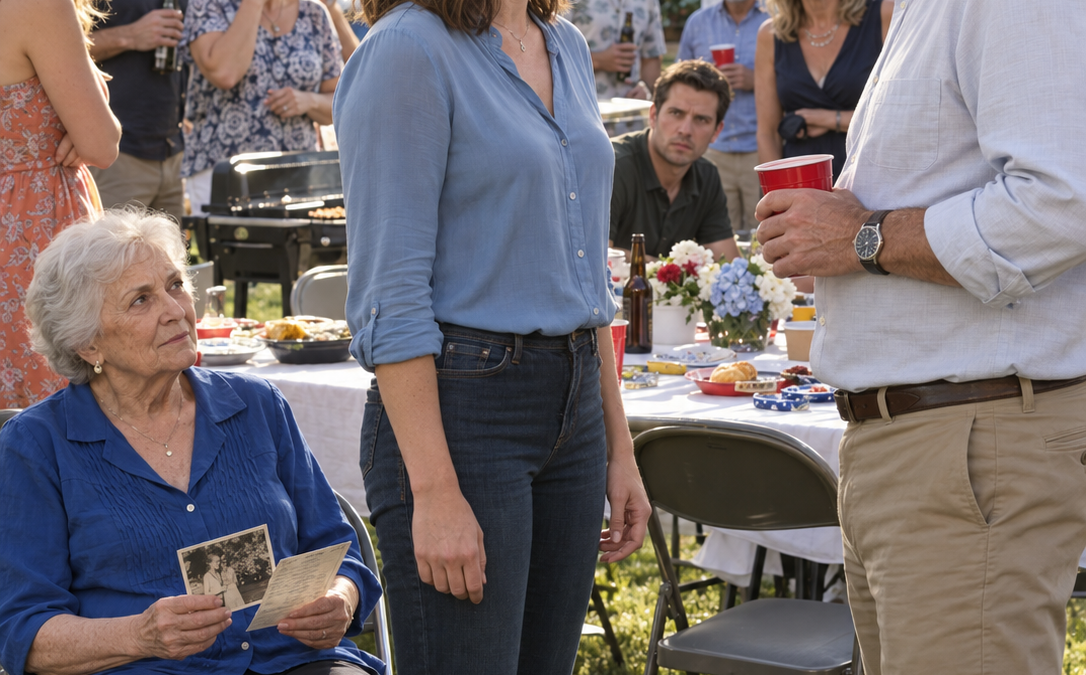
Two long folding tables under a rented canopy.
A banner along the fence.
28 YEARS.
Travis, the lead technician who was buying the company with his wife.
Two young techs I’d met at a Christmas party.
Neighbors.
My mother’s church friends.
Pam and her husband.
Doug standing by the cooler with his arms crossed.
Brianna, who saw me and put her hand over her mouth.
Tessa in a sundress, Colby and Nora orbiting her.
Curt over by the grill with a beer he was holding like a shield.
And my father in the middle of it, laughing at something Travis had said.
He saw Lorraine before he saw me.
I watched it happen.
His face did something I’d never seen it do.
A kind of flinch that started at the eyes and didn’t make it to the mouth.
It lasted maybe three seconds.
Then he turned back to Travis and said, loud enough to carry, “Get everyone a plate. I’ll say a few words at five.”
He didn’t look at me at all.
Lorraine found a chair.
It was, God help me, the metal folding chair from the garage—one of half a dozen my mother had set out to make up the numbers.
She sat in it like a throne.
I nearly laughed.
It was the first thing in that backyard that made sense.
Tessa was at my elbow inside of a minute.
Her smile stayed on for the neighbors.
Her voice didn’t.
“If you say one word, I swear—”
“I’m not going to say a word. I’m going to ask one question.”
She didn’t know what to do with that.
She went back to her children.
I didn’t eat.
I stood near the fence with Hank and watched my father work the yard.
He was good at it.
He’d always been good at it.
A hand on a shoulder.
A joke about the summer heat.
“Call Travis now. Don’t call me.”
He didn’t look at the folding chair once, which is how I knew he couldn’t look anywhere else.
At five, he tapped a red plastic cup with a fork and stood up at the head of the long table.
He thanked Travis.
He thanked the two young techs.
He thanked my mother, who had put up with a man who smelled like refrigerant for 28 years.
People laughed.
He held up the plastic cup like it was a trophy.
And then he told it.
“I’ll tell you how this company started. Twenty-two years old. Kicked out. A brown Chevy and a duffel bag. A month in that car.”
He looked straight at the folding chair when he said it.
“A month.”
Dead at her.
It was a dare.
“Nobody handed me anything. A month in that car taught me more than any school. And I’ll say this to anyone in my family who thinks they’re above that lesson—”
He stopped because I’d stood up.
I didn’t raise my voice.
I’ve never needed to.
I said it the way I’d say it on a mezzanine to 60 people who needed to hear that the last truck was late.
“Dad, tell them where the car was parked.”
The yard went quiet in stages.
First the people nearest the table.
Then the ones by the grill.
Then the kids, who go quiet last and only when they sense the adults have.
“What?”
“Where was the car parked? The Chevy. For the month.”
“In a lot.”
His jaw worked.
“A grocery-store lot. What is this?”
Lorraine didn’t stand up.
She didn’t need to.
Her voice carried the way an old teacher’s voice carries without effort.
“For four nights, honey. Then in my driveway. Fourteen months. The room’s still there.”
Nobody said wow.
Hank stepped forward from the fence.
I hadn’t planned that.
He’d told me he was done not saying it, and I’d believed him.
And here it was.
He had his hands in his pockets, and he spoke to the ground more than the crowd.
“I ate dinner in that house every Thursday that whole year. It’s true.”
He looked up at my father.
“I should have said so at her seventh birthday. I’m saying it now.”
“That’s not how it—”
My father didn’t finish the sentence.
He’d never had to finish it before.
Nobody had ever asked him to.
Travis looked down at his plate.
Pam looked at my mother.
My mother looked at the grass.
Lorraine folded her hands in her lap over the blue blouse.
“I’m not here to take anything from you, Wade. I paid for the certificate. You paid me back with 28 years of a story.”
A pause, gentle as a door closing.
“I just wanted your daughter to hear the other one.”
For about four seconds, nobody in that yard moved.
Then Tessa stood up.
Not to defend the truth.
To change the subject.
“Are you serious?”
She was talking to me loud now.
The neighbors forgotten.
“You want everyone to feel sorry for you. You lost a job, and you drag an 81-year-old woman across the state to humiliate Dad at his own party. That’s who you are.”
I didn’t answer her.
I’d promised myself one question, and I’d asked it.
Pam answered instead.
She’d been sitting at the far end of the table.
She didn’t stand.
She didn’t raise her voice either.
She just asked the question Doug had planted in her a month ago, in the voice of a woman who’d been waiting since February to find out whether she’d been lied to.
“Tessa, is it true your parents pay your mortgage?”
Tessa had had three glasses of wine.
I could see it.
I could see her reach for the denial and grab the wrong thing.
“That’s different. We have kids.”
You could hear the canopy fabric moving in the wind.
Brianna spoke from behind me, barely above a whisper.
“You told me not to give her a couch.”
“That was Mom—”
My mother, without looking up from the grass, said, “Tessa, sit down.”
Tessa sat down.
Curt set his beer on the table very carefully, like it might break, and walked out through the side gate to the driveway.
He didn’t come back for 40 minutes.
My father lowered himself into his chair.
He didn’t say anything.
Travis, who is a decent man, put a hand on his shoulder for a second and then went to get a beer because there was nothing else to do.
The party didn’t end.
That’s what I want people to understand about moments like this.
Nobody applauds.
Nobody stands up and says, “You were right all along.”
The party just changed volume.
People found reasons to look at their phones.
Two of my mother’s church friends started clearing plates.
The kids went back to the corner of the yard because kids know when the weather has turned.
I looked around that backyard and realized I didn’t need anything else from it.
I’d said the one sentence.
It was in the room now.
It would stay in the room after I left.
That was all I’d wanted.
I went out to the driveway.
Hank helped Lorraine out to the truck, and the three of us stood there by the tailgate next to a cracked patch of concrete with an old oil stain on it.
The exact spot where I’d always been told to park off to the side so I wasn’t in anyone’s way.
Hank had one more thing.
He’d been carrying it for 42 years.
And he’d apparently decided to put it down in this driveway.
“Dad said it to him,” he said. “In ’84. Word for word: ‘A month out there will do you good.'”
He looked at the house.
“Wade’s been quoting his own father for 40 years and calling it wisdom.”
Lorraine put her hand on the truck door.
“And it didn’t do him good,” she said. “I did.”
Then the side gate opened, and my father came out alone.
He walked halfway across the driveway and stopped two steps from Lorraine’s side of the truck.
He had the red plastic cup in his hand, still empty.
He didn’t look at me.
He didn’t look at Hank.
He looked at her.
And I watched a 64-year-old man try to find a sentence that would let him stand there without falling.
“Is the unit still running?”
Lorraine considered him for a long moment.
“Rattles in August. Still runs.”
He nodded once.
“I’ll send Travis.”
“Send yourself, Wade. Or don’t. The room doesn’t care.”
He stood there a few seconds longer.
Then he turned around and went back through the gate.
He didn’t apologize.
I didn’t expect him to.
And I want to be honest that I don’t think he ever will.
But I heard from Brianna later that when Travis asked him a little while afterward if he was going to finish the speech, my father said, “That’s the car,” and pointed at the photo on the invitation.
And left it there.
He didn’t say best thing.
He didn’t say a month.
He just stopped.
He has not told the story since.
Lorraine slept most of the drive back to Springfield.
Hank drove.
I sat in the back seat with my phone, and somewhere around the halfway point, three messages came in.
Tessa:
Hope it was worth it. At my dad’s party.
My mother:
A single period.
Sent at 1:12 in the morning, which meant she’d typed something, deleted it, and sent the only thing she could.
Brianna:
Can I call you? Not about tonight. About me.
I didn’t answer Tessa.
Not out of anger.
It was the first time in my life I’d had nothing to add.
And I let that be the reply.
I called Brianna the next morning.
She’d broken up with her boyfriend in April. She had to be out of their apartment by the end of May, and she’d been too ashamed to ask anyone because of what she’d said to me in February.
“I know I don’t deserve to ask, but I don’t have anywhere for June.”
“You didn’t deserve to be asked to say no to me either. Come the 30th. Bring a pillow.”
When I hung up, Lorraine was in the kitchen wiping down a metal folding chair with a dish towel.
“Your mother said, ‘Take it,'” she said. “She carried it out to the truck herself. Didn’t say a word.”
My mother called six days after the party.
She didn’t mention the party.
She asked if I’d eaten.
“Yes.”
“Your father’s quiet.”
“Good.”
The pedal exerciser wasn’t going in the background.
She’d finished the 12 weeks.
I noticed the silence the way I’d noticed the sound.
“Mom, you can call. But not to tell me what he says. Call to tell me what you think.”
There was a long pause.
Then, very small:
“I’ll try.”
That was the whole conversation.
That was the most honest conversation we’d ever had.
Pam called that same evening.
Awkward, circling the thing before she landed on it.
“I should have asked one question in February.”
“You asked it in May. That counts.”
Doug called after that.
Then nothing.
No call from my father.
No call from my sister.
I caught myself counting three calls.
Then I set the phone facedown on the table and let three be three.
The offer came on May 20th.
Night-shift supervisor at a regional food distributor’s warehouse on the north side of Springfield.
$54,000.
$3,000 less than I’d made in Kansas City.
And I’d never have to explain a single dollar of it to anyone.
Start date: June 1st.
That night, Lorraine and I sat at the kitchen table and wrote out a rental agreement by hand.
$400 a month.
Six months.
Renewable.
I insisted on the paper.
“You don’t need a paper.”
“I do. I’m my father’s daughter.”
I signed my name.
“I just want the receipt to say something different this time.”
She wrote June’s receipt in the yellow book before June had arrived.
Page two.
The stub of page one was still there beside it, torn along the line where a young man had once promised to pay her back with interest.
Then I sat down with a blank card.
Not a Christmas card.
It was May.
I wrote it to Brianna and left it on her pillow on the couch where she’d be sleeping in a week.
I used Lorraine’s sentence.
I changed one word.
There’s a couch in Springfield with your name on it. No lesson attached.
On the last Sunday in May, I came home from the grocery store and found a chalk line drawn across the driveway.
One white line.
A little crooked.
The way a line comes out when it’s drawn by a hand that’s 81 years old.
It marked the middle.
Dead center.
I pulled in and stopped on it and turned the engine off and sat there.
In the back-room window, the unit was rattling.
It would rattle all summer.
It would still run.
My father used to say a month of struggle was the best thing that ever happened to him.
It wasn’t.
She was.
And she’d been sending me her address for 13 years.
I stopped counting the cards.
Not because the number changed.
Because I did.
If you’ve ever had a family that decided how much you had to suffer before you’d earned their help, tell me in the comments what you did with that.
And if there’s a Lorraine somewhere in your life you’ve been meaning to call, this is your sign.
Thank you for listening.








