A year after my divorce, my sister spotted me at the hospital; she smirked: “still alone? your ex did well leaving you”; then she lowered her voice: “he has a son now—with the woman you called your best friend”; my parents said nothing; i just smiled: “is that what she told you?”; five minutes later, my ex walked in—and my sister’s face lost all color.
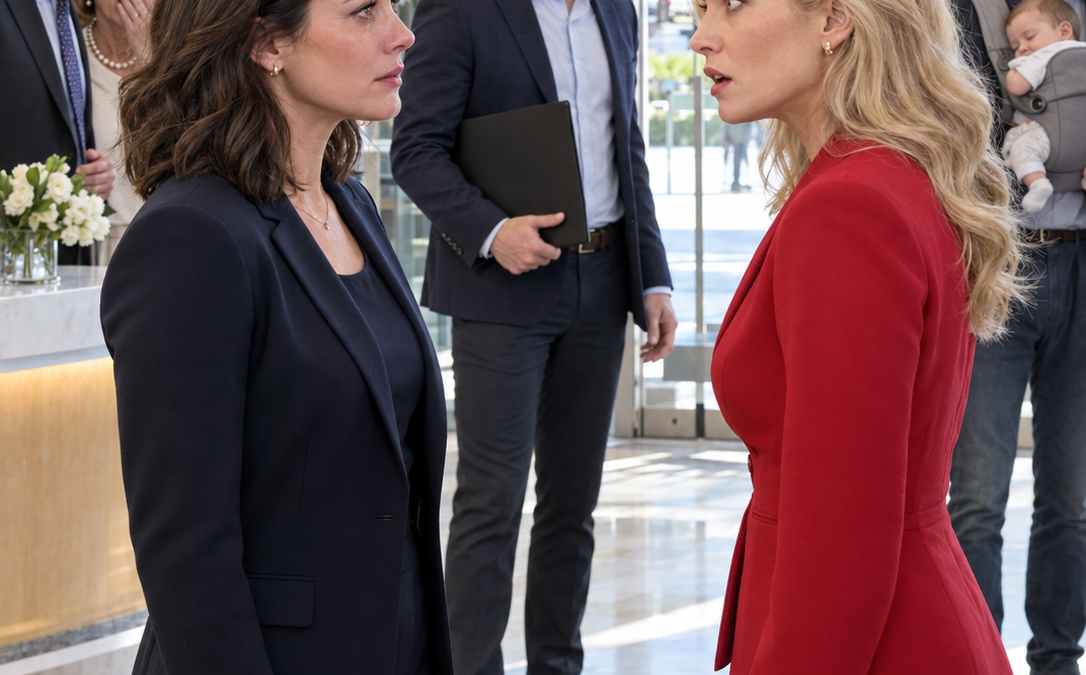
My sister marched straight up to me in the hospital lobby and raised her voice so the whole ER could hear. “Still alone, Abby. Look at you. Nathan finally did the smartest thing of his life. He left you. Now he has a beautiful son with the woman you called your best friend.”
She smiled sweetly while our parents stood right behind her, silent. Not a single word of defense. They just watched as their golden daughter buried me. I looked her dead in the eyes and asked, calm as ever, “Is that what she told you?”
Meredith thought she had won. She thought 3 years of carefully destroying my life had finally paid off. She had no idea the story she’d been feeding everyone wasn’t hers to tell. And in 5 minutes, the man she had cast as her perfect hero was going to walk through those doors holding the truth that would burn her entire script to the ground.
My name is Abby Carey. I’m 35 years old. If you’ve ever been quietly destroyed by the people who were supposed to love you, drop a comment and tell me where you’re listening from. Subscribe if you want to see what happens when the woman they thought they broke finally fights back.
Let me back up because to understand why I smiled in that lobby, you need to know what my family had spent 13 months believing about me and what my sister had spent 3 years arranging. I’m the chief nursing officer at Mercy Memorial Hospital in Charlotte, North Carolina. I’ve been there for 11 years. I manage 240 nurses, an annual budget of $28 million, and I answer to a board of six people who have never once asked me if my sister was ruining my life. Most mornings, I’m at the hospital by 6:15.
Sometimes earlier, when a nurse walks off the floor with a patient still crashing, that patient dies. My job is to make sure nobody walks off the floor. That’s it. That’s why my family calls me cold.
For 11 years, no one at my parents’ Thanksgiving table has asked me what I actually do all day, but they have a very confident opinion about it. My mother, Diane, believes I chose my career over my marriage. My father, Warren, believes I was “always going to be the difficult one.” My sister, Meredith, believes I’m the reason my ex-husband left me.
And 13 months after my divorce, they all thought the story had finally ended in their favor. That was the story they had built. That was the version they had been telling at Easter, at Thanksgiving, at every gathering I attended and everyone I didn’t.
It had one recurring victim, and everyone in the room had gotten used to the sound of my name attached to it. My sister is a top-producing broker at Keller Williams Charlotte. She lives in a $920,000 house in Cotswold. Her husband Bradley is an attending physician at UNC Health. Her two children, Delaney, who is 10, and Weston, who is seven, go to a private school in Myers Park.
Her Instagram has a hashtag she has been using since 2016. #GirlMom. Every family holiday, she posts a photo of them under warm porch light with a caption about endurance. My mother comments on every single one.
Meredith didn’t just win in our family. She won the way a person wins who has been keeping score since she was old enough to hold a pencil. There’s a specific sentence my mother has said to me in some variation. Every time we’ve been alone since March of last year, it always starts the same way.
“Sweetheart.”
And my mother is a woman who calls almost everyone sweetheart, which in the polite Southern way is how you put distance between yourself and the person you’re about to disappoint.
“Sweetheart, you know, Nathan needed someone softer.”
She said it at Thanksgiving. She said it at Easter. She said it in her kitchen in March when I flew home for her 65th birthday. And every time I would sit there and let her tell me who I was because I had learned that arguing was the fastest way to prove her right.
The kind of woman who argues in my family is difficult. The kind of woman who cries is a mess. The kind of woman who accepts what she’s told about herself and smiles quietly through it is not soft. She is broken.
There was no version of me my mother could name that would not become evidence of my failure. So I stopped trying to be named. In our family, silence has always been how they picked their favorite. For a long time, I thought that meant I had lost.
I want to tell you about a Thanksgiving. November 2013. I was 23. I’d been out of nursing school for 18 months and was working ICU shifts at a Level I trauma center in Charlotte. Meredith was 27. She was 2 weeks away from meeting Bradley Vance, though none of us knew that yet. My grandmother, my father’s mother, had died 2 weeks before Thanksgiving.
My father was drinking not badly, just enough. After dinner, he moved into the living room with a Glencairn of Redbreast and started talking about his own father. He talked for a while.
I was in the kitchen doing dishes and I could hear him from the sink. He was in that soft, half-lit voice men in my family use when they think they’re being philosophical. My mother had gone to bed. Meredith was in the armchair listening, her iPhone face down on the coffee table beside her whiskey glass.
I only remember what he said because I heard it twice: once from the kitchen, once 12 and a half years later on the last night of my old life.
He said, “You know what makes a family? Endurance. That’s what your grandfather used to say. Whichever one of you two girls can keep her family together the longest, that’s who this house goes to. All of it. The Raleigh house. That’s how you earn a legacy. That’s how you prove you weren’t just born into a name.”
I laughed a little into the sink. I thought it was whiskey talking. I forgot it by breakfast.
Meredith didn’t.
Meredith came into the kitchen 10 minutes later while I was drying a wine glass. She stood in the doorway. She said one sentence to me quietly, the way you tell someone the score of a game you have already been playing without them.
“One of us is going to earn everything, Abby. And it won’t be you. You’re too busy trying to save strangers.”
I laughed again. I told her she was drunk.
She wasn’t.
That was the difference between us. She had a memory for sentences. I had a memory for shifts.
I want to skip ahead to a wedding, not mine. Meredith’s in June 2014. She got married in Raleigh at the church my mother had gone to as a girl. She didn’t ask me to be her maid of honor. She had a Kappa Delta friend from Wake Forest who wore ivory. I stood fourth in the bridesmaid line in a blush dress.
My father cried when he walked her down the aisle. My mother took a picture of that moment and kept it in a silver frame on the mantle for the next 12 years.
Then my wedding, June 2015. I was 25. Nathan was 27. He was a senior architect at Cornerstone Architecture in South End. And he was the kindest man I had ever dated.
Meredith was my matron of honor because our mother said it would look strange if she wasn’t. During the toast, holding a champagne flute and smiling at Nathan, she said, “Nathan, thank you for being patient with our Abby. She’s not the easiest, but I know you’ll bring out her softer side.”
Nathan laughed. He didn’t know that toast was the first line of a script my sister had already started writing.
The Christmas of 2021, my parents mailed out a card with a family photo. My mother said, “Oh, honey, we just wanted a candid one. It wasn’t personal.”
Nathan and I had flown in 2 days before the photo was taken. We had been in the house the whole afternoon. The card contained Meredith and Bradley and Delaney and Weston in front of the fireplace at my parents’ house, and I was not in it.
Nathan held the card for a long time when I opened the envelope. He said, “Your mom’s right. It’s not personal.”
It took me two more years to understand that it was. I just didn’t know who was making it personal.
There are moments in a marriage that you don’t realize are the beginning of the end because they don’t look like anything. In late 2022, Nathan came home from a fall gala at my hospital and mentioned casually that Meredith had introduced him to one of her friends.
He said the name Hollis.
He said, “Wasn’t she your friend from Charlotte?”
I said, “Yes, she was.”
I said, “We’d fallen out of touch after her first divorce.”
I didn’t think about it again.
I found out later that Hollis had been Meredith’s real estate client for over a year. At that point, Meredith had helped her sell a house in Ballantyne and buy a smaller condo in South Park. Meredith had learned in the course of those transactions that Hollis had gone to UN Charlotte with me, and Meredith had brought Hollis to that gala on purpose.
She had walked her over to my husband’s table and said, “Have you two ever met?”
But I want to slow down. I want to tell you about 2018 because 2018 is when I first began to understand that my sister was not simply keeping score.
She was placing bets.
Nathan and I tried to have a baby in 2017. It didn’t happen. My doctor at Novant referred us to a fertility specialist off Randolph Road. We began IVF in the spring of 2018. Our first cycle failed. Our second cycle failed.
It was quiet, private grief.
We told nobody outside my mother, who wrapped both of my hands in both of hers when I told her, and Meredith, whom I told because we were still at that point sisters.
Or so I believed.
That November at Thanksgiving, Meredith arrived at my parents’ house with a canvas tote bag full of photos of Delaney. Delaney was 3 months old. Meredith set the photos out on the kitchen counter beside the deviled eggs while I was slicing celery.
She said, “Aren’t they precious? Bradley says I take too many.”
My mother laughed and picked up the top photo and held it up to the light. My sister looked at me while my mother looked at the picture.
She did not look away.
She wanted me to know that she had timed it.
I said the photos were beautiful. I finished slicing the celery. I did not tell Meredith what I felt because I had already learned that a woman in my family who cried at her sister’s baby photos was a woman who deserved to.
That was the year my mother began telling other people I had decided I didn’t want children. I never said that sentence. Meredith had said something like it to my mother the previous summer in the kitchen, and my mother had heard it in the voice she trusted most.
In January of 2023, Nathan started talking about how tired he was of feeling invisible. He hadn’t used the word invisible before. It was a new word.
Then Meredith called me one afternoon while I was in a budget meeting.
She said, “You two should really see someone. Bradley’s cousin just opened a practice in Elizabeth. She’s family kind of. She’ll take care of you both. Her name is Dr. Colette Ashford.”
I Googled Colette Ashford. Her website was clean. Her reviews were five stars. Her office was in a small building off East Boulevard. I never checked the state licensing board.
Why would I?
My sister sent her.
For 30 weeks, Nathan and I sat on a gray couch in Colette’s office. She was in her late 20s. She wore soft cardigans. She was very good at asking Nathan how something made him feel and then repeating his answer back to me as though it were a diagnosis.
“Nathan, when Abby comes home from work and doesn’t talk about her day, how does that feel to you?”
He said it made him feel like he was married to her patients more than to her.
Colette nodded. She said, “Abby, do you hear what Nathan is telling you? He’s saying he feels invisible.”
Then she wrote in her notebook.
I remember thinking she was talking to Nathan more than to me. I remember thinking she was really good at her job.
I was half right.
I remember one session in particular. It was the 11th, I think. Colette asked me if I had considered why I chose a career in a hospital instead of a career in a home.
I said the phrase was unfair and she smiled and said, “I’m not judging, Abby. I’m just noticing.”
That word noticing became her habit.
She would notice everything. She noticed when I looked at my phone. She noticed when I answered too quickly. She noticed once that I had worn scrubs to a session because I’d come from the hospital and she said, “It’s interesting how much you bring the hospital into rooms that aren’t the hospital.”
Nathan nodded on the couch beside me.
I did not answer.
I was by then being trained not to.
By session 12, Nathan was using the phrase emotional availability. By session 18, he was using the phrase running away into your work. By session 22, he was leaving my texts on read for hours at a time.
In December of 2023, I found a hotel receipt in the pocket of his coat.
I didn’t confront him. I didn’t scream. I gave him space because I had been taught that the woman who fought was the woman who had already lost.
In January of 2024, he asked for a divorce. The papers were finalized on March 11th, 2025.
The last night he lived in our house, he stood by the door with his hand on the handle of a Navy Samsonite. He didn’t look at me.
He said, “You’ve been unavailable for years, Abby. I need someone who can actually be here.”
I heard those words in Nathan’s voice, but they weren’t Nathan’s. I could hear the shape of Colette’s hand in them.
It took me 2 years to figure out whose voice that really was. When I did, I finally understood why he’d said it like a line he had rehearsed.
13 months later, on the evening of Saturday, April 12th, 2026, I was eating leftover pad thai on my couch when my phone vibrated. The name on the screen was one I hadn’t seen there in almost 14 months.
Nathan.
The text said, “Abby, I know I have no right, but I found something you need to see. It’s about Meredith, about our marriage. Meet me at Mercy Memorial Lobby Tuesday the 14th at 10:45 a.m. I’m not asking for anything. I just need to give you the truth.”
I read the message three times. I did not put my chopsticks down until I got to the end.
I typed one word.
Yes.
I hit send.
I didn’t know it yet, but I had just agreed to walk into the last week of the story my sister had been telling about me.
Tuesday, April 14th, was a Joint Commission audit day at the hospital. I had a 9:00 meeting with my clinical director, Dana Hollister, and two auditors from the accreditation office. The meeting ended at 10:36.
I took the elevator down to the main lobby to wait for Nathan.
I saw them before they saw me.
Hollis was standing under the glass canopy of the main entrance holding a baby in a soft gray carrier. My mother was on her right holding her purse the way she held her purse when she was uncomfortable in public. My father was on her left staring at his phone. Meredith was slightly behind them, ending a call.
Between the three adults was a pediatric cardiology follow-up appointment card and the sticker that a nurse on floor 5 puts on every baby leaving their first echo cardiogram.
First hospital visit.
I hadn’t known Owen was coming to my hospital that morning.
Meredith turned.
She saw me.
She smiled the way a person smiles when the room has finally arranged itself the way she planned.
Then she walked over.
And then everything you heard at the beginning of this story happened.
My sister raised her voice. My parents did not defend me. Owen slept in Hollis’s carrier and had no idea that any of the words being said would ever belong to him.
And I asked one question: “Is that what she told you?”
The clock behind the reception desk read 10:38.
The lobby had six other people in it. A security guard behind glass at the desk. A woman waiting for someone to be discharged. A cardiology fellow on his phone. Two families near the coffee machine.
Everyone heard.
Nobody moved.
Meredith didn’t stop after I asked the question. She thought I hadn’t understood her. She stepped closer.
She said, “Owen has his father’s eyes, Abby. It’s the sweetest thing.”
“Really?” I said. “That’s nice.”
My mother’s hand tightened on the strap of her purse. Hollis turned her body slightly toward the ER driveway. It was the first time I had ever seen her look uncomfortable in front of my sister.
She kept going.
She said, “I know it’s hard for you to see us all here together, but we don’t want you to feel excluded, Abby. That’s why we told him he could come today. Well, I told him.”
I looked at her.
She was smiling.
She was, I realized, still adding lines, still improvising, still trying to find the right way to twist the knife so that my mother would see it as a generosity.
My father hadn’t looked up yet.
Hollis had.
Hollis said very quietly, “Meredith, maybe we should—”
Meredith cut her off.
“Hollis, sweetheart, you don’t have to protect her. She’s a grown woman. She can hear it.”
At 10:41, my father finally looked up from his phone. He looked at Meredith, then at me, then at Meredith again.
He didn’t say anything.
His silence was the same silence he had used for 12 years.
It was not neutral.
It was a vote.
At 10:43, the sliding doors opened.
Meredith didn’t turn around. She was still enjoying her sentence.
Nathan walked in carrying a black paper folder with three white labels on the spine. He was wearing the navy blazer he wore to closings.
He didn’t look at Hollis. He didn’t look at my parents.
He looked at me and he nodded.
Meredith turned.
Then I watched her face do the thing that happens to a person who has spent three years believing the wrong ending was the real one. Her mouth opened before her brain caught up.
“Nathan,” she said. “What are you—?”
He didn’t answer her.
He walked past her. He stopped in front of me and said quietly, “Hi, Abby. I brought what I promised.”
Meredith stepped between us with a small, forced laugh.
“Nathan, whatever this is, let’s not do it here. Everyone’s tired. Owen has an appointment.”
Owen had his appointment.
Nathan said, still not looking at her, “It was 30 minutes ago on the fifth floor. You’ve been down in this lobby for 8 minutes.”
Meredith’s laugh got a little quieter.
“Nathan.”
He opened the folder.
He didn’t hand it to me. He held it up so that my parents, standing 6 feet behind Meredith, could see the top page.
It was an email.
It had a subject line I would later come to know by heart.
Session notes. Phase two. Wife detachment framing.
He looked at me.
He said, “Meredith paid your therapist.”
Nobody said anything for the length of a heartbeat.
Then Meredith laughed the way she used to laugh when she’d been caught with our mother’s earrings when we were kids. The laugh she had gotten very good at using as a delay tactic.
“Abby,” she said, “this is absurd. Nathan, whatever she’s told you, my sister has always misread people. Colette was doing us a favor. I paid her because you two couldn’t afford her, and I didn’t want you to feel like a charity case. It was a gift.”
My father was already staring at the top of the folder. I watched his reading glasses slip a quarter inch down his nose.
“Then why?” Warren said, and my father’s voice had a papery quality to it that I hadn’t heard since his own mother’s funeral. “Does the email in Nathan’s hand from you to Colette Ashford say, ‘Frame Abby as detached. Nathan is receptive’?”
Meredith opened her mouth.
Nothing came out.
My mother’s face was still. Her hand was no longer moving on her purse. She had stopped breathing the way you breathe when you don’t want to hear more.
Hollis was looking at Meredith with an expression I had never seen from Hollis before. It wasn’t hurt yet.
It was something colder.
It was the first crack in the version of the story my sister had been feeding her for 3 years.
Nathan closed the folder.
He said calmly to the group, “There’s more, but not here. Not with Owen. Meredith, Warren, Diane, whatever comes next needs to happen at a table, not a hospital lobby.”
He turned to me.
He said, “I’ll be at your parents’ house on Sunday if you’ll have me.”
I said, “I’ll have you.”
For the first time in 12 years, our parents were looking at Meredith, not at me.
I want to tell you what I did that night. Because between the moment Nathan opened that folder in the lobby and the moment my father listened to himself on a Sunday 6 days later, there is a story that lives in a beige USB drive with a Sharpie label that says, “M, do not touch.”
Two months earlier, in the second week of February, I had flown to Raleigh for my mother’s 65th birthday. My mother had thrown out her back three days before I arrived, and she asked me to clear out the guest room closet on Sunday afternoon.
That was Meredith’s old room.
Meredith hadn’t slept in that closet since 2004.
My mother said, and I quote, “Just get rid of whatever’s in there, honey. Meredith hasn’t lived here in 20 years.”
I found a Nike Air Max shoe box on the top shelf behind a folded Kappa Delta banner. Inside there were letters from a college boyfriend, a stack of Spar’s programs, one Metro Ford key from a car she had wrecked at 19, and a single beige USB drive with a Sharpie label handwritten by my sister:
“M, do not touch.”
I stood there for a full minute.
My sister and I had not had a private conversation in 6 years. I couldn’t picture calling her about a USB drive labeled with her own name. I couldn’t picture throwing it away either.
I put it in my purse.
I told myself I would ask her the next time we spoke.
That conversation never happened.
That was February.
On the night of April 14th, after I got home from the hospital, I sat down at my kitchen island in my apartment in Dilworth and I plugged the USB drive into my MacBook.
It didn’t ask for a password.
There were four folders: Family, Bradley, Business, Nathan_A.
Not Nathan.
Not Sister.
Nathan_A.
My sister had labeled a folder with my husband and my initial like a case file.
I opened Nathan_A.
There were 40 documents.
The first one was called “Session Notes: Phase 2 — Wife Detachment Framing.” It was a Word document. It ran seven pages. Each page was dated. Each page summarized what Colette Ashford had done in that session.
Session 8, first bullet: “Nathan now consistently uses the phrase emotional availability unprompted. Advance framing accordingly.”
Session 12, first bullet: “Nathan initiated the topic of married to her patients. Meredith, please forward further material for the framing.”
Session 18: “Transition Nathan from invisible to unwanted.”
Below the session notes were emails between Meredith and Colette. Some of them were three lines long. Some of them were entire strategy documents.
There was an email from January 2023 in which Meredith laid out what she called the timeline.
She wrote, and I quote, “Abby is analytical. Do not confront; frame. Let Nathan arrive at the conclusion himself. Give him three months to fully internalize the language.”
Colette had replied with two sentences: “I’ve drafted three scripts for the invisible husband framing. We’ll workshop in session 14.”
There was an email from March 2023 in which Meredith wrote, “Colette, Nathan is asking about legal separation timelines. Slow him down. He needs to think this was his idea and no one else’s. If he moves too fast, our mother will suspect.”
Colette had replied with a single word.
“Understood.”
There was an email from August 2023 in which Meredith wrote, “Watch for Abby to bring up children. She almost broke through the last session. If she does it again, redirect to career prioritization. Say the word passion three times in one exchange. Nathan responds to it.”
I sat there in my kitchen and I read email after email.
It felt like reading somebody’s homework about how to end a marriage.
One of them stopped my breath for a full minute.
April 17th, 2023.
From Meredith to Colette.
Subject line: For post-divorce placement.
“Do you have someone in mind for Nathan?”
The email from Colette back said, “Do you?”
The email from Meredith said, “Yes, a friend of mine, Hollis Prescott. She’s ready. She just needs a soft landing.”
Hollis wasn’t a rebound.
Hollis was a placement.
I closed the laptop.
I looked at the microwave.
It said 8:31.
I sat still.
I didn’t cry. I didn’t call anyone.
I noted the time so that later, when I tried to remember when I had truly understood, I would have a real number.
Then I opened the laptop again.
I still had 38 files left to read.
Some of the files were correspondence. Some were spreadsheets. There was a document called timeline_adjustment_q3.docx that outlined the pace at which Nathan was expected to detach.
There was a document titled introductory scripts for Hollis with three drafts of what she should tell my mother about her divorce, her career, and her family.
Meredith had written her friend’s biography before she had officially introduced her to my parents.
There was a folder inside the folder called family_talking_points.
It had four documents in it.
One was labeled “mom.”
One was labeled “dad.”
One was labeled “aunt Viv.”
One was labeled “general.”
The one labeled mom had a single bulleted list.
“Always frame Abby’s career as the wound. Always frame her calmness as coldness. Mom will fill in the rest. She wants to.”
I read that line three times.
My sister had not written a plan to fool my mother.
She had written a plan that only required my mother to be who she already was.
I searched Colette Ashford on LinkedIn from my phone. Her profile said she was a real estate assistant at a firm in Asheville called Blue Ridge Homes. There was no mention of counseling anywhere in her work history since March 2024.
I sent her one message:
“I need to talk tomorrow. This isn’t a threat, but you and I both know why I’m reaching out.”
Her reply appeared at 10:52 the next morning.
“Please call me. I’ve been waiting for this message for 3 years.”
I called her.
She picked up on the first ring.
Her voice was already shaking.
That call lasted 42 minutes.
I will not tell you every part of what she said because some of it was the kind of self-blame that a person offers up when they have been carrying a secret so long they no longer know how to speak about anything else.
But I will tell you the parts you need.
I owe you that.
Colette Ashford has a master’s in counseling psychology from Western Carolina University. She got it in 2019.
To become a licensed marriage and family therapist in North Carolina, she needed 3,000 supervised clinical hours and a state board exam.
She never completed either.
In December of 2022, she had been fired from a nonprofit in Asheville over a policy dispute and she was 3 months behind on her rent. She had moved back down to Charlotte to sleep on a friend’s couch.
Her cousin Bradley called her the second week of December and asked if she wanted to help his wife with a family project.
Then Meredith flew to meet her.
Meredith paid Colette $4,800 upfront in a Zelle transfer marked consulting retainer. She paid $200 a session for the 30 sessions Nathan and I attended.
She rented Colette a suite in a small office building off East Boulevard through a real estate contact and paid 12 months in advance so there would be no lease trail.
She told Colette this was a marriage-saving intervention.
Colette believed her for the first five sessions.
By the sixth, she had begun to understand what she was actually being paid to do.
By the 15th, she had stopped asking herself whether it was ethical.
I asked her when she stopped believing my sister.
She said, “Session six. Meredith emailed me a phrase to use on you. She wrote it in a bulleted list. She wrote: ‘Describe her as detached. Then use the word detached again the next session. Then again the session after that. Nathan will begin using it. Once he uses it, ask him to reflect on whether it’s fair. He’ll say yes. That’s how you plant a word. It has to grow on him, not on her.'”
Colette said, “I understood. Then that’s not couples therapy. That’s coaching, and I did it anyway.”
I asked her why she didn’t stop.
She said, “Because I told myself it was already too late. Because your husband was leaving anyway. Because if I stopped, I’d have to admit what I’d already done. Every session I stayed, it got harder to leave. My cousin’s wife had my rent.”
I asked her if she’d ever put the word doctor in front of her name in writing.
She said, “Only in a Word document that Meredith drafted, never in a chart. But I let it happen. I let people call me it in the waiting room. I never corrected anyone. That’s fraud, Abby. I know what it is. I’ve known what it is.”
I asked her why she was telling me this now.
She said, “Because Nathan called me two weeks ago. Because I have a fiancé and I don’t want to lie to him anymore. Because I never had a license. Abby, I’m sorry. She said you’d never notice.”
I did not answer.
I did not hang up right away.
I just listened to her breathing for a few seconds before I put the phone down on my counter, still connected, and walked over to my kitchen window to look at the sky.
Then I went back and I disconnected.
I need to tell you something before we go any further.
If a piece of this is starting to sound familiar, if there is someone in your family who introduced the person who ended your marriage or who paid for the room where you were told what was wrong with you, leave a single line in the comments.
Just tell me you’re here.
You don’t have to explain.
I want to know you exist.
I want to know I wasn’t the only one.
The next day, Nathan sent me a screenshot. He said he had held on to it for a year and had not known what to do with it.
It was an iMessage thread between him and Meredith dated Friday, April 12th, 2025, exactly 2 weeks after our divorce was finalized.
Meredith had written, “Nathan, I’ll wire the $62,500 tomorrow morning. Think of it as a bridge loan, not a gift. Just make sure you’re happy with Hollis. That’s the interest I want, $62,500.”
My sister had loaned my ex-husband the down payment on his new life with my former best friend.
The interest was that he stay with Hollis.
Nathan hadn’t understood the phrasing at the time.
12 months later, he did.
I sat with that screenshot for a long time.
Then I went back to the USB drive.
I hadn’t yet opened the folder called Family. I had assumed it was old photos.
That night, I opened it and found 16 files.
15 of them were photos.
The 16th was a voice memo.
Dad_Thanksgiving_203.m4a.
Three minutes and 14 seconds.
I put on my AirPods.
I clicked.
I heard the clatter of silverware. I heard my mother’s laugh from the kitchen. I heard the low rise and fall of my father’s voice, softer than I remembered it, warmer, with the give of two whiskeys and one more waiting on the side table.
Then I heard the sentence I had forgotten by breakfast 12 and 1/2 years ago.
“You know what makes a family? Endurance. That’s what your grandfather used to say. Whichever one of you two girls can keep her family together the longest, that’s who this house goes to. All of it. The Raleigh house. That’s how you earn a legacy. That’s how you prove you weren’t just born into a name.”
The recording continued for another 80 seconds.
My father laughed at his own joke.
My sister laughed with him.
Then the file ended.
I set the AirPods down on the counter.
I stood up from my chair.
I was not angry.
I was still.
My sister had not been trying to earn my father’s love.
My sister had been building a legal case to inherit his house, and she had used my marriage as the collateral.
I opened a new Excel file on my MacBook.
I typed the dates.
November 2013, whiskey and quote.
June 2015, matron of honor and toast.
Fall 2018, my second failed IVF cycle and Meredith’s Thanksgiving photo of Delaney at 3 months old placed casually on the table where the appetizers were served.
2020, my mother telling my aunt Vivien that I had “decided I didn’t want children.”
A sentence I had never said.
October 2022, the fall gala introduction.
January 2023, the fake therapist.
April 2023, the placement plan.
June 2023, the affair.
January 2024, the divorce request.
April 2025, the $62,500.
December 2025, the baby.
February 2026, the shoe box.
April 2026, the lobby.
12 years, 12 rows.
Every row had a column called evidence.
I filled every one.
I sat back from the laptop when I was done, and I looked at the spreadsheet as though it were something I was seeing from far away.
12 years of gestures. 12 years of dinners. 12 years of Christmas cards. 12 years of my mother saying sweetheart in the tone that meant we are done discussing this.
And laid out in a single Excel grid, it looked like exactly what it was.
Not a family.
A project-management document.
My sister had been running a program with a beginning, a middle, and an intended end.
And every one of us—my mother, my father, Nathan, Hollis, Bradley, and me—had been assigned a role.
I was the obstacle.
Everyone else was a resource.
I saved the file.
I named it Sunday_handout.xlsx.
Then I called my aunt Vivien.
Vivien is my father’s younger sister. She’s 68. She was a professor of American literature at UNC Chapel Hill for 34 years before she retired to Durham.
She is unmarried. She has no children. She had one husband briefly in the 1990s and she has never spoken about him.
My family has said she is difficult in the same voice they used to say I am difficult.
I have suspected for a long time that we were being called the same thing for the same reason.
She picked up on the second ring, which is how she always picks up.
She heard three sentences of what I was about to tell her and interrupted me.
“Abby, sit down. I have something to tell you that I should have told you when you were 16.”
She said she had watched Meredith do things to me since I was a child. She said she had watched my parents look the other way. She said she had watched herself do the same because she had been afraid of losing the little bit of family she had left.
She said she was sorry.
Then she told me four things.
The first was that at my grandmother’s funeral two weeks before Thanksgiving of 2013, Meredith had asked her in the parking lot of the funeral home, “Aunt Viv, if Dad’s house went to just one of us, who would he pick?”
Vivien had said she’d thought it was a rude question. She had told Meredith not to talk about her father’s house at his mother’s funeral.
Meredith had smiled at her, apologized in a soft voice, and walked back into the reception.
Vivien said she had spent the drive home wondering whether she had imagined the whole exchange.
She hadn’t.
She just hadn’t understood that it was research.
The second was that at my wedding in June of 2015, she had gone looking for the caterer through a side hallway of the venue. She had heard my sister’s voice behind a half-open door.
Meredith was saying something to Bradley in a tone Vivien had never heard from her before.
Vivien said it was the voice of a person talking about a project timeline.
Meredith had said, “Bradley, this is going to be a five-year game at minimum.”
Vivien had walked past the door quickly and had never mentioned it to anyone.
She said, “I told myself she was talking about buying a house. I told myself that for 11 years because if I let myself hear what I actually heard, I would have had to say something to your father. And I was afraid your father would take Meredith’s side and I would lose him, too.”
The third was that at Thanksgiving of 2023, the year Nathan and I were seeing Colette, Meredith had invited her to her house in Cotswold and introduced her to a young woman she called Colette, described as a friend of the family.
Vivien had asked Colette what she did for a living.
Colette had answered vaguely about counseling and had changed the subject.
Vivien said she had noted the deflection at the time.
“Abby, I have taught undergraduates for 34 years. I know what it looks like when a young woman is protecting someone else’s story. Colette looked at your sister three times in one conversation before she gave me a full sentence about herself. I have never seen a licensed therapist do that.”
The fourth was harder for her to say.
She said that in the summer of 2024, at a family barbecue at Meredith’s house, Bradley had come out onto the back patio to refill her wine glass, and he had been just drunk enough to say a sentence to her that he probably didn’t know he was saying out loud.
He said, “Aunt Viv, I don’t ask my wife what her sister’s therapy sessions are about anymore. Some things you learn not to ask.”
And then he had gone back inside.
Vivien said, “I stood on that patio for 20 minutes after he left. I told myself I would call your mother. I didn’t. I told myself I would call you. I didn’t. I told myself Bradley had a good marriage and if there was something wrong, he would fix it. I was wrong to trust him with what I heard. I should have called you the next morning. I should have said something to your father. But your father does not hear things he doesn’t want to hear. And Diane has spent her whole marriage keeping the peace by keeping quiet. And Bradley knew enough to feel sick, but not enough to leave. Not until now, at least.”
I asked her if she would come to Sunday dinner.
She was quiet for 8 seconds.
Then she said, “I’ve been waiting 12 years for someone to bring this out into the light. I’ll be there Sunday, and I think Bradley may finally be ready to leave a room he’s been sitting in too long.”
I called Nathan that Friday morning, not to reconcile, to brief.
I told him I wanted him to come to my parents’ house on Sunday evening. I told him he did not have to defend me.
I told him I needed him as a witness.
He said, “Abby, whatever you need me to do at that dinner, I’ll do. I’m not going to pretend I’m the victim. I made choices, but I’ll tell them what I know.”
I said, “I don’t need you to be a victim. I need you to be a witness.”
He was quiet for a moment.
He said, “Is Hollis going to be there?”
I said, “That’s up to you.”
He said, “She won’t be. I already told her this isn’t hers to attend.”
That was the last question of the last conversation I had with my ex-husband before the dinner.
Saturday, I built two folders.
Folder A was the master copy. It had the three key emails between Meredith and Colette. The screenshot of the $62,500 text thread. Colette’s signed statement.
She had faxed it to Vivien’s law professor friend at Chapel Hill on Friday morning, and the voice memo file transferred onto an iPad in the pocket of the folder.
Folder B was a one-page summary.
I printed six copies of Folder B, one for each person who would sit at the table.
Sunday morning at 9:15, I picked up Vivien at her house in Durham and we drove west.
My parents live in Cameron Park in Raleigh, 2 miles from where my father grew up. The drive from Durham to Cameron Park is a little over an hour.
It was a warm April Sunday. The dogwoods were just past their peak.
Vivien looked out the window for a while.
Then she said, “Do you know what the hardest part of the next 4 hours is going to be, Abby? Watching your mother realize she chose the wrong daughter.”
I said, “I don’t need her to choose me now, Aunt Viv. I just need her to see.”
Vivien looked at me.
She said, “Your sister is going to survive today, Abby. Your mother might not. Are you prepared for that?”
I said, “Yes.”
What I didn’t say was that I wasn’t sure yet.
We arrived at my parents’ house at 4620 Beacon Ridge Drive at 12 minutes before 4. Sunday dinner in my family had been at 4:00 in the afternoon for as long as I had been alive.
My mother opened the door and was startled to see Vivien on the porch.
She said, “Vivien, honey, we didn’t know.”
Vivien said, “Diane, I invited myself. There’s family business we need to talk about.”
Meredith and Bradley pulled up in the driveway 6 minutes later. Delaney and Weston went straight to the trampoline in the back.
Meredith saw Vivien through the dining room window and stopped in the entryway.
“Aunt Viv,” she said, and her voice went up just slightly. “Nobody said you were coming.”
“Because I didn’t tell anyone, dear,” Vivien said.
Meredith looked at Bradley.
Bradley looked at the floor.
Meredith touched her fingers to her chest the way she used to touch it when she was about to lie about a broken vase in 2001.
Then she asked Bradley to help her get more wine from the kitchen.
They were in the kitchen for 2 minutes.
When they came out, Bradley did not look up.
Meredith’s mouth was set in a particular thin line I had known since we shared a bathroom as teenagers. It was the line of a person planning how to control a room that had already started to slip.
We sat down.
Pot roast, roasted potatoes, green beans with almonds, rolls in a basket wrapped in a blue kitchen towel.
My mother started to pour coffee.
Before she reached the second cup, I placed Folder A in front of my father, Folder A in front of my mother, and a single Folder B in front of Meredith and Bradley.
“Mom, Dad, before you pour the coffee, there are three things I need you to see. Bradley, one of them is about your cousin. Meredith, all three of them are about you.”
Meredith’s hand tightened around the wine glass she had just poured for herself.
“Abby,” she said, “whatever this is—”
“Meredith,” I said, “let me finish.”
My father opened his folder.
He did not say anything.
He was looking at the first page.
It was one of the emails.
My mother put her hand on the top of hers but did not open it.
Meredith did the thing she always did when she was cornered.
She laughed a little, not too loud, and she tried again.
“This is out of context. Abby has always misread people. Colette was helping Nathan and Abby. I paid her because they couldn’t afford it and I didn’t want them to know it was me. It was a gift.”
My father was reading.
He did not look up.
In a voice that did not sound like the voice of a man on his second glass of Sunday afternoon Chardonnay, he said, “Then why does the email in my hand from you to Colette say, ‘Frame Abby as detached. Nathan is receptive’?”
Meredith opened her mouth.
Nothing came out.
She tried a second angle.
“Dad, that email doesn’t say what she says it says. She’s twisted the words. This is why she and I don’t talk. She reframes everything.”
My mother turned the page of her folder.
She was still not saying anything, but she was reading now.
Meredith tried a third angle.
“Mom, Mom, please look at me. This isn’t fair.”
My mother did not look at her.
My mother said softly into the folder, “Meredith, please stop talking for one minute so I can read.”
Meredith stopped talking.
It was the first time in 12 years I had ever heard my mother tell my sister to stop.
The room was quiet for a full minute.
My father turned to page two.
My mother turned to page three.
Meredith stared at the wine glass she had clattered.
Then the doorbell rang.
My mother stood up automatically the way you stand up automatically to answer a doorbell in a Southern house. She walked into the entryway.
I heard her open the door.
I heard her say, “Nathan.”
Her voice broke a little on the second syllable.
Nathan stepped into the dining room.
He did not look at Meredith.
He said gently, “Diane, Warren, Meredith, Bradley, Aunt Vivien, Abby. Thank you for letting me come. If it’s okay, I’ll only speak once.”
My father said quietly, “Please.”
Nathan looked at my father, not at Meredith.
He said, “Meredith paid me $62,500 2 weeks after Abby and I finalized our divorce. She sent it as a wire. She sent me a text explaining it. I have the screenshot. The text says, ‘The interest she wanted was that I stay with Hollis.’ I didn’t understand the phrasing when she sent it. I understood it two weeks ago when I found out she had also paid Colette Ashford, my supposed marriage counselor, who does not have a license to practice therapy in North Carolina.”
He set the screenshot on the table in front of my father.
Warren stared at it.
He did not touch it.
Meredith made a small wet sound and set down her wine glass without meaning to.
It clattered.
Bradley stood up.
He was the first one to stand.
He did not look at Meredith.
He looked at my parents.
He said, “Warren, Diane, I owe you an apology. I have known enough for 18 months to have said something. I didn’t. I let my wife tell me it wasn’t my business. I’m going to get the kids off the trampoline and I’m going to take them to my mother’s. Meredith, I’ll be filing paperwork on Tuesday morning.”
He walked out of the dining room without turning back around.
Meredith called after him.
“Bradley, Bradley, wait. Bradley, we can talk about this.”
He did not turn.
The back door opened.
The back door closed.
I heard Delaney laugh from the yard.
I heard Bradley call her name in the ordinary tone of a father calling a child on an ordinary Sunday.
I heard the SUV start in the driveway.
My mother sat with her hand still resting on her closed folder and stared at the wall behind Meredith’s head.
She did not say a word.
I turned the laptop toward my father.
I said, “Dad, there’s one more file. I want you to hear it before I say anything else.”
I clicked play.
The recording was 3 minutes and 14 seconds long.
Nobody in the room moved.
The clatter of silverware from a Thanksgiving 12 and a half years ago filled a Sunday dining room in Cameron Park.
“You know what makes a family? Endurance. That’s what your grandfather used to say. Whichever one of you two girls can keep her family together the longest. That’s who this house goes to. All of it. The Raleigh house. That’s how you earn a legacy. That’s how you prove you weren’t just born into a name.”
My father made a sound in his throat as though he had been hit in the chest with something soft.
He lifted both his hands to his face and covered it.
He sat that way for 42 seconds.
Nobody counted.
Nobody had to.
My mother finally looked at me.
Her eyes were wet.
She did not speak.
Meredith was crying now without sound the way she had cried as a child when she couldn’t get out of a lie.
I said only two more sentences at that table.
I said them to my mother.
I said, “Mom, you didn’t lose me because I got divorced. You lost me because when your daughter decided to end my marriage for a house, you decided the house was worth it.”
My mother’s hand rose halfway to her mouth.
She did not answer.
She could not answer.
There was no answer to give.
I did not say anything else.
Not yet.
If you’re still with me, if you have ever been the daughter who is called cold or difficult or too much, I want you to know this.
Silence in a family is a choice.
And if the people around you keep making it, you are allowed to make a different one.
That is the whole message.
Take care of yourself, then keep going.
The two weeks after that Sunday were the quietest of my life.
On Tuesday morning, Bradley filed for divorce and requested primary physical custody of Delaney and Weston. His attorney sent a preservation of evidence letter to Meredith regarding all communications with Colette Ashford.
My father did not answer his phone for 3 days.
My mother called me on Wednesday morning at 7 and said, “Abby, I’m calling a therapist today. Not for Meredith, for me. I need to understand why I chose not to see you.”
I said, “I’m not ready to talk to you about that yet, Mom, but I’m glad you’re calling.”
She said she understood.
She did not ask me when I would be ready.
That was the first time in my life my mother had refrained from asking me for a timeline for something she wanted.
Colette Ashford wrote a full statement to the North Carolina Board of Licensed Clinical Mental Health Counselors on the Monday after Sunday dinner.
She copied me.
She also copied the executive editor of a local investigative reporting outlet on Vivien’s advice so that the story could no longer be quietly buried.
She resigned from Blue Ridge Homes.
She said in an email that she would spend the rest of her career, whatever it now became, telling people how easily she had let herself be bought.
Nathan called me 8 days later.
He didn’t ask to come over.
He didn’t ask for anything.
He said, “I know I don’t get to be part of your recovery, Abby, but I want you to know I finally understand what I was. I wasn’t the man who left you. I was the man she wrote a script for. That’s not an excuse. That’s just what I finally see.”
He paused.
He said, “Owen is a good baby. He deserves a father who knows the truth about how he got here. I’m going to make sure he does. Not now. When he’s old enough to hear it.”
I said, “Thank you for showing up on Sunday.”
And I meant it.
Aunt Vivien and I have started meeting for lunch every other Thursday at a small restaurant halfway between Durham and Charlotte.
We do not talk about Meredith much.
We talk about her students mostly and her garden. She has been trying to grow figs.
Hollis moved out of the house Nathan bought with the $62,500.
She kept Owen.
Nathan sees him three days a week.
Hollis and I have not spoken.
I don’t expect we will.
My father wrote me a letter.
It came on cream stationery with a Cameron Park return address and no message on the outside of the envelope.
Inside was one page in his handwriting.
Abby, he wrote, “I am not going to ask you to forgive me. I sat at a Thanksgiving table 12 years ago and said something drunk that turned into a weapon in your sister’s hand. I let it happen because I wanted to believe the best of my oldest daughter and the least of my youngest. That was cowardice. I am going to spend whatever years I have left learning to see the daughter I chose not to see. If you never come home again, I will understand.”
I read it once.
I put it in the drawer of my kitchen island.
I did not answer it right away.
I intend to.
Not yet.
At the end of April, the board of Mercy Memorial Hospital voted unanimously to offer me the position of chief operating officer.
I accepted it on May 5th.
My new office is on the fourth floor of the administrative building. It has a window that looks out over the ambulance bay of the ER lobby where my sister once told me I was still alone.
On my first morning in that office, I stopped at the flower shop across the street and bought myself a bunch of white lilies.
I trimmed the stems in the sink of my new bathroom and put them in a mason jar on my desk.
Then I sat down at the desk and I looked at them for a while.
My sister spent 12 years trying to earn a house.
My parents spent 30 years trying to earn a family that would never disappoint them.
I stopped trying to earn any of them at 35 years old in a hospital lobby when my sister smirked and my ex-husband walked in with a folder.
I didn’t take the house.
I didn’t need it.
I finally had what my sister spent 12 years trying to build for herself.








