1. My sister bragged that west point was already hers, “you’re just a clerk,” she said, “carry my bags on induction day,” i said nothing, three days later, she stood on stage, waiting to celebrate, i handed her the microphone, then the screen lit up.
I sat at the far end of the table wearing a simple gray civilian blazer instead of my Army uniform. To everyone there, I was simply the quiet older sister who supposedly worked somewhere inside West Point’s administration. Some kind of clerk. Some kind of bureaucrat. Fourteen years in uniform had apparently become “paper-pushing” once my family realized my medals couldn’t be displayed beside designer handbags. I kept cutting another piece of steak. The server quietly refilled my water glass at 8:16 p.m., careful not to interrupt the performance unfolding around us. My mother smiled without looking at me. “If only Gwen cared half as much about presentation,” Miriam said while adjusting the diamond bracelet around Priscilla’s wrist.
“Military offices always need dependable employees.” Employees. Not officers. Not soldiers. Not leaders. Just employees. I almost admired how consistently they erased me. The strange part wasn’t that it hurt anymore. It was how predictable it had become. Inside my blazer pocket rested something far more valuable than anything displayed in that room. A worn silver pocket watch. My grandmother had pressed it into my hand years earlier with only one sentence. “When the time comes, you’ll know why this matters.” She never explained what she meant. Neither did I. Not that night. I simply touched the cool metal with my thumb before letting my hand fall away.
That watch had survived wars, bankruptcy, and three generations of stubborn Ashcrofts. By the end of this story, you’ll understand why it became the only family inheritance worth keeping. My father raised his glass again. “West Point isn’t just admitting another cadet.” He pointed proudly toward Priscilla. “They’re welcoming the future.” Everyone applauded again. Everyone except me. Priscilla reached beside her designer handbag and removed a cream-colored folder embossed with a congressional seal. She made sure everyone could see it. “Our nomination arrived three days ago.” Several guests leaned forward immediately. One investor actually whistled. She slowly slid the document across the polished table until it stopped directly in front of me.
“I’ll probably have more luggage than most cadets,” she said casually. “Since you already work there, you can carry my bags on Reception Day.” A few people chuckled. One woman covered her mouth, pretending the comment wasn’t intentionally cruel. Priscilla smiled wider. “It’ll be nice for you to finally contribute to my success.” No one corrected her. Not my mother. Not my father. Not a single guest. Because every person in that room believed exactly what she believed. That I answered phones. Filed paperwork. Stamped forms. They had absolutely no idea what my actual office looked like. Or whose signature determined whether a candidate ever became a cadet. My father nodded approvingly.
“That’s a practical arrangement.” Priscilla leaned closer. “You know everyone there, right?” “I know enough,” I answered. She laughed. “I figured as much.” The nomination packet remained between us. I glanced at the congressional letterhead only long enough to recognize the district number. Then I pushed it gently back toward her. “You should keep it.” “Oh, don’t worry,” she replied. “Soon I’ll have plenty more documents worth framing.” If arrogance made noise, hers would’ve drowned out the string quartet playing softly in the adjoining ballroom. The waiter cleared dessert plates. Someone ordered another bottle that cost $1,480 before tax. Conversation shifted toward future officer salaries, prestigious careers, and political connections. Nobody asked what service actually demanded. Nobody mentioned honor. Nobody mentioned sacrifice.
Those words never seemed fashionable inside rooms like this. I quietly slipped my grandmother’s silver watch into my pocket and fastened the button over it. Its weight felt strangely comforting. Almost like a promise. Across the table, my parents exchanged satisfied smiles while Priscilla basked in congratulations from people who confused prestige with character. They believed the celebration had already been won. They believed West Point belonged to families like ours. And they believed I was too insignificant to change anything. So I stayed silent. Because sometimes the quietest person in the room isn’t powerless. Sometimes she’s simply the one holding the final signature.
I left the nomination folder exactly where Priscilla had pushed it, but the weight of my grandmother’s silver watch stayed in my pocket all the way home, pulling me toward a memory I had spent years trying not to revisit. The attic of our Beacon Hill house always smelled the same. Damp cedar. Old insulation. Dust that had settled over decades of pretending certain things never happened. When I was sixteen, that attic became my classroom. When I was twenty-two, it became the place where my family buried my life. My bedroom downstairs had wallpaper selected by my mother before I could read. Soft flowers. Lace curtains. Antique mirrors.
Everything a future debutante was supposed to admire. The attic was different. Nobody decorated it. Nobody cared if the floor creaked or the roof leaked during heavy rain. That was exactly why I loved it. Every afternoon after school, I carried my chemistry books, military history manuals, and SAT prep guides up the narrow staircase. I studied until the words blurred together and my eyes burned so badly that I had to rinse them with cold tap water before reading another chapter. While other teenagers worried about prom themes, I memorized engineering formulas. While Priscilla practiced smiling for charity galas, I practiced solving navigation problems without a calculator. My family thought I was hiding.
The truth was I was building an escape route. Every weekday morning, my alarm rang at 4:38. Not because anyone expected excellence from me. Because no one expected anything at all. I laced up worn running shoes, slipped quietly through the kitchen, and started my route before the city had fully awakened. Beacon Hill looked different before sunrise. Delivery trucks rolled across wet cobblestones. Bakery ovens filled the streets with warm bread that made an empty stomach complain. The air coming off the Charles River cut through every layer I wore, freezing my lungs during the first mile. I ran anyway.
Five miles became seven. Seven became ten. There were mornings when ice collected along the sidewalks, forcing me into the street while taxis splashed dirty snow against my legs. I never skipped a run. Not because someone was watching. Because someday someone would. When I came home, the kitchen lights were usually on. Priscilla sat eating Belgian waffles covered with fresh strawberries while my mother packed gift bags for another charity luncheon. She barely looked up. “You’re tracking mud through the hallway.” That was almost always the first thing she said. Never “Good morning.” Never “How was your run?” Just mud. One winter morning, I placed my stopwatch beside my cereal bowl. Thirty-seven minutes. Forty-one seconds.
A personal record. I smiled without realizing it. My father glanced over the newspaper. “You look exhausted.” “I broke my best time.” “For what?” “The candidate fitness assessment.” He folded another page. “You know there are easier colleges.” “I don’t want easier.” He shrugged. “Suit yourself.” The conversation ended there. Years later, I received my appointment to West Point. No connections. No political favors. No donations. Every interview. Every recommendation. Every score. Every mile. I earned all of it. The acceptance packet arrived by certified mail at 2:17 that afternoon. I signed for it myself because nobody else bothered answering the front door.
I carried the envelope upstairs with shaking hands before opening it on the attic floor. For the first time in my life, I cried because something beautiful had happened. Not because something had been taken away. Graduation four years later should have been the happiest day of my family’s life. Instead, it became another project in image management. I returned home in full dress gray, carrying my commissioning certificate, class ring, and an official photograph taken moments after receiving my commission. My grandmother hugged me first. She whispered, “Your grandfather would’ve stood a little taller today.” She was the only one who cried.
That evening I found my mother holding the framed graduation photograph. I thought she was finally going to display it. Instead she frowned. “A girl in uniform ruins the family’s debutante aesthetic.” I laughed. I honestly believed she was joking. She wasn’t. Without another word, she carried the frame upstairs. I followed quietly. She lifted one loose floorboard near the chimney, slid the photograph underneath, replaced the board with the heel of her shoe, and dusted her hands as though finishing ordinary housekeeping. “There.” She smiled with satisfaction. “No one needs to see that.” I stood completely still. She walked past me without apology. Priscilla was downstairs trying on gowns for another charity fundraiser.
The house continued as though nothing remarkable had happened. That was the first day I understood that invisibility wasn’t an accident. It was policy. Years passed before I returned to that attic alone. My grandmother had already moved into assisted care. The house was being prepared for another renovation. I climbed the familiar stairs carrying nothing but a flashlight. Dust floated through the narrow beam as I searched corner after corner. Behind broken lamps. Inside cracked trunks. Beneath stacks of outdated tax records. Then I noticed an old cardboard box labeled “Vacuum Parts.” It made no sense. Nobody in the family repaired appliances. I opened it anyway.
Inside were cracked hoses, rusted screws, worn plastic wheels… and beneath them lay a thick cream-colored envelope covered in gray dust. My original West Point commission. Still sealed. Still bearing my name. Still exactly where someone had hidden it years earlier. For a long moment I simply stared. Then I searched the rest of the box. Training certificates. Academic awards. Letters of recommendation. Even newspaper clippings about my military accomplishments. Everything that proved I had ever mattered had been packed away with broken machine parts. That was the moment I finally understood something that hurt far more than neglect. My family hadn’t forgotten what I’d achieved. Forgetting is passive.
This had taken planning. Organization. Deliberate choices made over years. They erased me piece by piece so nothing would ever compete with the story they wanted to tell about Priscilla. Standing in that silent attic, surrounded by dust and cedar, I carefully gathered every document into my arms. Not because I needed proof of who I was. But because one day someone else would need proof of who they had always been. I carried those recovered documents home, but I never needed them to remind me who I was because the next Monday morning, my work did that for me. The Admissions Registrar’s office overlooked the Hudson River, where sheets of gray water drifted past patches of floating ice like quiet reminders that nature never rushed the truth. Neither did we. At West Point, every applicant represented more than another freshman arriving on Reception Day.
Every file carried the possibility of someone leading soldiers into impossible situations years from now. That responsibility had a way of changing how you looked at paperwork. Most people imagined admissions as stacks of transcripts and recommendation letters. They had no idea how much verification happened after the applause ended. At 7:42 a.m., I unlocked my workstation using my Common Access Card and biometric verification. Overnight updates had already synchronized with the federal admissions database. A fresh list of regional candidates waited in my review queue. Forty-three files. Most were routine. A missing vaccination record. An unsigned physician’s statement. One candidate had accidentally uploaded his high school marching band schedule instead of his leadership résumé.
Those mistakes happened every year. Fraud was different. I reviewed each application slowly, making handwritten notes beside my keyboard instead of relying only on digital comments. My first platoon sergeant used to tell me that people noticed details differently when they actually wrote them down. He was right. By 10:11 a.m., I reached the file labeled: ASHCROFT, PRISCILLA ELIZABETH. For a moment, I simply looked at the name. Not because she was my sister. Because inside these walls, she wasn’t. She was Candidate 24-NE-1187. The standards didn’t recognize family. Neither could I. I opened the application. Academics. Competitive. Nothing extraordinary. Teacher recommendations. Strong but strangely similar in tone. Leadership essays. Polished. Almost too polished. Physical Fitness Assessment. Perfect. Not excellent. Perfect.
Every event landed almost exactly on the ninety-ninth percentile benchmark. Push-ups. Sit-ups. Shuttle run. Modified pull-ups. One-mile run. There wasn’t even the natural variation you usually saw between events. Athletes had strengths and weaknesses. Real people were uneven. This profile wasn’t. It was symmetrical. That alone wasn’t enough to raise concern. But it made me curious. I clicked into the certification page. Evaluator: Brandon Keller. Certified Personal Performance Coach. No military affiliation. No school athletic department. Private certification. I entered his name into our verification portal. His credentials were legitimate. His employment history, however, immediately caught my attention. Current employer: Iron Summit Performance Group. The name sounded familiar. I searched one level deeper. Corporate ownership. Ashcroft Development Holdings.
My father’s company. I leaned back without saying a word. Conflict of interest. Not automatic fraud. But enough to keep digging. Outside my office window, a pair of cadets crossed the snowy courtyard carrying engineering models toward Bartlett Hall. Inside, I opened the next section. Community Leadership. Five hundred documented volunteer hours. Youth leadership workshops. Veterans fundraising events. Food distribution drives. Environmental restoration weekends. The list looked impressive. Too impressive. Each event included photographs. Attendance sheets. Supervisor signatures. Everything appeared complete. Experience had taught me something simple. The cleaner a file looked, the more carefully I read it. At 11:03, I requested supporting metadata attached to the uploaded documents. Most applicants never realized every submission carried digital fingerprints.
Creation dates. Upload histories. Location stamps. Editing software. Nothing dramatic. Just facts. Several certificates had been generated within minutes of each other despite claiming to represent projects completed over nine different months. Interesting. Still not enough. I opened a secure verification request already available through our interagency compliance portal. Volunteer organizations receiving federal grants periodically submitted attendance records that could be cross-referenced during audits. The first response returned within ninety seconds. No attendance. The second. No attendance. The third organization listed Priscilla as “invited but absent.” Now my pulse slowed instead of quickened. Excitement had no place here. Evidence did. I continued. One charity claimed she had supervised a youth leadership retreat during the second week of July.
I opened another federal database available for identity verification. Passport travel declarations. Departure: Boston Logan International Airport. July 9. Destination: Nice, France. Return: July 22. The leadership retreat had supposedly taken place… July 11 through July 16. I checked again. No mistake. She couldn’t have been mentoring teenagers in Massachusetts while entering France through Charles de Gaulle border control. Unless someone had discovered teleportation. I almost smiled. Almost. Instead, I opened the travel attachment linked through customs records. Additional itinerary. Helicopter transfer. Monte Carlo. Private marina. Then a vessel registration. M/Y Celestial Crown. Length: 183 feet. Owner: A holding company represented by one of my father’s investment attorneys. I enlarged one attached immigration image. There she was. Designer sunglasses.
White linen outfit. Holding a champagne flute. Standing on the upper deck of a luxury yacht somewhere off Monaco’s coastline. Timestamp: 2:18 p.m. Exactly forty-three minutes after her application claimed she was leading a community service workshop for military families outside Worcester. The silence inside my office felt heavier than before. I wasn’t shocked. Disappointed, yes. Surprised, no. People willing to manufacture one credential usually manufactured several. I reopened the fitness certification. Then the employment records. Then the volunteer documentation. One thread connected everything. The trainer who certified impossible athletic scores collected consulting payments from my father’s company every month. The nonprofit supervisors who signed attendance forms either had no record of her involvement… or didn’t exist.
Every perfect line inside her application rested on something that collapsed the moment real records touched it. I created a new folder. Enhanced Verification Review. Then another. Supporting Documentary Evidence. Every file received a timestamp. Every screenshot received a chain-of-custody reference. Every observation remained factual. No opinions. No family history. No emotion. Just evidence that could survive any legal review. I glanced once more toward the Hudson. The river kept moving exactly as it had an hour earlier. Cold. Steady. Indifferent to names. Back at my desk, I opened a blank forensic audit worksheet. By the time I finished documenting the first page, I understood something my sister never imagined. She thought she’d submitted the strongest application in the Northeast. In reality, she’d handed me a map. And every document she forged pointed calmly, methodically, toward the same destination. The truth.
I encrypted every audit file before shutting down my workstation, then locked the supporting evidence inside the secure evidence cabinet the same way I had done hundreds of times before. Procedure has a calming effect. It gives your hands something to do while your mind catches up with what your heart already knows. By the time I drove back to Highland Falls, the temperature had dropped another few degrees. Winter rain tapped steadily against my windshield, turning the streetlights into blurry ribbons of gold. My apartment sat only a few minutes from the Academy—small, quiet, and exactly the kind of place nobody in my family would have understood.
There were no marble columns. No imported chandeliers. No dining room large enough to impress investors. Just a bookshelf full of military history, a worn leather chair my grandmother had given me years ago, and a radiator that hissed every few minutes like it was carrying on a private conversation with itself. I changed into an old navy sweatshirt, heated a bowl of leftover vegetable soup, and had just settled into the chair when my cell phone vibrated across the coffee table. Dad. He rarely called. He preferred issuing instructions through assistants or attorneys. I let it ring twice before answering.
“Hello.” There wasn’t even a greeting. “I finally figured out what you actually do.” His voice carried the same confidence I’d heard at the Boston club, except now there was no audience for him to perform to. “I wondered how someone with your salary managed to stay hidden all these years.” “I wasn’t hiding.” “No,” he replied. “You were being conveniently quiet.” Rain struck the window harder. The radiator hissed again. Neither of us spoke for several seconds. Finally, he broke the silence. “You work in admissions.” “I work in the Registrar’s Office.” “Close enough.” He sounded almost pleased with himself.
“I had someone confirm your position this afternoon.” Of course he did. My father considered private investigators a normal business expense. “I suppose congratulations are in order,” he continued. “You’re in exactly the right place to help your sister.” There it was. Not concern. Not pride. Not curiosity about my life. A transaction. “I can’t help any applicant outside established procedures.” “You can.” “I won’t.” He laughed softly. “Tabby, don’t insult my intelligence.” It had been years since he’d used that nickname.
Coming from him, it sounded less like affection than ownership. “I’ve reviewed enough organizations to understand how they work.” “This one doesn’t.” “Everything works.” “No.” “You bypass one verification.” “No.” “You flag a supporting document as already confirmed.” “No.” “You move the file into final approval.” “No.” Every answer came out exactly the same. Calm. Measured. Professional. His patience began disappearing. “I’ve already invested too much into this.” “I know.” “You know?” “I know how public you’ve made her acceptance.” He ignored that. “I’ve spent years building relationships with people who matter.” “I’m sure you have.” “There are senators who answer my calls.” “I’m sure there are.” “There are campaign committees that appreciate my donations.” “I don’t doubt it.” His voice sharpened.
“I’ve already made certain the political side has been handled.” That sentence told me more than he realized. He honestly believed a congressional nomination guaranteed admission. It didn’t. A nomination opened a door. It never decided who walked through it. West Point had rejected candidates with far stronger political backing than anything my father could assemble. The Academy had survived wars, scandals, and presidents. It certainly wasn’t going to surrender its standards because a Boston developer hosted expensive fundraisers. “You don’t understand how this process works,” I said quietly. “I understand influence.” “You understand politics.” “Same thing.” “No.” I stood and walked toward the window. Across the street, rainwater collected along the curb beneath a flickering streetlamp.
“The verification exists for a reason.” “So skip it.” “I can’t.” “You mean you won’t.” “I mean both.” His breathing grew slower. Whenever negotiations stopped working, threats usually followed. I’d seen it happen with contractors. Business partners. Even relatives. “Listen carefully,” he said. “I am.” “I don’t care about one signature.” “It’s more than a signature.” “I don’t care about one regulation.” “It’s more than a regulation.” “I care about this family.” That almost made me laugh. Not because it was funny. Because it was familiar. Whenever my father said “family,” he usually meant obedience. “I’ve protected this family for decades,” he continued. “I’ve paid tuition.” “I’ve built careers.” “I’ve kept everyone comfortable.” Then came the sentence I’d been waiting for.
“So now it’s your turn.” “My turn to do what?” “Stop pretending rules matter more than blood.” I closed my eyes for one brief moment. On the bookshelf beside me sat my West Point class ring inside a small wooden display case. The words engraved inside it had carried me through deployments, impossible decisions, and nights far darker than this one. Duty. Honor. Country. Those weren’t decorative words. They were promises. “Dad,” I said, “every cadet who walks through those gates is expected to live by the Honor Code.” “I don’t care about slogans.” “It isn’t a slogan.” “It sounds like one.” “It governs everything.” He sighed impatiently.
“You’re making this harder than it needs to be.” “No.” “I’m making it exactly as difficult as integrity requires.” The silence that followed felt colder than the rain outside. Then his voice returned, stripped of every trace of charm. “If your stubborn pride destroys your sister’s future…” He paused deliberately. “…I’ll stop paying for your grandmother’s care.” Every muscle in my body tightened. He knew exactly where to strike. My grandmother’s assisted living expenses came from a family trust he still controlled. Her monthly memory-care program alone cost $8,940. He’d never once complained about paying it. Until now. “You wouldn’t.” “I already spoke with the trustee this morning.” I said nothing.
“You understand me perfectly.” He wasn’t bluffing. That was the worst part. He had finally found something he believed could outweigh my principles. He thought I would measure one woman’s safety against one fraudulent application. He still didn’t know me. I looked down at my grandmother’s silver watch resting on the coffee table. Its second hand moved steadily. Unhurried. Unafraid. When I finally spoke, my voice was quieter than it had been at any point during the conversation. “The Honor Code isn’t negotiable.” Neither was I. He disconnected without another word. The apartment fell silent except for the steady rain and the radiator breathing in the darkness. I picked up the silver watch and closed my hand around it.
For the first time since opening Priscilla’s file, I understood this was no longer just an admissions investigation. It had become a choice between protecting the institution that had given me purpose… or surrendering everything it had taught me for the approval of a man who had never once believed I deserved to wear the uniform. I set my phone face down after my father ended the call, but his threat followed me long after the screen went dark. Sleep never came. Instead, I drove through the Academy gates before sunrise, parked near the Cadet Chapel, and let the cold air clear the noise from my head.
The chapel was almost empty. Only a groundskeeper quietly adjusted hymn books near the entrance before disappearing through a side door. The silence inside felt different from ordinary silence. It wasn’t empty. It was honest. Massive stained-glass windows stretched toward the vaulted ceiling, pouring deep blue and crimson light across the old stone floor. Every footstep echoed softly beneath the wooden beams, reminding me how many generations of cadets had stood exactly where I was standing now. Some entered as teenagers. Many graduated as officers. Some never came home. I walked slowly down the center aisle with my hands inside my coat pockets. There was no audience here. No investors. No family.
No one expecting me to become smaller for their comfort. Only me. Halfway to the altar, I stopped and twisted my class ring with my thumb. The gold had grown smooth around the edges after years of deployments, field exercises, and countless hours gripping steering wheels, rifle stocks, and coffee mugs during overnight duty shifts. The ring looked worn. I wasn’t ashamed of that. Wear meant service. Service meant time. Time meant responsibility. I remembered the first evening our class gathered to discuss the Honor Code. The instructor hadn’t raised his voice. He didn’t need to. “A cadet will not lie, cheat, or steal,” he said, “or tolerate those who do.” Simple words.
Impossible standards. Exactly the kind worth living for. People often imagined honor as something dramatic. A medal. A battlefield. A speech. In reality, honor usually arrived disguised as paperwork no one wanted to sign or decisions nobody celebrated. This was one of those moments. I closed my hand around the ring. Then another memory surfaced. Not Boston. Not my family. Kandahar. A dusty operations tent with temperatures climbing well above one hundred degrees before noon. My platoon had been responsible for escorting engineers repairing damaged infrastructure outside a small farming village. We depended heavily on a local interpreter named Farid. One afternoon another officer quietly suggested overlooking discrepancies in a contractor’s supply inventory.
“Nobody will notice,” he said. “They already delivered most of it.” But somebody would notice. The soldiers who eventually lacked equipment. The families waiting for those repairs. The taxpayers who believed their money was being used honestly. So we reported it. The contractor lost his contract. Several people became furious. Life moved on. Integrity rarely earns applause. It simply lets people sleep at night. I looked toward the chapel’s altar. If I ignored Priscilla’s fraud now, every young lieutenant I had ever mentored would become nothing more than a convenient speech I’d never actually believed. Every soldier who trusted me to make difficult decisions deserved better than selective honesty.
Honor couldn’t exist only when it was comfortable. Otherwise it wasn’t honor. It was branding. A faint smile crossed my face as I remembered something that happened during one of our earlier stories on this channel. Different people. Different circumstances. The details couldn’t have been more different, yet the lesson felt strangely familiar. If another case about hidden truth and quiet courage catches your attention, keep an eye on the recommendation that appears in the top-right corner of your screen between minutes 45 and 55. You’ll see why this moment reminded me of it. I checked my watch. 8:27 a.m. Time to stop thinking. Time to act. The administrative building was already busy when I arrived. Cadets hurried through hallways carrying textbooks.
Faculty members discussed schedules over paper coffee cups. The ordinary rhythm of the Academy continued without knowing one family had declared war against its own integrity. I carried a slim black portfolio beneath my arm. Inside rested thirty-six pages. Application records. Employment verification. Travel documentation. Digital metadata. Financial relationships. Chain-of-custody certifications. No assumptions. No emotional language. Only facts. At exactly 8:41, I stood outside Colonel Montgomery Clashing’s office. His executive assistant glanced up. “Good morning, Major.” “Morning.” “Do you have an appointment?” “I requested fifteen minutes.” She checked her calendar. “He’s expecting you.” I entered after hearing his voice. “Come in.” Colonel Clashing sat behind a simple walnut desk overlooking the Hudson River.
His office reflected the man himself. No unnecessary decorations. One bookshelf. One American flag. A framed copy of the Cadet Honor Code. Nothing more. He looked up from the report he was reading. “What do you have for me, Major Ashcroft?” I closed the door quietly behind me. Then I crossed the room and placed the black portfolio on his desk. “I’ve completed an enhanced verification review on Regional Candidate Twenty-Four Northeast Eleven Eight Seven.” He immediately understood the seriousness. Enhanced reviews were rare. He opened the folder without another question. The room remained completely silent except for pages turning one after another. Fitness certification. Employment records. Volunteer verification. Passport entries.
Corporate ownership reports. Financial connections. Photographic evidence. Cross-reference summaries. His expression never changed. Neither did mine. Several minutes passed before he reached the final page. He closed the folder carefully instead of snapping it shut. Then he removed his reading glasses and looked directly at me. “Candidate Ashcroft.” “Yes, sir.” “Any personal relationship?” I held his gaze. “She’s my younger sister.” He didn’t react immediately. Instead, he looked back down at the evidence. When he finally spoke, his voice carried neither surprise nor sympathy. Only respect. “You documented everything before disclosing the conflict.” “Yes, sir.” “You removed opinion from every finding.” “Yes, sir.” “You understand what happens next.” “I do.” He rested one hand on the closed portfolio.
Then he nodded once. It wasn’t dramatic. It wasn’t loud. But after years of being invisible inside my own family, that quiet nod carried more respect than every standing ovation my father had ever purchased. “Well done, Major,” Colonel Clashing said softly. “You protected the institution before you protected yourself.” At that moment, I knew I had already made the only decision I could live with. I left Colonel Clashing’s office carrying the same black portfolio, but it no longer felt like evidence waiting to be believed. It had become evidence waiting to be processed. That distinction mattered. West Point wasn’t built on dramatic confrontations.
It was built on procedure. By 9:18 a.m., the Admissions Review Committee had assembled inside the secure boardroom. Bright fluorescent lights reflected off the brushed steel conference table, giving the room the clean, almost clinical feeling of an operating room. There were no portraits on the walls, no inspirational slogans, and no unnecessary decorations. Only work. Six voting members. One legal advisor. One compliance officer. Colonel Clashing sat at the head of the table. I took my assigned seat near the records terminal as Registrar of Record. No one mentioned my last name. No one asked how I was feeling. That was one of the reasons I respected the institution.
Personal history stayed outside the room. The first several files moved quickly. Medical waiver approved. Academic appeal denied. Prior service credit verified. Routine decisions made with quiet efficiency. At exactly 10:07, Colonel Clashing opened the next agenda item. “Regional Candidate Twenty-Four Northeast Eleven Eight Seven.” He looked toward me. “Registrar, present the findings.” I stood. The screen behind me illuminated with the first page of the forensic audit. “This enhanced verification review concerns inconsistencies identified during routine admissions compliance procedures.” Nothing emotional. Nothing personal. Just facts. I walked the committee through every document exactly as I had assembled it. Physical fitness certification.
Corporate ownership records connecting the evaluator to Ashcroft Development Holdings. Volunteer hour verification. Passport travel entries. Digital metadata showing multiple documents created within the same production window despite claiming activities months apart. Photographic evidence from international customs records. Every page supported the next. Every conclusion came directly from documented evidence. When I finished, the legal advisor adjusted his glasses. “Chain of custody?” I handed him the certification log. “Maintained from initial discovery through evidence preservation.” He reviewed each timestamp. “No irregularities.” The compliance officer asked the next question. “Were independent verification requests completed before escalation?” “Yes.” “Responses included?” “Appendices D through G.” She nodded after checking the documents.
One committee member leaned back slightly. “The passport entries alone establish physical impossibility.” Another responded. “The financial relationship with the fitness evaluator removes any presumption of independence.” Nobody raised their voice. Nobody argued. There was nothing to argue about. Evidence doesn’t become stronger because someone speaks louder. Colonel Clashing remained silent until everyone finished reviewing the file. Then he folded his hands. “Any additional questions for the Registrar?” None. “Any procedural concerns?” None. “Any dispute regarding the factual findings?” Silence. Not uncomfortable silence. Certain silence. He looked around the room one final time. “Very well.” The committee entered executive discussion. As required by policy, I stepped outside while voting took place.
The hallway felt strangely ordinary. Cadets walked past discussing calculus exams. A maintenance technician replaced ceiling lights. Someone laughed near the vending machines. Life continued. It always does. People imagine major decisions happening beneath dramatic music. Most happen while someone nearby is wondering whether to buy coffee or tea. After eleven minutes, the assistant opened the boardroom door. “Major Ashcroft.” I returned to my seat. Colonel Clashing already had the decision packet in front of him. “The committee has reached a unanimous finding.” His voice remained calm. “Candidate Twenty-Four Northeast Eleven Eight Seven knowingly submitted materially false representations and fraudulent supporting documentation during the admissions process.” He paused briefly before continuing.
“Application denied.” The legal advisor slid the final determination across the table. Colonel Clashing signed his name using a black fountain pen that had probably signed thousands of official Academy decisions before this one. Then he turned the document toward me. “Registrar.” I understood immediately. Every final admissions determination required an official Registry authentication. I inserted my Common Access Card into the secure terminal. Identity confirmed. Authorization level verified. Registrar authentication available. The electronic record appeared on my monitor. For just one second, I saw my sister’s full name centered on the screen. Not as my sister. As an applicant. Nothing more. Nothing less.
My right index finger rested lightly against the biometric scanner. Authentication accepted. I entered my digital credential. Then pressed one final command. APPLY OFFICIAL REGISTRAR SEAL. The system processed for less than two seconds. OFFICIAL RECORD CERTIFIED. A soft confirmation tone echoed through the room. No applause. No celebration. Just another completed responsibility. But the process wasn’t finished. Admissions fraud involving federal institutions triggered mandatory secondary actions. The compliance officer initiated the automated reporting sequence. Supporting evidence package attached. Committee determination attached. Chain-of-custody certification attached. Destination one. Federal admissions integrity archive. Submitted. Destination two. Congressional nominating authority. Submitted. Destination three. Interagency applicant eligibility registry. Submitted.
I watched each confirmation appear one after another. Then the final system notification opened across my screen. FINAL DISPOSITION RECORDED. For a brief moment, the cursor blinked. Then the permanent classification populated the record in bold red lettering. REJECTED FOR APPLICATION FRAUD. Below it, another line appeared automatically under federal eligibility regulations. PERMANENTLY BARRED FROM FEDERAL SERVICE ELIGIBILITY REVIEW. No one in the room reacted. This wasn’t vengeance. It wasn’t satisfaction. It was simply the consequence attached to documented dishonesty. I closed the electronic file and removed my access card from the reader. The record could no longer be altered through ordinary administrative review. The decision had entered permanent federal archives.
Some people spend their lives believing power means forcing the world to bend around them. West Point believed something entirely different. The standard bends for no one. Not donors. Not politicians. Not decorated officers. And certainly not the daughter of Gideon Ashcroft. When I gathered my portfolio to leave, Colonel Clashing spoke quietly enough that only I could hear. “The hardest signatures are usually the right ones.” I nodded once. Outside the boardroom, sunlight finally broke through the clouds over the Hudson, reflecting across the river in long bands of silver. For the first time in days, I felt no uncertainty. Only stillness. The truth had entered the record.
And unlike family stories, official records never cared who your father was. I almost declined the invitation. Not because I was afraid of seeing my family again. Because I already knew something they didn’t. Three days had passed since the Admissions Board entered its final decision into the federal record. By then, the official rejection notice had already been delivered through the secure applicant portal linked to Priscilla’s admissions account. A notification email had also been generated automatically. Whether anyone had opened it was another question. Judging by the embossed invitation resting on my kitchen counter, they hadn’t. The front read: The Ashcroft Family Requests the Honor of Your Presence at a West Point Send-Off Celebration Honoring Future Cadet Priscilla Ashcroft. Black tie. Reception at 6:30 p.m. Grand Meridian Hotel. Boston.
I stared at the card for a long moment before slipping it back into the envelope. Truth has an unusual habit. It doesn’t care whether people are ready for it. The Grand Meridian’s ballroom glittered long before sunset. Crystal chandeliers stretched across the ceiling like frozen waterfalls, reflecting thousands of tiny lights over white marble floors. A live jazz quartet played near the entrance while servers carried silver trays filled with champagne flutes and smoked salmon canapés. At least two hundred guests had already arrived. Real estate developers. Corporate attorneys. Bank executives. City council members. State legislators. Television reporters from two local stations. Every conversation sounded expensive.
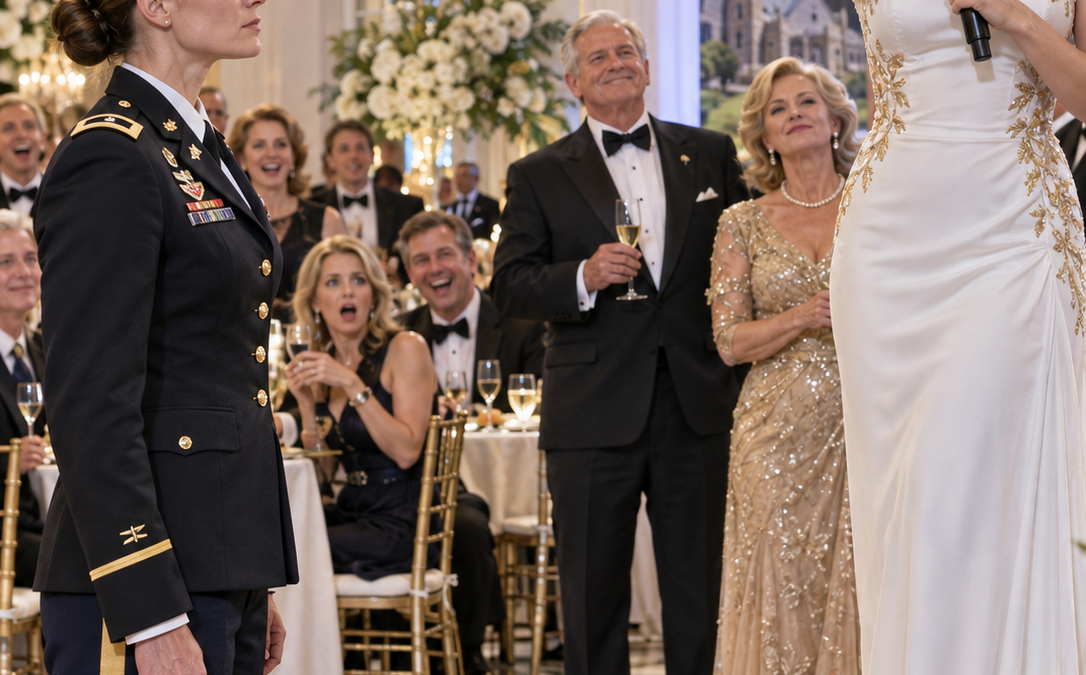
A twelve-foot ice sculpture shaped like the West Point crest stood beside the main stage, illuminated from below with blue and white lighting. Someone had spared no expense. Later I learned the sculpture alone had cost $6,700. It would melt before midnight. I couldn’t think of a better metaphor. I arrived wearing my Army Dress Blues. Not to make a statement. Because I had driven directly from an official Academy function and saw no reason to change into civilian clothes simply to satisfy my family’s expectations. The valet thanked me for my service before handing back my keys. That brief exchange contained more genuine respect than I’d received from my parents in years.
Inside the ballroom, conversations slowed as guests noticed the uniform. Several strangers smiled. A retired Marine colonel crossed the room just to shake my hand. “Good to see another officer here.” “Thank you, sir.” Before we could speak further, my mother’s voice interrupted. “There you are.” Miriam approached with the controlled smile she reserved for public events. She kissed the air beside my cheek without actually touching me. “I wish you’d worn something less… intimidating.” I glanced down at the uniform. “This is the Army service uniform.” “I know what it is.” She lowered her voice. “Tonight isn’t about you.” “I didn’t think it was.” “Good.” She looked around to make sure no one appeared to be listening.
“Stay toward the back.” I waited. “And if guests arrive with coats, help the staff.” I almost asked whether she’d mistaken me for hotel personnel. Instead, I simply looked at her. She interpreted my silence as agreement. “Please don’t stand near the stage,” she continued. “Priscilla deserves everyone’s attention tonight.” “She certainly has it.” “And try not to look so… rigid.” I nearly smiled. Apparently twenty years of military posture had become another social inconvenience. “People can misread that.” “I’ll keep that in mind.” She squeezed my forearm. “Thank you for cooperating.” Then she disappeared into the crowd before waiting for an answer. Some lessons require no explanation. Mine had started years earlier.
So I walked toward the back of the ballroom exactly as instructed. There was a small table near the rear wall beside the audiovisual control station where I could see almost everything without becoming part of the celebration. Perfect. An elderly waiter placed a glass of sparkling water beside me. “No champagne, Major?” “I’m working tomorrow.” He nodded approvingly. “Smart.” From my seat I watched my father move through the room like a politician during campaign season. Every handshake lasted exactly long enough for a photographer. Every laugh sounded rehearsed. Every introduction included the words “future West Point officer.” Nobody questioned him. Why would they? Confidence often passes for credibility. At 7:18 p.m., ballroom lights dimmed.
The jazz quartet stopped playing. A spotlight illuminated the stage. Priscilla stepped into it wearing a custom white evening gown with gold embroidery along the shoulders, somehow managing to resemble both a beauty pageant contestant and someone auditioning to command an army she had never served. Thunderous applause erupted. She waved graciously. My father took the microphone first. “My friends,” he announced, “thank you for joining us as we celebrate one of the proudest moments in our family’s history.” Another round of applause. “Our daughter has earned the privilege of joining the Long Gray Line.” I lowered my eyes for a moment. No. She hadn’t. He continued describing discipline, sacrifice, and leadership as though reading words from a brochure instead of qualities developed through years of service.
Then he invited Priscilla forward. She accepted the microphone with effortless confidence. “I’ve been fortunate,” she began. “I’ve always believed opportunity follows preparation.” Several guests nodded approvingly. She spoke about excellence. Legacy. Responsibility. Every sentence sounded polished. Every sentence rested on a foundation that no longer existed. I wondered how many people in the room had unopened email notifications waiting on their phones. Near the front row, I noticed Congressman Harold Whitmore’s district director quietly checking messages between speeches. Interesting. The notification system had probably reached that office by now as well. Priscilla continued smiling. “I know some people think institutions like West Point are impossible to reach.” She paused for effect.
“I disagree.” The audience leaned closer. “When you grow up learning leadership from the right people, doors naturally open.” More applause. Then her eyes drifted toward the back of the ballroom. Toward me. Recognition flashed across her face. A slow smile spread across her lips. I knew that smile. It always appeared a few seconds before she tried to humiliate someone. She raised one hand toward me. “There she is.” The spotlight operator instinctively followed her gesture. Suddenly every face in the ballroom turned in my direction. Priscilla laughed softly into the microphone. “My big sister finally made it.” She tilted her head with theatrical sympathy. “While I was preparing to lead the nation’s future…” She pointed directly at my uniform.
“…my sister spent her entire career stamping forms in a basement.” Scattered laughter rolled across the ballroom. She waited until it faded. Then she delivered the line she had clearly rehearsed. “But I guess every leader needs someone willing to carry the paperwork.” The laughter grew louder. She smiled at me as if offering mercy. “Some of us are simply born to lead the nation.” I remained exactly where I was. Hands folded. Expression calm. Because for the first time in my life, I wasn’t listening to what my sister believed about herself. I was listening to how close she had just walked to the edge of a truth that was already waiting behind the curtain.
I waited until the laughter finished. Silence is a powerful thing. If you interrupt mockery too quickly, people remember the argument. If you let it breathe for a few seconds, they remember who started it. Priscilla stood beneath the spotlight smiling like she’d just delivered the perfect closing line. Around the ballroom, guests lifted champagne glasses, still chuckling at my expense. Even my father looked satisfied, convinced the evening had unfolded exactly as he had planned. I didn’t answer. I simply stood, buttoned my service coat, and began walking toward the audiovisual control booth at the rear of the ballroom.
A few guests assumed I was leaving. Others barely noticed me. The ballroom manager glanced up as I approached. “Major, is everything all right?” “It will be.” Inside the booth, two technicians monitored lighting, microphones, and the massive twenty-foot LED screen hanging behind the stage. The younger technician looked nervous. “Can I help you, ma’am?” I removed a small encrypted government-approved flash drive from my breast pocket. It had remained there since leaving West Point.
Attached to it was a chain-of-custody tag bearing the Registrar’s authentication number. “I need to display one certified document.” The technician hesitated. “I… I can’t interrupt the program without authorization.” Before I could respond, the hotel’s event director stepped into the booth. He recognized my uniform immediately. “Is there a problem, Major?” I handed him a folded letter. It wasn’t classified. It simply identified me by name, rank, and official position within the United States Military Academy. He read it once. Then looked at me. “You are the Associate Registrar?” “Yes.” “And the material on this drive?” “An official admissions record already certified through federal procedure.” He studied my face for a moment.
People who have spent years managing high-profile events develop a useful instinct. They recognize the difference between drama… and certainty. He nodded once. “What do you need?” “When I ask for the microphone, switch the display to the encrypted presentation.” “No editing?” “No.” “No video effects?” “No.” “Only the official record.” “Exactly.” He turned toward the technician. “Do it.” The young man inserted the encrypted drive into the isolated presentation computer. The authentication window appeared immediately. Federal certificate verified. Read-only access enabled. Presentation ready. I thanked both of them before stepping away from the booth. The applause in the ballroom had started again.
Priscilla was answering questions from guests about Academy traditions she had never experienced. Someone asked about Beast Barracks. She confidently described it anyway. My father laughed proudly. My mother wiped away imaginary tears. Neither of them had checked their phones all evening. I walked calmly toward the stage. Not fast. Not slowly. Just steadily. Every polished shoe striking the marble floor echoed through the ballroom. Some conversations faded as people noticed my approach. Priscilla finally saw me climbing the stage stairs. She smiled again. “I was just telling everyone about my hardworking sister.” I stopped beside her. Close enough to hear her breathing. Far enough away that no one could mistake my intentions.
She lowered the microphone slightly. “What are you doing?” “I’d like one minute.” She laughed quietly. “This really isn’t your moment.” “It never was.” Then I gently reached for the microphone. Perhaps it was my uniform. Perhaps it was the confidence in my voice. Or perhaps something deep inside her suddenly realized this wasn’t going according to plan. Whatever the reason… she let go. The ballroom became unexpectedly quiet. I looked across nearly two hundred faces. Investors. Judges. Business executives. Political donors. Family friends who had watched me disappear for years without asking where I’d gone. “Good evening.” My voice carried evenly through the speakers. “My name is Major Tabitha Ashcroft.” Several guests exchanged puzzled looks.
“For those who haven’t met me, I serve as the Associate Registrar of Admissions at the United States Military Academy.” The room froze. I heard someone set down a champagne glass. Another guest whispered, “Registrar?” My father’s smile disappeared. Only slightly. Only for a second. I continued. “I wasn’t planning to speak tonight.” I glanced toward Priscilla. “But several statements were made regarding West Point’s admissions process.” Behind me, the massive LED screen remained black. Waiting. I nodded once toward the control booth. The technician pressed ENTER. The display flickered. West Point’s official seal appeared first. Then the authenticated admissions interface. A ripple of confusion spread through the audience. My father took one step forward.
“What is this?” I ignored him. Authentication numbers appeared across the screen. Committee certification. Registrar verification. Federal archive confirmation. Every line carried digital timestamps. Every page bore the official Academy formatting that couldn’t be mistaken for a homemade document. Priscilla’s face had already lost its color. “No…” she whispered. The final page loaded. Across the enormous screen behind us, visible from every table in the ballroom, appeared the official determination. Her full legal name. Candidate identification number. Admissions status. Then, centered in bold crimson letters large enough for every guest to read without standing—REJECTED FOR APPLICATION FRAUD. The ballroom didn’t make a sound. No whispered conversations. No clinking silverware. No music. Nothing. Another line populated beneath it.
Even larger. PERMANENTLY BARRED FROM FEDERAL SERVICE ELIGIBILITY REVIEW. The red lettering reflected faintly against the polished ice sculpture of the West Point crest standing beside the stage. For one strange moment, the only movement in the entire ballroom came from melting water sliding slowly down the sculpture’s edges. Priscilla stared at the screen without blinking. Her mouth opened. No words came out. Across the front row, guests instinctively reached for their phones. Others looked from the screen… to my father… then back to the official federal record glowing behind his favorite daughter. I lowered the microphone slightly.
I hadn’t raised my voice once. I hadn’t insulted anyone. I hadn’t accused anyone of anything. I had only allowed the truth to introduce itself. And in that ballroom filled with people who believed appearances were everything, the truth needed only one screen to erase an entire evening of carefully rehearsed lies. I lowered the microphone, and for several long seconds, nobody in the ballroom moved. Two hundred people stared at the enormous screen behind us as though it might suddenly apologize for telling the truth. It didn’t. The crimson words remained exactly where they belonged. REJECTED FOR APPLICATION FRAUD. The only sound came from melting water dripping off the giant ice sculpture beside the stage.
Then my father exploded. “This is a lie!” His voice ripped through the silence as he shoved past the front-row tables. “Turn that screen off!” Several guests instinctively stepped aside as Gideon climbed onto the stage, his polished dress shoes slipping slightly on a patch of melted ice. He pointed directly at me. “This is a petty family fabrication.” Nobody answered him. He turned toward the audience instead. “My older daughter has always been jealous of her sister.” His finger never left me. “She’s abusing her position because she couldn’t stand seeing Priscilla succeed.” For years, that explanation had worked.
Whenever I accomplished something, my family called it envy. Whenever I stayed quiet, they called it weakness. Tonight, neither story fit the evidence glowing twenty feet high behind him. He jabbed a finger toward the screen. “That document isn’t authentic.” I didn’t argue. Instead, I reached into my portfolio and removed my government-issued tablet. The device unlocked with facial recognition and my security credential. I tapped the presentation controls once. The screen changed. Page two appeared. A financial audit summary. Across the top was a simple heading. PAYMENT HISTORY – IRON SUMMIT PERFORMANCE GROUP. Beneath it sat twelve electronic transfers. Monthly consulting payments. Each originating from Ashcroft Development Holdings.
Each signed through my father’s corporate accounting office. The final transfer totaled $18,475.60. On the right side of the page appeared the evaluator’s name. Brandon Keller. The same personal trainer who had certified Priscilla’s flawless fitness assessment. A murmur spread through the ballroom. Someone near the front whispered, “Oh my God.” My father shook his head violently. “That proves nothing.” “It proves employment,” I answered calmly. “It proves financial dependence.” “It proves absolutely nothing about my daughter.” I tapped the screen again. The financial records disappeared. Another document replaced them. Volunteer leadership certificates. Passport entry records. Customs verification. Immigration timestamps. Every page appeared side by side. Left column. A certificate claiming Priscilla supervised a youth leadership program in Massachusetts. Right column.
French immigration records showing her passport entering Europe that same morning. Another tap. A Monaco customs stamp. Timestamp: 2:18 p.m. Another tap. A photograph attached to the travel declaration. Priscilla smiling on the upper deck of the yacht Celestial Crown, wearing oversized sunglasses with the Mediterranean Sea stretching behind her. Another tap. The volunteer attendance sheet. Same date. Same hour. Claiming she had been speaking to military families nearly four thousand miles away. No dramatic graphics. No accusations. Just documents. One after another. The room began changing. Not emotionally. Mathematically. People stopped looking at me. They started comparing dates. Times. Signatures. Corporate names. Evidence has an interesting effect on intelligent people.
Once enough pieces fit together, they begin solving the puzzle themselves. Near the center table, one investment banker quietly closed the folder containing tonight’s sponsorship proposal. Another executive removed his reading glasses and stared at my father without speaking. Across the ballroom, conversations started in whispers. “They’re identical signatures…” “Look at the timestamps…” “That’s his company…” “I know that trainer…” My mother attempted one final smile. “There has to be some misunderstanding.” No one looked at her. She had lost the room. Then another chair scraped across the marble floor. Congressman Harold Whitmore’s district representative rose slowly from his table. Earlier that evening he had applauded louder than almost anyone else.
Now he carried no expression at all. He walked toward the stage holding his phone. “I received a federal notification twelve minutes ago.” His voice carried easily through the silent ballroom. “The congressional nominating office has completed its preliminary review.” He looked directly at Priscilla. “Based upon documented fraudulent representations submitted during the nomination process…” He paused briefly. “…our office formally withdraws its congressional nomination effective immediately.” You could almost hear people’s assumptions collapsing. He folded the notification and slipped it into his jacket pocket. “Our office does not sponsor applicants who obtain consideration through falsified records.” Then he turned toward my father. “Mr. Ashcroft…” There was genuine disappointment in his voice.
“…I trusted your family’s representations.” Without waiting for a response, he walked down the center aisle toward the ballroom exit. The heavy doors opened. Closed. He never looked back. That was all it took. One investor stood. Then another. A woman from a regional banking group quietly gathered her purse. Someone canceled tomorrow’s breakfast meeting with Gideon before even leaving the room. Phones appeared everywhere. Not to take pictures. To send messages. To protect themselves. The invisible network my father had spent decades building began unraveling in real time. Nobody wanted to be the last person still standing beside a collapsing reputation. My father looked around wildly. “Where are you going?” Nobody answered.
A private equity partner he’d known for nearly fifteen years simply shook his head before walking toward the exit. “I can’t be associated with this.” Another investor spoke quietly to his assistant. “Pull every pending project.” A third looked directly at my father. “If these records are genuine…” He stopped. There was no need to finish. Everyone understood. If he had manipulated something this important… What else had he manipulated? My mother reached for Priscilla’s arm. “Honey…” Priscilla hadn’t spoken since the first document appeared. Her mascara had begun running. She looked from the screen… to me… to her father…
…then back to the audience that had admired her only minutes earlier. The applause. The admiration. The certainty. All of it had disappeared. She tried taking one step backward. The heel of her designer shoe slipped on spilled champagne near the podium. Her balance vanished. She collapsed onto the stage with a dull sound, the white fabric of her designer gown dragging through melted ice and golden champagne. No one rushed forward. Not because people had become cruel. Because the performance was finally over. I looked across the ballroom one last time. My father still stood beneath the bright white spotlights, surrounded by everything money had purchased over a lifetime. Crystal. Luxury. Influence. Prestige. Yet he had never looked so completely alone.
For years he believed his empire rested on wealth. Tonight, everyone finally saw what it had actually been resting on. A house of carefully protected lies. I didn’t return to Boston after the gala. There was nothing left for me to say there. The official investigations unfolded exactly the way federal procedures are designed to unfold—slowly, methodically, and without regard for anyone’s social status. Rumors disappeared. Certified records remained. Several weeks later, I stood at Trophy Point overlooking the Hudson River. The sharp autumn air carried the clean scent of water and stone, washing away the stale perfume and cigar smoke that had filled the ballroom the night my family’s illusion collapsed.
The river moved with the same quiet certainty it always had. It hadn’t celebrated my victory. It hadn’t mourned my family’s downfall. It simply kept flowing. That felt strangely comforting. News traveled farther than I expected. The Academy never issued dramatic public statements, but the legal consequences moved through the appropriate channels. Priscilla’s fraudulent application remained permanently disqualified under federal admissions records. The congressional nomination had been formally withdrawn. Every appeal submitted through legal counsel was denied because none of the underlying evidence had changed. Facts have a remarkable quality. They don’t become less true because someone hires a more expensive attorney.
My father’s problems grew much larger than one admissions file. Federal investigators expanded their review after inconsistencies surfaced between several corporate disclosures and financial reporting records connected to his development company. One audit became another. One subpoena became several. Projects that once seemed untouchable suddenly found themselves under scrutiny. Banks delayed financing. Business partners requested independent compliance reviews. People who once waited months for an appointment with Gideon Ashcroft now returned his calls through lawyers. His empire hadn’t collapsed in one dramatic afternoon. It had simply lost the one thing every reputation depends upon. Credibility. My mother stopped organizing charity galas. Society magazines quietly removed photographs from upcoming features. Invitations became fewer.
Then they stopped altogether. Status, I learned, is one of the most fragile currencies in the world. Honor lasts much longer. The change that mattered most never appeared in any newspaper. Three weeks after the gala, I sat inside a conference room with military legal counsel and an independent financial trustee. The family trust that funded my grandmother’s long-term care had become part of several ongoing legal reviews. Fortunately, provisions already existed allowing vulnerable beneficiaries to receive protection through independent administration. After hours of documentation and signatures, the monthly medical payments were transferred permanently into a protected veterans’ family support trust administered outside my father’s control.
When the final document cleared, I called the care facility. The administrator smiled through the phone. “Mrs. Eleanor Ashcroft’s services will continue without interruption.” I thanked her. Then I sat quietly for several minutes. My father had believed he possessed the power to decide whether my grandmother received dignity. He never actually owned that dignity. He only controlled access to the money. Those are not the same thing. The following Saturday, I visited my grandmother. Her memory wandered more often now, but every once in a while remarkable clarity returned. She reached for my hand. “You look lighter.” “I feel lighter.” She studied my face for several seconds.
“You finally stopped carrying everyone else’s weight.” I smiled. “I think I did.” She slipped something into my palm. It was the same silver watch she had entrusted to me years before. “I think it belongs with you now.” On my drive back to West Point, I realized she hadn’t asked about the scandal once. Not because she didn’t care. Because she already understood something I had only recently learned. Peace doesn’t come from winning arguments. It comes from no longer surrendering your character to people who keep demanding it. Now, standing at Trophy Point, I turned the silver watch over in my hands. Its surface carried tiny scratches gathered across generations. Unlike polished trophies or expensive crystal, it had never been beautiful because it was perfect. It was beautiful because it had endured.
For most of my life, I believed exposing my family’s lies would destroy them. Standing above the Hudson, I finally understood the truth. I hadn’t destroyed my family. Their choices had done that long before I ever opened an admissions file. All I did was refuse to build another floor on top of a collapsing foundation. I simply drew a line where their lies could no longer cross. The morning wind tugged gently at my uniform. For the first time since I was a little girl hiding textbooks in the attic, I no longer felt invisible. I wasn’t the forgotten daughter. I wasn’t the quiet clerk. I wasn’t the convenient sacrifice.
I was exactly who I had earned the right to become. And that was finally enough. I stood on the cliffs of Trophy Point this morning, watching the gray waters of the Hudson River carve their way through the ancient stone. The river doesn’t care about the labels on your coat, the pedigree of your family name, or the zeros in your bank account. It only respects what is solid, what is real, and what stands steady against the current. For thirty years, my family treated my life like a draft they could edit out of their story. They wanted me to be the invisible labor, the quiet sister who paid for their comfort with her silence.
They believed that dignity was something you could negotiate with a signature and that respect could be purchased like another luxury investment. The Army taught me different mathematics. The things that matter most cannot be inherited, donated, borrowed, or bought. Honor isn’t something you perform for an audience. Integrity isn’t a title printed on expensive stationery. And genuine love never asks you to become smaller so someone else can pretend to be taller. When my sister carried beautifully wrapped lies to the gates of West Point, she wasn’t simply breaking a rule. She believed appearance could replace character. She mistook silence for surrender. She forgot that the quietest person in the room is sometimes the one responsible for protecting the record. I didn’t reveal the truth because I wanted revenge. Revenge fades too quickly.
I revealed it because truth deserves defenders, especially when telling it becomes uncomfortable. Protecting honest people, preserving institutions that stand on principle, and refusing to reward deception are responsibilities—not acts of cruelty. So if you’re listening today while shrinking yourself to keep peace inside a family, a workplace, or a relationship that only values you when you’re useful, I hope you remember this. You are not required to finance someone else’s illusion with your own dignity. Stand where your principles remain clean. Speak when the evidence is ready. And never apologize for choosing integrity over approval. Because long after applause disappears… the only foundation that still holds is the one you built with your own two honest hands. Before you leave, take a look at the story waiting for you on your screen right now.
It’s one of the most talked-about cases on this channel, and thousands of viewers have said it changed the way they see family, loyalty, and justice. Once you watch it, you’ll understand why it belongs beside this one.








