I was the unwanted guest at my sister’s wedding, when i arrived and said my name, staff looked confused: “your name is not here,” when i called her to ask, she sneered: “you really think you’d be invited?” so i left quietly, placed a gift on the table, and hours later, what she saw inside made her call me nonstop, but i never answered…
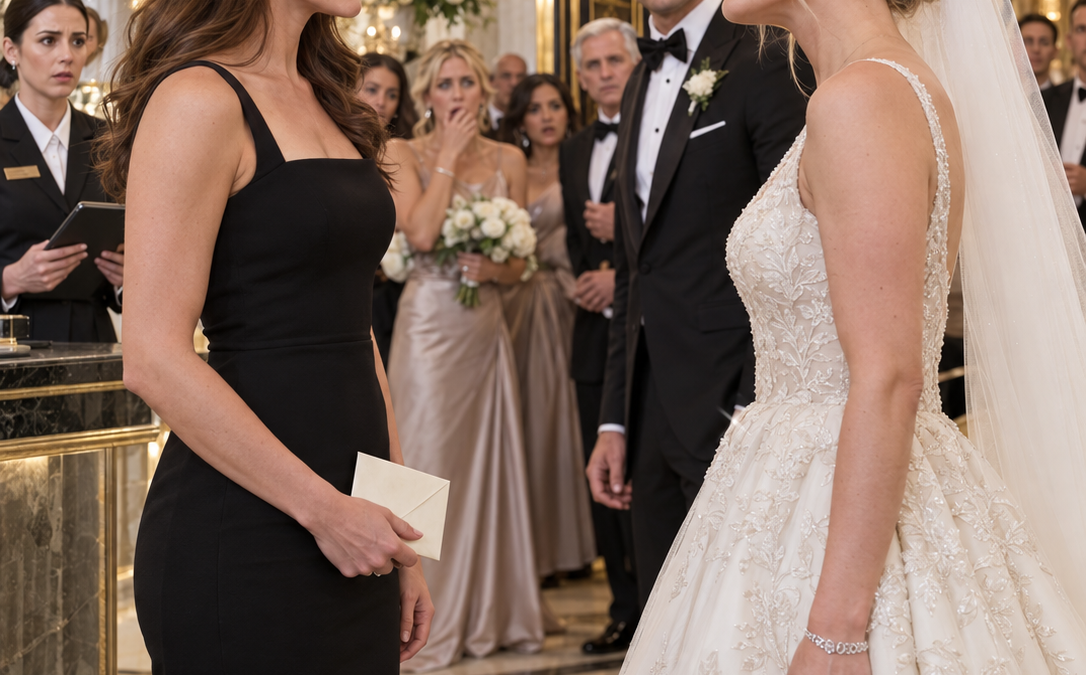
I watched her face carefully as she searched through what must have been an extensive list. Five hundred guests, Victoria had told me—the biggest wedding the St. Regis had hosted that year.
“I’m so sorry, Miss Mitchell, but I’m not seeing your name here.” She looked genuinely confused. “Perhaps you’re listed under a plus-one?”
“No. I RSVP’d directly two months ago.”
I pulled out my phone and scrolled until I found the confirmation email.
“See? April fifteenth. Confirmed for one.”
The receptionist bit her lip, clearly uncomfortable. Behind me, more guests were arriving, and I could feel their impatience building.
“Would you mind stepping aside for just a moment? Let me call the wedding coordinator.”
But I already knew something was wrong.
Victoria was nothing if not meticulous. She didn’t make mistakes with lists, especially not for an event she’d been obsessing over for a year and a half.
My stomach tightened as I moved to the side, watching happy couples check in and receive their table assignments. I pulled out my phone and dialed Victoria’s number. She answered on the third ring, and I could hear the excitement in her voice, along with the bustle of the bridal suite behind her.
“Grace, what is it? I’m about to walk down the aisle in thirty minutes.”
“Victoria, I’m at the check-in desk. They can’t find my name on the list.”
There was a pause.
Not the confused pause of someone trying to solve a problem, but the deliberate pause of someone choosing her words.
In the background, I heard champagne glasses clinking and her bridesmaids laughing.
“Oh. That.”
Her tone shifted, becoming cooler, more businesslike.
“Did you really think you’d be invited, Grace?”
The words hit me like ice water.
“What? Victoria, I’m your sister. You sent me an invitation.”
“That was before Robert’s investors confirmed. Do you understand who’s here tonight? The founding partner of Sequoia Capital, three board members from Goldman Sachs, Robert’s entire executive team.”
She lowered her voice, but I could still hear every cutting word.
“I can’t have my underemployed sister mingling with these people, talking about her little real estate side hustle. It’s embarrassing.”
“Side hustle?”
I kept my voice steady, though my hand trembled slightly.
“I’ve been in real estate for eight years.”
“Playing with house showings isn’t a career, Grace. Look, I need you to understand. This is about Robert’s future—our future. His investors need to see that we run in the right circles. And frankly, a thirty-four-year-old single woman who can barely afford her rent doesn’t fit the image we’re projecting tonight.”
I stood there for ten seconds, maybe longer, just breathing.
The receptionist was pretending not to watch me. A couple in Armani evening wear brushed past, the woman’s diamonds catching the light.
Somewhere in that ballroom, five hundred people were about to watch my sister marry a man whose success apparently meant more to her than twenty years of sisterhood.
“I understand perfectly,” I finally said.
“Good. I knew you would. Maybe we can do lunch next month when things calm down.”
I hung up.
My hands were surprisingly steady as I reached into my clutch and pulled out the small cream envelope I’d been carrying. Inside wasn’t the $500 cash I’d originally planned to slip Victoria during the reception—money I had actually scraped together despite what she thought about my finances.
Instead, there was something far more valuable.
Something that would have changed everything if she had just given me five minutes at the microphone that night.
I walked back to the reception desk. The coordinator had arrived looking flustered and apologetic, but I simply smiled and handed her the envelope.
“Please make sure Victoria gets this. It’s her wedding gift.”
As I walked out of the St. Regis that night, I thought about all the times Victoria had dismissed my career choice.
It had started eight years earlier, when I left my corporate accounting job to get my real estate license.
“You’re throwing away your degree,” she’d said, fresh out of her MBA program. “Real estate is for people who can’t handle real careers.”
Every family dinner became a comparison showcase.
Victoria would arrive with stories about her latest marketing campaign, the Fortune 500 clients she was landing, the six-figure bonuses that came with her director title. Mom would beam. Dad would nod approvingly.
Then all eyes would turn to me.
“How’s the house selling going, Grace?” Mom would ask, her tone suggesting she was inquiring about a child’s lemonade stand.
“It’s good,” I would say simply.
I never mentioned the luxury properties I was starting to handle, the network I was building, or the clients who trusted me with their biggest financial decisions.
Why bother?
In their eyes, I was playing pretend while Victoria conquered the corporate world.
Last Christmas had been particularly brutal. Victoria had just gotten engaged to Robert, and she couldn’t stop talking about their combined income, their five-year plan, and the investment property they were buying in the Hamptons.
“You should really think about your future, Grace,” she’d said, cutting into her prime rib. “You’re not getting any younger, and freelance real estate isn’t exactly a retirement plan.”
Mom had chimed in, as she always did.
“Victoria’s right, sweetheart. Maybe you could get a job at her company. I’m sure she could put in a word.”
“I’m doing fine,” I’d replied, taking another sip of wine.
“Fine isn’t thriving,” Victoria had shot back. “When Robert’s company goes public next year, we’ll be set for life. What’s your plan? Show houses until you’re sixty?”
I’d wanted to tell them about the Blackstone opportunity that was already in motion. I’d wanted to tell them about the portfolio I was being considered to manage.
But I’d learned long ago that defending myself to my family was like shouting into the wind.
They had already decided who I was: the underachieving older sister who couldn’t keep up with Victoria’s success.
What they didn’t know was that while Victoria was climbing the traditional corporate ladder, I had been building something entirely different.
Something that was about to make their definition of success look adorably small.
The second sign that I’d become invisible to my family had been more subtle, but somehow more painful. It wasn’t just about career comparisons anymore.
It was about being erased from Victoria’s life milestones entirely.
When Victoria got engaged the previous year, I found out through Instagram. Not a call. Not a text. Just a perfectly staged photo of her hand wearing a three-carat diamond, accompanied by the hashtag #HeSaidYes.
By the time I called to congratulate her, she’d already told fifty other people.
“Oh, Grace, sorry. It’s been so crazy. You know how it is.”
Except I didn’t know how it was.
I was thirty-four and single, something she never let me forget.
The family group chat about wedding planning started without me. I discovered it existed only when Mom accidentally sent me a screenshot that had been meant for someone else.
There was Victoria, Mom, our aunts, our female cousins—everyone except me.
When I asked Mom about it, she fumbled for an explanation.
“Oh, honey, we didn’t want to make you feel bad. You know, since you’re not—well, since you don’t have experience with these things.”
These things.
As if I couldn’t possibly understand flower arrangements or venue selection without a ring on my finger.
Then came the bridesmaid selection.
Victoria chose her three college roommates, Robert’s sister, and two cousins I barely knew she still talked to. When our aunt asked why I wasn’t in the wedding party, Victoria laughed it off.
“Grace isn’t really the bridesmaid type. She’s more comfortable behind the scenes.”
Behind the scenes.
Invisible.
The single sister who apparently didn’t photograph well beside all the couples in the wedding party.
But the final erasure—the one that should have prepared me for what happened at the St. Regis—came just a month before the wedding.
Victoria posted a long, emotional tribute to all the important women in her life who had supported her journey to the altar. She mentioned her mentor, her yoga instructor, even her hairdresser.
My name was nowhere in those five paragraphs.
I had become the ghost at every family gathering, the placeholder at holiday dinners, the sister who existed only when they needed someone to feel superior to.
And for too long, I had let them.
I had smiled through the dismissals, stayed quiet through the comparisons, accepted my role as the family’s cautionary tale about what happens when you don’t follow the traditional path.
But ghosts have a funny way of haunting people when they least expect it.
Standing outside the St. Regis, watching happy couples stream into my sister’s wedding, I had a choice to make. I could fight for my seat at that table, cause a scene, demand to speak to Victoria in person, maybe even convince security to let me inside.
The old Grace would have done exactly that.
She would have swallowed her pride and found some way to smooth things over, to make herself small enough to fit into whatever corner they allowed her.
But as I stood there in my simple black dress, holding my clutch with that envelope inside, I realized something crucial.
Some tables aren’t worth sitting at.
If I walked away now, if I let Victoria have her perfect wedding without the embarrassment of her “unsuccessful” sister, I would lose any chance of reconnecting with extended family I only saw at weddings and funerals. Our cousins from California were in there. Our great-aunt from Boston, whom I hadn’t seen in three years, was inside.
Those were relationships that might never recover once word got out that I’d been excluded.
More than that, I would be cementing my reputation as the family failure.
Victoria would spin the story for years. She would tell people how I couldn’t even show up to support her on her big day, how I was probably too embarrassed by my own life to face all those successful people.
Every family gathering would include whispered updates about poor Grace—still single, still struggling, still trying to make it in real estate while everyone else thrived.
But the biggest loss, the one that made my chest tighten, was that I would lose whatever claim remained to my place in this family. Not just Victoria’s family, but the entire Mitchell clan.
I would become the cautionary tale they told their children.
Don’t end up like Aunt Grace, who chose career instability over a real job and ended up alone.
The doorman glanced at me sympathetically. I must have looked pathetic, standing there in the October cold, clearly dressed for a wedding I wasn’t attending.
“Can I call you a cab, miss?”
“No, thank you. I’m fine.”
And surprisingly, I was.
Because losing all of those things—the family connections, the reputation, the place at their table—suddenly seemed like a small price to pay for keeping the one thing they had been trying to take from me for years.
My self-respect.
I thought about the email sitting in my drafts folder, the one I had planned to send Victoria the next day with photos from the wedding, congratulating her again on her happiness.
I thought about the speech I had written but would never give, about how proud I was of my little sister.
I thought about all the ways I had been prepared to celebrate her even as she systematically erased me from her life.
My phone buzzed.
A text from Mom.
Where are you? Ceremony starting soon.
I typed back: Victoria uninvited me. I’m going home.
Three dots appeared immediately. Then disappeared. Then appeared again.
Finally, a response came.
There must be a misunderstanding.
There was no misunderstanding.
For the first time in years, everything was crystal clear.
I turned my back on the St. Regis, on the warm light spilling from its windows, on the sound of celebration and belonging that I had never really been part of anyway.
Some bridges are meant to burn.
Some doors are meant to close.
And sometimes the most powerful thing you can do is simply walk away.
If you’ve ever been underestimated by your own family, you’ll understand what happens next.
Before we continue, if this story resonates with you, please hit that like button. It really helps share these important messages about setting boundaries with toxic people, even when they’re related to you.
Now let me tell you exactly what was inside the envelope I left at the reception desk—and why Victoria tried to call me forty-seven times that night.
Back at the reception desk, I pulled the cream envelope from my clutch one last time. It was smaller than a typical wedding card, more like the kind that comes with flowers. I had been carrying it for weeks, waiting for the perfect moment during the reception to slip it to Victoria.
Maybe during our dance.
Maybe while she made the rounds to thank guests.
The receptionist watched nervously as I borrowed her pen.
On the front, in my neatest handwriting, I wrote:
Wedding gift for Victoria Mitchell.
“Please make absolutely sure she gets this,” I said, sliding it across the marble counter. “It’s important.”
“Of course, Miss Mitchell. I’ll personally deliver it to the bridal suite.”
“No.” I shook my head. “Not now. After the ceremony. During the reception, when she’s surrounded by all those important investors and executives she mentioned. The timing matters.”
The receptionist nodded, though she looked confused.
I didn’t blame her.
What kind of sister leaves a gift and disappears from her own sister’s wedding?
The kind who’s about to change the game entirely.
I walked through those massive doors into the October night. The city was alive around me—taxis honking, people laughing on their way to dinner, the endless energy of Manhattan on a Saturday night.
Inside the St. Regis, five hundred people were about to watch my sister marry into what she considered success. They would toast with champagne that probably cost more than my monthly subway pass. They would dance until midnight in a ballroom that looked like Versailles.
And I would be sitting in my favorite restaurant three blocks away, eating pasta arrabbiata and drinking a perfectly reasonable glass of Chianti alone.
As I walked, my phone stayed silent.
The ceremony must have started.
I imagined Victoria floating down the aisle in her $30,000 dress, Robert waiting at the altar in his custom Tom Ford tuxedo, their venture-capitalist friends dabbing at their eyes while mentally calculating the couple’s combined net worth.
None of them knew what was waiting inside that envelope.
None of them could imagine that the absent sister—the family disappointment, the one whose name had literally been erased from the guest list—had left behind something that would redefine every assumption they’d made about success and failure.
Thirty minutes.
That was how long I estimated it would take Victoria to open my gift once the reception started.
Thirty minutes before my phone would explode with calls I had no intention of answering.
I turned it to silent and kept walking.
I was halfway through my pasta when it started.
My phone, face down on the table, began to glow like a strobe light. The vibrations were so intense that it actually moved across the table.
I flipped it over.
The screen was chaos.
Forty-seven missed calls from Victoria.
Twenty-three text messages, each more frantic than the last.
Grace, what is this?
Is this real?
Call me now.
Please, this can’t be real.
Where are you, Grace?
Please.
I’m sorry.
Okay, just call me.
There were fifteen messages from Mom.
What did you do?
Victoria is having a breakdown.
This is her wedding day.
How could you do this to your sister?
Answer your phone.
Eight calls from Robert.
I’d never even saved his number, but there it was, lighting up my screen again and again.
Three calls came from numbers I didn’t recognize. Probably Victoria borrowing other people’s phones after I refused to answer hers.
The restaurant was small and intimate, the kind of place where everyone could hear your phone buzzing. Other diners were starting to stare.
The waiter approached, concerned.
“Is everything all right, miss?”
“Perfect,” I said.
And I meant it.
I held down the power button until the screen went black.
“Could I get another glass of wine?”
For the first time in years, maybe for the first time in my adult life, I felt completely in control.
Not because I had hurt Victoria. That wasn’t the point, and it never had been.
It was because I had finally stopped accepting the role they had assigned me.
I had stopped being the family’s designated failure, the cautionary tale, the one they could always point to and say, At least we’re not Grace.
My phone might have been off, but I could imagine the scene at the St. Regis perfectly.
Victoria in her designer dress, surrounded by all those important people she had wanted so desperately to impress, holding my business card with shaking hands.
The whispers beginning to spread through the ballroom.
The questions she couldn’t answer.
The assumptions crumbling.
The image she had so carefully crafted beginning to crack.
And the best part?
She had done it to herself.
She had opened that envelope in front of everyone, probably expecting cash or a check—something she could accept with false modesty and then forget about.
Instead, she had found something that made her call me forty-seven times in the span of twenty minutes.
My pasta was getting cold, but I didn’t care.
For once, I was exactly where I wanted to be.
The truth was, I had been keeping secrets for months.
Not malicious secrets. Not the kind meant to hurt anyone.
The kind you keep close when you’re no longer sure who can be trusted with your success.
The email had arrived on a Tuesday morning six months earlier while I was showing a cramped two-bedroom apartment in Queens to a young couple.
My phone buzzed with a notification from an address I didn’t recognize.
I almost deleted it, assuming it was spam. Real estate agents get all kinds of bogus investment offers.
But something made me open it.
Dear Ms. Mitchell,
Following your exceptional handling of the Riverside portfolio disposition and your innovative approach to our Chelsea development project, Blackstone Real Estate Partners would like to discuss a senior position within our New York office.
I read it three times while standing inside that musty Queens apartment as my clients debated the square footage.
Blackstone.
The largest real estate investment firm in the world, managing more than $300 billion in assets.
They wanted me.
The interviews had been intense.
Six rounds over three months. Trips to their Manhattan offices. Meetings with executives whose names I had only ever read in The Wall Street Journal.
They grilled me on market analysis, portfolio management, international real estate trends—everything I had taught myself over eight years of doing what my family called “playing with houses.”
The final offer arrived just one week before Victoria’s wedding.
Senior Vice President, Real Estate Acquisitions.
I would manage a $500 million portfolio focused on luxury residential properties throughout the tri-state area.
The salary was more than Victoria and Robert’s combined income.
The signing bonus alone was more than I had made in the previous two years.
But there was something else.
Something sitting inside my safe-deposit box at Chase Bank.
Something I had been planning to reveal at the wedding in the most gracious way possible.
Six months earlier, shortly after that first Blackstone interview, I had done something impulsive.
There was a penthouse on the Upper East Side—a three-bedroom residence with floor-to-ceiling windows overlooking Central Park. It was the exact apartment Victoria had dragged me to see two years earlier, back when she was window-shopping for her future.
She had taken photos in every room. She had added pictures to her vision board. She had told everyone it would be her dream home once Robert’s company went public.
The owner was going through a divorce and needed a quick cash sale.
With my real estate connections—and the growing confidence that Blackstone was going to come through—I made an offer.
Cash.
Closed in thirty days.
The key to that $2.8 million penthouse was supposed to be my wedding gift to Victoria.
I had planned to stand during the toasts, tell everyone how proud I was of my little sister, and hand her the key in front of all those important people she wanted so desperately to impress.
It would have been perfect.
The underestimated sister giving the ultimate gift.
Proof that success could come in many forms.
But the key was still in my safe-deposit box.
After that night, it was going to stay there.
Or rather, it was going to find a much better home.
I already had donation papers prepared for the Women’s Shelter of New York.
They could sell the property or use it for transitional housing. Either way, it would actually help people who deserved it.
Victoria would eventually find out about the penthouse. She would probably even recognize the address when she saw it in the donation announcement.
But by then, it would be too late.
Some gifts, once refused, can’t be taken back.
By Sunday morning, the voicemails had evolved from angry to desperate.
I finally turned my phone back on and discovered 127 missed calls and a voicemail box so full it had stopped accepting messages.
Victoria’s voice in the first message was shrill and disbelieving.
“Grace, what kind of joke is this? Blackstone? Please call me back and explain.”
By the tenth message, she was crying.
“I Googled it, Grace. Oh my God, I Googled it. Senior Vice President—is this real? Please, please call me. I’m so sorry about yesterday. I didn’t mean it.”
Robert’s message was more measured, but equally shocked.
“Grace, Victoria is having a complete meltdown. Half our investors are asking about you. Apparently, three of them know you professionally. Please call us back.”
But it was Mom’s final voicemail that truly captured the family’s panic.
“Grace Elizabeth Mitchell, you answer this phone right now. How could you hide this from us? From your own family? Victoria says you’re some kind of executive at Blackstone, that you manage hundreds of millions of dollars. This can’t be true. You sell houses. You can barely pay your rent. What is going on?”
You can barely pay your rent.
Even now, even with the evidence literally sitting in Victoria’s hands, they couldn’t quite believe it.
The business card I had left inside that envelope was elegant in its simplicity.
Grace Mitchell
Senior Vice President, Real Estate Acquisitions
Blackstone Real Estate Partners
345 Park Avenue
New York, NY
On the back, in my handwriting, I had written:
I was going to announce this at your reception and give you the keys to the Riverside Penthouse, the one you loved. But it seems successful people don’t belong at your wedding. Congratulations on your marriage. The penthouse will be donated to charity in your name.
According to a text from my cousin Sarah—the only family member who reached out with congratulations instead of demands—Victoria had opened the envelope during the reception’s cocktail hour, surrounded by at least fifty guests.
She had laughed at first, thinking it was a prank.
Then someone pulled up Blackstone’s website on a phone and found the leadership page, which had been updated only three days earlier with my photograph and biography.
The reception essentially stopped.
Three of Robert’s investors immediately recognized my name.
I had been managing their personal real estate portfolios for the previous year, though they knew me only through emails and phone calls.
The founding partner of Sequoia Capital—the very man Victoria had been so desperate to impress—had tried to poach me for his private family office just the month before.
Every assumption.
Every dismissive comment.
Every moment they had treated me as the family failure.
It all came crashing down in front of the exact audience Victoria had spent months trying to impress.
The Google searches must have been frantic.
I could picture Victoria still wearing her wedding dress, huddled with Robert and her bridesmaids around someone’s iPhone, typing my name into search bar after search bar.
The first result would have been Blackstone’s official announcement from three days earlier.
Blackstone Real Estate Partners Appoints Grace Mitchell as Senior Vice President of Real Estate Acquisitions.
Then came the details that would have made their jaws drop.
Mitchell will oversee a $500 million portfolio of luxury residential properties across the New York metropolitan area. She brings eight years of experience in high-end real estate transactions, including the record-breaking Riverside portfolio disposition that generated a 47% return for investors.
Then there was the Wall Street Journal mention from the previous month, published before my official appointment.
Grace Mitchell, the independent broker who orchestrated the $127 million Chelsea development deal, represents a new generation of real estate professionals disrupting traditional models.
And a profile from The Real Deal six months earlier:
The Quiet Power Broker: How Grace Mitchell Became the Go-To for Ultra-High-Net-Worth Real Estate.
But the number that would have truly stunned them was right there on Blackstone’s website.
Assets under management: $1 trillion.
My division alone: $15 billion.
Sarah’s text included a photo from the reception.
Victoria was holding my business card, her face a mixture of shock and devastation, surrounded by guests who were all staring at their phones.
Robert stood beside her, his hand resting on her back, but his expression was equally stunned.
In the background, I could see several of his investors huddled together, clearly discussing the revelation.
Everyone’s asking where you are, Sarah wrote. Three of Robert’s investors want your contact information. They said they’ve been trying to get a meeting with you for months. Victoria had to admit she doesn’t even have your work email.
She didn’t have my work email.
She didn’t know where my office was.
She didn’t know anything about my professional life because she had never asked.
For years, every conversation had been about her achievements, her milestones, her success.
The moment I tried to share anything about my work, she waved it away.
“Oh, you’re still doing the house thing?”
The house thing.
That was what she had called the career that had just made me one of the youngest Senior Vice Presidents in Blackstone’s history.
My phone buzzed with another text from Sarah.
Victoria just announced she needs to leave her own reception early. She looks sick. Your mom is telling everyone you must have made a mistake on the business card.
A mistake.
Because even with all the evidence, they still couldn’t quite accept that the family failure had become more successful than any of them.
Victoria spent her entire wedding reception trying to reach me instead of enjoying her big day.
But the real shock came three days later, when she discovered what I had done with her dream penthouse.
If you’re finding value in this story about setting boundaries with toxic family members, please subscribe and hit the bell icon so you don’t miss similar stories. I’d also love to hear from you. Have you ever had to cut off a family member who didn’t value you?
Share your experience in the comments below.
Now, let me tell you about the emergency family meeting that changed everything.
Three days after the wedding, my phone rang.
Dad.
Not Victoria. Not Mom.
Dad, who usually stayed out of family drama.
“Grace, we need you at the house. Family meeting tonight at seven.”
“I’m not coming, Dad.”
“Your sister is devastated. Your mother is beside herself. The least you can do is explain yourself.”
“Explain what? That I got a job promotion? That I’m successful? What exactly needs explaining?”
He sighed heavily.
“Just please. One hour. We need to understand what happened.”
I almost felt bad for him.
Almost.
“They can have their meeting. I won’t be there.”
The family meeting happened anyway.
Sarah, bless her, gave me the play-by-play through text messages.
The entire Mitchell clan assembled in my parents’ living room.
Mom. Dad. Victoria and Robert. Three aunts, two uncles, and several cousins.
The same people who had been at the wedding. The same people who had witnessed Victoria’s meltdown over my business card.
According to Sarah, Victoria stood in front of everyone, still dressed in what Sarah described as her “honeymoon-canceled casual wear,” and read my business card aloud as though it were evidence in a trial.
“Grace Mitchell. Senior Vice President, Real Estate Acquisitions. Blackstone Real Estate Partners.”
Her voice cracked on the word senior.
Then came the questions from the relatives.
“How long has she been working there?”
“Why didn’t anyone know?”
“Is this why she wasn’t at the wedding?”
Then Aunt Patricia—Mom’s sister, who had driven down from Boston specifically for the wedding—asked the question that made the room go silent.
“Wait. Victoria, you uninvited your own sister?”
Victoria tried to explain.
To justify.
To minimize.
“She wasn’t uninvited exactly. There was a mix-up with the list, and honestly, I thought she’d be uncomfortable around Robert’s business associates. I was trying to protect her.”
“Protect her?”
Uncle James laughed.
Actually laughed.
“Your sister is a Senior Vice President at Blackstone, and you were trying to protect her from some startup investors?”
That was when the truth started to unravel.
How Victoria had deliberately removed my name.
How she had called me an embarrassment.
How she had told me I didn’t belong among successful people.
Robert tried to salvage the situation.
“We didn’t know about her position. If we had known—”
“You would have invited her?” Aunt Patricia interrupted. “You only want Grace around if she’s successful enough? What kind of family operates like that?”
Mom attempted damage control.
“Grace should have told us about her job. We’re her family. Why would she hide something like this?”
Sarah spoke up then.
“Maybe because you’ve spent eight years telling her she was a failure. Just a thought.”
The meeting devolved from there.
Relatives taking sides.
Victoria crying.
Robert making excuses.
Mom insisting the entire thing was a misunderstanding.
And everyone—everyone—asking the same question.
Where was Grace?
I was at my apartment reviewing contracts for a new acquisition, living my life exactly as I had been for months.
Successfully.
Quietly.
Without their approval.
The penthouse revelation came the next morning, when Victoria finally did something she should have done months before.
She actually paid attention to my life.
Sarah told me that Victoria spent hours going through my social media, searching for clues she had missed.
She found a photo I’d posted six months earlier. I was standing in front of a building on the Upper East Side, and the caption read:
Big moves coming.
Victoria had liked the photo at the time without even reading it, probably scrolling with only half her attention.
But now she recognized the building.
It was the same one she had dragged me to two years earlier to see her dream home—the three-bedroom penthouse overlooking Central Park that she had talked about incessantly.
She had even made it the wallpaper on her laptop.
“That’s the Riverside building,” she apparently whispered to Robert. “That’s my penthouse.”
My penthouse.
She still called it hers even though she had never made an offer, never had the money, never done anything except dream about it and post photos.
But in her mind, she had claimed it.
Real estate records are public.
It took Robert less than five minutes to find the sale from six months earlier.
Unit 47B.
Sold for $2.8 million.
Cash purchase.
Buyer: Grace Mitchell.
Victoria called immediately.
For once, I answered.
“You bought it?”
Her voice was barely a whisper.
“You actually bought my dream apartment?”
“I bought an apartment,” I corrected. “It became yours only in your imagination.”
“But… but you knew I wanted it. You knew it was my dream home.”
“And I was going to give it to you.”
The silence on the other end was immediate.
“The keys were going to be my wedding gift. I had a whole speech planned about how proud I was of my little sister, how she deserved her dream home. I was going to hand them to you in front of all those important investors you mentioned.”
The silence stretched so long that I thought she might have hung up.
“You were going to give me a three-million-dollar apartment?”
“Two-point-eight. And yes. But then you decided I wasn’t successful enough to attend your wedding, so I decided you weren’t grateful enough to receive my gift.”
“Grace, please. I’m sorry. I was wrong. I was so, so wrong. Can we talk about this? Can we fix this?”
“Some things can’t be fixed, Victoria. You didn’t just uninvite me from your wedding. You erased me from your life because you thought I was beneath you. And you did it publicly, cruelly, on what should have been a day of celebration.”
“I’ll do anything. Please. Robert and I—we’ve been saving for years for a place like that. It would change our lives.”
I thought about all the times my success could have changed my life in their eyes if they had only bothered to look.
“It’s already changing lives,” I said.
“Just not yours.”
The donation paperwork had been signed that very morning.
At nine o’clock sharp, I had met with Maria Santos, the director of the Women’s Shelter of New York, in the conference room at my attorney’s Midtown office.
“Miss Mitchell, I need to make sure you understand,” Maria had said, her eyes wide. “This is a $2.8 million property. You’re certain you want to donate it entirely?”
“Completely certain.”
I leaned back in my chair.
“I want it to help women who are starting over. Women who’ve been told they’re not enough. Women who need a chance to prove everyone wrong.”
The tax benefits were substantial—a $2.8 million charitable deduction that made my accountant very happy.
But more importantly, the penthouse could be sold and the proceeds used to fund the shelter’s operations for the next five years.
Or, if they chose, they could convert it into transitional housing for twelve women at a time.
That afternoon, I had my attorney send a copy of the donation receipt to Victoria’s email.
The subject line was simple.
Your wedding gift has found a better home.
The attachment showed everything.
The deed transfer.
The donation valuation.
The tax documents.
And a letter from the shelter thanking me for the most generous single donation in the organization’s history.
Victoria called seventeen times in the next hour.
Robert called ten.
Mom called twenty-three.
I answered none of them.
Instead, I sat inside my new office at Blackstone—a corner unit on the forty-second floor overlooking Park Avenue.
My assistant, James, knocked and entered with my afternoon coffee.
“Miss Mitchell, you have three messages from a Robert Chen insisting it’s urgent, and someone named Victoria has called reception four times trying to get past security.”
“Thank you, James. Please add them to the no-call list.”
He nodded without question.
That was one of the things I loved about Blackstone.
Professional boundaries were sacred there.
My phone buzzed with another text from Sarah.
Victoria just told everyone you gave away her apartment to charity. Uncle James said it wasn’t her apartment if she didn’t own it. She ran out crying.
I set my phone aside and turned back to my computer.
I had a portfolio to manage.
Deals to close.
A career to build.
The same career they had dismissed as “playing with houses” for eight years.
The penthouse was gone now, donated and making a real difference in the world.
And Victoria?
She was learning what it felt like to have something she thought belonged to her disappear in an instant.
The difference was that she had only lost a dream.
When she uninvited me from her wedding, she had tried to take my dignity.
One of those things could be replaced.
The other was priceless.
Two weeks after the wedding, Victoria made her last desperate attempt.
She had somehow figured out the address of the Blackstone building, probably from LinkedIn, and showed up in our lobby on a Tuesday morning.
James called up to my office at 9:15.
“Miss Mitchell, there’s a Victoria Mitchell in the lobby insisting she’s your sister. Security won’t let her upstairs without your approval.”
I looked at the security monitor on my desk.
There she was in a designer suit, arguing with the security desk.
She looked smaller somehow.
Diminished.
The confident marketing director who had dismissed me at her wedding had been replaced by someone who finally understood what she had thrown away.
“She doesn’t have an appointment,” I told James. “Our policy is clear.”
“Of course, Miss Mitchell. I’ll inform security.”
I watched the monitor as security explained that she couldn’t access the elevators without clearance.
Victoria pulled out her phone.
Mine immediately rang.
I let it go to voicemail.
Her message was desperate.
“I’m in your lobby, Grace. Please. Five minutes. That’s all I’m asking. I know I hurt you. I know I was wrong. But we’re sisters. That has to mean something.”
Sisters.
We were sisters when it was convenient for her.
When she needed something.
When my success suddenly made me worth knowing.
I composed an email instead of calling her.
Victoria,
Boundaries are not suggestions. They are not negotiable. They are not erased by apologies or blood relations.
You made it clear at your wedding that success was your entry requirement for family. Now that you know I’ve exceeded that requirement, you want to change the rules. But that’s not how this works.
I wish you and Robert every happiness in your marriage. I hope your careers continue to flourish. I hope you find your dream home someday through your own efforts.
But I will not be part of your life moving forward.
This is not punishment or revenge.
It is a choice.
The same kind of choice you made when you removed my name from your guest list.
The difference is that I am making my choice with honesty instead of deception.
Please do not come to my office again. Security has your photo now.
Grace.
I watched her read it on her phone in the lobby.
Her shoulders sagged.
She remained there for another ten minutes, perhaps hoping I would change my mind, before finally walking out into the Manhattan morning.
That was the last time Victoria tried to contact me directly.
The family pressure continued for months, but I held firm.
Some boundaries, once set, shouldn’t be moved.
The social consequences of that wedding night rippled through Victoria’s carefully constructed world in ways she never anticipated.
It started with Robert’s investors.
Three of them were my clients, something Victoria discovered only after the wedding when they asked Robert why his wife had banned one of their top real estate advisers from the reception.
The founding partner from Sequoia Capital was particularly blunt.
“Your wife uninvited Grace Mitchell? The same Grace Mitchell who manages my family’s $30 million property portfolio? That shows remarkably poor judgment.”
The startup community in New York is smaller than people think.
Word spread quickly that Robert’s new wife had publicly humiliated an SVP from Blackstone—someone many of them needed for their own real estate investments.
Two potential investors pulled out of Robert’s Series B funding round, citing concerns about the leadership team’s decision-making.
But the real blow came from an unexpected source.
Robert’s own company.
Sarah heard through the family grapevine that Robert’s board called an emergency meeting three weeks after the wedding.
Having a spouse who publicly alienated major players in the financial world was apparently not the image they wanted for their CEO.
They didn’t fire him.
But they did institute a new policy regarding spouses attending company-related social events.
Translation?
Victoria was no longer welcome at corporate functions.
The woman who had been so concerned with impressing investors that she had literally uninvited her own sister to protect her image was now herself uninvited from the very world she had tried so hard to enter.
Meanwhile, my professional life flourished in ways that became impossible for my family to ignore.
The Wall Street Journal ran a feature on young leaders in real estate, and my photograph was prominently displayed.
The article mentioned the $500 million portfolio I managed, the innovative deals I had structured, and the fact that I was the youngest Senior Vice President in Blackstone’s real estate division.
Mom sent me a clipped copy of the article with a handwritten note.
So proud of you, sweetheart. Always knew you’d make something of yourself.
Always knew.
The revisionist history was almost amusing.
Victoria and Robert’s social media accounts, once filled with glamorous couple photos and celebration posts, went quiet.
The honeymoon pictures never appeared.
The “Mr. and Mrs.” posts stopped.
Sarah mentioned that Victoria had taken a mental-health break from work, which in corporate language meant she was too humiliated to show her face at the office.
The golden couple who had supposedly had everything—the extravagant wedding, the important connections, the perfect image—had watched it all collapse in a single night.
And all because Victoria couldn’t see value in people beyond their job titles.
Six months passed.
The family’s attempts at reconciliation evolved from desperate to resigned.
Mom still called once a month, always with the same refrain.
“She’s your sister, Grace. Family forgives.”
“Family also respects,” I would reply. “When Victoria learns that lesson, we can talk about forgiveness.”
The extended family divided into camps.
Aunt Patricia and Uncle James, who had witnessed Victoria’s behavior firsthand, supported my boundaries.
Others, who had heard only Victoria’s version about being “misunderstood,” thought I was being cruel.
I no longer cared about their opinions.
I was too busy living my life.
The promotion to Executive Vice President came eight months after the wedding.
With it came a new portfolio worth $1.2 billion and a team of twelve analysts.
The announcement made the Financial Times.
This time, Victoria didn’t try to call.
But Sarah told me she had printed the article and cried at her desk.
“She keeps telling people you two are just going through a rough patch,” Sarah said over coffee one afternoon. “That you’ll come around eventually.”
“And what do you tell her?”
“The truth. That you’ve moved on. That you’re dating that architect from the Tribeca project. That you’re happy.”
I was happy.
David was everything my family would have approved of—successful, stable, from a good family.
The irony that I had found him only after I stopped caring about their approval wasn’t lost on me.
Victoria, meanwhile, was struggling.
The woman who had built her entire identity around being “the successful sister” was now known as the one who had humiliated herself at her own wedding.
Robert’s company had gone through layoffs, and although he kept his position, the stress was showing.
Their Instagram-perfect life had crumbled into something far more ordinary than Victoria had ever imagined.
She still texted me every few weeks.
I never responded.
But I read them.
I think about that night every day.
I’m in therapy now, learning about toxic family patterns.
I was wrong about everything.
I miss my sister.
That last one almost got to me.
Almost.
But then I remembered standing outside the St. Regis, being told I wasn’t enough.
I remembered eight years of dismissive comments.
Eight years of being treated like a failure.
Eight years of having my career mocked as “playing with houses.”
Some bridges, once burned, light the way forward.
The light from that fire had illuminated a path toward a life where I was valued, respected, and seen for who I really was.
And that life didn’t include Victoria.
Today, it has been exactly one year since Victoria’s wedding.
I’m sitting in my new office now.
Executive Vice President.
Corner suite on the fifty-third floor.
A view stretching from Central Park to the Hudson River.
The nameplate on my door still feels surreal sometimes.
My assistant knocks.
“Miss Mitchell, your three o’clock is here.”
“Send them in, James.”
The door opens, and Maria Santos, director of the women’s shelter, walks inside.
She’s beaming.
“Grace, I had to tell you in person. The Riverside Penthouse sale closed yesterday. $3.2 million. The market went up since your donation. That money will keep our doors open for the next seven years and fund our new job-training program.”
“That’s wonderful, Maria.”
“Forty-three women have already gone through our transitional housing program because of you. Forty-three women who were told they were worthless, who had nowhere to go, who needed someone to believe they were enough. You gave them that.”
After she leaves, I stand at my window and look out over the city.
Somewhere out there, Victoria is living her life.
Still married to Robert, last I heard.
Still working her corporate job.
Still posting carefully curated photographs of a life that looks successful from the outside.
She sent me a letter last week.
An actual letter.
Not a text.
Not an email.
I recognized her handwriting on the envelope and almost threw it away, but curiosity won.
Grace,
It’s been a year.
A year since I made the worst decision of my life.
I don’t expect forgiveness. I don’t expect a response.
I just need you to know that I understand now.
Success isn’t about titles or salaries or who has the bigger apartment. It’s about being the kind of person others want to celebrate—not because of what you’ve achieved, but because of who you are.
I failed that test.
I failed as a sister.
You didn’t just become successful, Grace.
You always were.
I was simply too blinded by my own insecurity to see it.
I’m not asking for another chance. I’m only asking you to know that I finally understand what I lost.
Not the penthouse.
Not the connections.
I lost my sister.
And that is worth more than any apartment could ever be.
Victoria.
I kept the letter.
Not because I’m ready to forgive.
But because it’s proof that people can learn, even if they learn too late.
My phone buzzes with a text from David.
Dinner at eight? That new place in SoHo.
Perfect. Love you.
My new rule is simple.
I surround myself with people who saw my worth when I had nothing to prove.
David.
Sarah.
My team at Blackstone.
The friends who celebrated my quiet successes long before those successes became public victories.
As for family?
Family isn’t just blood.
Family is the people who stand beside you when you’re invisible and celebrate you before you’re impressive.
They’re the ones who see your worth when your name isn’t on any list.
Sometimes the most expensive gift you can give yourself is walking away from people who can’t see your value.
Even if they share your last name.
Even if they eventually learn to see it.
Even if they beg for another chance.
Because self-respect?
That’s the only success that really matters.
If you’ve made it this far, you understand that sometimes the most powerful thing you can do is simply walk away from people who don’t see your worth, even if they’re family.
What boundaries have you had to set with toxic relatives?
Have you ever had to choose self-respect over family harmony?
I’d love to hear your story in the comments below.
And if this message resonated with you, please share it with someone who needs to hear that they’re already enough exactly as they are.
Subscribe for more stories about choosing self-worth over toxic relationships.
Remember, success isn’t about proving others wrong.








