I told my parents i was having a once-in-a-lifetime event and begged them not to miss it, they laughed and said my brother’s soccer game was ‘more important,’ what they skipped was my wedding, when the photos blew up online, my in-laws were furious, and my dad finally snapped: ‘i didn’t know… but if your mother did, we’re done,’ now the whole family’s tearing itself apart.
I’m a documentary editor, by the way. Nothing flashy, but I’ve worked on a few Netflix and Hulu projects. Not that my family ever watched any of them.
I once told them I’d been nominated for an editing award.
Mom blinked and said, “That’s nice, sweetie. Adam’s team made it to regionals.”
Adam had always been the center of gravity in our family.
His soccer games were sacred. I’m not exaggerating.
Once, we had a relative’s funeral, and my dad left the wake early so he could make Adam’s 1:00 p.m. kickoff.
When I graduated from college, they came, but they left during the lunch reception because Adam had training.
They missed my speech.
I was class valedictorian.
So eventually, I started drawing boundaries. Quietly. Slowly.
I stopped sharing my biggest victories with them.
When I got my first apartment, I didn’t tell them until a week later. When one of my projects trended on YouTube, I never brought it up. I learned to keep my expectations low.
Then I met Elise.
Elise was everything I wasn’t. Warm, bubbly, unapologetically emotional. She was the kind of person who cried at strangers’ wedding videos and made friends while standing in grocery store lines.
We met while I was editing a piece on environmental conservation. She was a consultant on the project. She had a calming presence and an annoying habit of calling me out every time I tried to downplay myself.
Within a year, I knew I wanted to marry her.
The proposal was simple. Just the two of us on a lakeside hike, a camera hidden in my backpack, and a ring I’d been carrying around for three weeks because I couldn’t find what felt like the perfect moment.
When I finally asked, she laughed through her tears and told me she’d been waiting for me to catch up.
She had already told her mother it was going to happen.
Her family welcomed me with open arms. Her dad even hugged me, something my own father hadn’t done since I was a teenager.
Planning the wedding wasn’t exactly a walk in the park, but neither of us wanted anything extravagant. Elise wanted something small and intimate, and I wanted the same. We didn’t care about a huge venue or fancy catering. We just wanted the day to mean something.
We set the date eight months out. Enough time to organize everything without dragging the engagement on forever.
I told my parents the news over the phone.
I still remember the silence after I said, “We’re getting married.”
It lasted one beat too long.
Then my mom said, “Oh, that’s wonderful, honey. When’s the date?”
I told her, excited.
Another pause.
“Oh. That’s the same weekend as Adam’s championship match.”
I blinked.
“Okay, but I mean, it’s eight months from now. That’s plenty of time, right?”
“Joel,” my dad chimed in, “you know how important this season is for Adam. His coach said college scouts will be there.”
“I’m not asking you to choose a random game over my wedding. This is a once-in-a-lifetime event.”
“We’ll figure it out,” Mom said quickly.
But it felt like a brush-off, like she was already constructing the excuse in her head.
Elise had been sitting beside me during the call. When I hung up, she didn’t say anything at first.
Then she asked, “Do you think they’ll come?”
I gave her the only answer I could.
“I hope so.”
Over the next few months, things got stranger.
I’d text my mom with updates.
Venue booked.
Florist found.
Elise’s dress was stunning.
I’d get one-word replies.
Dad didn’t respond at all.
Meanwhile, I’d hear through my cousin that my parents were traveling every other weekend for Adam’s away games.
My cousin even joked, “Is your brother the next Ronaldo or something?”
At our engagement party, hosted by Elise’s parents, my family didn’t show up.
No call. No message.
Just a text from Mom the next morning.
“Sorry, things got busy this weekend. Hope it went well.”
I started to spiral a little.
Was I overreacting?
Was I being dramatic?
Elise told me I needed to talk to them directly.
So I did.
I called Mom one afternoon and laid everything out.
“I feel like you’re not excited. Like you’re not even planning on being there.”
She gave a long sigh.
“Joel, weddings aren’t everything. We went to yours and Adam’s kindergarten graduations. We’ve supported you both equally.”
The statement was so absurd I actually laughed.
“Equally? Mom, you left my college graduation early for one of Adam’s scrimmages.”
“It wasn’t a scrimmage. It was a team dinner.”
“Even worse.”
“I think you’re being unfair and selfish.”
Selfish.
That word cut deeper than she probably knew.
I’d spent my entire life folding myself into whatever shape they needed me to be. Quiet. Understanding. Low-maintenance.
I swallowed the rest of the conversation.
It wasn’t worth it.
Not then.
A week before the wedding, I tried one last time.
I called both of my parents conference-style and told them again how much the day meant to me. I told them how I’d grown up watching them put Adam first and how, for once, I needed them to show up for me.
I said it plainly.
“This is the biggest day of my life. If you miss it for a soccer game, I’ll take that as the answer to every question I’ve ever had.”
They laughed.
My mom actually laughed.
“Joel, don’t be so dramatic. It’s not like it’s your funeral.”
Then Dad said, “We’ll see what we can do, but Adam’s worked really hard.”
I stared at the wall for a long time after that call ended.
Elise came into the room, saw my face, and didn’t even ask.
She just held me.
Then the wedding day came.
We stood beneath an old oak tree, surrounded by Elise’s smiling family and a handful of our closest friends.
Before the ceremony began, I scanned the crowd.
Once.
Twice.
My parents weren’t there.
Adam wasn’t there.
No message.
No text.
Nothing.
But Elise’s mother cried. Her father beamed at me like I was already his son. The photographer captured everything—the raw joy, the sunlight glowing through Elise’s veil, the way her eyes lit up when we kissed.
Later that night, I posted a few photos online.
Nothing fancy.
Just a caption.
“Married the love of my life today.”
By morning, the post had gone viral.
Not millions-of-views viral, but enough.
Enough that friends of friends were sharing it. Enough that Elise’s extended relatives were commenting, tagging people, and sending congratulations.
Then one comment appeared from someone I didn’t know.
“Wait. Where’s the groom’s family?”
That was the spark.
The fire that followed burned hotter than I ever expected.
And it hadn’t even reached my father yet.
I didn’t respond to any of the comments that first day. I told myself it didn’t matter. The people who had shown up were the only people who mattered.
Elise was radiant. Our friends were still glowing from the celebration. The air seemed to carry the scent of lavender from the garden her mother had insisted we use.
But that single comment—Where’s the groom’s family?—burrowed into my brain like a splinter.
I wasn’t even the one who showed the post to my parents.
My aunt, my dad’s sister, had been quietly following everything online.
She texted me later that afternoon.
“Joel, was this today? You didn’t tell them?”
I stared at the message, my stomach twisting.
“I told them eight months ago. I reminded them three times.”
She didn’t reply.
But I could imagine the rest.
I imagined her calling my father. I imagined the argument.
My family was many things. Communicative wasn’t one of them.
But when gossip was in the air, they were like bloodhounds.
Three days after the wedding, my father finally called.
He sounded tired.
“Joel,” he said, his voice low. “Why didn’t you tell me the wedding was that weekend?”
I went silent for a second.
Across the room, I could feel Elise watching me.
“I did tell you. More than once.”
“No, no. You said it was sometime in May. You never said the fourteenth.”
“Dad, I have the texts.”
He didn’t respond.
He just breathed.
“Mom knew,” I added, letting the words hang between us like smoke. “She confirmed it. She laughed about it. Remember?”
The silence that followed wasn’t defensive.
It was still.
“I didn’t know,” he repeated.
Then, after another pause, he said, “But if your mother did, we’re going to have a problem.”
Something shifted in that moment.
The ground underneath my family tilted.
My father wasn’t yelling. He wasn’t accusing me. He sounded betrayed.
Just like me.
And for the first time in a very long time, I realized something.
My mother had manipulated him, too.
That wasn’t the end of it.
Not even close.
Because what came next—the fallout, the layers of buried truth, the real reason behind their absence—that was when everything broke open.
But I’m getting ahead of myself.
Two days after that phone call, Dad texted me a screenshot.
It was a Facebook post from Mom.
“So proud of Adam for scoring the winning goal this weekend. What a memory. Some moments you never forget.”
Underneath was a photo.
The whole family was there.
My mother.
My father.
Adam.
Two cousins.
Even my grandmother sitting in a lawn chair.
Saturday, May 14.
The same day as our wedding.
I read the caption again.
Some moments you never forget.
Something inside me cracked.
Not like a clean break.
It splintered.
I showed the picture to Elise.
She didn’t say anything. She just sat on the couch with one hand over her mouth.
I think she knew I needed to be the one to speak first.
But I couldn’t.
My throat felt tight.
I didn’t cry. I didn’t rage. I don’t think I even breathed properly for a full minute.
I just stared.
Then Elise said, “You should show her the pictures.”
So I did.
That evening, I messaged my mother.
No long explanation.
No guilt trip.
Just three high-resolution wedding photographs.
Me and Elise.
The garden.
Her family huddled around us, smiling.
No caption.
Just the images.
She read the message.
No response.
An hour later, I checked again.
Still nothing.
Then my phone rang.
It was Adam.
“Dude, what is your problem?” he barked.
“My problem?”
“You couldn’t just be chill for once? You had to post your wedding all over the internet and make Mom look bad.”
I blinked, stunned.
“Adam, are you serious right now?”
“She’s getting torn apart in the comments. Joel, our family is catching heat because you decided to play the victim.”
“I am the victim of what?”
“A scheduling conflict.”
I lost it.
“You knew, Adam. You knew it was that weekend.”
“So what?” he said. “You picked a weekend you knew was important for me, and then you got mad that I didn’t cancel my game.”
“My wedding,” I snapped. “It was my wedding, Adam.”
“You could have moved it.”
The sheer arrogance in his voice stunned me.
Except it wasn’t even arrogance.
It was certainty.
Like I was supposed to organize my entire marriage around his sports schedule. Like I was a satellite orbiting his world.
“I hope the scouts saw your goal,” I said flatly. “Because you missed the only thing that mattered to me.”
He hung up.
I didn’t tell Elise about that call.
Not immediately.
I couldn’t.
I felt too raw.
Too stupid.
Then, two days later, things got worse.
My cousin Sarah—bless her—called me sobbing.
She’d been scrolling through Facebook and found screenshots from a private group conversation between my mother, two aunts, and a few other family members. One of them had screenshotted the exchange and shared it with her.
Sarah, God bless her twice, sent everything to me.
The messages were dated five months earlier.
“Joel says the wedding is May 14th. Adam has a game that weekend, so we obviously can’t go. I don’t want him making a scene about it. Let’s all agree to say we thought it was the week after if it comes up.”
Another message came from one of my aunts.
“Maybe tell him you never got the invitation. Could work.”
Then another.
“It’s not like he’s close to us anyway. Just Elise’s family and some artsy coworkers.”
I read those messages over and over.
Like some part of me hoped the words would rearrange themselves into something less cruel.
They never did.
I called my father and sent him the screenshots.
He didn’t answer.
An hour later, I received a message.
“I’m staying at a hotel for a few nights.”
That was all it said.
No explanation.
No context.
But I knew.
Then the phone rang again.
My grandmother.
Eighty-three years old and rarely called anyone.
She didn’t even say hello.
“Joel, what in God’s name is going on? Your mother’s in a state. Says your father is threatening divorce. Says you’re spreading lies about the family online.”
Something inside me hardened.
“They’re not lies.”
“Did you know they skipped my wedding?”
There was a pause.
“I thought it was a small courthouse thing.”
“Because that’s what she told you.”
Silence.
“Joel,” Grandma said slowly. “She said you didn’t invite them.”
I almost laughed.
“I sent invitations. I called. I begged. She lied to everyone.”
“I don’t know what to believe anymore,” she whispered.
“Believe the photos,” I said. “Believe the silence.”
The call ended.
I felt numb.
Elise sat beside me, her hand wrapped around mine.
“They’re unraveling,” she said softly.
I nodded.
“She made a choice. And now everyone sees it.”
But I still hadn’t seen everything.
Not yet.
A week after the wedding, my father showed up unannounced.
No suitcase.
No smile.
He just stood at our door, hat in hand, eyes bloodshot.
I let him inside.
Elise gave him a polite nod before heading upstairs.
He sat on our couch like he wasn’t sure he deserved to.
“I didn’t know,” he said again.
“You keep saying that.”
“I say it because it’s true.”
“I told you.”
“I know. But she told me you changed the date. That the invitation must’ve been lost. That you were being vague on purpose. She made it sound like you didn’t want us there.”
I stared at him.
“Do you believe her now?”
He slowly shook his head.
“No. I don’t.”
I didn’t respond.
He looked around the room until his eyes landed on a framed wedding photograph on our mantel.
He reached toward it, then stopped himself.
“I missed this,” he said, his voice breaking. “And I’ll never forgive myself.”
I didn’t have it in me to comfort him.
Not yet.
Maybe not ever.
Then he said something I’ll never forget.
“If she really did what you say she did, we’re done.”
That was when I realized the betrayal went deeper than me.
My mother’s manipulation hadn’t been aimed solely at me.
It had warped our entire family.
She’d built a world around Adam, weaponized loyalty, rewritten narratives, controlled the flow of information.
And now it was collapsing.
But the breaking point didn’t come until a week later, when I discovered what my mother had planned next.
That was when the real storm hit.
I didn’t expect things to become quieter after Dad’s visit.
I thought there would be screaming. Confrontations. Tearful apologies. Dramatic phone calls.
Instead, there was silence.
A thick, suffocating silence, as if my family had collectively pressed pause on reality and hoped that if they waited long enough, I would let everything go.
That I would smooth things over the way I always had.
That I’d minimize the pain and let them rewrite the story again, turning a deliberate betrayal into a harmless misunderstanding.
But I didn’t reach out.
Not this time.
They didn’t either.
Instead, the first sign that my mother hadn’t moved on came from an unexpected place.
Elise’s uncle, Mark.
Mark was a blunt, no-nonsense kind of guy. He’d served in the Navy, now ran a woodworking shop, and made jokes so dry they might catch fire in the sun.
We’d bonded during the wedding planning over a mutual love of silence and espresso.
He wasn’t the kind of man who called just to gossip, which was why his message raised every hair on the back of my neck.
“Hey, kid. You might want to talk to your HR department. Someone’s been sniffing around asking weird questions.”
I called him immediately.
He told me a woman had contacted the consulting firm Elise worked with and claimed to be fact-checking an article.
She asked whether Elise’s company had affiliations with international political groups and whether there had been any financial misconduct connected to a recent environmental documentary we had both worked on.
The woman gave a fake name.
But Mark recognized her voice.
“It was your mother, Joel,” he said. “I’d bet my shop on it.”
My stomach twisted.
I couldn’t believe it.
No—scratch that.
I did believe it.
I just didn’t want to.
“She called your company pretending to be a reporter?”
“Not just yours,” Mark said. “She called Elise’s direct supervisor. I only found out because they thought it was strange and mentioned it over coffee.”
That night, I sat on the couch beside Elise, numb, while she read through the email summary Mark had forwarded.
She said nothing for a long time.
Then she looked at me.
“Joel, this was meant to hurt us.”
And I knew.
This wasn’t petty anymore.
This was sabotage.
I confronted my father.
I texted first, asking whether he had any idea what Mom had been doing.
He called within two minutes.
“Joel, I’m sorry,” he said before I had even finished saying hello.
I stayed quiet.
“She told me she was going to set the record straight. I didn’t know what that meant. I didn’t think she’d go this far.”
“Why would she try to ruin my job?” I asked, my voice low.
“I don’t know. Maybe she thought you’d cave. That she could scare you into staying quiet. She’s always been afraid of public shame.”
“She lied, Dad. She planned this months ago. She turned the whole family against me, and then she tried to make Elise and me look like liars.”
“I’m not defending her,” he said quickly. “I’m done doing that.”
“So what now?”
He didn’t really answer.
He said he was looking for a lawyer.
He said he didn’t recognize the woman he’d married anymore.
He said that if she had truly tried to damage my career, it was over.
I didn’t feel satisfied.
I didn’t feel vindicated.
I just felt empty.
The next few weeks blurred together.
Elise kept me grounded.
She made tea every morning and started playing our wedding playlist during breakfast to remind us that there had been something good in the middle of all this.
We framed our favorite wedding photographs and hung them in the hallway.
We started taking walks in the evenings.
Sometimes we didn’t even talk.
We just walked.
But deep down, I knew I wasn’t okay.
Because when your own mother tries to destroy your life, it doesn’t simply sting.
It uproots something.
You start questioning your memories.
Your judgment.
Yourself.
Had I been blind?
Had I been too eager to believe the best in people who had shown me again and again how little I mattered?
I stopped checking my phone.
I muted the family group chat, even though it had gone eerily silent.
Elise’s parents invited us over every Sunday for dinner, and while I loved them, part of me still felt like an orphan pretending to have a family.
I hit rock bottom two weeks later when a letter arrived.
It wasn’t from Mom.
It wasn’t from Dad.
It was from my grandmother.
The handwriting was shaky. The ink was smudged in places, as if she had been crying while she wrote.
“Dear Joel,
“I want you to know something. I didn’t know the truth. I didn’t know they were lying.
“Your mother told us you were being difficult. That you didn’t want a big wedding. That you told her not to come. I believed her.
“I’m ashamed of that.
“I always thought I was close to you, but I see now that I chose to believe the louder voice.
“I’m sorry.
“I don’t expect forgiveness, but I needed to tell you I’m sorry.
“And I saw the photos.
“You looked so happy. So sure.
“Please know that I’m proud of you.
“I always have been.
“Love, Grandma.”
I read the letter three times before I started crying.
Not the quiet kind.
Not one cinematic tear sliding down your cheek.
It was the gut-wrenching, body-shaking kind that comes from years of swallowing pain you never had the words for.
That night, Elise held me while I cried against her shoulder.
And something shifted.
I realized I had been waiting for my family to rescue me from the pain they had caused.
But they never would.
I had to rescue myself.
So I started small.
I wrote back to my grandmother.
I thanked her for her words. I told her I forgave her and hoped to see her soon.
Then I called Sarah, the cousin who had sent me the screenshots.
We had lunch downtown, and for the first time in months, I laughed.
She filled me in on the family gossip.
My mother was furious. She claimed I was trying to destroy her reputation and that my father had betrayed her.
My aunts were divided. One had quietly messaged Elise to apologize. The other had unfriended me on Facebook.
Mom was still denying that she’d made the calls to Elise’s company, but apparently she’d been caught in another lie.
She told one of my aunts that she hadn’t known the wedding date.
That same aunt remembered being explicitly invited in a group email.
Things were fracturing fast.
But for the first time, I didn’t feel like the broken one.
I poured myself into work.
I picked up a freelance docuseries project about forgotten World War II photographers. Long days of editing, slow piano soundtracks, dusty black-and-white footage.
There was something comforting about working with stories of people who had been ignored and overlooked.
It felt personal.
I started going to therapy again.
Elise encouraged me.
At first, I hesitated.
What if it didn’t help?
What if digging everything up only made it worse?
But the first session hit me like a freight train.
Not because of anything dramatic.
Just one simple question.
“When did you first learn that your needs weren’t important?”
I didn’t have an answer.
But I knew I’d been living under that belief for most of my life.
Over time, I started shedding it slowly, like peeling off an old, suffocating coat I hadn’t realized I was wearing.
I reached out to people I had distanced myself from—college friends, former coworkers.
I let people in again.
I even joined Elise on one of her volunteer projects, a local youth media program that helped high school students learn video editing.
It was strange having kids look up to me.
But it healed something.
My confidence came back.
My laughter came back.
Then one afternoon, while sitting in a sunny café with Elise, I received an email from Netflix.
They wanted to feature one of the documentaries I’d worked on in a spotlight series called Hidden Visionaries.
They wanted to interview me.
I sat there in stunned silence, rereading the email.
Elise looked at me.
“What?”
I turned the phone toward her.
She shrieked so loudly the couple at the next table jumped.
We celebrated that night.
And for the first time in months, I didn’t feel like I was trying to outrun my past.
I felt like I was walking toward something.
Something I had built.
The following week, I posted the news on social media with a short clip from the documentary trailer.
The comments poured in.
Congratulations.
Pride.
Surprise.
Then, buried in the middle, appeared a comment from someone I hadn’t heard from in a long time.
My mother.
“Proud of you. Wish we could have been there from the start.”
No apology.
No ownership.
Just a vague, passive admission disguised as praise.
I stared at the comment for a long time.
Then I deleted it.
Not out of anger.
Out of peace.
Because I didn’t need her to be there anymore.
I had already risen without her.
But the real turning point—the moment when everything I had built collided with everything she had tried to destroy—was still ahead of me.
And when it came, it didn’t simply end the fight.
It exposed everything.
When the Netflix feature went live, it changed everything.
Not just my career, though that changed too.
I started getting cold calls from producers, journalists, even a university professor who wanted me to guest lecture.
But more than that, it changed me.
Something about seeing my name in those credits, hearing my voice in the behind-the-scenes interview, and watching the documentary trend on the most-watched list for three straight days finally made everything click into place.
I wasn’t the forgotten son anymore.
I wasn’t the backup plan.
I wasn’t the person who had to beg to be seen.
I was seen.
Fully.
Publicly.
Permanently.
And my mother saw it, too.
Less than a week after the documentary blew up, I received an email.
It wasn’t directly from her.
It was from the leader of her church group, a woman I’d only met once years before who always smelled like lemon candles and wore necklaces with enormous crosses.
“Hi Joel,
“I hope this message finds you well. I wanted to say how inspiring your documentary was. Our entire fellowship watched it together during Sunday evening film night. Truly beautiful work.
“Your mother is so proud. She told us all how she always knew you’d do something special.
“We’d love to have you come speak at one of our gatherings soon.”
I read it twice.
Then a third time, just to make sure I wasn’t misunderstanding.
My mother.
The same woman who had tried to sabotage my job.
Who had coordinated a cover-up so she could miss my wedding.
Who had spent years allowing me to believe I was second best.
Now she was parading my success around like she had built it herself.
That was when I realized this wasn’t over.
Not really.
I could have ignored it.
I could have blocked the email, thrown my phone across the room, and gone on living peacefully.
But something shifted inside me that day.
It wasn’t bitterness.
It wasn’t spite.
It was clarity.
She had spent years rewriting the narrative of our family.
She painted herself as the devoted mother, Adam as the golden boy, and me—the quiet, inconvenient one—as forgettable.
Now that the world had acknowledged me, now that strangers were applauding my work, she wanted to jump back into the story as if she had supported me all along.
It made my skin crawl.
More than that, it gave me an idea.
I wasn’t going to confront her.
I wasn’t going to scream across a family dinner table or write a ten-page email listing every wound she had ever left on me.
No.
I was going to do something cleaner.
It started with a list.
I wrote down everyone she had lied to and manipulated during the wedding fallout.
My grandmother.
My aunts.
Adam.
Even family friends she had used to spread her version of the story.
I listed the people she had painted me as difficult to. The people she told I hadn’t invited my family or had deliberately chosen a private wedding because I wanted to avoid family drama.
Then I made a second list.
Everyone whose approval she craved.
Church leaders.
Former coworkers.
Her little Facebook crafting group, where women commented on each other’s scrapbook photos and shared Bible verses over Minion memes.
Because here was something therapy and six months of hard-earned clarity had taught me.
People like my mother didn’t only crave control.
They craved admiration.
They survived on the perception that they were the good ones.
And the moment you took that perception away, their world began to collapse.
So I started planning.
The Netflix buzz was still strong, and I took advantage of it.
I agreed to do a podcast interview hosted by a filmmaker who loved family-centered narratives and had a huge following.
I knew exactly what I was doing.
During the interview, she asked me about support systems. About what had kept me going through the hardest parts of my career.
I answered carefully.
“I had to learn that sometimes your real family isn’t the one you’re born into. It’s the one that shows up. The one that celebrates you instead of simply tolerating you.
“I got married recently, and my in-laws have been incredible. Truly. But my side of the family didn’t attend. It was a choice they made, and I’ve made peace with that.”
The host leaned forward.
“Wait. They chose not to come?”
I nodded.
“Yeah. It was hard, but it taught me something valuable. You can’t force people to care. You just have to recognize when they don’t and stop begging for crumbs.”
I didn’t say names.
I didn’t need to.
The podcast went viral.
Clips spread across Twitter, TikTok, and Instagram.
“Stop begging for crumbs” became trending audio.
People stitched the clip into videos about their own families.
It resonated with thousands.
Possibly millions.
And my mother was furious.
I found out through Sarah, who texted me screenshots from Mom’s now-private Facebook account.
“How dare he twist the truth like this. We always supported him in our own way. Not every parent has to attend a wedding to prove love.”
But she wasn’t denying it anymore.
She was defending it.
That was all I needed.
Then came the fundraiser.
Elise had been helping a local youth media nonprofit for a while. They were low on funds and desperately needed a new editing lab.
I initially offered to donate equipment.
Then, impulsively, I offered to sponsor the entire program.
They renamed it the Joel Wexler Initiative for Young Storytellers.
They wanted to announce it publicly.
Press release.
Launch event.
The whole thing.
I agreed under one condition.
I got to write the official donor letter.
And I did.
“I was fortunate enough to find my voice in the world of storytelling, but I didn’t always feel heard.
“In fact, for much of my life, I felt invisible—even to the people who were supposed to love me unconditionally.
“This program exists because young voices matter. Their stories deserve to be heard before the world tells them they’re too quiet, too strange, too inconvenient.
“I dedicate this initiative to the families we build when our birth families fall short.”
It hit hard.
Local news picked up the story.
Elise’s parents cried when they read the letter.
Then, a week later, another invitation arrived from the church group leader.
“We’d love to have you speak. The Women’s Fellowship is planning a celebration for your mother’s birthday. She’s such a shining light in our community. We thought it would be lovely if her son, the successful filmmaker, could surprise her with a few words of appreciation.”
I stared at the email for a long, long time.
I didn’t respond.
Instead, I forwarded it to Sarah.
“Would you do me a favor?”
“Sure,” she replied.
“Make sure they film the event.”
She didn’t ask why.
I didn’t explain.
Because I wasn’t going.
But something else was.
While all of this had been happening, my father had been quietly going through boxes in storage.
He had moved out of the house months earlier but hadn’t taken everything with him.
He told me he simply hadn’t been ready.
Until now.
Inside one of the boxes, he found an old camcorder.
Tucked in the back was a MiniDV tape labeled:
“Joel’s 8th Birthday.”
Curious, he connected it to a converter and played it on his laptop.
What he found broke him.
It wasn’t footage of a birthday party.
It was a private recording.
An argument between my parents, accidentally recorded and forgotten.
The audio was grainy.
But my mother’s voice was clear enough.
Sharp.
Cruel.
“He’s not like Adam. He’s not special. He’s just there.”
Then came Dad’s voice.
Tired.
Hurt.
“He’s your son.”
“So? I didn’t ask for two.”
My father didn’t send me the tape immediately.
He sat with it.
Watched it three times.
Then he finally sent me the file.
No message.
No subject line.
Just the video.
I watched it alone.
Then I watched it again with Elise.
And I knew what I had to do.
I was finished begging.
Now I was going to expose her.
Not with hate.
Not with a public screaming match or some dramatic confrontation.
I was going to let her own words speak for themselves.
But it had to happen at the right moment.
On the right stage.
So I waited.
And I planned.
When the opportunity finally arrived, I was ready.
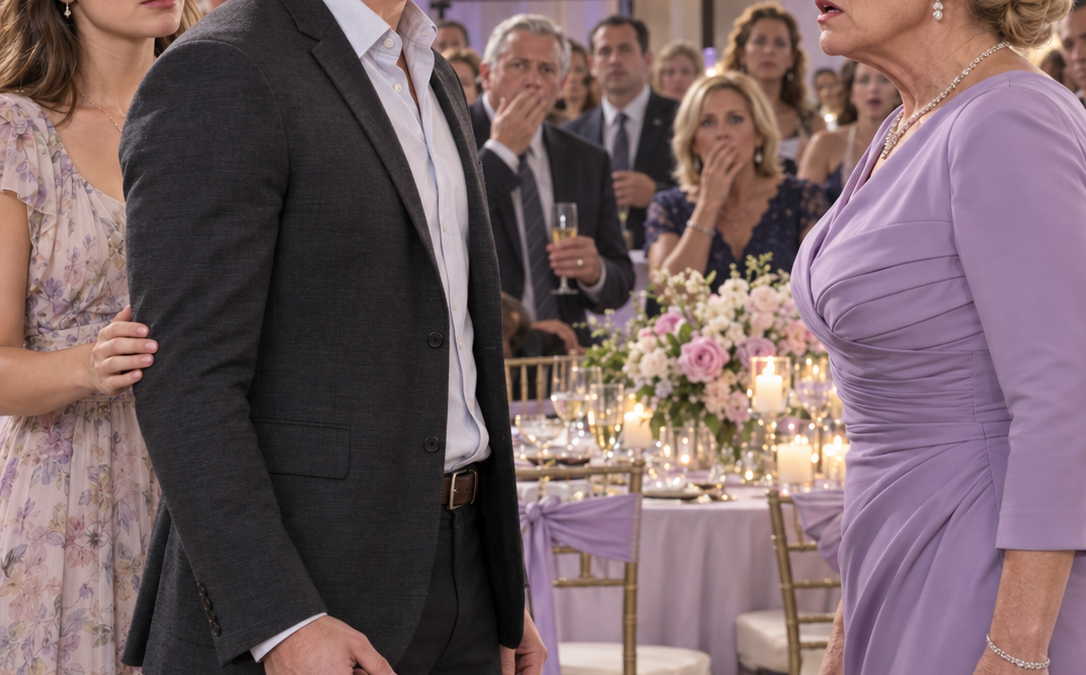
Two months after receiving the tape—the one where my mother said she hadn’t asked for two sons—I stood at the back of a church banquet hall with a USB drive in my jacket pocket and Elise’s fingers resting gently on my wrist.
The room was decorated in pale pink and lavender balloons.
A banner stretched across one wall in gold cursive letters.
“Happy 60th, Diane.”
Card tables surrounded a makeshift stage where a microphone stood waiting.
My mother, Diane, stood near the center of the room, surrounded by women in floral blouses and wide smiles, soaking up compliments like a sponge left too long in dishwater.
She looked radiant in the way people do when they believe they’ve won.
I wasn’t supposed to be there.
At least, not personally.
When I received the invitation to her birthday celebration—an invitation clearly designed as a public-relations opportunity to reclaim her social standing—I had said nothing.
But through Sarah, now fully on my side, I learned that the church group was planning a video montage.
Family memories.
Old home movies.
Exactly what I had been counting on.
Sarah volunteered to help.
She offered to gather footage for the slideshow and coordinate with the church’s AV team under the guise of being my mother’s niece and a tech-savvy angel.
It didn’t take much convincing.
Everyone loved Sarah.
And almost nobody in that room knew the whole story.
Not yet.
I arrived quietly, about an hour into the event, dressed in muted colors with a hat pulled low over my forehead.
Elise walked beside me, her expression unreadable.
My father wasn’t there.
He’d declined the invitation, citing “conflicting appointments,” which was really code for, I can’t fake this anymore.
My mother didn’t see me.
She was too busy laughing.
Too busy basking in compliments about her son, the filmmaker, and how she had always believed in me.
“He must have gotten his talent from you.”
“You must be so proud.”
I let her talk.
I let her smile.
I let her believe.
Then the lights dimmed.
Someone took the microphone.
“We’re going to play a little video montage for Diane. Some memories from over the years—birthdays, holidays, and family moments we all treasure.”
People applauded.
Several phones rose into the air.
The screen flickered to life.
It began innocently.
Baby photos of me.
Adam’s soccer highlights.
Grainy home videos of us opening Christmas presents in footed pajamas.
My mother gasped and covered her mouth, tears gathering in the corners of her eyes.
Then the sound changed.
The next clip was darker.
Visually.
Tonally.
The timestamp read August 2002.
The shaky footage from my eighth birthday ended.
Static filled the screen.
Then voices.
“He’s not like Adam.”
The room began to quiet.
“He’s not special.”
Silence.
“He’s just there.”
You could have heard a pin hit the floor.
Then my father’s voice.
“He’s your son.”
My mother answered.
“So? I didn’t ask for two.”
Her face froze.
At first, some people appeared to think it was part of the montage.
Maybe an outtake.
Maybe some strange joke.
Then they understood.
There was no music.
No laughter.
Just two people arguing.
Her voice—young, sharp, unmistakably hers.
My father’s voice trying to defend me.
“He’s sensitive. He tries. You don’t see it because you’re too busy bragging about Adam.”
“Oh, please. One of them is going to make us proud. The other will probably end up crying in a corner somewhere.”
That was when the gasps came.
Slowly at first.
Then rippling through the banquet hall like an echo underwater.
The clip ended.
Static returned.
The screen faded to black.
Silence.
Complete, suffocating silence.
I stepped forward.
I pulled off my hat and slowly walked toward the front of the room.
My heart was pounding.
But my hands were steady.
I took the microphone.
My mother turned toward me.
Her face had gone pale.
Her mouth hung slightly open.
Frozen.
Some people recognized me immediately.
Others needed a moment.
Within seconds, whispers began spreading through the room.
I took a breath.
“Hi. I’m Joel. Diane’s son.”
More murmurs.
One woman clutched her chest.
“I wasn’t planning to speak tonight. But since my mother has been sharing my story with so many of you lately, claiming credit for a life she actively tried to sabotage, I thought it was only fair to let you hear a different version.”
My mother opened her mouth.
I lifted one finger.
Calm.
Controlled.
“Don’t.”
She stopped.
“You’ve said enough.”
I turned back toward the room.
“I was told my mother didn’t come to my wedding because of a scheduling conflict. That she supported me in her own way. That I was overreacting.”
I paused.
“I believed that for a long time.
“I even believed it when she tried to damage my career behind the scenes. When she called my job pretending to be a reporter. When she told our family I hadn’t invited them.
“I believed her lies because, like most kids, I wanted to believe my mother loved me.
“That I mattered.”
I looked down for a moment and let the silence stretch.
“But I don’t believe it anymore.
“Because love doesn’t look like sabotage.
“It doesn’t sound like that tape.
“And it sure as hell doesn’t skip your wedding to attend a soccer game.”
A man near the front shifted uncomfortably.
The woman beside him covered her mouth with one hand.
My mother tried again.
“Joel, please. This isn’t the time.”
“Isn’t it?”
I turned and faced her directly.
“You made my wedding about you. You made my success about you. You twisted every moment I ever had into something you could claim.
“And now you want sympathy because I finally stopped letting you rewrite the narrative.”
Her eyes filled with tears.
“I am proud of you,” she whispered, her voice trembling.
“You’re proud now,” I said. “Now that strangers are clapping.”
I took one final breath.
“You taught me that people only love you if you make it easy for them.
“But I’m done making it easy.
“I’m done apologizing for needing love you never wanted to give.”
I stepped back.
I handed the microphone to Sarah.
She nodded, her lips pressed into a tight line.
Then I walked out.
I didn’t look back.
Elise was waiting outside the doors.
Her eyes were shining, but she didn’t say anything.
She just took my hand.
Together, we walked out into the cool evening air while shocked murmurs followed us from the banquet hall.
Later, I heard my mother sat down and didn’t speak for the rest of the night.
Some people left early.
Others stayed and awkwardly picked at slices of birthday cake.
The church group leader sent me a frantic email two days later, apologizing and saying she’d had no idea about the deeper context.
The crafting group—my mother’s pride and joy—quietly removed her as an administrator.
One of my aunts stopped returning her calls.
And Adam?
He called me once.
He didn’t scream.
He didn’t accuse me.
He just said, “You nuked her, man.”
I replied, “She lit the fuse.”
He hung up.
We haven’t spoken since.
As for my father, he finally filed the divorce papers.
Afterward, he sent me a quiet message.
“Thank you for giving me the strength.”
Grandma came to visit.
She brought lemon cookies and hugged me so tightly I almost started crying again.
We didn’t talk about the video.
We didn’t need to.
Because some things, once seen, cannot be unseen.
And me?
I kept rising.
I finished another documentary.
I was invited to speak at a film festival.
Elise and I traveled to Italy for our delayed honeymoon.
I finally gave that guest lecture at the university.
And every time someone asked me about my success, I told them the truth.
It didn’t come from talent alone.
It came from silence.
From being overlooked.
From learning how to listen so closely that I could see what other people missed.
It came from knowing what it felt like to be forgotten—and deciding I would never forget myself again.
My mother tried to erase me from her story.
So I wrote my own.
And this time, it’s permanent.








