At my brother’s wedding, i was told to “stand near the wall” so i wouldn’t ruin the family photos. My seat? Taken by his fiancée’s cousin’s plus-one. I walked up to the gift table, took back my envelope, and said, “don’t worry — i’ll stay out of the frame forever.” He came running as i walked out…
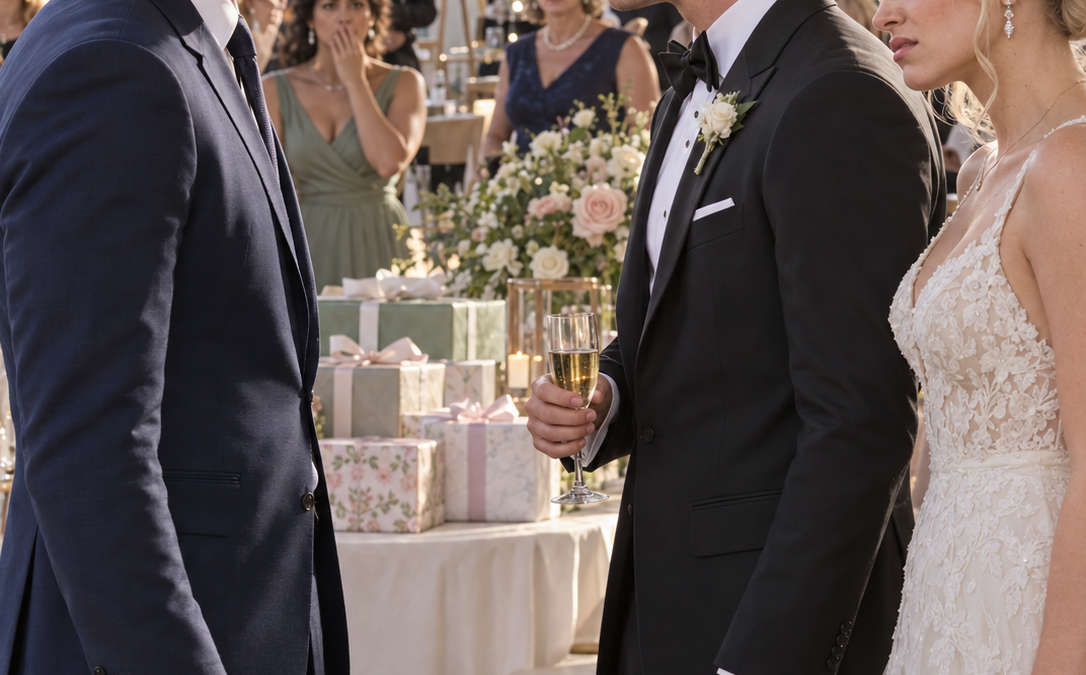
I’d rented a suit, gotten a hotel room nearby, and brought a thoughtful gift: a card with a check for $1,500.
It wasn’t just generous. It was meaningful.
That money wasn’t pocket change for me. I had saved it slowly, wanting to contribute something significant because I genuinely believed this was supposed to be a big moment for my brother.
I was nervous driving up, not because of the event itself, but because something in my gut told me the day wasn’t going to go smoothly.
When I arrived at the venue, I saw the seating chart posted on a small easel near the entrance. I scanned it for my name.
First time through, nothing.
I looked again.
Then again.
My name wasn’t on it.
Assuming it was an oversight, I headed inside and approached one of the wedding planners, a younger woman juggling clipboards and a walkie-talkie.
“Hi, sorry,” I said gently. “I don’t think I see my name on the chart. Adam Reynolds.”
She glanced at me, clearly already exhausted, then flipped through her guest list.
“Adam… Oh, you’re Nate’s brother, right?”
Her tone changed, like she’d just realized something awkward.
“Yeah, so there were some last-minute shifts. I think you’re supposed to be over by the west wall. There are a few open seats near the photo booth.”
The west wall.
I blinked.
That wasn’t even at a table. It was near the speakers, where the extra folding chairs had been stacked like an afterthought.
Still thinking it had to be a mistake, I made my way over.
That’s when I noticed it.
The only labeled seat that should have been mine had a place card, but not with my name.
It said:
“Tiffany, Cousin’s Plus-One.”
I didn’t even know who Tiffany was, but there she was, already sipping champagne in the seat I’d assumed was mine, laughing with a group of people I barely recognized.
Trying to keep calm, I walked toward my mom, who was adjusting the boutonniere on my dad’s jacket.
“Hey,” I said, trying to keep it casual. “Do you know what’s going on with the seating?”
She didn’t even look up.
“Oh, yeah. Brianna’s family had more people show up than expected, and they’re all flying in from so far away. We didn’t want to move them. Just hang near the wall for the ceremony. You’ll still see everything.”
“The wall?” I echoed, a little too loudly.
My dad gave me a look like I was making a scene.
“It’s not a big deal,” my mom said, brushing me off with a wave. “Just don’t ruin the pictures by sulking.”
I wasn’t sulking.
I was stunned.
And then came the final twist of the knife.
Brianna’s voice rang out behind me, bright and sharp.
“Oh, good. You found a spot,” she said, not even waiting for a response. “We’re just trying to keep the family photos looking clean, you know?”
I don’t know what my face looked like, but it must have said everything I was trying not to, because she quickly added, “It’s nothing personal. You’ll still be in the reception shots, I promise.”
I nodded, tight-lipped.
She walked off with her bridal posse in tow.
There’s a kind of humiliation that doesn’t come with yelling or tears. Just a slow, hollow ache in your chest as you realize you’re not welcome somewhere you should have been.
I stood there for a minute, trying to swallow it down, but then my eyes drifted across the room toward the gift table.
A white-linen-covered surface sat near the cake, loaded with pastel-wrapped boxes and fancy envelopes. Mine was easy to spot—matte silver, hand-addressed, tucked neatly under a thin ribbon.
I had sealed that envelope with so much care. I’d even tucked in a note about how proud I was of Nate, how I hoped the money would help them start their next chapter.
I didn’t even think.
I walked straight over, reached down, and calmly took it back.
No one stopped me.
No one even noticed at first.
Not until I turned toward the door and someone—maybe one of the groomsmen—called out, “Hey, Adam, where are you going?”
I didn’t pause.
I just looked over my shoulder, held up the envelope, and said, “Don’t worry. I’ll stay out of the frame forever.”
I was almost at the exit when I heard Nate’s voice behind me.
“Adam, wait.”
I stopped walking, but I didn’t turn around.
I stood there beside the large double doors leading out to the gravel parking lot, one hand resting on the polished brass handle and the other gripping the envelope like it was the only solid thing keeping me grounded.
“Adam,” Nate said again, closer now, his shoes crunching softly against the floor behind me. “Come on, man. Don’t do this. It’s not that deep.”
I turned slowly.
And for the first time in years, I really looked at him.
He stood there in his designer tux, bow tie slightly askew, champagne still fizzing in a glass in his left hand. He looked confused, like I was the one making a scene. Like he hadn’t just relegated his own brother to a folding chair near the photo booth because Brianna’s cousin brought an extra guest.
“Not that deep?” I repeated quietly.
“Yeah,” he said with a shrug, lowering his voice a little as if he didn’t want the other guests to hear. “It’s just the seating, bro. It’s not like we kicked you out. And Brianna’s family, man, they flew in from, like, Portugal. We had to make room.”
I let out a short laugh, but there was nothing funny about it.
“So I get to sit in a corner and hope no one asks if I’m the DJ?”
“Dude, don’t be dramatic. It’s one day. You seriously going to make this about you?”
That one hit.
Make this about me.
I had spent years showing up for birthdays, holidays, family cookouts. I was always the one who sent cards, remembered anniversaries, stayed late to help clean up while Nate disappeared to take a call.
I never made anything about me.
And maybe that was the problem.
Maybe they had all gotten so used to me not taking up space that the idea of me needing a chair—a single, literal chair—was suddenly too much.
“I flew out,” I said slowly. “I rented a hotel. I bought a suit. I gave you $1,500.”
“Were giving,” he corrected, pointing toward the envelope.
“Right,” I said. “Was.”
I looked down at it, then back at him.
“But then I realized something. I’m not really your brother today. I’m just background.”
His jaw clenched.
“You’re blowing this way out of proportion.”
“No,” I said. “You already did. You just didn’t think I’d notice.”
He sighed and rubbed his temple.
“Look, it was Brianna’s call, okay? She wanted the photos to be all of her close circle. Clean lines, matching colors, that kind of thing.”
“So I didn’t match?” I asked. “Did she run a background check on who had photogenic bone structure?”
He didn’t answer.
Maybe he knew better than to try.
“You know,” I said, finally taking a few steps back toward him, “I didn’t expect a spotlight. I didn’t even expect a toast or a dance or a shout-out. I just expected a seat. A place somewhere that said, ‘You matter enough to be here like everyone else.’”
“You do matter,” he muttered, almost like it hurt to say.
“Then why didn’t you act like it?”
His eyes flicked past me toward the rest of the room.
The guests were watching more openly now. The photographer had paused mid-shot. The DJ had lowered the volume slightly.
Nate hated this kind of attention. I could see it all over his face.
He wanted the day to be perfect. Curated. Instagrammable.
And now it wasn’t.
Not because I had thrown a tantrum, but because I refused to disappear quietly.
“Look,” he said through gritted teeth. “If this is about money—”
“It’s not,” I cut in. “It’s about respect. And today showed me how little I have from you.”
He opened his mouth like he was going to protest, but nothing came out.
Just a frustrated exhale.
“I’m leaving,” I said, adjusting the envelope in my hand. “But don’t worry. I’ll make sure the photos are perfect. No awkward older brother in the background to mess up the symmetry.”
I walked out before he could respond.
The gravel crunched under my shoes as I made my way to my car.
I didn’t cry.
I didn’t throw anything.
I just sat behind the wheel for a moment, watching the vineyard fade into the distance through the rearview mirror.
It was surreal. Like I had just stepped out of a movie where I hadn’t been cast as the main character, or even in a supporting role.
I was just an extra who had wandered too close to the shot.
Back at the hotel, I changed out of the suit, packed my bag, and opened the envelope I had reclaimed.
I pulled out the note I’d written—the one about being proud of him, about hoping the money helped them start a new chapter.
I read it once.
Then I tore it cleanly in half.
After that, I turned off my phone.
It didn’t stay off for long.
About an hour later, when I powered it back on, I had six missed calls from Nate, four from my mom, and a string of increasingly anxious texts.
The last one was from Brianna.
All it said was:
“You really ruined everything today.”
And that was the moment the guilt stopped.
That sentence. The way she framed it, like I had wrecked their carefully filtered little fantasy, made something in me finally click into place.
I hadn’t ruined anything.
I had exposed it.
But that wasn’t the end.
Not by a long shot.
The next morning, I checked out of the hotel before sunrise. The front desk clerk barely looked up when I dropped off my key card, which was fine because I wasn’t in the mood for small talk.
I grabbed a stale croissant from the breakfast bar, tossed it onto the passenger seat, and drove out of that vineyard town like it owed me money.
By the time I got back to my apartment, I’d racked up eleven more missed calls and two voicemails I had zero interest in hearing.
My mom’s texts had shifted tone entirely.
They went from, “You shouldn’t have walked out,” to, “Please call your brother, he’s devastated,” and finally to the one that actually made me laugh.
“Family means sometimes making sacrifices, Adam.”
Sacrifices.
I sat down on my couch, still wearing the jeans from the night before, and reread that sentence.
It sounded like something ripped off a refrigerator magnet at a gas station gift shop.
What exactly had Nate sacrificed?
His wedding photos were still going to be on-brand. His bride was still going to post them with captions like “Blessed” and “Our fairy tale begins.”
He’d still get the curated experience he wanted, minus one sibling who apparently clashed with the color palette.
And here’s the thing.
I’d already made the sacrifices.
They just never noticed.
For the past year and a half, I’d been quietly helping Nate with his startup, a mattress import business that was, frankly, bleeding money.
It wasn’t public knowledge, but back when he first launched it, he’d called me in a panic because he needed someone to co-sign a loan.
Not for a house.
Not for a car.
For warehouse space and an inventory contract.
I didn’t ask for anything in return.
I figured he was my brother. If he succeeded, we all won. If he failed, at least he had tried.
And yeah, maybe part of me hoped that helping him would finally be seen as something more than just Adam being dependable.
I never told our parents about it.
I didn’t even tell my friends.
It was just something I quietly managed.
I made sure the payments were on time, fielded a few calls from the bank when things got tight, and even wired him an emergency $3,000 the previous fall when his supplier nearly pulled out.
All of it without a thank-you longer than a one-line text.
“Appreciate it, bro.”
That check I’d reclaimed from the gift table wasn’t just a wedding gift.
It was me finally drawing a line.
But now, sitting there in my apartment, surrounded by unopened mail and half-wilted plants, I realized something deeper.
They hadn’t just forgotten my seat at the wedding.
They had forgotten my role entirely.
So I got to work.
First, I opened my files—every email thread, every signed document, every bank statement tied to the loan.
I was still the co-signer, which meant I still had administrative access.
The loan wasn’t fully paid down.
Not even close.
And while I hadn’t made any legal claims to the business, I had leverage.
I didn’t want to destroy him.
I really didn’t.
But something about Brianna’s text—“You really ruined everything today”—echoed through my head like a dare.
As if their perfect little world couldn’t handle one ounce of reality.
As if my silent support over the past eighteen months mattered less than how I looked in the background of their Instagram carousel.
I drafted an email.
Simple. Clean. Legally sound.
It notified the bank that, due to personal and financial reasons, I was formally withdrawing as co-signer and no longer authorizing any further use of my credit or identity in business operations.
I attached the proper forms, copied Nate’s email address, and clicked Send.
Then, for good measure, I forwarded a few key documents to a lawyer friend of mine from college, just in case things got messy.
Not because I expected a fight, but because Nate was impulsive.
And Brianna?
Let’s just say I didn’t trust someone who referred to wedding centerpieces as “branding assets.”
About an hour later, my phone buzzed.
A number I didn’t recognize.
I let it go to voicemail.
Then it buzzed again.
This time, it was Nate.
I answered.
His voice was clipped. Tense.
“Did you just pull out of the loan?”
“Yes.”
“Why?”
“You’re married now,” I said flatly. “Time to stand on your own.”
There was a pause.
“Adam, come on. This is not the time to be petty.”
I could hear it.
The frustration he was trying to keep under control. The tone of someone who still believed he was the reasonable one in the conversation.
That I was just overreacting.
That it would all blow over like one of his many overdue invoices.
“This isn’t petty,” I said. “It’s overdue.”
“You’re seriously doing this because of a chair?”
“No,” I said, leaning back against the couch. “Because of a pattern. The chair was just the final straw.”
He exhaled sharply.
“Okay. Okay, let’s talk. Come over. We’ll figure something out.”
“You mean like how you figured out where to seat me? Or how to tell everyone I didn’t matter enough for the photos? Or how to let your new wife treat me like an inconvenience?”
Silence.
“You didn’t even ask if I was okay when I left,” I added. “You didn’t check on me. You called because now there’s something you want from me.”
Still silence.
Then, more quietly, he asked, “So is this, like, permanent? You’re just done?”
“I don’t know yet,” I said honestly. “That depends on you.”
Then I hung up.
I didn’t feel triumphant.
I didn’t feel smug.
I felt tired.
Like I had just finished cleaning up a mess that wasn’t mine but had been left for me all the same.
A mess that had been building for years in the unspoken slights, the shrugged-off moments, the quiet betrayals no one ever thought I noticed.
What I didn’t know yet was that Nate wasn’t the only one rattled by what I had done.
The ripple effect had already started.
Brianna’s father, a quiet investor in Nate’s business, had questions.
My mother was now organizing a family mediation dinner.
And my inbox was about to light up with messages from cousins who, it turned out, had also been snubbed by Brianna’s guest-list adjustments.
But I’ll get to that part.
Because the moment that truly shifted everything—the one where things went from awkward family drama to a full-blown fracture—came three days later.
I got a Facebook message from my cousin Melissa.
We weren’t especially close, but we’d grown up around the same chaotic holiday dinners and shared more than a few eye rolls over the years.
Her message was short.
“Hey, just wondering… were you also asked not to be in the family photos?”
That word stopped me cold.
Also.
We hopped on a call that night.
Melissa had been seated at the farthest table, near the portable heaters. Her husband didn’t even get a place card.
Apparently, Brianna had sent an updated “guest flow” to the wedding coordinator two nights before the event, reshuffling the seating to “optimize the aesthetic.”
Translation?
Anyone over thirty, not photogenic enough, or not TikTok-presentable got pushed to the fringes.
And it wasn’t just Melissa.
She had already spoken to two other cousins.
One had driven six hours and wasn’t even offered a drink.
Another had bought a $400 espresso machine from their registry, only to be seated behind a hedge.
The more she dug, the more she found.
Half of the Reynolds side of the guest list had been sidelined in favor of Brianna’s influencer circle, distant relatives from her mom’s Pilates class, and people who “fit the vibe.”
The wedding wasn’t a celebration.
It was a photo shoot with vows.
Melissa ended the call by saying, “I don’t think I’m being dramatic, but this really feels like they used us as fillers. Background extras. Like they were embarrassed to actually have family there.”
I told her she wasn’t being dramatic at all.
Later that night, curiosity got the better of me.
I clicked over to Brianna’s Instagram.
Sure enough, the photos had started rolling in.
Perfectly filtered snapshots of rustic charm and candid laughter.
Nate looked like an ad for cologne.
Brianna looked like a bridal influencer in a sponsored post.
The captions were as hollow as I expected.
“The day our forever began.”
I scrolled.
And scrolled.
Dozens of photos.
Not a single one featured a member of our family.
Not even our parents.
Not even Nate’s best man, who I later found out was one of his old coworkers instead of his actual best friend because, apparently, the real friend didn’t “fit the look.”
It hit me then.
This wasn’t just about me being disrespected.
This was about the entire family being repackaged to fit a brand.
And they had assumed none of us would say anything.
The next morning, I called my parents.
Mom answered on speaker, which meant Dad was hovering nearby.
I kept it civil.
I asked how they were doing, whether they had gotten back okay, how the rest of the reception went.
They were guarded. Polite, but cautious.
I could tell they weren’t sure where I stood.
Finally, Mom sighed.
“Adam, I wish you hadn’t left like that. You embarrassed your brother.”
I waited a beat.
“Did he tell you where I was seated?”
There was a pause.
“I think there was a mix-up. You should have spoken up quietly.”
“So it would have looked better on camera?” I asked, no longer hiding the bite in my voice.
She didn’t answer.
“I’m not angry,” I said calmly. “I’m just done pretending I wasn’t treated like an afterthought. And apparently, I wasn’t the only one.”
That got their attention.
I told them about Melissa.
About the cousins.
About the people quietly simmering behind the scenes.
All of them too polite to cause a scene, but not too blind to see what had happened.
Dad finally spoke.
“Brianna organized most of it.”
I nodded even though he couldn’t see me.
“And Nate let her. That’s the part no one’s saying.”
Mom tried to defend him. She said weddings were stressful, that couples made mistakes, that maybe they would make it up to me later.
“They won’t,” I said flatly, “because they don’t think they did anything wrong.”
And that was when I told them about the loan.
The silence on the other end was immediate and total.
I gave it a second to sink in.
“You what?” Dad finally asked.
“I co-signed the loan for Nate’s warehouse lease,” I said. “Eighteen months ago. I’ve been covering the payments he couldn’t make. No one knew because I didn’t make it a thing. I just did it quietly, like I always do.”
Mom’s voice cracked.
“Why didn’t you say anything?”
“Because I thought I was helping,” I said. “Because I thought that’s what family did.”
I let the silence hang again.
“Anyway,” I continued, “I pulled out. I notified the bank. Nate’s on his own now.”
Dad cleared his throat.
“You’re trying to sabotage him.”
“No,” I said. “I just stopped protecting him.”
Later that day, I got a call from an unfamiliar number.
It was Mr. Galen, Brianna’s father.
His tone was icy but polite.
He asked if I could clarify some sudden changes in the loan agreements that had come to his attention.
I explained the situation—my former involvement, my formal withdrawal, and the fact that I was under no obligation to continue supporting a business that had excluded me financially and personally from day one.
“I understand,” he said after a long pause. “I just wish you’d spoken to me first.”
“I wish a lot of things had been done differently,” I replied.
The next forty-eight hours were a blur.
The fallout spread fast.
Nate called three more times and left voicemails, none of which I answered.
The first was furious.
The second apologetic.
The third was a mess of half-excuses and forced chuckles.
He said Brianna was “super upset,” that “everyone was being dramatic,” and asked if we couldn’t just hit reset.
But I didn’t want a reset.
I wanted closure.
That Friday, I got an invitation.
Not to another wedding, thankfully.
To a brunch organized by Melissa.
A bunch of cousins and second cousins were planning a low-key get-together, partly to decompress and partly to quietly acknowledge that something had broken between all of us and Nate.
It was casual.
Just coffee, waffles, and people who actually wanted to see one another.
No staged photos.
No filters.
No hierarchy based on who looked best on camera.
We swapped stories, laughed about the absurdity, and cried a little too—especially the cousin who had paid for her flight on a credit card just to support family.
Near the end, Melissa looked at me.
“Thank you for walking out,” she said. “We were all thinking it. You just had the guts to do it.”
That stuck with me.
It would have been easier to stay quiet.
To sit in my little folding chair near the wall and smile politely for the camera.
But instead, I stood up.
Not for drama.
Not for revenge.
But because I finally knew my worth, and I wasn’t going to let them crop me out of it.
Three weeks later, Nate sent me a handwritten letter.
I still have it tucked inside a drawer with the torn-up note I once included with that $1,500 check.
The letter was a mixture of regret, frustration, and vague attempts at reconciliation.
He never actually said the words, “I’m sorry.”
But he did write this:
“I thought keeping the peace meant avoiding conflict. I see now it really meant ignoring you. I was wrong.”
I haven’t responded.
Maybe I will one day.
Maybe I won’t.
But I know this.
I’m no longer the background brother.
I’m not a placeholder.
I’m not a fallback.
I’m not a chair by the wall.
I’m Adam.
And I finally chose myself.
And this time, I stayed in the frame.








