Category Report

News

Latest in News

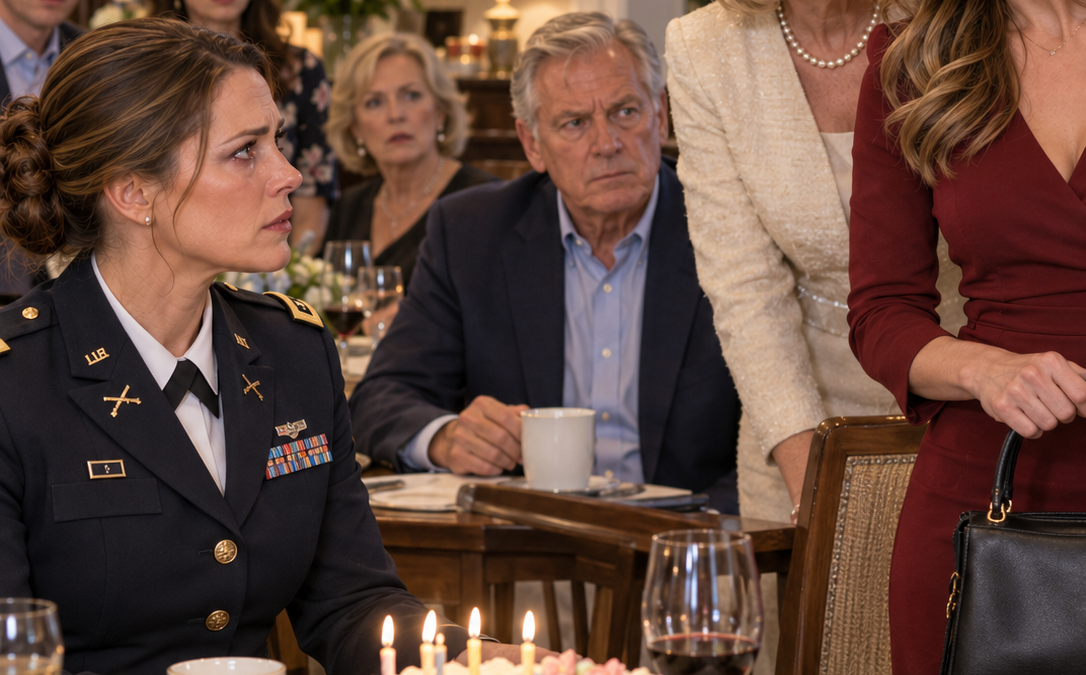
I walked into court while my whole town called me a greedy army officer. then the judge asked one simple question that made my sister freeze, her lawyer go silent, and exposed… the lie she had been living for 2 years. I had chosen the Army. Marissa had stayed home. She had handled our parents’ appointments, bills, meals, and medical problems while I built a career thousands of miles away. Now, according to her, I had come back because our family land had become valuable. Marissa sat across the aisle in a cream jacket and soft gray dress, calm enough to look as if the case were already over. Then Judge Rebecca Sloan lifted one page. “Miss Caldwell.” Marissa looked up. “Yes, Your Honor.” The judge adjusted her glasses. “Could you explain how your sister personally appeared before a Tennessee notary on October 14th, 2022?” Grant Holloway, Marissa’s attorney, stopped moving. Judge Sloan continued. “While these Army deployment records place her at Aluded Air Base that exact afternoon?” I didn’t move. Neither did anyone else. And for the first time, the small smile disappeared from my sister’s face. That moment had started years earlier. Marissa and I grew up on 35 acres outside a small Tennessee town. Our father, Thomas Mercer, had served 22 years in the Army before coming home and opening a repair business. Our mother, Diane, ran the office. Marissa stayed close. I left for college, Officer Candidate School, and eventually one military assignment after another. Georgia. Texas. Kansas. Germany. Dad was proud of me, and sometimes that pride hurt Marissa more than any of us understood. She was the one who stayed when our parents got older. She drove Mom to appointments. She handled insurance forms. She checked the furnace before winter. I sent money. I came home when I could. I called every Sunday unless duty made it impossible. But I knew the truth. In person, Marissa carried more. Then Dad created the Mercer Family Trust. He wanted the property protected for Mom. After that, Marissa and I would share control. No major property could be sold without both signatures. No loans against trust assets without written approval from both of us. Dad looked at us across his attorney’s conference table. “This land is not a jackpot.” Neither of us argued. Then Marissa asked one question. “What if one of us is overseas?” The attorney answered carefully. “Then nothing is sold until both parties can give valid consent.” Dad tapped the table. “That is the point.” Not long afterward, I overheard Marissa and her husband, Wes, arguing on my parents’ back porch. His construction business was struggling. “The bank wants another payment by Friday,” he told her. “You said the county contract would cover it.” “It got delayed.” Then Marissa asked the question that changed everything. “How much?” After a pause, Wes answered. “More than we have.” I offered to help. Marissa refused. Later, while I was deployed, she called again. “There might be a way out.” “What kind of way?” “A developer.” They were buying property near the new highway. “Our land?” “Just a small piece.” “Dad would never agree.” “We wouldn’t ask him.” That stopped me. “What does that mean?” She backed away from it. But weeks later, she admitted something else. “We’re drowning, Ally.” “I’ll help.” “You already do.” “I’ll do more.” “It isn’t enough.” Then I came home. The first thing I noticed was the fence. Old fencing along the east field had been replaced. Survey stakes stood in the grass. Orange ribbons moved in the wind. Nobody had told me anything. Then Mom asked me a question. “Did you really know about selling the east field?” I stared at her. “What?” “The papers. I thought Marissa said you agreed before you left.” “I never agreed to sell anything.” Mom’s face changed. “Oh.” That one word told me someone had already created a version of events in which I had agreed to something I knew nothing about. So I didn’t confront Marissa. I didn’t call Wes. I didn’t start shouting. The Army had taught me something useful. Don’t react. Reduce uncertainty first. Emotion is expensive. Evidence is cheaper. The next morning, I went to the county recorder’s office. I requested every filing connected to Mercer Family Trust property. Tax records. Boundary surveys. Routine documents. Then I found a power of attorney. My name was across the top. Allison Mercer. And underneath it was a signature that looked almost exactly like mine. Almost. I stared at it. I had never signed that document. Then I saw the date. October 14th, 2022. The notarial certificate said I had personally appeared before a Tennessee notary that afternoon. I photographed every page. No confrontation. No accusations. I went home, opened my laptop, and created a folder called “Trust.” Then I started building a timeline. I hired Julia Bennett, an estate-litigation attorney in Nashville. She looked at the power of attorney and asked me one question. “Can you prove where you were that day?” “I think so.” “I don’t need think. I need records.” “I was deployed.” That changed her expression. Deployment orders. Travel records. Leave records. Command certifications. Government paperwork nobody would ever call exciting. But paperwork doesn’t care which sister has the more sympathetic story. While Julia worked on the signature, a forensic accountant named Carmen Alvarez started following the money. And Marissa apparently realized I was asking questions. One afternoon, an unknown number texted me. I heard you’ve been asking questions about the trust. A second message followed. Marissa knows. Four days later, she sued me. The complaint said I had abandoned my parents for my military career, manipulated my father, ignored my mother after her stroke, and returned only because the land had become valuable. A local news site repeated the allegations. Facebook did the rest. People I had known for years stopped looking at me the same way. Even one of Dad’s old friends refused to shake my hand. Marissa’s story was simple. She stayed. I left. She sacrificed. I wanted money. And simple stories are easy to believe. Then Marissa asked me to meet her privately. “We can still stop this.” “How?” “You drop everything, and I’ll tell Grant to settle.” “Walk away from what?” “The trust.” “The forged signature?” She flinched. “I was protecting this family.” “No. You were protecting Wes.” Her eyes narrowed. “He would have lost everything.” She told me I didn’t understand what it had been like. She told me she was offering peace. Then she said, “I’m your sister.” “You are.” “Then stop.” I didn’t. By the morning of the hearing, Grant Holloway walked into court with two boxes of documents and the confidence of a man who believed his client’s story would hold. He told the judge Marissa had remained in Tennessee while I built a successful career thousands of miles away. People behind me nodded. Then he said they had documentation proving Marissa acted under a valid power of attorney. Judge Sloan looked down at one page already sitting on her desk. Not his boxes. Not Marissa’s binder. One page. “Miss Caldwell.” Marissa looked up. “Yes, Your Honor.” Judge Sloan held the document by one corner. “Could you explain how your sister personally appeared before a Tennessee notary on October 14th, 2022?” Grant’s hand stopped over his file. Then the judge reached for the military records beside her. “While these Army deployment records place her at Aluded Air Base that exact afternoon?” Marissa’s smile vanished. Her lips parted. And the entire courtroom waited for her answer.

    That was the headline. It made me sound like I had come home with a duffel bag and…

My parents laughed, “you’ll never be as good as your sister.” i stood up and said, “then let her pay your bills”—i’m done sending money. my mom froze, “what bills? we never asked you for a dime…” Nobody stopped him. My mother laughed softly. Aunt Rita gave that uncomfortable little smile people use when they know something is wrong but do not want to say it. And my younger sister Kendall leaned back with her wine and looked at me like she had just won something. “Don’t take it personally, Sav,” she said. “You’re just more of an Army robot. It’s not bad. Robots are useful.” Useful. I was 34 years old, a major in the United States Army, and at that exact moment I had an envelope beside my plate with $800 inside. Money for my parents’ overdue home insurance. Money they were expecting me to provide. I rested my hand on the envelope. “You’re right,” I said. Dad blinked. “About what?” “Kendall is the one with the spark. Kendall is the one with the drive. Kendall is the one you’re proud of.” Mom shifted in her chair. “Savannah, don’t be sensitive.” “I’m not being sensitive.” Kendall gave a little laugh. “Then what are you doing?” I stood. The chair scraped across the floor, and suddenly everyone stopped laughing. I picked up the envelope and slid it back into my purse. Then I looked at my parents. “Then let her pay your bills.” Mom stared at me. “What bills?” That question hit harder than everything else they had said. Because for six years, I had been the person they called when something was due. Dad’s prescriptions. The electric bill. Mom’s car repairs. Groceries. Insurance. A $4,800 roof repair. And Kendall’s business expenses whenever another “guaranteed” real estate commission somehow failed to arrive. Kendall needed $450 for a licensing renewal. Then $600 for marketing photos. Then $900 for office rent. Then more for staging and other expenses. Every request sounded temporary. Every request came with a reason. And because I had steady Army pay, my family treated me like the reliable one. Dependable. Useful. The person who would quietly fix things. Kendall, meanwhile, was the one everyone celebrated. When I paid for my parents’ roof repair, Kendall later stood under that repaired roof for a Facebook photo and wrote that she had finally gotten Mom and Dad taken care of. My relatives praised her. My parents never corrected them. When I confronted Mom privately, she said, “Your sister is trying to build confidence. You already have your career. You already have stability. Why can’t you let her have this?” So I did what I had always done. I swallowed it. Until the birthday dinner. Until my father told me I would never be as good as Kendall while my parents were waiting for me to cover another bill. When I reminded them of the money I had spent over the years, Mom said, “We have never received a single dollar from you that you did not choose to give.” That sentence told me exactly where I stood. I left with the $800 still in my purse. Before I even reached my car, Mom texted me. You ruined my birthday. Then another message appeared. We need to talk about that insurance payment. No apology. Just another bill. That night, I went home and opened my banking records. At first, I was only trying to remind myself that I had not imagined everything. Then I started finding transfers. $220 for Dad’s medication. $150 for electricity. Car repairs. Groceries. Insurance. Payments to Kendall. The roof. Venmo notes. Zelle confirmations. Emails. Text messages promising repayment. By the time I finished going through years of records, the little emergencies no longer looked little. So I bought a black three-ring binder. I printed everything. Dates. Amounts. Receipts. Messages. Payment confirmations. The roof invoice Kendall had taken credit for. The insurance email Mom had sent asking for $800. I organized every page. Then Dad called. “We need to sit down as a family.” Of course Kendall would be there. When I arrived at my parents’ house that Saturday, she was already sitting on the couch. She saw the black binder under my arm and smiled. “Oh, good,” she said. “The evidence locker is here.” Mom looked furious. Dad stood near the fireplace. They told me my behavior at the birthday dinner had been cruel. They told me family had lost its sense of respect. Then Mom explained that Dad’s medical costs were still high, the house still needed work, and Kendall’s business was going through a slow season. “We need to talk about how both daughters can contribute in a healthy way,” she said. For about two seconds, that sounded reasonable. Then Dad added, “Obviously Kendall’s situation is different. Real estate is unpredictable. She has to keep investing in herself.” Mom looked at me. “You have steady income, benefits, housing allowance, structure. You’re fortunate.” I stared at them. “So your plan is that I keep paying because Kendall’s dreams are more expensive than mine.” “Nobody said that,” Kendall snapped. “You didn’t have to.” Dad’s eyes dropped to the black binder sitting between us. Then he pointed at it. “If you have something to say, say it.” I put my hand on the cover. Kendall was still confident. Mom still looked angry. Dad still thought this meeting was about my attitude. Then I opened the binder. Their eyes dropped to the first page. And suddenly, my attitude had page numbers.

    “Savannah,” he said. “You made it.” “Barely,” I said. “Traffic outside Fayetteville was a mess.” He stepped aside….